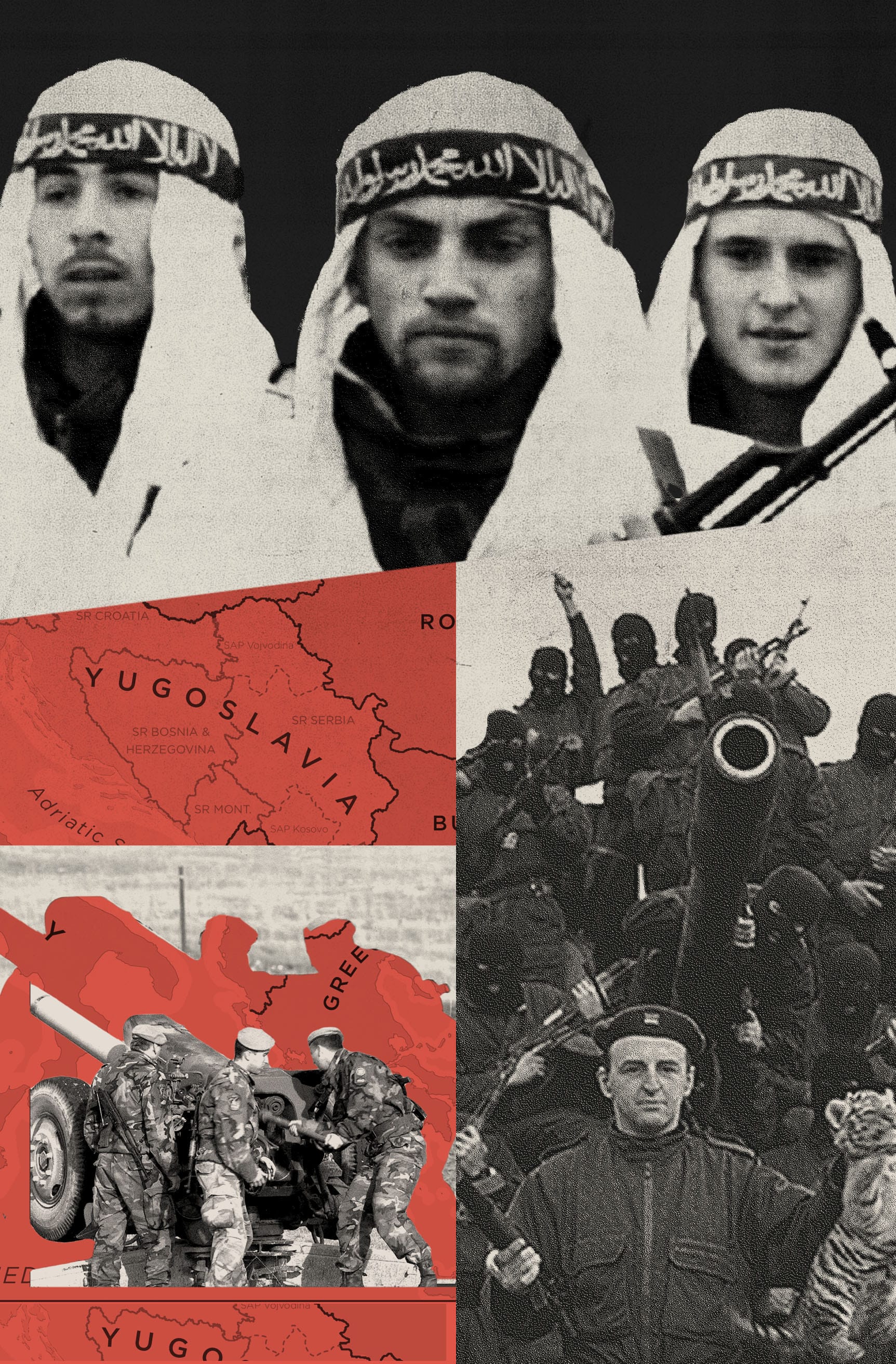
The YUGOSLAV WARS will not die. In the fall of last year, news broke that the Bosnian Serb leadership arranged “sniper safaris” during the 1990s for wealthy Western war tourists, bringing them to the hills above Sarajevo and letting them shoot Bosnian civilians in the besieged city below. According to new allegations, these Western sadists would meet in the Italian city of Trieste, where they would catch a flight to Belgrade on the Yugoslav charter carrier Aviogenex. They would then be taken to the Serb-held hills around Sarajevo where they were permitted to fire at civilians. The price was steep, reportedly between $92,000 and $116,000 per target. Shooting children cost the most, while shooting a man cost more than shooting a woman. The elderly could be shot for free.
The allegations of “sniper safaris” have been polarizing in the Balkans; opinions diverge as to their extent. Few doubt the presence of isolated sadists: there is even a notorious clip from 1992 of Russian writer and provocateur Eduard Limonov in the Sarajevo hills with Republika Srpska’s then–President Radovan Karadžić. (Limonov, who in 1993 cofounded the National Bolshevik Party alongside far-right philosopher Aleksandr Dugin, developed an increasing fascination with violence during the decade for reasons that were as much aesthetic as political; of Serbian warlord paramilitary leader “Arkan” Željko Ražnatović he reportedly said, “I’ve always loved bright and handsome gangsters.”) In the video, Karadžić tells Limonov that Sarajevo is a Serbian city, that sometimes the smoke that rises over it after an attack looks “like tamjan” (frankincense, used in Orthodox Christian worship), and that the weapons market in Yugoslavia was “very dirty business”—so much so, he claimed, that the Serbs had even purchased arms from NATO, something they surely found distasteful.
There had always been the occasional whisper about foreign sadists. Sometimes this idea found expression in Serbian horror cinema like The Life and Death of a Porno Gang (2009) and A Serbian Film (2010), two films in which Balkan snuff is produced for an elite Western clientele. Most of the time, however, viewers assumed this theme was strictly allegorical: perhaps a comment on the televised nature of the conflict—“may your house be seen on CNN,” per the Bosnian curse—or on the country’s dissolution as “the first internet war.” A nascent internet kept people connected to each other, undermining nationalist governments’ monopoly on the dissemination of information and feeding an early mythos that the new technology was inherently democratic. It also allowed the world outside to access the conflicts in near-instantaneous, personal ways, inviting distant audiences to consume the spectacle of war from their homes.
But as the sniper safari suggests, foreign involvement in the conflict wasn’t limited to TV war correspondents and early internet users. Along with the alleged sniper tourists in Sarajevo, wartime Yugoslavia became a magnet for mujahideen fighters, Western neo-Nazis, and Russian Cossacks, all fighting their own holy war. Others were more prosaically mercenary, in search of a buck, a thrill, or even oblivion.
Perhaps others came to bear witness to history. Many sensed then that the world was on the cusp of a new era, and they were right. The Yugoslav Wars produced both experienced foreign fighters who would go on to serve in other wars around the world and a new humanitarian logic that has since been appropriated to serve very different aims than those originally intended. If the “short twentieth century” began in Sarajevo with the shot heard around the world, perhaps it ended in Bosnia too.
Socialist Fraternal Diss
The last years of the millennium were a dizzying period of post–Cold War hyperglobalization, a time of unprecedented global interconnectedness. The nascent internet and global television coverage broadcast in real time were but two early manifestations of it. Though the principle of noninterference had been a norm of international relations since the 1648 Peace of Westphalia, liberal internationalists viewed sovereignty as an obstacle. In their wide eyes, a state’s supreme authority over its territory was too often used as a shield by dictators who wanted to escape scrutiny for human rights abuses committed within their borders. Now, as the world inched closer to Y2K, transatlantic liberals argued for humanitarian intervention in distant conflicts—war waged in defense of human rights. In the new era, borders would be rendered meaningless; international trade would flow unimpeded, and information would circulate freely to all corners of the world at the speed of a dial-up modem. Václav Havel, the Czech playwright and liberal democrat, concurred. “Human beings are more important than the state,” he said. “The idol of state sovereignty must inevitably dissolve.” The Maastricht Treaty, the founding document of the European Union, was signed in February 1992; introducing the concept of European citizenship, it presaged a continued march forward into this luminous future. Liberal internationalists sought to impose their will on the world through a system of multilateral governance and supranational institutions; while it was generally understood that the United States would lead, it would do so through alliances.
“The Yugoslav Wars never ended, they just entered into global circulation.”
Meanwhile, in southeastern Europe, Yugoslavia’s dissolution represented the process in reverse: a multicultural, multinational, and multi-confessional socialist state that touted the motto “Brotherhood and Unity” was breaking apart. While the Western political elite popped champagne in Brussels and celebrated the emergence of a new cosmopolitan era for human rights, the Balkans and its particularist nationalisms, its atavistic preoccupations with blood and soil, were that new world’s regressive foil. Liberal internationalists were sure that if they could only vanquish the old jingoism, it could be left behind along with all the other horrors of the twentieth century. The New York Times therefore described NATO’s 1999 humanitarian intervention in Yugoslavia as “the 21st century arriving early.” The overthrow of Serbian President Slobodan Milošević on October 5, 2000, was referred to by Hollywood producers as “the last revolution of the 20th century” and by British historian Timothy Garton Ash as simply “the last revolution.”
But upon closer inspection, the West’s liberal imperialism and the archaic nationalisms of the Balkans weren’t so incompatible after all. While the Balkan wars of the 1990s had a primordial quality to them—American author Robert D. Kaplan famously chalked them up to “ancient ethnic hatreds” between Orthodox Serbs, Catholic Croats, and Bosnian Muslims—the conflicts themselves were thoroughly modern. As it would turn out, this new kind of war was as much at home in the millennium as the personal computer. Crossing borders and traveling great distances, the fighters who arrived in the region were often more effective than many members of the so-called international community, widely criticized for its inaction throughout the breakup of Yugoslavia. NATO intervened in the conflicts twice: once against Bosnian Serb forces in 1995 and again during the Kosovo War in 1999, but critics viewed these interventions as belated. The foreign irregulars, by contrast, proved willing to take decisive action, embodying a cosmopolitan spirit that seems to have outlasted that of the liberal internationalists. Yugoslavia would become a sort of incubator for fighters of future conflicts and an experimental model that would later be exported the world over, sometimes even by the same people. As one Balkan friend put it, “The Yugoslav Wars never ended, they just entered into global circulation.”
Martyrdom on the Small Screen
Some have called Bosnia “the cradle of modern jihad.” As one volunteer from Saudi Arabia put it, “Bosnia gave the modern jihadist movement [its] narrative.” That narrative was as follows: the “international community,” and the West in particular, was allowing a genocide of Muslims to go ahead in Europe. The UN and Western governments, contrary to their wishful self-presentation, were not well-meaning but regrettably hamstrung actors: their inactions were viewed as rooted in a perennial indifference to the loss of Muslim life. An arms embargo imposed by the UN Security Council in 1991 halted deliveries of arms and military equipment to all parties in the former Yugoslavia, inhibiting Bosnia’s ability to defend itself. In this newly interconnected era, as scholar Darryl Li has pointed out in his work on the conflict [*], Bosnia became a major cause célèbre for Muslims around the world, particularly among diasporas in the West, and charities organized to help Bosnians flourished. Muslim countries lobbied on Bosnia’s behalf at the UN and sent humanitarian aid and economic assistance to the Bosnian government, and Bangladesh, Egypt, Jordan, Pakistan, and Turkey contributed troops to UN and NATO forces. Iran, defying the arms embargo, sent military aid covertly. For many Muslims, however, this wasn’t nearly enough. Beginning in 1992, Muslim volunteers from around the world began arriving in Bosnia. Some were veterans: the Soviet withdrawal from Afghanistan left battle-hardened mujahideen suddenly in search of a new conflict. Between 1992 and 1995, the Bosnian War drew between two thousand and five thousand Muslim volunteers who would go on to fight alongside Bosnian government forces. In this way, the Bosnian War was unique. Of the many global jihads since the end of the Cold War, Bosnia’s was unusual, per Li: one of the few in which foreign fighters waged war on the side of a recognized government. The El Mudžahid was the best organized of these units, composed mostly of foreign volunteers but also of locals, operating as part of the Bosnian Army. The unit had a training camp near the village of Mehurići where it imposed strict Islamic practices, Li writes, including regular prayer and bans on alcohol, swearing, fornication, pork, and, remarkably in chain-smoking Bosnia, cigarettes. Some foreign fighters doubled as Islamic teachers, teaching local children the Quran in between battles.
Efforts to rid Bosnia of any latent jihadist threat in the wake of the war on terror were relatively successful, but they weren’t perfect.
The mujahideen developed a reputation for brutality, including torture and beheadings. This meant they would later become a political liability for newly independent Bosnia and Herzegovina, particularly after 9/11. While many foreign fighters married local women and remained in Bosnia after the war, the Americans viewed their presence as a potential security threat and put the new authorities under great pressure to eradicate them. The 1995 Dayton Accords stipulated that foreign fighters had to leave Bosnia, but the new government had already granted some mujahideen Bosnian citizenship as a reward for fighting. After 9/11, the Council of Ministers of Bosnia and Herzegovina amended the citizenship laws in consultation with the American embassy in Sarajevo, which allowed for a review of those granted citizenship during and immediately after the war. Around one thousand people had their Bosnian citizenship revoked as a result.
Efforts to rid Bosnia of any latent jihadist threat in the wake of the war on terror were relatively successful, but they weren’t perfect; Bosnia would become a rallying point for subsequent jihads, not only as a supplier of a limited number of seasoned fighters but also as a font of propaganda. Two pieces of media from the late 1990s, In the Hearts of Green Birds and The Martyrs of Bosnia, became popular vehicles for radicalization, calling Muslims around the world to fight in other jihads, and were still being used over a decade later to recruit fighters to join the Syrian Civil War. The spread of jihadist propaganda was facilitated in large part by the internet, and both pieces of media were promoted by the website Azzam.com, run by a British veteran of the Bosnian War.
Originally circulated in audio cassette form, In the Hearts of Green Birds takes its title from the belief that the souls of martyrs ascend to heaven inside the hearts of green birds “who have their nests in chandeliers hung from the throne of the Almighty.” The text tells the story of the Bosnian martyrs who fought Serbs and Croats, blending biographical information about real fallen fighters with fantastical and dreamlike imagery, with a spoken narration recorded over sounds of gunfire and war. It became a major hit in jihadi circles: the 7/7 suicide bombers in London reportedly had In the Hearts of Green Birds in their possession, and it was said to have played a role in the radicalization of British “shoe bomber” co-conspirator Saajid Badat. Green birds would remain a potent symbol long after the Bosnian War ended. In online recruitment efforts for the Syrian Civil War, jihadists used the hashtag #greenbirds on Instagram in posts dedicated to martyrs, often paired with a green heart emoji.
The Martyrs of Bosnia was touted as the first mujahideen video in the English language; it was also published in Arabic. The two-part video tells the story of the Bosnian War as part of a wider conflict: one of the West against Islam. It shows extensive footage of dead fighters, often badly disfigured in violent death. The Martyrs of Bosnia closes with an image of Osama bin Laden, still relatively unknown when the video was released.
Indeed, the Syrian conflict drew numerous veterans of the Bosnian War, along with some radicalized Bosniaks, to fight alongside their coreligionists. Salafism, a Sunni revivalist fundamentalist movement, had been introduced to predominantly secular Bosnian society by mujahideen during the 1990s. In a small number of cases, it stuck. After the war, Salafists in Bosnia built mosques with Saudi money, which proved relatively fertile ground for recruitment to fight in Syria and Iraq, most often with ISIS and al-Nusra Front. The latter would eventually transform itself into Hay’at Tahrir al-Sham, or HTS, the group whose leadership toppled Syria’s President Bashar al-Assad in December 2024. All told, around one thousand individuals from the Western Balkans are believed to have fought with various jihadist groups in Syria and Iraq.
Though Salafi jihadism is often depicted as a return to archaic barbarism, it too is thoroughly modern. After all, Bosnia’s mujahideen weren’t so unlike their contemporaries in the liberal internationalist bloc who argued for humanitarian intervention; frustrated by the limitations of the nation-state and its inability to stop or prevent genocide, they, too, were motivated by a cosmopolitan concern for a supranational identity—the ummah. Connected to one another by new developments in telecommunications, they also abhorred particularist nationalisms, which they saw as a tool to divide the global Muslim community and prop up corrupt secular regimes. “Jihad,” Mujahid Commander Abu Abdel Aziz said, is meant “to make [Allah’s] word supreme, not for a nationalistic cause, a tribal cause, a group feeling, or for any other cause.” The commander, who arrived in Mehurići from Saudi Arabia, told a reporter for Newsweek, “I come from Islam”—the cosmopolitan motto “I am a citizen of the world” reformulated for the Bosnian struggle.
Dread Cavalry
Adherents of other faiths also traveled long distances to fight in the same war, albeit on the opposite side. The Serbs were joined by their fellow Orthodox Christians, and none more than the Russians. Some came as veterans of fresh conflicts in Chechnya and Transdniestria, two other wars also born out of the collapse of communism. Some had been professional Soviet soldiers who had found themselves suddenly without purpose as Russia had been brought to its knees. Some were searching for a little money, but the pay was paltry, with Russians receiving around $155 a month to fight with the Army of Republika Srpska (VRS). Others still had more ideological motivations: they had been seduced by the story of embattled Serbdom and believed that they were helping preserve Orthodox Christianity from the Muslim “Turks” who supposedly sought to destroy it. In the Serbian nationalist imagination, local Bosniaks had been transmogrified somehow into the Ottomans. While Russians formed the bulk of the Serbs’ foreign support, other Orthodox brothers also came to fight in Bosnia. Exact numbers vary but, according to Hague documents, the VRS had between 529 and 614 volunteers from Greece, Romania, and Russia. They carried out war crimes and were present among General Ratko Mladić’s troops when he entered Srebrenica in 1995, where genocide was committed against Bosniaks—all under the watchful eye of the international community.
“They are spitting on a democratic Russia and a democratic America and I am happy with this.”
The Russians, like the mujahideen, had something of a mixed reputation with locals, albeit for different reasons. Journalistic accounts describe world-weary Russians with a bottomless appetite for alcohol, drinking shots of local rakija for breakfast as they chain-smoked. In one dispatch published in 1993 in the Los Angeles Times, a “baby-faced neo-Nazi from St. Petersburg” named Yuri tells an aghast journalist about his work as a recruiter of Russians for the Bosnian War. He says that the Russians are “fed, clothed and armed by Serbs,” while some of them “are involved in economic rather than military activities, like smuggling gasoline.”
Such criminal activity was an integral part of Yugoslavia’s violent dissolution and was another way the wars were avant-garde. As political scientist Peter Andreas writes,
these conflicts are partly made possible by “taxing” and diverting humanitarian aid, diaspora remittances, illicit exports and clandestine trading across front lines, and black-market sale of looted goods. . . . They may utilize quasi-private criminal combatants who operate in the absence of, alongside, and sometimes within formal military units, and are especially prevalent when at least one side does not have a regular army and is not a full-fledged state.
The more recent conflict in Sudan, as well as earlier phases of the war in eastern Ukraine, bear similar features: Sudan has drawn mercenaries from as far afield as Colombia, many recruited by firms based in the UK, while scandals around stolen aid have plagued wartime Ukraine.
While such qualities made the wars modern, the conflicts also possessed certain primordial traits. The breakup of Yugoslavia saw movements long suppressed under communism abruptly surface. These were most often rooted in local nationalism and religion, which had quietly persevered, but others were conjured back into existence; among them was the resurrection of the Cossack tradition. The Cossacks had been Russia’s seminomadic warrior caste under the czars, the descendants of outlaws and escaped serfs along the Russian Empire’s southern borders. During the early 1990s, the Cossack cultural revival became a major site of recruitment for the Bosnian War. “We have fought, are fighting, and will always fight wherever there is Orthodox Christianity,” the chief of the local Cossacks told a journalist in Rostov in 1993.
In Death Is Our Business: Russian Mercenaries and the New Era of Private Warfare, which chronicles the rise of Russian private military company the Wagner Group, John Lechner speaks with a self-identified Cossack named Alexander Kravchenko, who fought near Višegrad in eastern Bosnia. Kravchenko argues that Cossacks believe in three things: “Orthodoxy, military service and loyalty to one’s ancestors.” In Bosnia, Kravchenko met one Igor Girkin, who fought in the explicitly monarchist unit RDO-2, the Second Russian Volunteer Detachment, sometimes referred to as the Czar’s Wolves. Girkin was also Russian, and, as Kravchenko tells it, his favorite topic was Russian imperial history; he also loved reenacting famous historical battles. Of course, Girkin would later go on to play a leading role in the 2014 Russian annexation of Crimea and war in the Donbas in eastern Ukraine. He was also convicted in absentia by a Dutch court for his role in downing Malaysia Airlines Flight 17 over eastern Ukraine that same year.
This is among the more ominous aspects of Russian participation in the Bosnian War: the understanding that for many men, it was merely practice for a war that they believed would one day be fought against the West closer to home. Perhaps they resented the West for the collapse of the Soviet Union, the depredations of “shock therapy,” and the many disappointments associated with liberal democracy, dreaming of the day when Russia would return to superpower status to confront its enemies; or perhaps they viewed the war on the Serbs as part of a wider war on Orthodox Christianity, which would one day also be waged against Russia as well. A Cossack named Ivan told The Christian Science Monitor in 1993 that he saw the war as a “‘testing ground’ of the West’s grand plan ‘for the further destruction of Russians and the Russian empire.’” The Serbs, in his estimation, were fighting back: “They are spitting on a democratic Russia and a democratic America and I am happy with this.”
“Our role here is primarily ideological,” declared Yuri Belyaev in the same year to the Los Angeles Times. Identifying himself as a businessman “trading in the commodity of fighters,” Belyaev recruited Russians to fight in Bosnia. “Serbs and Russians are both Slavs, and our presence at the Serbian side sends a message to their enemies.” In addition, he continued, “there are also practical concerns. This is good preparation for us. It is very important that we get experience in the Yugoslav conflict for when this situation occurs in Russia.”
In fact, along with Girkin, Ukraine has provided other veterans of the Yugoslav Wars with a fresh opportunity. Like Girkin, Bratislav Živković also fought in the Yugoslav Wars before making his way to Ukraine some twenty years later. Živković was at the forefront of the Chetnik revival, a resurrection of the Serbian nationalist and royalist movement that fought against the antifascist Partisans in World War II. The breakup of Yugoslavia saw the resuscitation of Chetnik imagery and symbols, which had been suppressed in Tito’s Yugoslavia. In 2014, Živković surfaced in Ukraine, where he commanded an irregular unit in Crimea that coordinated with Cossack paramilitaries. With his big beard and black fur Chetnik hat, Živković won the attention of Vice News. “Russians always came to volunteer in Serbian wars when we faced hardships and now we have come to help them,” he told Vice’s Simon Ostrovsky in a 2014 dispatch from Crimea. Živković’s luck ran out in January 2025, when he was killed by Ukrainian forces during the Kursk campaign.
The afterlife of Yugoslavia’s breakup is felt in other ways in Ukraine. Though recent wars have revealed the West’s abandonment of the notions of “Responsibility to Protect” and humanitarian intervention, Russia has embraced them. Putin legitimized his full-scale invasion of Ukraine with rhetoric that looked lifted from Western leaders on the eve of the NATO bombing of Yugoslavia. “We had to stop that atrocity, that genocide of the millions of people who live there and who pinned their hopes on Russia,” he said in his speech at the launch of the “special military operation” in 2022. (Then–President Bill Clinton told the nation on the day of the 1999 NATO intervention that “we act to protect thousands of innocent people in Kosovo.”) Eight years earlier, the annexation of Crimea was justified with the so-called “Kosovo precedent”; Putin repeatedly cited the West’s support for Kosovo’s unilateral declaration of independence from Serbia in 2008 as precedent for Crimea’s separation from Ukraine. Among its Atlanticist liberal proponents, humanitarian intervention and its associated legal innovations and concepts may be dead, but it lives on in the policies of the West’s enemies.
Not Good Civilians
Some opponents of Western liberalism who flocked to the Balkans came from much closer to home. On the Croat side, foreign volunteers were typically drawn from Europe’s far right. Wartime propaganda reinterpreted and glorified the nation’s past, particularly the dark history of the World War II–era Independent State of Croatia, a Nazi puppet state responsible for a great many atrocities perpetrated against Serbs, Jews, and Roma. The Hrvatske obrambene snage, a far-right Croatian paramilitary group active throughout Croatia and in Bosnia and Herzegovina, attracted many likeminded activists and sympathizers from Europe, especially Germany. Meanwhile, the Croatian Army’s First International Platoon was based near Osijek and boasted some one hundred fighters, about half of whom were foreign. They typically came from the West: among them were volunteers from France, Canada, Switzerland, Australia, Britain, and the United States. Many would say that they had joined the war to fight the communists, which was how Croatian nationalists depicted the Serbs.
Human rights and their associated laws and norms became impediments to be circumvented by states.
These fighters were paid little money for their trouble; according to one British documentary, men in the English-speaking company near Osijek were paid around £100 per month. Many seemed to come for reasons that were far more personal than wealth, in any case: the hyperglobalized nature of the war, as well as its proximity to the rest of Europe, meant it also drew seekers from the West searching for purpose. As historian Nir Arielli writes in his study of foreign volunteers in wartime Croatia, “if a generalisation can be made at all, it is to be found in a search for meaning that was common both to those who fought out of ideological conviction and to those who volunteered for personal reasons.” Arielli goes on to explain “meaning” here via Nietzsche by way of Austrian psychiatrist Viktor E. Frankl: “He who has a why to live can bear with almost any how.”
By taking up the cause of Croatian independence, many sad men found something worth living for. One lovesick twenty-one-year-old Frenchman named Nicolas told French journalists that he had come to Croatia because he “needed action in his life and he wanted to die as he was in love with a girl who did not love him and did not care about him.” Another volunteer from Britain cried as he told a documentary film crew that he had come to Croatia after the passing of his wife, who had kept him tethered to civilian life and domestic convention. Another Brit named Steve wrote upon departing for Croatia, “I must admit that I don’t feel I’m leaving much behind.” He didn’t have much in his life—many foreign fighters in Croatia were unmarried and from “lower than average” social backgrounds—and perhaps this made risking it easier.
Another story that stands out is that of a twenty-seven-year-old American woman named Collette Webster of Sunfield, Michigan. Her marriage and convenience store were failing. While she had little personal connection to the conflict—she had befriended an exchange student from Sarajevo, according to her family—Webster decided to escape her circumstances by taking a short training course in emergency medicine and heading to the Balkans. Once there, she applied to join a Croatian military unit as a combat medic. She died of shrapnel wounds in the city of Mostar in 1993, the first American to die in the war.
Of course, not all were motivated by personal problems at home. Some volunteers were motivated by the simple sadism also seen in the sniper safaris and later allegorized in the region’s cinema. They had come to get their kicks. As another British man told the documentary film crew, “I’ve always wanted to kill legally . . . I want this feeling. It’s higher than any drug can get you.” Another British volunteer decorated his helmet with the words “Yorkshire ripper.” Yet another said, “A lot of the time you’re doing it for the buzz.” His unit, he said, is filled with warlike men. “We are not good civilians,” he said with a laugh.
Few volunteers that fought for Croatia during the breakup of Yugoslavia demonstrated greater viciousness than Jackie Arklöv. A Swedish national of Liberian descent, Arklöv reportedly embraced neo-Nazism as part of a youthful identity crisis, once trying as a young boy to scrub his dark skin off to make it white. Already a committed fascist by the time the war in Croatia began, the black neo-Nazi developed something of a fascination with the Ustaša, the notoriously brutal fascist movement that had led the Independent State of Croatia. That preoccupation that led him to Croatia, where he joined the Ludvig Pavlović special unit within the Croatian Defense Council. As part of the Croatian Armed Forces, Arklöv committed numerous war crimes, including the torture of pregnant Bosniak women. Upon his return to Sweden, he joined with fellow neo-Nazis to commit a bank robbery in which a police officer was shot; he is now serving a forty-one-year term in prison.
Veterans of Croatia’s war for independence also went on to play major roles in the war in Ukraine. Frenchman Gaston Besson, who fought for Croatia in his youth, led recruitment of foreign fighters for Ukraine’s far-right Azov Brigade; these included some twenty to thirty Croats, as well as members from the United States, Germany, and the United Kingdom. These fighters shared with the Ukrainian far right an embrace of WWII revisionism, including the glorification of fascist figures and symbols. There was also the shared belief, at least among some fighters, that they were fighting the remnants of communism.
“We are not mercenaries, we are volunteers who receive no pay at all and fight for a righteous cause,” Besson said of his cohort. He made ample use of social media for recruitment purposes. In a Facebook post directed at potential foreign volunteers in 2014, he wrote, “You will find nothing but trouble, war, adventure, and perhaps death or serious injury, but you will definitely have great memories and make life-long friends.” Others were more explicitly ideological. Denis Seler, a Croatian war veteran and the former leader of football club Dinamo Zagreb’s hooligan group the Bad Blue Boys, had reportedly been engaged in intensive recruitment efforts, sending as many as two hundred Croats to fight in Ukraine. “In Ukraine, a battle is being fought for the white European race, its culture and history,” he said.
The millenarian vision of an enlightened U.S.-led order could hardly appear more remote today. Indeed, a new world did arrive in the first years of the new millennium, but it wasn’t the humanitarian order rooted in multilateralism and respect for human rights that many liberal internationalists hoped for. Just two years after the NATO bombing of Yugoslavia in 1999 supposedly ushered in a humanitarian epoch, the 9/11 attacks instead heralded the Global War on Terrorism, and with it, a reign of extraordinary rendition and torture. Human rights and their associated laws and norms became impediments to be circumvented by states rather than an organizing principle for an enlightened new world order.
This state-led erosion of sovereignty continues to this day. Israel’s assault on Gaza and attacks on Iran, Lebanon, Qatar, Syria, and Yemen revealed that the West was not prepared to intervene to halt a genocide nor place checks on a rogue state—especially not the United States, which has at the beginning of this year invaded Venezuela and kidnapped President Nicolás Maduro in an unilateral act of imperial aggression, far from the kind of enlightened multilateral endeavor dreamed of by Atlanticists in the 1990s. The Trump administration has even attempted to justify the invasion using the language and legal precedents of humanitarian interventions past, holding that “force may be necessary to protect civilians.” Decidedly antiliberal figures like Putin and Trump are now happy to cloak obvious acts of aggression in the rhetoric of humanitarianism, creating a funhouse mirror of the 1990s that reminds anyone willing to listen: beware the precedents you set.
[*] Correction: Due to errors in the editorial and fact-checking processes, an earlier version of this piece omitted reference to Darryl Li’s “Jihad in a World of Sovereigns: Law, Violence, and Islam in the Bosnia Crisis.” The Baffler regrets the error.