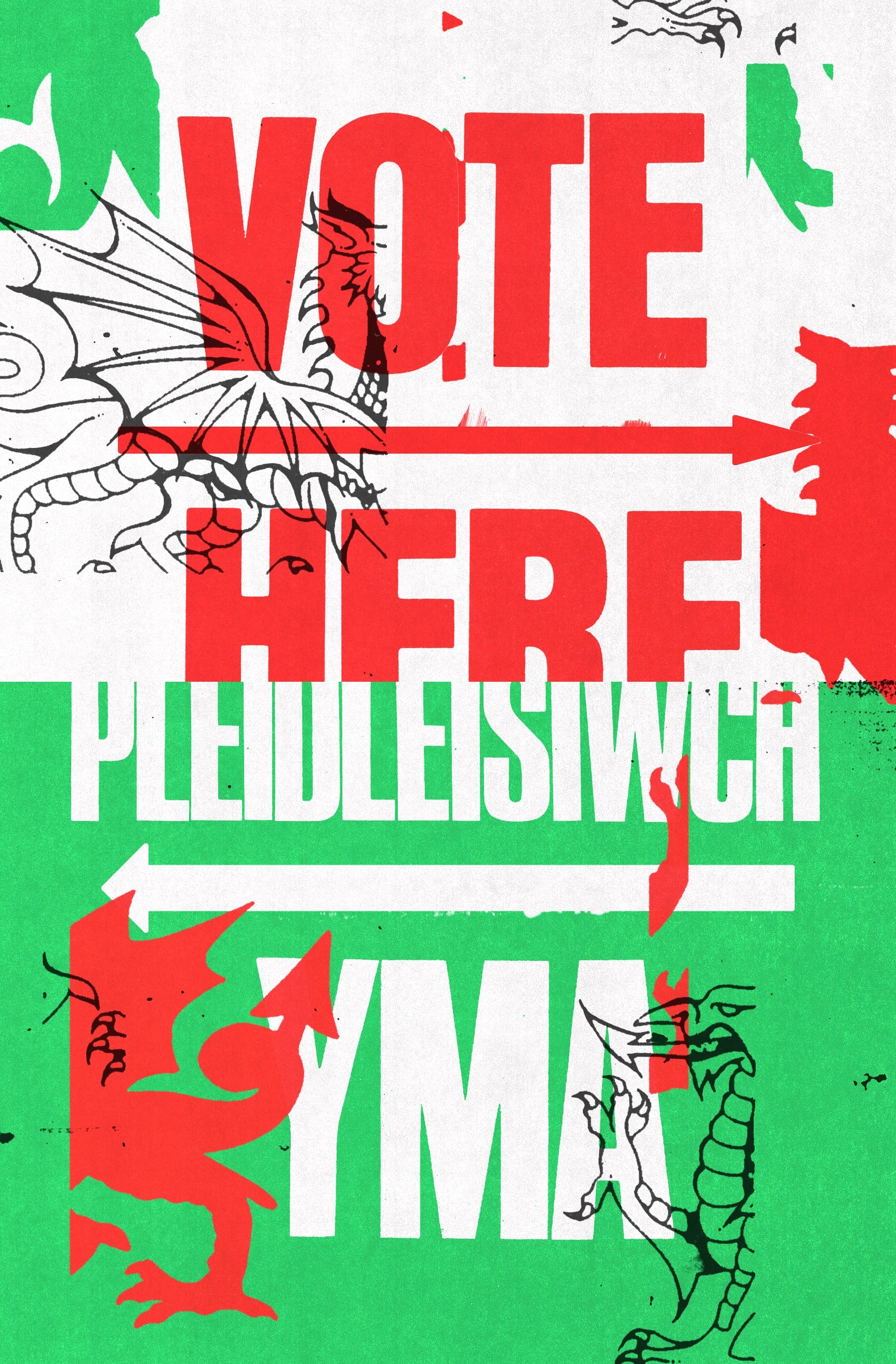
When I was thirteen years old, I joined a band. We were the best rock musicians among the students at our school in the western suburbs of Swansea, South Wales. We were not a regular outfit, but a supergroup formed for a limited purpose: to win the 2004 edition of the school’s annual eisteddfod.
An eisteddfod is a Welsh festival of the arts in a competition format. Contestants are judged across a range of literary, visual, musical, and performance disciplines. The most prestigious contests are in artistic forms that have been developed in the Welsh language, many of which are defined by their formal rigor. First among these is awdl, a long poem written in the strict meter of cynghanedd, a traditional system of prosody that tightly constrains consonance, rhyme, and stress within each line.
The largest and most important competition is the National Eisteddfod of Wales, known simply as the National and held the first week of August each year. Each edition culminates in a ceremony in which a bespoke bardic chair is awarded to the winning entrant in the awdl contest. (The judges can withhold the chair if they deem the standard of entries to be too low.) Prizes of furniture hearken to the earliest eisteddfod on record, convened in 1176 at Cardigan Castle by the nobleman Rhys ap Gruffydd. A bard from Gwynedd won the wooden armchair for poetry, while the music prize went to the son of Eilon the Crythwr, a member of Rhys’s court.
Across official competitions, the chief concern of eisteddfod rules is the use of the Welsh language—Cymraeg, to its speakers. Since 1950, a requirement that the Welsh language must be used in all contests at the National has been strictly enforced. The National holds extraordinary cultural and social value for many Welsh speakers, who are a minority within Wales. The country has a population of 3.1 million, roughly the same as the state of Arkansas. According to the most recent census, taken in 2021, 17.8 percent of people aged three years or older in Wales—just 538,300 people—are able to speak Cymraeg, which UNESCO classifies as a vulnerable language. Alternating its location between the north and the south of the country each year, the National consistently draws over 150,000 visitors, and is one of the only large-scale, immersive environments in which the ability to speak Cymraeg is assumed.
My school’s eisteddfod was a different kind of event, amounting ultimately to a Wales-themed talent show conducted mostly in English. There were few pupils at my school who spoke Welsh with a meaningful degree of fluency. This was not abnormal: in many parts of Wales, there is a strong sense of Welsh identity and a desire to celebrate it but insufficient fluency in Cymraeg to hold eisteddfods that meet the stringent official Welsh-language requirements. Suburban Swansea in the late 1990s and early 2000s as I experienced it was both reflexively Welsh and almost completely anglophone. Originally from Aberdare, a historic mining town to the northeast, my mother’s side of the family speaks a richly accented idiom of Welsh-vernacular English. My father is from England, but that’s not unusual in Wales: according to the 2021 census, 29.1 percent of Wales’s population was born outside the country, with the largest subgroup from England. In this social context, there was no sense that engagement with Cymraeg was a necessary or even desirable component of being Welsh. The few weekly hours of mandatory language lessons in my comprehensive school were uniquely neglected by the pupils, with even some of the most abject nerds struggling to feign engagement.
In old and young alike, Welshness manifested around me as a quality both bone-deep and lightly worn. It was asserted most stridently during international sporting contests and rarely found expression in nationalist political convictions. For the most part, we were peaceably resigned to the fact that people outside the country seldom thought of Wales, and that when they did it tended to be in blithely condescending terms. At an early age I was given to understand that the rest of the British Isles were quick to claim the Welsh had sex with sheep at high incidence and with uncommon ardor—that we are, in other words, sheep shaggers. The comments of foreigners from farther afield tended to focus on the abundant natural beauty of Wales, making clear the fame of our country’s verdant landscape eclipsed that of its people.
The section of Welsh society to which I belonged was generally capable of ignoring these views and enjoying ourselves on our own terms. That was the spirit in which my school’s unofficial eisteddfod, which featured few Welsh-language contests, was conducted. Certainly, no linguistic requirement applied to the rock and pop performance category in which our band was to compete. We were free to express our sense of national identity through forms of art which more naturally fitted our linguistic and cultural idiom than awdl: 828 years after Rhys’s eisteddfod, our band would weave its own thread into the ancient cultural tapestry of our nation with a performance of the title track from By the Way, the 2002 Red Hot Chili Peppers album.
“By the Way” had the unusual distinction of both being popular among the audience of our peers and featuring a bass guitar solo by Flea equal to the task of showcasing the musical preeminence of Reece, our virtuosic fifteen-year-old bass guitarist. The only substantial difficulty the track presented was that none of us was willing or able to perform its energetic rap-rock lyrics. An entirely instrumental recital would not do; other than the bass line, “By the Way” was not musically interesting enough to bear the weight of the judges’ scrutiny. As a workaround, we were allowed to play the original record as a low-volume backing track, a specter of Anthony Kiedis’s vocals filling the gap left by our shortcomings. In hindsight, I’m surprised the school authorities granted us this sonic crutch. But it didn’t matter in the end. Reece played with a verve that left no room for doubts in the judges’ minds. The audience went wild, and we won first place, though none of us was awarded an armchair.
Our triumph was more poignant for the fact that Reece had started down a troubled path. He was cultivating a reputation as something of a hard man, gained mainly through chinnings dished out in pubs and rugby club function rooms. Those who felt a sense of responsibility toward Reece must have hoped his eisteddfod victory would mark a turning point. But sometime after the performance, having grown distant from him, I heard a story about Reece that told of a different fate. One day, he had entered a local pasture and approached a grazing ewe. For reasons stated earlier, an English, Irish, or Scottish person would immediately register such an image as archetypically Welsh; they would stand a decent chance of reaching unanimity on the question of what the young man is most likely about to do. Reece did smash the ewe, but in a sense that undermined rather than confirmed cultural expectations, when he caved the animal’s head in with a hatchet.
Red All Over
Reece’s act reminds us of the capacity of Wales, the United Kingdom’s most overlooked nation, to repay close attention with intriguing behavior. Welsh national life has a peculiar texture, and Welsh politics is correspondingly exceptional, but in ways difficult to see at first glance. The most prominent Welsh nationalist party is Plaid Cymru, or the Party of Wales, commonly shortened to Plaid. Plaid’s defining causes are the promotion and protection of the Welsh language and the pursuit of political independence for Wales. Since the 1980s, Plaid has propounded a center-left nationalism and positioned itself as the only party that prioritizes the interests of Wales. This appeal has mostly been made in vain: the cause of independence has never been endorsed by a majority in Wales (the highest level of support ever recorded is 42 percent in a 2021 poll), and there has been a lingering perception that Plaid mainly represents the interests of the minority population of Welsh speakers concentrated in the west and the north of the country. Combined with the fact that Plaid’s broadly social democratic economic platform now substantially crosses over with that of Welsh Labour’s, Plaid has suffered from the view that it has little to offer over that party other than a political independence most Welsh people don’t want and the promotion of a language most Welsh people don’t speak.
A tectonic shift is taking place in Welsh politics.
For over a century, the country Plaid is named after has demonstrated world-historical loyalty to its main rival, the Labour Party having been for that period the de facto national party of Wales. After becoming the country’s biggest party in 1922, Labour has held a 103-year-long winning streak in Wales, the longest of any political party in the democratic world. The party has won the most votes in Wales at every election to the UK parliament and to all six elections to the Senedd, the semiautonomous Welsh national parliament established in 1999 and located in Cardiff. Welsh governments led by Labour have used the legislature’s powers to deliver free school breakfasts, public transport benefits, and universal free medical prescriptions. While Plaid has exerted significant influence on these policies—especially as a junior partner in a coalition Senedd government with Labour between 2007 and 2011 and via a three-year cooperation agreement with Labour signed in 2021—the party hasn’t been able to convince very many Welsh people to vote for it. Plaid has never won more than seventeen of the Senedd’s sixty seats and never more than four of Wales’s Westminster seats, which have fluctuated in number between thirty-two and forty since the party was formed in 1925.
But a tectonic shift is taking place in Welsh politics. Since last September, polls regarding the Senedd election in May began to show Plaid consistently beating Labour for the first time ever. This was remarkable on its own. But then Labour began to slide further and further down the rankings. As of this writing, Labour is unprecedentedly polling in fourth place—alongside the Conservatives and behind Plaid, the Green Party, and Reform UK, the populist right-wing British nationalist party in second place. Reform’s proposals for Wales are broadly the same as its policies for the UK in general: reduce taxation, limit immigration, oppose net-zero emissions policies, and substantially reduce public spending. But the party’s specific policies are less important than its overall timbre, recently described by my South Walian uncle (congenitally but moderately red in both politics and complexion) as “basically fascist” as he tried to convey the flavor of sadomasochistic political disgruntlement that fuels support for Reform in Wales and in Britain more generally. (Since April of last year, Reform has polled as the most popular party in the UK overall.) I suspect and hope most Welsh Reform voters don’t want to see jackboots on the streets of Cwmbran. But just as certain sections of the Welsh electorate aren’t exempt from the rightward drift observable across the world, nor is Wales insulated from its worst possible consequences.
Support for Reform in Wales is disproportionately concentrated among older voters. Conducted in September, the most recent poll to break down Senedd voting intention by age showed Reform to be the most popular party among all categories of voter over the age of fifty. But it also showed that, to an even greater degree, support for Plaid is concentrated among younger voters. Plaid was the most popular party among twenty-five- to forty-nine-year-olds, commanding 38 percent of their intended vote; among sixteen- to twenty-four-year-olds (you can vote at sixteen in Senedd elections), the margin of Plaid’s first-place lead was even higher, with intention to support the party up at 58 percent.
While there is not a huge amount of actual power at stake in the Senedd election—the UK Parliament allows the devolved Welsh government to make decisions in certain policy areas, while Westminster retains ultimate authority—the symbolic stakes are inordinate. For over a century, the Welsh have been shy to assert their national interests or express their national feeling by casting a meaningful number of votes for openly nationalist parties. Today, more Welsh people than ever are open to representation by a party that not only looks after the country’s material interests but which carries its name. Looking back, Reece’s violent subversion of the ultimate Welsh stereotype seems to anticipate this consolidation, this mending of internal contradictions, through an attempt to expiate a national sin: that of introducing the scarcely intelligible but incontestably anglophone vocals of Anthony Kiedis to an eisteddfod.
Miner Feelings
Welsh nationalist consciousness may appear underdeveloped, but the very idea of Wales as a modern country is relatively new. The ninth edition of the Encyclopaedia Britannica, completed in 1888, contained over seventy pages on Scotland, the other minority nation that shares the island of Great Britain with England; its entry on Wales reads, in full, “See England.”
Many were unsentimental about leaving behind Cymraeg, which they associated with conservatism and limited economic opportunity.
This is still cited as a paragon of establishment disregard of Wales and the Welsh. But in a simplistic way the entry reflected brute facts. Scotland enjoyed over eight centuries of internationally recognized independence before entering political union with England in 1707; today, Scotland still has an independent church, legal system, and education system that antedate the formation of the United Kingdom. Wales, on the other hand, had very few vocational, cultural, or educational institutions that recognized Welsh national unity at the time the offending entry was published. The country was administratively subsumed into England with the passage of the Laws in Wales Acts of 1535 and 1542. Before that, its territory had been split between rival Welsh and Norman rulers, and there was never a permanent, fully unified Welsh state encompassing the entire country. Even labeling Wales a nation risks overstating the cogency of Welsh society up to around the middle of the eighteenth century, which is probably best described as that of a stateless ethnolinguistic minority within Britain.
Much of the country’s diffuse situation came down to inescapable facts of geography and demography. The Welsh were spread across their own country in a way that inhibited the development of an involved national life, the inhospitable landscape also limiting population growth; until the middle of the eighteenth century there were very few people in Wales, never more than five hundred thousand. The Welsh language provided the glue that held Wales together and is the very basis of Welshness as a distinct identity; in the middle of the nineteenth century, an estimated 69 percent of the population of Wales still spoke Welsh, and the majority of those spoke no other language.
It was a tenuous state of affairs. The historian Gwyn A. Williams speculates that “if Wales had not been industrialized . . . any recognizable entity which could be called ‘Wales’ would have disappeared in the nineteenth century, its people blown away by the winds of the world.” But with the growth of industry—particularly iron production and metalworking—and declining mortality, the population of Wales increased to about 1.16 million by 1851. It was around this time that intense mining of the South Wales Coalfield began and with it a new phase of national transformation that would attenuate the linguistic basis of Welsh distinctiveness while laying the demographic foundations of the country’s viability as a modern nation.
The South Wales Coalfield is the largest continuous coalfield in Great Britain, covering approximately one thousand square miles in a broad band stretching from Pembrokeshire in the west to Monmouthshire in the east. The area began to attract migrants as soon as intensive mining commenced in the 1850s. This rapidly turned into a historic influx. Between 1851 and 1914, the population of Wales increased 117 percent, from 1,163,139 to 2,523,500. In the decade leading up to the First World War, Wales was, according to Williams, “the only country to register a plus in the immigration tables outside the USA.”
The development of the South Wales Coalfield created a society with characteristics so distinct from those of traditional Wales that it effectively functioned as a nation-within-a-nation—a “World of South Wales,” to use the coinage of the historian Dai Smith. The earliest migrants to the coalfield established predominantly Welsh-speaking communities. But as more people arrived from England and continental Europe, they began to adopt English as a lingua franca. The peak decade for migration to the South Wales Coalfield was between 1901 and 1911, when approximately 129,000 people moved to the area. The census of 1911 was the first to show more English speakers than Welsh speakers in Wales; since then, Cymraeg has never recovered its position in the country. It is certainly the case that strong economic factors incentivized the adoption of English in the South Wales Coalfield in the late 1800s and early 1900s. But any idea that its general use was imposed on the population is a misconception; many were unsentimental about leaving behind Cymraeg, which they associated with religious and cultural conservatism and limited economic opportunity.
Alongside the transition to the English language, the development of the coalfield brought a new politics to Wales. From an early stage, miners learned to flex their collective muscle to gain more favorable wages and conditions, and the region quickly became notorious for its recurrent and often bitter industrial disputes. Over time, this volatile syndicalism coalesced into what Raymond Williams recognized as “one of the major centres of socialist consciousness anywhere in the world,” a political culture that played a central role in shaping and institutionalizing the parliamentary Labour movement itself.
Coal nationalization was the issue that ultimately tipped Wales decisively toward Labour and away from the Liberal Party, which had previously dominated Welsh elections. After the First World War, Labour’s unequivocal support for public ownership contrasted with Liberal equivocation, aligning Labour firmly with the ambitions of Wales’s mining communities. In the general election of 1922, Labour displaced the Liberals as the largest party in Wales, drawing its core support from the South Wales Coalfield and putting the capstone on what Smith describes as “the most drastic alteration of Welsh sensibilities that ever occurred.”
The Party of Wales
The English language, socialist politics, and a shift of the nation’s center of gravity to the south of the country had come to Wales rapidly and as a bundle. Not everyone was happy about it. Out-migration to the southern coalfield had depopulated rural Welsh-speaking communities in the west and north of the country, and many felt left behind. Cultural traditionalists, both within Wales itself and among the Welsh expatriate communities of large English cities, were troubled by a sense that the nation’s unique culture had been spoiled by the loss of a Welsh-speaking majority.
The English language, socialist politics, and a shift of the nation’s center of gravity to the south of the country had come to Wales rapidly.
One of those concerned was Saunders Lewis, the contentious founding figure of Plaid Cymru. Lewis was born in 1893 in Wallasey, an English town that faces Liverpool across the River Mersey. In his literary biography of Lewis, Bruce Griffiths describes his family’s milieu as members of “the only Welsh-speaking urban bourgeoisie that has ever existed—the expatriate Welsh of Manchester, Liverpool, and London.” At home, the Lewis family spoke Welsh exclusively and kept an extensive library of Welsh-language literature. Aspiring to be a writer, Lewis started an undergraduate degree in English at the University of Liverpool but saw his studies interrupted by the outbreak of the First World War. Lewis volunteered and was sent to France. While in the trenches he read Le Culte du moi, a trilogy of novels by the reactionary French writer Maurice Barrès. He was impressed by Barrès’s conservative ethos, which extolled geographical rootedness and a hierarchical social order. It was reading Barrès, Lewis said, that turned him into “a convinced Welsh Nationalist.”
In the years immediately following the war, Lewis wrote in English, attempting to create an Anglo-Welsh literature by developing “an English diction that would interpret the native speech of the Welsh.” But Lewis felt unable to transmute the English he heard spoken in industrialized South Wales, finding it to be “something more hideous than parody can suggest” and “the horrible jargon of men who have lost one tongue without acquiring another,” adding that “no feebler stuff is spoken in these islands.” He turned to writing in the Welsh language, sensing that it was his only remaining path to literary fulfillment. The consequences of this decision went beyond the literary, both for Lewis and for Wales. As Griffiths puts it, Lewis’s “future as an author, now that he had thrown in his lot with Welsh as a medium, depended on there being an audience for his work. It was only logical for him to join the struggle for the survival and furtherance of Welsh.” With the aim of advancing traditional Welsh culture—and with one eye on boosting his potential readership—Lewis was drawn into politics. “Though my own desire is for a life of literature,” Lewis said in 1929, “I have hindered that ambition in a political attempt to remedy the evils that I see.”
In the early 1920s, while working as a lecturer in Welsh at the University College of Swansea, Lewis joined a semiclandestine group of nationalist intellectuals called Y Mudiad Cymrieg (the Welsh Movement). In 1925, they merged with a northern group called Byddin Ymreolwyr Cymru (the Army of Welsh Home Rulers) to form the first Welsh nationalist political party, Plaid Genedlaethol Cymru (the Welsh National Party—the party would later drop Genedlaethol, becoming the Party of Wales). There were founding members of Plaid, notably the socialist economist David James Davies, who wanted the party to pursue Welsh self-governance as a way of achieving economic and social justice for all Welsh people. Initially a member of the Labour party, Davies took a trip to Denmark in 1924 and was impressed by the small country’s ability to meet the needs of its citizens through self-government. It convinced Davies that socialism could be achieved through nationalism, and he felt the advancement of the Welsh working class could only be secured in a free, independent Wales. He also realized any hope of political success depended on Plaid appealing to English-speakers in South Wales.
But Lewis was never going to give oxygen to such an inclusive vision, joining Plaid only on the condition that the party adopt his agenda wholesale. Accordingly, in its early years under Lewis’s leadership, Plaid functioned less as a political party than as a socially conservative Welsh-language interest group with the flimsiest pretext of electoral ambition, conducting its business exclusively in Welsh. The nationalist ideology and policy platform Lewis devised for the party was bizarre: in Lewis’s vision, Welsh sovereignty had no value in and of itself; he acknowledged that Wales was politically subsumed into England in the Middle Ages but felt “no irreparable harm” came of this. However, Welsh self-government was now necessary to restore a factitious ideal of “Welsh civilization” that Lewis thought had been degraded by the homogenizing forces of modernity, with industrialization inflicting the most recent and drastic injuries.
In Lewis’s view, Welsh society should be economically agrarian, socially hierarchical, and—most important—monolingually Welsh. Lewis believed the primary responsibility of any Welsh government was to make Cymraeg the sole official language of Wales. A massive snob, Lewis thought Wales should maintain strong ties with the British monarchy so the crown could provide a framework for an ordered Welsh society capped by an aristocracy fit to lead the nation. The society of the South Wales Coalfield had no place in his vision. In a notorious 1933 manifesto called Deg Pwynt Polisi (Ten Points of Policy), Lewis wrote that “agriculture should be Wales’s chief industry and the foundations of its civilization,” and that “for the sake of the moral wellbeing of Wales and for the moral and physical benefit of its population, South Wales must be de-industrialised.”
Lewis’s deindustrialization policy is, as Richard Wyn Jones has written, difficult to read as “anything other than an attack on a very substantial part of Wales’s population”; it is astonishing Lewis’s vision in general “could ever have been regarded as an appropriate basis to (re)launch Welsh nationalism as a serious political force.” But while his idiosyncratic prejudices were not representative of all Welsh speakers, or all Welsh nationalists, Lewis’s views were sufficiently consonant with the sensibilities of Plaid’s early members for Lewis to be able to serve as party president from 1926 to 1939. At the heart of Lewis’s nationalist ideology was his conviction that “it is only a monoglot Welsh-speaking Wales that is consistent with the aims and philosophies of Welsh nationalism.” If the core of Plaid’s membership hadn’t basically endorsed this linguistic hierarchy of Welshness, their attachment to Lewis wouldn’t have been so strong; Lewis tried to resign his presidency of the party nine times over the course of his tenure, but the members wouldn’t let him go.
Even if Plaid had appealed to English-speaking South Wales from the beginning, it is likely the scale and speed of the changes brought on by the region’s industrialization would have caused some kind of conservative reaction elsewhere in Wales. But in handing over the reins of the party to Lewis, Plaid endorsed a vision of Welshness that was openly hostile to a majority of the country’s population, institutionalizing the internal divisions that would define Welsh politics in the twentieth century and condemning themselves and their cause to electoral obscurity. The party would not win a single parliamentary seat in Wales until 1966.
Despite this marginal status, Welsh Labour politicians were moved to object to Plaid’s agenda and offer a competing national vision; even when it disavowed nationalism as such, socialism in South Wales carried a distinctly national charge. The greatest politician produced by twentieth-century South Wales was Aneurin Bevan, a miner’s son born in Tredegar on the northern edge of the coalfield. Appointed minister for health when Clement Attlee’s Labour party won the 1945 British general election, Bevan was tasked with designing a universal health service for Britain; what he delivered was based on his hometown’s Workmen’s Medical Aid Society, which provided health care free at the point of use in return for contributions from its members. “All I am doing is extending to the entire population of Britain the benefits we had in Tredegar for a generation or more,” he reassured a skeptical nation. “We are going to Tredegarise you.” On July 5, 1948, Bevan launched the National Health Service.
Bevan was not only the greatest politician to come out of the South Wales Coalfield but the most emblematic: stridently socialist, English-speaking, wholly Welsh, and untroubled by any sense of contradiction between these positions. In 1946, he addressed Parliament to argue against the establishment of a dedicated Welsh secretary of state on the grounds that the office risked capture by Welsh-speakers. Reminding his audience that “the culture and cultural institutions of Wales do not belong entirely to North Wales or Mid-Wales,” and that the English-speaking regions possessed “a culture as rich and profound as that which comes from the Welsh speaking people,” Bevan warned that “some of our nationalist friends are making an enclave” of Welsh speakers inside the government. “The result,” he continued, “is that the whole of the Civil Service of Wales would be eventually provided from those small pockets of Welsh-speaking, Welsh-writing zealots, and the vast majority of Welshmen would be denied participation in the government of their country. . . . That is a situation we are not going to allow to grow up, and in stating that I represent far more Welshmen than do my honorable Friends.”
Socialism in Un Country
Today, the pursuit of Welsh independence and the promotion of the Welsh language remain at the heart of Plaid’s credo. But the party’s policies, and its framing of these goals, couldn’t be further removed from Saunders Lewis’s divisive vision. Plaid’s current leader, Rhun ap Iorwerth, has made an extraordinary effort to moderate the party’s messaging. “We are for everyone equally,” ap Iorwerth said in 2023 at his first party conference as leader. “Plaid Cymru speaks your language, whatever that language is.” To avoid spooking the majority of Welsh who continue to oppose independence, ap Iorwerth has also ruled out the publication of an independence plan within the first term of a Plaid-led government; the implication is that such a plan will emerge if Plaid wins the Senedd back-to-back in both 2026 and 2030.
Wales simply wasn’t big enough for two democratic socialist parties.
Since the early 1980s, Plaid’s platform has combined socialist and nationalist principles, ironically echoing the approach advocated by David James Davies in the 1920s but rejected by Lewis. In practice, this means policies that combine economic redistribution and social justice with an assertion of Welsh national identity: support for public ownership or community control of key infrastructure, including railways and social services; investment in regional development and social housing to redress economic imbalances; expansion of Welsh-medium education and promotion of the Welsh language; and greater fiscal autonomy for Wales, including control over taxes and public revenue.
Plaid first turned to this approach in the wake of the four-to-one defeat of a Welsh devolution proposal in a 1979 referendum. Realizing how far the party had drifted from the nation it purported to stand for, Plaid took a bolder economic stance to show it was serious about meeting the material needs of Welsh people. But this created a new problem: as the party became more economically leftist and socially liberal, it struggled to positively distinguish itself from Labour in the minds of voters. Wales simply wasn’t big enough for two democratic socialist parties. Forced to choose, the English-speaking majority generally went for Labour, which had a proven track record of representing their interests, over Plaid, which was both untested and also tainted by association with a language most didn’t understand and a political independence most didn’t believe in.
But the convergence between Plaid and Labour from the early 1980s onward didn’t run in one direction. As Plaid moved leftward on questions of economic organization and social justice, Labour began to incorporate elements of Welsh national identity and even nationalism into its own political program. One of the main spurs to this was the final deconstruction of the mining industry in South Wales under the Conservative UK government elected in 1979. In 1985, a national miners’ strike that had seen some of its greatest displays of solidarity in South Wales was defeated by the government. By 1994, all but one large-scale deep mine had closed on the southern coalfield. As the region’s economy transitioned to one based on generic service-sector jobs, most people in South Wales continued to vote for Labour. But deprived of the economic leverage once provided by South Wales’s heavy industry, Welsh Labour became increasingly receptive to devolution as a mechanism for protecting Welsh public services and economic priorities.
A broader convergence of Welsh culture accompanied this political melding. In the 1960s and 1970s, Welsh-language activists—most prominently Cymdeithas yr Iaith Gymraeg (the Welsh Language Society)—adopted a direct-action campaign to advocate for improved Welsh-language public services. They defaced and removed monolingual English road signs, vandalized radio and television transmitters to protest insufficient Welsh-language programming, and blocked traffic with sit-ins. At the time, the group attracted significant hostility in Wales. But in the long run, the victories they won served to normalize the presence of Cymraeg as a part of national life throughout the country.
The first television channel aimed specifically at a Welsh-speaking audience, Sianel Pedwar Cymru (or S4C, literally “Channel Four Wales”), started broadcasting in 1982, shoring up the image of Welsh as a modern, living language. Cymraeg became a compulsory subject for all students in primary schools in 1990, a requirement extended to pupils up to the age of sixteen in 1999. There was a growth in Welsh-medium schools, in which most lessons were taught in Welsh. In 1993, the Welsh Language Act established the principle of equality of Welsh and English in the provision of public services and justice in Wales. Aside from enshrining Wales’s status as officially bilingual, as a piece of legislation that applied uniquely to Wales it reinforced the idea of the country as a distinct legal-administrative space.
Many of these developments were based on the promotion and protection of the Welsh language. But they did not generally register as coming at the expense of the English-speaking population, and they served to make Wales feel more distinct even to people who didn’t speak Welsh. The overall effect was to open just enough Welsh minds to the possibility that at least limited self-governance was a good idea. In 1997, Wales was offered devolution for a second time, and the proposal won a majority of votes—albeit by a razor-thin margin of 50.3 percent versus 49.7 percent, and on a turnout of just 50.1 percent. The Senedd was established in 1999, the first permanent national government with lawmaking powers in the country’s history.
Heavy Goods
There were, and still are, gaps between the official ideal of Wales as a meaningfully bilingual nation and reality. In 2008, a road sign was installed near a supermarket in Swansea. The sign’s English text said “No entry for heavy goods vehicles. Residential site only.” The Welsh text beneath read “Nid wyf yn y swyddfa ar hyn o bryd. Anfonwch unrhyw waith i’w gyfieithu” (“I am not in the office at the moment. Please send any work to be translated”). The contractor responsible for the sign did not speak Welsh and had requested a translation of the English text into Cymraeg from Swansea City Council’s internal translation division. He received an automatic out-of-office message in response and mistook it for the translation itself. Readers sent photographs of the resulting sign to the Welsh-language magazine Golwg. “We’ve been running a series of these pictures over the past months,” Golwg’s editor Dylan Iorwerth told the BBC. “They’re circulating among Welsh speakers because, unfortunately, it’s all too common that things are not just badly translated, but are put together by people who have no idea about the language.”
The victories Cymdeithas yr Iaith Gymraeg won served to normalize the presence of Cymraeg as a part of national life throughout the country.
But these are superficial hitches in the process of Wales becoming more unified in recent decades and more legible as a distinct nation both to outsiders and to the Welsh themselves. This process is ongoing even as the country’s institutions struggle to address its problems. Wales’s economy lags, with output and productivity diminished in comparison to the rest of the UK. Public spending exceeds taxes raised, leaving the country heavily reliant on transfers from Westminster. Wales has historically been more closely tied economically to the European Union than much of Britain and has suffered from post-Brexit rules and paperwork.
Considering Aneurin Bevan’s legacy, it is a bitter irony that managing the NHS is one of the country’s biggest challenges. NHS performance in Wales has in recent years compared poorly with the rest of the UK, though the entire system is under strain. Wales also records weaker education outcomes than the rest of the UK on international benchmarks. Such persistent problems are a special source of national embarrassment, with management of the NHS and education being two of the most important powers devolved to the Senedd.
It is little wonder voters feel the sheer length of Welsh Labour’s tenure in the Senedd has sunk the party into a malaise. One Labour MP even admitted to The New Statesman that “it’s not healthy for any party to be in government for two decades.” Writing for the same magazine last October, Chris Carter, the Labour Party Senedd candidate for Newport and Islwyn, acknowledged that, “in recent years, Welsh Labour has looked and sounded like a government running out of imagination.” Voters drifting away wasn’t about differences in ideology, he argued: “It’s psychological. Labour in Wales has lost its instinct for focus.” This downplays the broader rejection of the British Labour Party, fueled by the unpopularity of Keir Starmer’s government in Westminster. From its earliest days in power, Starmer has faced allegations of abandoning Labour’s core mission by embracing fiscal caution that looks like austerity, dropping flagship redistributive pledges, and accepting Conservative-era limits on welfare, migration, and public spending. While Welsh Labour has pointedly distanced itself from its British counterparts in response—incumbent First Minister Eluned Morgan told the BBC that Starmer is “not on the ballot” in the upcoming Senedd election—they cannot fully escape association with a tainted national party.
Wales’s rejection of Labour can be read as a double protest vote, against both the sclerotic Welsh party in the Senedd and the disappointing British party still in its first term in Westminster. Plaid has found itself perfectly placed to make hay of the collapse in Labour’s support. Consolidated under ap Iorwerth’s leadership, the long-term strategy of expanding Plaid’s appeal beyond its Welsh-speaking core is paying off, a shift in perception traceable across generations. In a poll from August 2025 to mark Plaid’s centenary, 50 percent of Welsh people over the age of sixty-five viewed the party as “more of a specialist party for Welsh-language speakers.” But this fell to 27 percent among twenty-five- to forty-nine-year-olds, and 14 percent among sixteen- to twenty-four-year-olds. At the same time, Plaid is considered distinctly Welsh in an inclusive and progressive way; its strong sense of national identity appeals to left-leaning voters hoping for more effective pushback to Starmer’s government. Nationalistic yet cosmopolitan, this identitarian balancing act enables Plaid to stand out to voters despite its similarities with Labour. “It’s really important that we start prioritising us,” a young student told the BBC last October, when Plaid beat Labour for the first time in a hotly contested Senedd by-election in Caerphilly. “We start prioritising our language and we start prioritising keeping our traditions and our heritage,” she went on, adding that it’s time that “Wales starts standing up for itself.”
Reform UK is set to emerge from the upcoming Senedd election as the second-largest party in Wales, trailing Plaid by fourteen points at 23 percent in January’s polls. As I write this in early February, the party has focused on broadly characterizing the Welsh government as little more than another layer of bureaucracy that makes life more irritating and difficult for ordinary people. The party’s leader, Nigel Farage, has teased a manifesto for the Senedd election to be released within the “first two weeks of March”; the only specific policy he has promised so far is abolishing Wales’s extraordinarily unpopular nationwide twenty-mile-per-hour speed limit on residential and busy pedestrian roads. (A particular appeal has also been made to rural Welsh communities, whose farmers feel burdened by environmentalist land management requirements.) The party has even kept the door open to getting rid of the Senedd entirely; while not its current policy, Reform does not “want to shut the discussion down,” according to a party spokesperson. It seems Reform voters’ sense of Welshness is comfortably nested within a broader British identity, and that they view the Senedd not as a manifestation of a long-suppressed collective will to national self-determination but as a provincial outpost of a technocratic class whose interests are opposed to those of ordinary people.
Reform appeals to a certain part of Welsh society that believes they are being left behind. Their support for the party is a slap in the face of cultural elites, an impulse to remind people that they are still there. This is a common sentiment in Wales, though it is not always an expression of such a thinly reactionary feeling. A distinct but adjacent angst over fading away is a profound component not only of Welsh nationalism but the Welsh psyche in general. The current most prominent Welsh nationalist slogan is Yma o hyd (Still here). It’s taken from the 1983 song of the same name by Dafydd Iwan, a folk singer and former president of Plaid. The chorus is a refrain: “Ry’n ni yma o hyd / Er gwaetha pawb a phopeth” (“We’re still here / Despite everyone and everything”). It is meant to strike a note of Welsh defiance against the perennial threat of disappearance, and the song’s lyrics place the Welsh language and the cause of Welsh nationalism at the forefront of the Welsh story.
Despite its contentious subject matter, Yma o hyd has been adopted by Welsh people of all language backgrounds and political persuasions and is sung at every match played by the national soccer team. I believe its popularity is based on a subconscious appeal; the phrase encompasses the contradictions of the Welsh experience more fully than Iwan intends. The excusable fixation of the Welsh on their own historical tenuousness distracts from the most salient aspect of an identity that lasted at least a millennium and a half on the western edge of Britain essentially left to its own devices: a perverse durability. If you put a question mark at the end of Iwan’s phrase, as I have always done in my mind, it conveys a note of bittersweet surprise that hints at the almost involuntary factor within Welshness, a deep and strange quality reassuringly out of political reach. In their pursuit of collective self-actualization—their diplomacy, their commerce, their cultural celebration—other modern nations seem to organize themselves around the expression of a basic assertive principle: they can’t be, they won’t be, stopped. It may be more accurate to say of the Welsh that, despite everyone and everything, we can’t stop. We are addicted to the shindig.