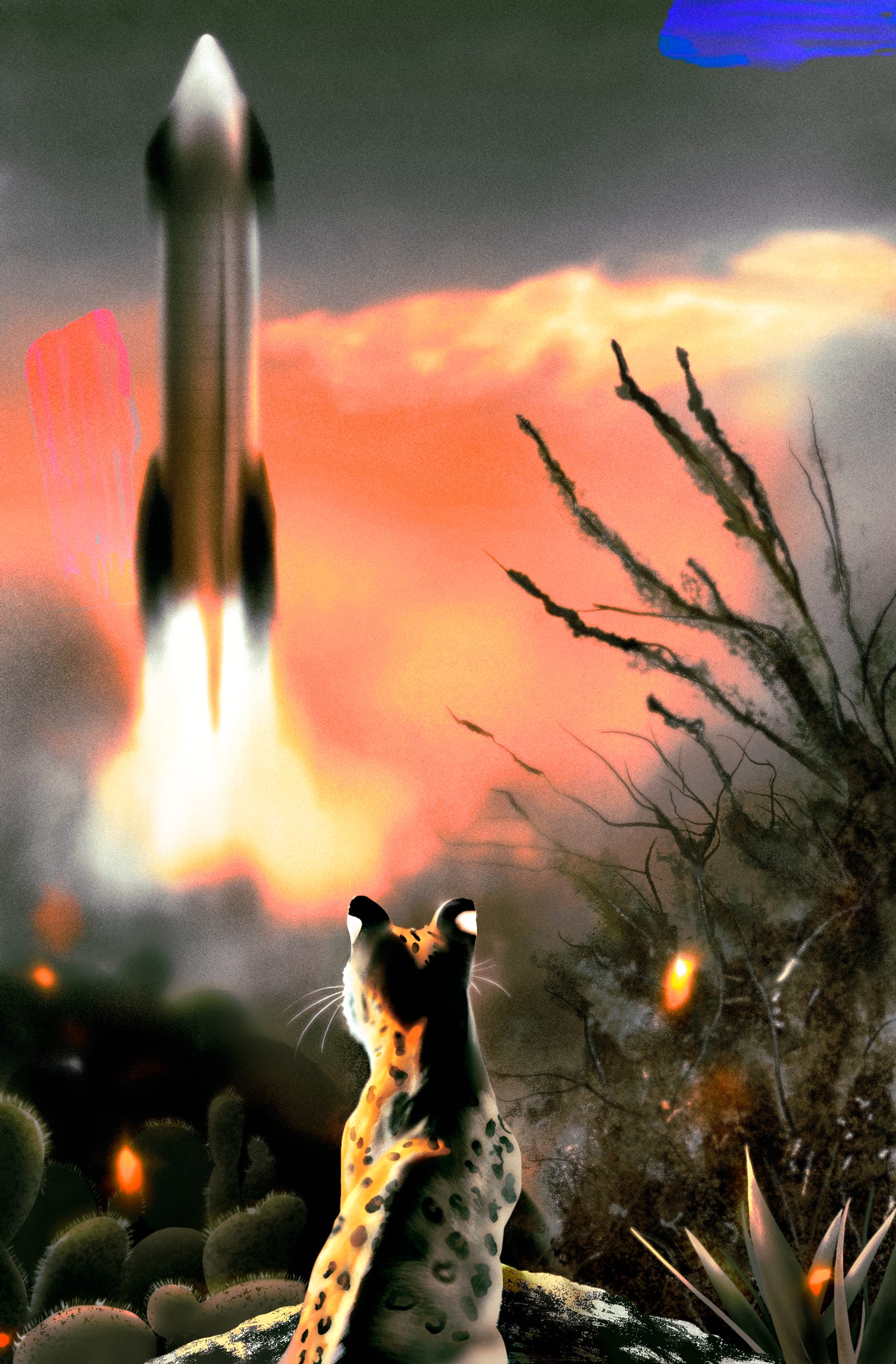
To understand the significance of Boca Chica, a stretch of coastal prairie, scrub forest, and dune on the far southern edge of Texas, I recommend a road trip along the Gulf Coast—or what’s left of it.
If you start in New Orleans, as I did, the first leg of the journey takes you through Louisiana’s river parishes, formerly plantation country where enslaved people toiled in sugarcane fields and where their descendants live in the shadows of the oil refineries, grain terminals, and chemical factories that have earned this stretch of the Mississippi the name “Cancer Alley.” Then it’s on through the hazy refinery districts of Baton Rouge, Lake Charles, and Beaumont, until you reach the outskirts of Houston, where oil refineries sprawl to the horizon, small cities unto themselves of pipes, lights, and smoke. You can camp on Matagorda Bay with a view of the plastics factory at Point Comfort or head for the beach and look out at night on the lights of the offshore rigs. In the entire 550 miles between New Orleans and Corpus Christi, you never go long without seeing some hulk of fossil fuel infrastructure.
But when you reach Brownsville, the largest city in the Lower Rio Grande Valley of Texas, and turn east toward Boca Chica Beach, you enter a landscape that feels far from all that. South of the road runs the Rio Grande, the international border with Mexico. This place is a borderland in more ways than one: Here, the flora of the Chihuahuan Desert spills into the dunes and tidal flats of the coast as the big river itself slows and unwinds through its delta and blends its waters with the Gulf. The result of this mixing of ecosystems is a landscape that strikes the visitor with the strangeness of an alien world. Giant yuccas hoist their shaggy, spear-leafed heads on ten-foot stalks over coastal prairies. A staggering array of migratory shorebirds forages its tidal flats. Thickets of mesquite, acacia, and prickly pear hide mysterious life-forms in their impenetrable shadows. These patches of Tamaulipan thornscrub are, after all, one of the last places in the United States where one could see that jaguar-skinned, bobcat-sized feline called the ocelot.
Nowadays, not so often. These elusive cats once roamed the Gulf Coast from Texas to Louisiana and Arkansas, and their decline tracks this coast’s ecological degradation. As their habitat has been destroyed over the decades to make way for agriculture, housing developments, freeways, strip malls, and industrial infrastructure, their range has shrunk southward toward the Mexican border. The last of them—a population estimated at around one hundred—cling to existence in the Lower Rio Grande Valley.
Very few people have ever seen an ocelot or ever will. In an age when the internet, AI, and smartphones have supposedly put all earthly knowledge at our fingertips, this fellow earthling remains almost as unknown as an extraterrestrial. For this I give thanks as I traverse the thornscrub—thanks for a world that still holds such wonders, for the mystery-keeping thickets unfurling before me as far as the eye can see. Or almost. For a metallic gleam troubles the scrubby horizon, a gleam that resolves into the form of a huge silver rocket looming over the tidal flats. The future, it seems, is coming for Boca Chica, and coming fast.
The rocket, known as Starship, belongs to the world’s largest private space company, SpaceX, owned by the world’s richest person, Elon Musk. Since 2014, the company has been busy clearing much of Boca Chica’s remnant wildlife habitat to make way for its “Starbase,” from which it hopes to launch people to Mars and make humanity “a multiplanet species.” The roughly one-thousand-acre complex lies twenty miles east of Brownsville, strung along a narrow ridge of high ground through the tidal wetlands on the river’s floodplain. The facilities include a black-glass office building, a rocket factory that would dwarf an NFL stadium, and housing developments for SpaceX employees. The launchpad, which sprawls through the dunes just behind Boca Chica Beach itself, and a rocket test site are isolated from the rest of Starbase so the fallout from fires and explosions can be absorbed by the surrounding Lower Rio Grande Valley National Wildlife Refuge.
SpaceX is not the only game in town when it comes to razing this ecosystem. Looking north from Starbase across the coastal plain, on the other side of the Brownsville shipping channel, you can see a dozen multistory construction cranes at work on an industrial compound of monstrous proportions. This one-and-a-half-square-mile chunk of ravaged coastal prairie and wetlands is the future site of Rio Grande LNG, a facility for the energy-intensive process of cooling and condensing methane into liquefied natural gas (LNG) and pumping it onto tanker ships for export across the world. To the east, out of the channel, another square-mile patch of coastal habitat is slated to be cleared for another such facility under the name Texas LNG. Rio Grande LNG alone will be one of the largest LNG complexes in the country.
In the thornscrub south of Starbase, Border Patrol SUVs stalk the dirt roads, and mobile sensing stations protrude above the vegetation, their androidal eyes trained into the brushlands toward Mexico. Companies under government contract have already begun to split the Rio Grande with a floating wall of buoys. Farther upriver, the U.S. Department of Homeland Security is handing out contracts to companies to build hundreds more miles of border wall, with stretches planned to rip straight through the middle of the wildlife refuges protecting some of the valley’s last patches of intact habitat. The plan, it seems, is to make the Lower Rio Grande Valley into a secure, LNG-producing “gateway to Mars”—at the cost of denuding and despoiling one more wondrous corner of our own ailing planet.
Poor Man’s Beach vs. Mars-a-Lago
Rene Medrano, sixty-five, has been going to Boca Chica Beach all his life. He has fished from the beach for red drum, speckled trout, sheepshead, and tarpon. Like many local families, he and his parents would visit the beach on days off to barbecue and swim. Later in life, on weekends from his job as a public-school history teacher and sports coach, Medrano would take his own family to Boca Chica. “It’s been a large piece of the puzzle for a lot of the people who grew up here,” Medrano told me when I met up with him at his house on the mesquite-shaded outskirts of Brownsville. “There’s so many stories, so many memories.”
You can walk or drive the beach, fish, swim, even camp—and, most important, you can do it for free. South Padre Island, the next beach to the north, caters to tourists, and beach access costs money. But Boca Chica belongs to Brownsville locals, who know it as “Poor Man’s Beach.”
In the thornscrub south of Starbase, Border Patrol SUVs stalk the dirt roads, and mobile sensing stations protrude above the vegetation.
More than a decade ago, when Elon Musk was hunting around for a place to build rockets, Texas courted him with its willingness to offer tax breaks and suspend public-interest laws that might get in his way. In 2013, the legislature amended the state’s Open Beaches law, which strongly protected public beach access rights, to make an exception for “spaceflight activities.” The reason was simple: SpaceX was eyeing Boca Chica Beach for its facility, and the company wanted to periodically close the beach to the public to conduct its rocket tests. The company officially selected the Boca Chica site the following year. In a 2018 interview, Musk celebrated the virtues of the locale for testing rockets: “We’ve got a lot of land with nobody around, and so if it blows up, it’s cool.” Residents, obviously, disagreed. “For someone to say there’s nothing out there, it just means they haven’t lived here,” Medrano said. “Their nothing is everything to us.”
As SpaceX ramped up testing for its Starship prototype, locals found the road to Poor Man’s Beach closed more and more often. No government entity seems to track how many times the beach has been closed on SpaceX’s behalf—the company did not respond to a request for an interview or to a detailed list of questions—but a survey of county closure notices by the Coastal Bend Bays and Estuaries Program found that between January and August 2021, for example, the beach had been closed on one hundred days. “The older generation feel it’s been an invasion to something we’ve had, so sacred to where we grew up,” said Medrano. The message from SpaceX, he went on, is clear: “This is ours. It’s not yours anymore.”
As in colonizations past, this one involves a lot of name changes. Just up the road from the SpaceX rocket factory lies a small grid of streets and low-slung bungalows that used to be called Boca Chica Village. When I visited for the first time in 2024, all except a couple of the houses had been painted white and black and had Teslas parked in the driveways. The name of the boulevard that runs through the middle of the village had been changed from Weems Street to Memes Street. More recently, a SpaceX enthusiast from Mississippi who travels to the area to watch launches officially petitioned the federal government to change the name of Boca Chica Beach to “Cyber Beach,” in honor of the Cybertruck.
When I headed for Memes Street in January to see how things had changed, I found the whole area cordoned off behind a locked gate and an ample number of security cameras. Since my previous visit, the area’s estimated five hundred residents, almost all of whom work for SpaceX, had voted in an election last spring to form their own town—Texas’s newest city, a company town for the space age or the end-times or however you like to think of it. The move has concentrated power over approving SpaceX’s expansion plans in the hands of the new city government, which is of course stacked with SpaceX employees, instead of a county commission responsive to all local residents.
That’s how Homer Pompa came to reside no longer in unincorporated Boca Chica but in Starbase, Texas. Starbase the town is technically a distinct entity from Starbase the rocket facility, but only a handful of the town’s residential lots are not owned by SpaceX or its employees, Pompa’s among them. His spot lies outside the gated neighborhood, about three miles from Memes Street. To get there, you follow a rural road recently rechristened “Mars-a-Lago” past a row of recently built houses in the black-and-white color theme of Starbase. Cloistered between two of them sits Pompa’s home, a holdout of old Boca Chica: a couple of decaying RVs, three crosses made of hardware-store lumber, a dock on the Rio Grande, goats foraging through the overgrowth.
Pompa, a disabled Vietnam vet, moved out to Boca Chica in the 1970s—“to be alone and away from everyone,” his daughter Amber Pompa explained to me across the bar at the Trails End Saloon in Brownsville, where she works. Over the decades, he became a true denizen of the Boca Chica borderlands, bartering beans and rice and packs of soda with Mexican fishermen for weed and fish.
“We’d turn off the lights at the end of the night to watch the stars, because it was so dark,” said Amber. “We were the only ones out there.” But there were animals: bobcats, roadrunners, rattlesnakes, alligators, javelinas. She remembers driving out to her dad’s place one night and how the headlights illuminated the specter of an ocelot running along the side of the road. Now she mostly avoids the area, especially around launches, because of what SpaceX has done to the land and wildlife.
The company isn’t finished with its plans for Boca Chica. Shortly after Starbase was incorporated as a city, SpaceX filed paperwork to build a $250 million, seven-hundred-thousand-square-foot “gigabay” that, Musk said, is designed to manufacture one thousand Starship rockets a year. To accommodate such ambitions, the company has been looking to acquire more of Boca Chica, including through a land swap with the federal government that would give SpaceX parts of the Lower Rio Grande Valley National Wildlife Refuge that currently surround parts of Starbase, hampering its growth. And in February, the Starbase city government advanced plans to annex more than seven thousand additional acres—a move that will triple the area under its jurisdiction.
“This is Elon’s playground,” said Amber. But locals know that Boca Chica’s sharp edges tend to make short work of fantasy. Long before Starbase arrived, a pair of real estate developers in the 1960s marketed the place as Kennedy Shores—and then, in 1967, Hurricane Beulah washed away parts of the land and destroyed the restaurant and the town’s utilities. Some locals predicted a similar fate for Starbase, for this is a land of beauty but also violence, as Amber knows. She told me about the time she and her father were scanning the far riverbank with binoculars when they noticed something white and round and soccer-ball-sized. Amber paddled across in a kayak to check it out. She took out her phone to show me what she found: In the video, a human skull rolls around in the river shallows, covered in barnacles, its lower jaw missing. Later, her father found the rest of the skeleton tied to a pole, so she concluded it had likely been an execution. (U.S. border security makes smuggling a highly risky and highly profitable enterprise, with rival cartels battling over control of crossing points in Tamaulipas in recent decades. The state ranks among the highest in Mexico in missing people.)
“I just feel like they come here and they’re like, ‘Ooh, I’m at Starbase!’” she said of the SpaceX employees and fans flocking to Boca Chica. The skull is emblematic for her of the Boca Chica she knows, and that the others do not.
As I drove back out toward Boca Chica, I stopped to look at a mural on the rocket factory wall. It depicts Mars colonies protected by glass domes against the alien wastes that surround them. It’s hard not to see a parallel between this artistic rendition and the actual Earth colony that is Starbase. Everywhere you turn out here, locked gates and walls keep outsiders at bay. Its glass-and-steel, black-and-white architecture appears as alien against the undulating green of the dunes as a glass dome against Martian red rock. The hundreds of Cybertrucks that populate its parking lots—which look so absurd everywhere else you see them—now look kind of at home here: rovers docked outside a space colony. That might be the best way of explaining what Elon’s playground looks and feels like: Imagine the aesthetic where Cybertrucks actually fit in, and that’s Starbase.
And that’s the unnerving part: SpaceX does not need to adapt to the Boca Chica Amber Pompa and Rene Medrano know. With enough money, the company can more or less replace it, utterly remaking the place to suit its vision, space rovers and all.
Down and Out in Brownsville
Longtime Starbase opponent Bekah Hinojosa—who was once arrested for allegedly defacing an Elon Musk-funded mural in Brownsville—sees the nearby LNG buildout as a twin threat to the coast she loves. Hinojosa, cofounder of the South Texas Environmental Justice Network (STEJN), has been fighting the project for over ten years. I met up with her at the organization’s offices in downtown Brownsville, a small, quiet city where sun-bleached stucco buildings sit along streets lined with dusty citrus trees. The population of just under two hundred thousand is around 94 percent Latino—among the highest, percentage-wise, in the United States. Brownsville is also a poor city and has long struggled with low household incomes and one of the nation’s highest poverty rates.
This is the explanation offered by the local politicians who have welcomed the LNG companies to the area with tax breaks worth hundreds of millions of dollars: They will bring money and jobs. “This project is critical for Brownsville and the entire region, providing long-term benefits for our communities,” said Brownsville Mayor John Cowen Jr. in a 2024 statement. He is joined in his support by the mayors of towns farther up the Rio Grande Valley, including Harlingen, Weslaco, Pharr, Edinburg, McAllen, and Laredo.
The area’s residents, almost all of whom work for SpaceX, had voted in an election last spring to form their own town.
But Hinojosa doesn’t buy it. A report from STEJN casts doubt on the belief that Rio Grande LNG’s reduced annual tax payments to the county—which the ten-year tax abatements cut from $40 million a year to $2.7 million a year, plus a $10 million community project fund—will cover LNG’s negative impact on county infrastructure. Other taxpayers, the report argues, will be on the hook to cover the difference. “The LNG projects do not benefit the community,” Hinojosa told me. “It’s a myth.”
Moreover, she went on, if you read the fine print, Rio Grande LNG has promised only eighty-eight long-term jobs for locals. (Rio Grande LNG could not be reached for comment, and Texas LNG did not respond to an interview request or a detailed list of questions.) And even these jobs, she says, are of dubious value to the area’s residents. “The kind of jobs local people want are ones that don’t hurt this place,” Hinojosa said. “They’re forced to take these oil and gas jobs.”
The communities Hinojosa says are closest to and most affected by the LNG buildout—namely, the fishing and shrimping town of Port Isabel, at the end of the Brownsville shipping channel, and the tourism town of South Padre Island—have both passed resolutions against the LNG projects, which would become the area’s number one source of air pollution. Port Isabel also joined environmental groups and the Carrizo/Comecrudo Tribe, who claim the lower Rio Grande as their ancestral homeland, to sue the federal government over its approval of permits for the companies. These resistance efforts, however, have done little to slow the projects—though the lawsuits did likely prompt Texas Senators Ted Cruz and John Cornyn to introduce the Protect LNG Act, which would make it harder for courts to revoke permits for LNG facilities if passed. Rio Grande LNG expects to fill its first shipments sometime next year, and Texas LNG expects to finish its facility in 2029.
Already, the scale of habitat destruction at the Rio Grande LNG site is jarring. Crews have cleared 750 acres of coastal prairie and scrub, and construction vehicles churn about in the resulting mud pit as workers assemble the mammoth condensers. But it’s not only the local impacts—such projects concentrate several forms of environmental destruction in one node. The gas to feed the facility will be funneled in on the planned Rio Bravo Pipeline from the West Texas oil fields on the Permian Basin. According to Hinojosa, this is “the whole point” of these LNG terminals. Crude oil extraction on the Permian produces a prodigious amount of methane as a byproduct—about four thousand cubic feet of gas per barrel of oil—and the abundance can at times hinder oil production. Pipelines and LNG terminals create a market for this byproduct, turning a hindrance into an opportunity for more profit. In this way, LNG fuels the profitability and the expansion of oil and gas fields in West Texas and the resulting environmental destruction.
But, again, the impacts are not confined to Texas. The companies behind these projects are sinking billions of dollars into infrastructure that will go on spewing carbon emissions for decades to come, even as the world careens headlong into the uncharted dangers beyond 1.5 degrees Celsius of warming.
Nothing Will Pass Through It
Some forty-five miles upriver from Brownsville, the two-thousand-acre Santa Ana National Wildlife Refuge huddles on the Rio Grande like a beleaguered outpost against the mass extinction event known as the twenty-first century. The Rio Grande Valley retains only about 5 percent of its natural habitat. A good portion of that lies within the bounds of refuges like Santa Ana, a sort of biodiversity oasis here at the junction of four ecosystems—the Great Plains to the north, the Chihuahuan Desert to the west, tropical forests to the south, and the Gulf to the east—and two major flyways for migratory birds.
Indeed, the birding here turns out to be spectacular, as I found out one morning when I joined a gaggle of sharp-eyed septuagenarians for a ranger-led birding walk through the refuge wetlands. In little more than an hour, thanks to the encyclopedic knowledge of my nylon-clad compatriots, I checked dozens of bird species off my list, among them the chachalaca (or Texas pheasant), the tropical kingbird, the Altamira oriole, the loggerhead shrike, the neotropic cormorant, and, flying noisily overhead, the Border Patrol helicopter. This is the bizarre duality that confronts you in Santa Ana and other natural areas along the Rio Grande, which manage to feel like a cross between a remote wilderness area and a prison. You will likely encounter several of the nearly five hundred bird species, three hundred butterfly species, and thirty-three kinds of mammals that find shelter in the refuge’s thickets and resaca wetlands, but you will certainly also encounter the surveillance and deterrence implements of the U.S. border policing apparatus. And soon, if the Trump administration gets its way, the steel beams of the border wall itself will tear through Santa Ana and the rest of the wildlife refuges along the lower Rio Grande.
If the Trump administration gets its way, the steel beams of the border wall itself will tear through Santa Ana.
“Down here in the Rio Grande Valley, they’re filling in the gaps in the wall, and the gaps are the wildlife refuges,” Jim Chapman explained when I reached him by phone. Chapman serves on the board of SaveRGV, an environmental justice group that formed in 2014 to fight the proposed LNG buildout and has gone on to advocate against the expansion of SpaceX and the border wall.
Although past wall-building frenzies have spared federal refuges like Santa Ana, the Trump administration has made clear its intentions to change that. Last year’s One Big Beautiful Bill Act didn’t include the carve-outs for some wildlife refuges and parkland in the Rio Grande Valley that previous legislation did, suddenly funding border wall construction through previously exempt areas. That, according to Chapman, will be another blow to the frail corridor of wildlands left along the Rio Grande: “When you’ve already lost 95 percent of your habitat,” he said, “what remains becomes all the more precious and irreplaceable.”
Birds and butterflies will suffer from the loss of trees and brush, he said, as wall construction also means denuding a corridor along its route. The main victims, though, will be all those terrestrial creatures that can’t fly over the thirty-foot-high steel bollards: “Nothing will pass through it.” Such barriers threaten scarce species like ocelots, which suffer from inbreeding and genetic decline as dwindling few individuals are penned into evermore isolated patches of habitat.
Many of the area’s refuges protect forest and scrub in the floodplain along the Rio Grande. The wall, meanwhile, would be built atop the levee that holds back the floods that still occasionally sweep down the river—and so it would sever much of the refuge land and its wildlife from the rest of the valley, penning it between river and wall.
When they’re walled in, “the refuges become death traps,” said Chapman. “Nothing can get to the river in times of drought, and nothing can get away from the river in times of flood. But of course the Trump administration doesn’t give a shit about that.”
The wall affects humans too, of course, sundering communities where language, culture, and family have long spanned the river. More than a quarter of Brownsville’s population, for example, is foreign born, and people have routinely journeyed back and forth across the border, legally and not. No numbers track such crossings, but migrant encounters reported by the U.S. Border Patrol in the Rio Grande Valley Sector have dropped nearly tenfold as the Trump administration has ramped up deterrence measures on the border, from almost 340,000 encounters in 2023 to just over 36,000 in 2025.
Despite tough border-security rhetoric from Texas Republicans, who control every branch of state government, the Texas economy, like that of the broader United States, has had no qualms about exploiting the desperate workers who flow across its border from the south. Even as politicians have passed harsher state-level immigration laws in recent years, they have not required most private employers to use the federal program E-Verify to check the legal status of new hires. As with most of U.S. crop work, the big farms in the Rio Grande Valley depend on cheap and largely undocumented labor. In a 2021 survey, the National Center for Farmworker Health found that 93 percent of farmworkers interviewed in Hidalgo County, where Santa Ana refuge is, were born in Mexico and 80 percent lacked legal status.
Recent ICE arrests and workplace raids have spread terror through the Rio Grande Valley, forcing the workers who power the area’s construction and agricultural industries to weigh fears of being locked up in detention centers and deported against the need to make money for rent and groceries. But this immigration crackdown has not changed the basic demographics of who does this grueling, poorly paid work.
Outside the bounds of Santa Ana, you can see what the refuge land would probably look like had it not been set aside for wildlife—namely, sprawling citrus orchards and vegetable farms. As I drove away from the refuge, I could see farmworkers in the fields, on their knees in the afternoon heat, harvesting cabbages and bundling onions. In the background, on top of the levees behind the fields, construction companies with fat government contracts worked against the clock, erecting new sections of border wall.
Feeding the World into the Furnace
Nightfall transforms the highways of the Rio Grande Valley into a nightmare-scape populated by Border Patrol trucks and huge semis roaring to and from maquiladoras across the river. To the south looms the border wall, a sharp angle of black cutting a wedge out of earth and sky. Rolls of razor wire in the ditches. Floodlights. Soon, back down the valley, the morning shift will fire up the digging machines to go on ripping at the coast to build more infrastructure for the fossil fuel industry.
Capitalism’s hunger for growth “would need several planets,” writes Bruno Latour in his 2018 book Down to Earth. “They have only one.” This is where SpaceX comes in. Starship offers the promise that we face no limits—to the economy, to consumption, to power. If we plunder this planet beyond habitability, well, there are more. “You want to wake up in the morning and think the future is going to be great,” Musk has said, “and that’s what being a spacefaring civilization is all about.” It hardly matters that getting people to Mars seems improbable, let alone living on that frozen, radiation-raked hunk of rock.
Musk is a baron uniquely fitted to our times, having bloated himself up into the richest person in the history of the world by peddling snake-oil solutions to capitalism’s existential doubts. You want to think buying an electric luxury sedan can stave off city-swallowing tides and fires. You want to think space colonies are a viable alternative to reining in the economy’s extermination of the Earth’s remaining life-support systems. You want to think the future is going to be great. But here, on the far south edge of Texas, you can glimpse what our overlords actually have in mind for us by way of a future—namely, to keep feeding the world into the furnace while pointing shiny rockets at the promise of a way out, the promise of other worlds.
At dawn on my last day in the Rio Grande Valley, I set out one more time into the thornscrub. The thickets shrieked with the morning calls of birds. I was kneeling in the trail to examine a place where a wound in an overhanging mesquite limb had stained the grass with a pool of sap when a sudden stirring in the brush, close at hand, sent a surge of adrenaline through my system. My mind groped for a name to explain the blur of brown with white wing spots knifing away through the brush. A poorwill? No, a nighthawk, or something else from that family, the goatsuckers, who roost on the ground, nearly invisible in their camouflage.
Alas, it was no ocelot. Still, an encounter with a wild creature can do what nothing else can: jolt you with awareness that you are not alone here, that we share this world with mysterious other beings we will never fully know. This kind of encounter, and the visceral knowing it provokes, cannot be synthesized or digitized or fantasized, and this is what, among so much else, we must not lose.