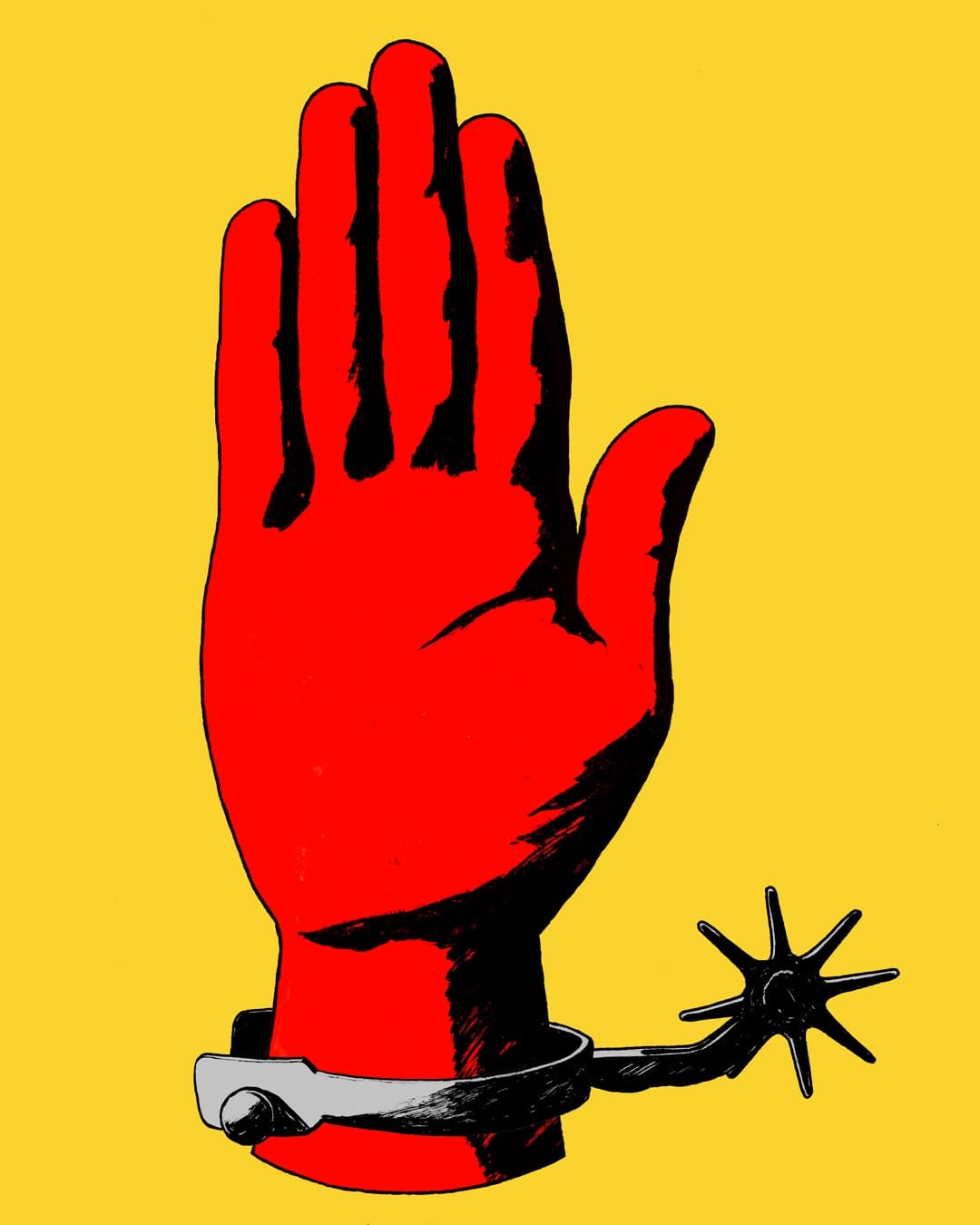
On a stormy Sunday in January, I decided to visit my local megachurch, a sprawling slate-gray complex called Green Pastures in the Northern Irish town of Ballymena, where hundreds gather every week to be washed in the blood of the lamb. Spotted as a newcomer by the doorman, I was given a free latte at the café on the ground floor and then escorted upstairs—past the gym, theological college, playground, and youth center—into the auditorium, where the house band was just beginning to perform a series of worship ballads. They sang in an American gospel style that left little trace of their own accents, with the lyrics displayed on several massive LED screens that glowed above the stage.
Over the next hour, we received sacramental grape juice in shot glasses, heard from a parishioner whose cancer had been cured by prayer, and prepared ourselves for the sermon, or “the preach,” as the congregants called it, delivered by the church’s founder, Jeff Wright. His topic was fear. “Are you here today with a sound mind,” he thundered, or “are you a basket case?” If it was the latter, he told us, that was probably because we had been expecting unconditional love from the Lord, when in fact He should inspire terror. Now that we have entered what Wright menacingly referred to as “the age of His return and the rapture of the church,” we had better get this straight. At which point the service ended and we went for tea and biscuits in the foyer.
Among the Bible Belts of Western Europe—Germany’s Ore Mountains, Finland’s Ostrobothnia, the Norwegian southwest—provincial Ulster has a distinctive kind of fervor. Throughout the seventeenth century, tens of thousands of English and Scottish planters came here to bring faith to the natives and settle the heathen soil, and many of their lineal descendants now continue the mission. Although their original creed of dour Calvinism continues to exert a strong influence on public life, its more charismatic offshoots have grown rapidly since the turn of the millennium, with places like Green Pastures (established in 2007) importing their songs and preaching styles from megachurches overseas, while older Presbyterian parishes increasingly remake themselves in the same exalted image.
Whatever the vintage of their faith, most Northern Irish Protestants are still loyal subjects of the Crown, viewing London rather than Dublin as the seat of sovereign power. For although the conclusion of the Irish War of Independence in 1921 triggered the flight of the colonists from the country’s South, they managed to carve out this region as a keepsake: a place where their occupation could last forever, with the implanted population extending its rule over the Catholic majority. The territory remains pockmarked by British army bases and official portraits of King Charles. Ragged Union Jacks hang from the lampposts of loyalist neighborhoods while the gentry hide away in stately homes. The outline of Scotland’s Inner Hebrides, visible across the water from County Derry, serves as a reminder of the stubborn presence of the United Kingdom in these isles, something which decades of Irish nationalist struggle, both military and electoral, has not yet managed to dislodge.
Yet, for all that, the local culture is different from anything on the British mainland: at once more insular—the most mono-ethnic part of the UK, which struggles to attract enough immigration or investment to save the economy from stagnation—and strangely evocative of settler societies elsewhere. Twenty percent of people are evangelical Christians, a figure with no equivalent on the Continent. Even before the megachurches began to spring up, practices like faith healing, street preaching, and exorcism were unusually common, as the revivalist and Pentecostal movements of the mid-twentieth century embedded themselves in ultraconservative church networks that formed the bedrock of unionist politics.
Those politics have long been dominated by the fire-and-brimstone far right, whose famously uncompromising attitude to its rivals derives in part from its theological outlook. Servants of the Almighty working overtime to hasten the Last Judgment have little need to compromise with followers of the Antichrist. These forces spent decades maintaining a system of segregation on the grounds that scripture would not permit the extension of civil rights to Catholics, who were denied equal access to housing, employment, and the franchise. Their movement extended to roving street militias who used their own unique methods to spread the Word. Today, although anti-Irish sentiment is no longer as acceptable in polite company, it has mutated into a vigorous strain of xenophobia, which these same colonial relics stoke against the small population of asylum-seekers, now the target of explosive riots.
Northern Ireland wants to emulate the worst parts of Texas and the American South more broadly.
If anything, the influence of thoroughly secularized Britain is more visible in the Irish Republic, where the two parties—Fine Gael and Fianna Fáil, indistinguishable in politics and almost in name—have imported the program of Thatcher-Blairism, transforming the country into a haven for mobile capital while excising the last remnants of theocracy, including constitutional bans on same-sex marriage and abortion. Up north, by contrast, many self-identified Brits still swim against the tide of modern life. Unionist leaders advocate for creationism to be taught in schools, prioritize the “rights of the unborn” over those of the born, and wage yearslong legal battles on behalf of Protestant bakers to spare them the torment of having to make wedding cakes for gay couples.
Much as this constituency wants to remain under the thumb of Westminster, its real political lodestar is further afield. “Don’t Mess With NI,” a play on the famous Texas bumper sticker, is among the slogans adopted by the largest unionist outfit, the Democratic Unionist Party (DUP). Paramilitaries in loyalist areas brandish Confederate flags. A giant mural in north Belfast celebrates the sons of ulster who led the confederate army during the war of northern aggression, depicting a number of secessionist generals who are claimed to have Northern Irish roots. BBC Ulster once broadcast an interview with a member of the Ku Klux Klan after one of the group’s flags was seen flying in the capital. Northern Ireland, it seems, wants to emulate the worst parts of Texas and the American South more broadly.
As Protestants in Ulster and white Southerners in the United States have figured out that they are on the losing side of demographic shifts, the politics of each place have been increasingly shaped by ethno-nationalist anxieties. Not trusting the central government to maintain their caste privileges (typically euphemized as “law and order”), members of both communities have taken matters into their own hands, creating the kind of pistol-toting culture associated with Dallas or El Paso. Northern Ireland is by far the most heavily armed nation in the UK, with lax hunting laws and strong rifle associations, as well as a thriving vigilante culture. “Migrant patrols” roam the streets like rangers guarding the frontier, while terror cells like the Ulster Defence Association have been known to police the communal borders. When my parents moved here in the early 2000s and started looking for a house, they wondered why the realtors were always so keen to show them the gun racks.
The Heritage-Industrial Complex
Some say that these American influences can be traced back to the Great Migration of 1717 to 1776, when about two hundred thousand Ulster-Scots—that is, the Ulster offspring of planters from the Scottish Lowlands—made for the United States, where they would become known as the Scots-Irish. Pushed out by onerous taxes and other economic restrictions, pulled in by cheap land and new beginnings, most arrived on the northeast coast and over subsequent generations moved south and west, through Virginia and the Carolinas and onward to Tennessee, Georgia, and Texas. This is the supposed genesis of the term hillbilly, as the Appalachians became home to Ulster Protestants whose icon was King William of Orange (“Billy”), for whom their forefathers had fought in the Williamite War.
I first encountered this history when I was around eight years old, at a place called the Ulster American Folk Park in County Tyrone, where my parents took me on the Fourth of July to see a battle reenactment. Rather than depicting a scene from the American Revolution—which would have involved watching the mock-killing of British soldiers in a place where the memory of the Troubles is still fresh—the local lads played it safe by putting on their Dixie uniforms and raising their Confederate flags to act out a skirmish from the Civil War. Although the park has since retired its commemorations of the 1860s, it is still able to scramble your temporality by re-creating the transatlantic journey of the Ulster-Scots. Returning on a Tuesday afternoon this winter, about two decades after my initial visit, I was ushered through a life-size replica of an eighteenth-to-nineteenth-century Ulster village composed of scattered farm buildings and thatched houses, before making my way through the cramped hull of an immigrant ship and emerging, on the other side, into the New World: a vast open-air display that reconstructs a typical East Coast city of the time, along with a tobacco plantation, log barn, smokehouse, and corn crib. All are populated by actors in period costume. As I roamed the cobbled streets with my guide, I soon realized I was the only visitor there. Generous grants from the DUP-run Department for Communities—an institution with deep pockets for the “heritage industry”—mean that the institution needn’t worry too much about footfall. When the actors have no audience, they simply go about their day as if it’s circa 1750, sweeping out their cottages with wicker brooms or puttering around the tinsmith shop.
The orange man opened the door for the Orangemen.
Given their relevant experience in wiping out the Irish, the newly arrived Ulster-Scots were supposedly sent to the front line of the campaign against the natives, acting as a buffer between Indigenous peoples and the Quakers or Cavaliers. “These were hardened explorers,” said Aaron Callan, a DUP politician whom I met for a coffee near the folk park, “brave pioneers” who were used to living in conditions of continuous warfare and famine, and whose “idea of manhood was built on the right to bear arms and to defend one’s property.” Among the notable American conquerors descended from Ulster settlers was General Sam Houston, whose ancestors had joined the Orange forces during the Siege of Derry, in which they successfully repelled the invading Catholic army. Callan told me, with an air of wonder, that famous battle cries like “Never Surrender,” heard at the Alamo in 1836, were the very same ones that had rung out in the conflict of 1689.
Animated by this self-satisfied chauvinism, the right on both sides of the Atlantic likes to claim that the attributes of the Ulster-Scots—grit, self-reliance, fighting spirit—gave rise to the distinctive culture that still reigns beneath the Mason-Dixon line. Jim Webb, the former Virginia senator and best-selling pop historian, credits Ulster émigrés with “creating a way of life that many would come to call, if not American, certainly the defining fabric of the South and the Midwest, as well as the core character of the nation’s working class.” There is indeed a wide range of homologies, from a shared fondness for moonshine—which reputedly created the NASCAR tradition, as bootleggers kitted out their cars to speed away from the authorities—to a love of country music, a genre believed to be rooted in Scots folk songs that melded with African American spirituals. Walk down the main street of Bushmills, Northern Ireland’s whiskey-distilling town, and you’ll see a number of large banners adorned with the faces of Johnny Cash and Dolly Parton, among other Southern stars.
Still, despite such continuities, the Webb narrative—like Callan’s claims—is ultimately a presentist invention: more a case of mutual imitation and fetishism than anything else. My guide at the folk park pointed out that only a tiny minority of Ulsterfolk in America fit the mythologized image of frontiersmen or fur trappers; most lived relatively humdrum lives in urban centers hundreds of miles from the backcountry, while those closer to the action typically integrated into mixed immigrant communities. Distinctions between Scots and Celtic culture, rigidly maintained back home, often broke down abroad. The idea that the Scots-Irish managed to preserve some singular set of values is the stuff of The Revenant rather than the historical record.
Yet the tale of Protestant heroism proved convenient for religious reactionaries in Ulster and the United States alike, who made common cause in the mid-twentieth century while beating back the civil rights campaigns in their respective nations. Ian Paisley, the evangelical minister who founded the DUP in 1971, had traversed the South during the late fifties and sixties, visiting fundamentalist churches and building alliances with segregationists who saw him as their equivalent in Ulster, an embodiment of the pious kin-based society they wanted to preserve. He in turn adopted many of their political-theological doctrines, most notably that of “interposition,” which urges local authorities to reject the ungodly impositions of the central state (namely the demand to grant greater liberties to Catholics). He befriended the notorious segregationist Bob Jones Jr. and developed a close relationship with his all-white university in South Carolina, which awarded Paisley an honorary degree. His movement went on to reproduce the rhetoric of Jerry Falwell’s “moral majority”—defending the faith from papists, communists, perverts—and dispatch its members to the United States for religious exchanges and internships with Republican officials.
Unionists’ interest in the American South was founded on the feeling that they had been abandoned by a British state that was all too willing to concede to Catholic pressure. As Irish republicans gained ground in the sixties and launched the full-scale armed campaign of the seventies, their opponents decided it was urgent to find allies elsewhere. The United States, as the rising cultural hegemon, whose Christian TV and radio shows were by that time being beamed directly into Ulster living rooms, was a natural place to look. But the unionists’ adventures overseas did not stop there. Loyalist leaders also visited South Africa on various occasions in defiance of the international boycott, reportedly praising its “vigorous action against the terrorists,” and committed themselves wholeheartedly to the cause of Zionism, with Paisley once asking the Israeli ambassador whether Tel Aviv would be willing to supply arms to his supporters. At the height of the Troubles, part of the loyalist movement followed the Israeli example in pushing for total independence from the UK, preferring to found its own ethnostate than to accept Westminster’s attempts to reach a cross-community settlement. Their attachment to the union, it turned out, was always secondary to its affection for apartheid.
In trying to confect this shared culture, unionists ended up creating surprisingly strong ties with their American idols, turning their fantasy of affinity into a partial reality. The rise of the Tea Party after the Great Recession gave the DUP a useful template. The newer crop of Paisleyites and Republicans have both relied on what remains of reactionary civil society, from religious networks to school boards, to build support in rural areas where the low-wage service sector has displaced farming and manufacturing. Both have touted fossil fuels as the road to renewal, at one point throwing their weight behind fracking in particular. Scientific consensus has made little impression on either movement, not only when it comes to the climate but also, in the DUP’s case, when it comes to geology and particle physics. Thanks to its lobbying, the visitor center at the Giant’s Causeway, Northern Ireland’s main tourist attraction, now features a display that suggests that the rock formation may have been the work of God rather than ancient volcanic fissures. Among the party’s many “young-Earth creationists,” who believe that the planet is only six thousand years old, is former leader Edwin Poots, who once claimed that Ulster history was a living refutation of the Big Bang theory: “You’re telling me that cosmic balls of dust gathered and there was an explosion. We’ve had lots of explosions in Northern Ireland and I’ve never seen anything come out of that that was good.”
The arrival of Donald Trump consummated this marriage. He and Paisley first met in 2006 to discuss investment opportunities in the region, with Trump hailing Paisley as “the Legend” and striking up a close working relationship with his son, who would later become the DUP’s most prominent Westminster politician. Ian Paisley Jr. described Trump’s 2016 election as “a revolutionary change in the grassroots, ordinary, authentic voice of America,” at last fighting back against liberal elites. He was rewarded with unprecedented access to the presidential court, which allowed unionists to challenge what they saw as Washington’s ingrained sympathy for Irish nationalism. The orange man opened the door for the Orangemen. The DUP and GOP adopted parallel positions on Brexit, Black Lives Matter, immigration, LGBT issues, and threats to Christian civilization. Unionists shut down the devolved Northern Irish government by refusing to work with their opponents just as Republicans did with Congress. When the Democratic interregnum came to an end in 2025, Paisley Jr.—who had labeled Joe Biden a “blathering idiot” on account of his misty-eyed paeans to Ireland—accepted an invitation to Trump’s inauguration and was photographed with Trump Jr. in the lobby of the D.C. Waldorf Astoria: a smiling portrait of the patrimonial new right.
It’s Like a Whole Other Country
It’s easy for the national-populist parts of the Trump coalition to indulge unionist mythology by claiming Ulster as the origin of their worldview, tracing it back to the ethnically pure towns of Down or Antrim. The writings of neo-Confederates like Michael Hill are full of such exercises in historical self-fashioning. However plausible they might be on their own terms, reality can get in the way. In Hillbilly Elegy, J. D. Vance claimed that it was the Ulster-Scots’ “distinctive embrace of cultural tradition” that gave their descendants “an intense sense of loyalty, a fierce dedication to family and country,” as well as a deep hostility to outsiders. “To understand me,” Vance wrote, “you must understand that I am a Scots-Irish hillbilly at heart.” Last year, the DUP spent thousands of pounds of taxpayer money attempting to prove the accuracy of this statement. The Department for Communities commissioned a genealogical report, titled “The Family Footsteps of JD Vance,” which Minister Gordon Lyons planned to give the vice president in person when visiting Washington for St. Patrick’s Day. After a thorough investigation, the researchers were forced to admit that “it has not been possible to establish conclusive proof of a direct Vance link back to Ulster.” A downcast DUP official told colleagues that they would have to “go with what we have,” and the highly speculative twenty-four-page document was sent to Vance, who wrote back to thank Lyons for “taking the time to create this unique work about my ancestors and for sharing it with me.”
The notion that the Scots-Irish created the United States as we know it eclipses the equally meaningful influence of Celtic-Irish immigration.
The notion that the Scots-Irish created the United States as we know it eclipses the equally meaningful influence of Celtic-Irish immigration. Although unionists have tried in this way to repeat in the New World the cultural erasure of Catholics from the Old, they have often struggled to monopolize Americana to the extent that they would like. Despite various attempts to prove themselves the forefathers of country music, for example, Celts have claimed just as much credit for the jigs and reels that evolved into the boom-chuck rhythms of bluegrass. For a closer look at this contested history, I returned to the mixed Protestant and Catholic town of Limavady, where I’d gone to elementary school. A remote conurbation with a declining population of about fifteen thousand, Limavady has a twofold claim to fame. Locals have long boasted that the melody to the song “Danny Boy” was written here by the famous blind harpist Donnchadh Ó hAmhsaigh in the eighteenth century; these days, however, the area is perhaps better known as the rugged backdrop to the series Game of Thrones. Whenever I’ve gone back to visit over the past decade, I’ve had crossed-wires conversations with Limavady residents who assume, because I no longer have an Ulster accent, that I must have come on a pilgrimage as a superfan of the TV show. Plausible reasons to visit are so sparse that convincing them otherwise is always an uphill battle.
But this time my trip had a singular purpose. I wanted to see one of the area’s premier country and western venues, the Blazing Saddle Saloon, established in the early 2010s on the site of what was once my parents’ local pub. The turnoff is marked by a star-spangled banner flying high and a statue of a bald eagle protruding from the gable. A covered wagon sits in the parking lot beside a mocked-up “County Jail” and “Boothill Cemetery,” where murals of coffins are inscribed with the last words of the departed: a bullet from a colt .44 and i was no more, i was a bad hure (meaning “whore” in Scots). Inside, there is a towering plastic cactus, a model gunslinger in a red bandana, tourist posters for the Lone Star State—it’s like a whole other country—and an extraordinary number of farm implements mounted on the walls. I asked a group of regulars, not a few of whom were wearing cowboy hats, whether they could feel the spirit of the Wild West in this faraway part of Europe, and in return I got a gruesome anecdote about a brawl that had broken out in the bar some years ago in which two men locked in a land dispute came to blows and one died from his injuries after cracking his head against the radiator.
The live music that evening was provided by Big Chief Raymond, a white Ulsterman in a Native American headdress and spurred boots, who performed a series of country classics to enthusiastic war-whooping from the audience. Once a member of Ireland’s longest-running showband, the Indians, he has since cast out on his own, bringing his crowd-pleasers to remote venues along the northwest coast. During his rendition of “Galway Girl,” he summoned to the stage a sprightly septuagenarian called “Jivin’ Ivan” who is known throughout the area for his mastery of the Texas two-step. (I later got the chance to ask Ivan how he manages to stay so limber. “Never drank, never smoked, and never been married,” he said. “That’s my secret.”)
But while Raymond’s pastiche might offend a certain strand of progressive opinion, the Blazing Saddle is by no means a site of Paisleyite bigotry. It is a solidly Catholic establishment where most patrons identify with the nationalist cause. The owner’s wife once ran as a Sinn Féin candidate. Sitting next to me was a former partisan of the armed struggle who had done time for his activities. Above the Guinness fridge, there is a framed portrait of Marion Michael Morrison, better known as John Wayne, whose great-great-grandfather, so I heard from a proud local, was among the United Irishmen who launched an uprising against British rule in 1791 inspired by revolutionary France.
Although the Catholic community naturally has little interest in the influx of Alabama-style megachurches, and is considerably less invested in the local gun culture, it is by no means immune to the forces of cultural imperialism, which, just as they try to level the distinctions between America and Northern Ireland, have a similarly flattening effect on America itself—eliding Texas with the South, the South with the West, and both with a starstruck image of the United States as the zenith of civilization: a universal source of commodified enjoyment that neither side of the sectarian divide can claim as its exclusive right. Some Catholics would even point out that American jouissance is more compatible with their faith than with ascetic Presbyterianism. One of Paisley’s followers, as mayor of North Down, banned a civic ball because of his church’s belief that dancing wages “a war against the soul.”
Catholics have also followed Protestants in drawing dubious historical comparisons with other ethnic groups—most notably African Americans, through the conflation of indentured servitude (which the Irish suffered) and slavery (which they did not). Their persecution complex is so acute that it has been given its own acronym, MOPE, or “Most Oppressed People Ever,” which was coined by the historian Liam Kennedy and has now entered into common parlance. It is only the more thoughtful elements of the republican left that tend to be wary of this instinct. On a windy night in Derry’s Bogside neighborhood, I caught up with Eamonn McCann, one of the leaders of the Northern Irish civil rights movement and a founding member of the legendary Marxist organization People’s Democracy (PD), which electrified the province in 1968 with its call for a mass nonsectarian movement toward a socialist united Ireland. McCann had felt the first stirrings of his socialism, he told me, when he watched cowboy movies as a child and found himself sympathizing with the natives. As he and his comrades began setting up barricades and flooding the streets with marchers—demanding equal voting rights, freedom of speech and assembly, and an end to economic discrimination—they looked to the Black Panthers more than the heroes of Irish history: “Young people were all talking about Huey Newton, not the leaders of the Easter Rising.” When his fellow PD member Bernadette Devlin was given the key to New York City in honor of her activism, McCann promptly requisitioned it and set off for the Panthers’ offices in Harlem, where he gave it to one of their prominent activists, Robert Bay.
In 1969, McCann created one of the most iconic images of the era by adapting a phrase he had heard during the Berkeley Free Speech Movement. Spray-painted in huge letters on the side of a terrace house, the words you are now entering free derry marked the entrance to the city’s autonomous zone, where state authorities were not welcome. The landmark has since been repainted in the colors of the Palestinian flag, which for McCann underscores a crucial point: Northern Irish leftists weren’t simply looking to the U.S. black liberation movement as a model; they were similarly engaged with anti-imperial uprisings in Nicaragua, Guinea-Bissau, Angola, and elsewhere, thanks in part to Catholic priests who visited these places as missionaries and came back radicalized by their ferment. “When we were running through the Bogside with rocks in our hands,” McCann recalled, “we knew we were doing something that people elsewhere in the world were doing. International solidarity wasn’t just an intellectual principle; it was palpable, something you could feel.” This meant more than simply inverting the loyalist identification with Afrikaners or Israelis; a genuine internationalist outlook recognized the interconnections between these struggles as well as their singularities.
The persistence of this sensibility is another sui generis feature of the region, which has recently been visible in its major mobilizations against the genocide in Gaza. In 2025, the UK government took the unprecedented step of designating Palestine Action, a direct-action group that sabotages facilities and equipment involved in the war on Gaza, as a proscribed terrorist organization, meaning that anyone who expresses support for it can be imprisoned for up to fourteen years. (In February, the designation was ruled unlawful, but as of this writing, it remains in place pending an appeal.) The crackdown has been ferocious across Britain, with the use of mass arrests and long-term detention without trial. Elderly peace campaigners are treated as equivalent to followers of ISIS or al-Qaeda and manhandled into riot vans by armored police. In Ulster, though, the enforcement has been much more tentative and uneven. Cops have chosen not to make arrests at solidarity protests. No one who has violated the proscription has yet been kept in custody or brought to court. “It would be much harder to start taking people in here,” said McCann. “There could be serious resistance. Northern Ireland has its problems, but it’s easier to be a militant for Palestine here than in many other places.”
Desectarian Derby
I finished my tour of American Ulster at an event called “Big Van Bangers: Van-dalism 2026,” at the Tullyroan Oval in Dungannon, in which sixteen heavy-duty vans faced off in a take-no-prisoners tournament, with the promotional flyer promising “smashes and crashes galore.” It had been postponed for nearly a month while the racetrack was defrosting, which helped build anticipation. Hundreds of spectators traipsed down a mud-spattered gravel path toward the sound of revving engines, which grew louder as the track came into view, blending with a cover of “Wagon Wheel” that played over the crackling loudspeakers. Children in racing suits erupted with joy as the vans began to collide. Their parents sat back in folding chairs and drank in the exhaust fumes. Portraits of celebrated drivers were displayed on a wall of fame, with a suspicious number claiming “World Champion” status. The final act was a “last van moving Destruction Derby” in which the aim was not to outpace the other vehicles but to scrunch them up like candy wrappers.
Some Catholics would even point out that American jouissance is more compatible with their faith than with ascetic Presbyterianism.
The vogue for racing, both stock car and motorcycle, is particularly strong in Protestant areas; just down the road from Tullyroan, I passed an estate with more Israeli and British flags than I could count, and looming on the hill above the track was the demure-looking Orange Hall, where the local loyalists gather. It was once reportedly common for the organizers of Ulster’s largest annual motorcycle race to ask each competitor whether they were Catholic—ostensibly so that last rites could be administered in the event of a fatal accident, but many racers suspected that the real motives were less pure.
Much like the Blazing Saddle, however, Big Van Bangers reflects the steady democratization of these traditions, with the audience drawn from as far afield as Dublin—the man next to me wore a tricolor hoodie—and drivers who compete on both sides of the border, some with crucifixes dangling from their rearview mirrors, like pinup boys for the peace process. A family like mine would have stayed away from such an event when I was a child; we once naively decided to bring my Bostonian grandparents to a Guy Fawkes Day bonfire in Limavady and were met with a barrage of fireworks aimed directly at our car, forcing us to hightail it back to our Catholic neighborhood. But now it’s clear how much the times have changed, with the two ethno-religious cultures increasingly seeping into each other—meeting on the safe middle ground of American kitsch—even as the official unionist movement remains exclusionary as ever.
The event seemed to underscore the fact that when figments of the American South are brought to Ulster, there is never a one-to-one match. The feeling certain loyalists crave, that their native customs are coming home after an excursion abroad, remains elusive. Rather than a deep sense of identification, what’s produced by this collision of worlds is often something more uncanny. If one ethnic group can no longer weaponize Southern symbols against the other, if that culture has instead mutated into the universal gray matter of American hegemony—a product that can be sold to either constituency—then perhaps the leveling force of globalization has created a degraded kind of Northern Irish “commons”: not the liberated, internationalist future for which McCann fought, but a much blander, privatized version of it.
What are the prospects for a loyalist politics of mimetic Trumpism, confronted with this process of desectarianization, and pitted against a republican movement with a rich internationalist history? They may well be bleak. As of 2021, Catholics now outnumber Protestants in the province. Sinn Féin has become its largest party, with the most seats in the devolved parliament, whereas the unionist vote is fractured, with outfits like the Ulster Unionist Party and Traditional Unionist Voice challenging the DUP. The companies that once formed the economic basis of Irish partition—tying Belfast into the same production circuits as London and Liverpool, and linking the fortunes of workers here to those in Britain—have downsized or shuttered, creating a chasm between Ulster and the rest of the UK that has widened further because of Brexit. One of the only material incentives for staying in the union, its historically strong welfare state, is now on its last legs: hospitals in crisis, benefits withdrawn. As yet, there is no majority for Irish unity, but polls are trending in that direction.
The experience of Northern Irish white settler politics has in this sense diverged from its U.S. counterpart. The Trump administration has already had considerable success in re-ethnicizing the category of citizenship and dismantling the constitutional order that emerged from the twentieth-century racial equality movement. In Ulster, there is no equivalent threat to the gains of the civil rights struggle. A forcible attempt to overturn them could cause a reversion to communal warfare that few, even in the DUP, are willing to countenance. Although it is difficult to see a path to full decolonization anytime soon, especially given Westminster’s ability to block a border poll, this does not change the fact that loyalism’s heyday is over. The anti-immigrant riots that have spread across Protestant towns are qualitatively different from the brutality of the Trump crackdown. They are evidence of what has been described as unionism’s “lashing out”: not the coordinated violence of a state project trying to smother dissent but the spasm of a majoritarian group that has become an embittered minority. If unionists could once imitate redneck culture to assert their dominance over Catholics, now the attempt to do so risks exposing the gulf between their own fortunes and those of their American role models. Once a sign of supremacy, the Confederate flags that still periodically spring up in East Belfast have come to seem, with each passing year, like an image of deepening decline.