From the Bog to the Cloud: Dependency and Eco-Modernity in Ireland by Patrick Bresnihan and Patrick Brodie. Bristol University Press, 284 pages. 2025.
On the bogs of Gweedore in early July, there is a blanket of wildflowers: butter-yellow tormentil and prickly lousewort cloak the ground, alongside delicate sea campion and violet milkwort—an orchidlike flora whose buds, smaller than a fingernail, resemble the heads of birds. Chaffs and pipits hold court in the hedgerows; hares, startled by a breeze, freeze then dart below drystone walls; pairs of oystercatchers conduct their antiphonic calls across the battered rocks of Brinlack and between the sea caves of Glassagh. Walking the bog’s coastal edge, even at the height of summer, is a lonesome affair. A solitary hiker might appear on the horizon, a farmer’s quad bike worry the sheep, or a local surfer emerge from an Atlantic barrel, but signs of human activity are for the most part few and far between. Move deeper, though, into the mossy terrain—the word bog, in Irish, means “soft”—and traces will begin to emerge: vertical incisions, three to four feet deep, made into the peat’s surface; sods stacked in pyramid formations; digging machines abandoned in puddles of brown groundwater. All are clues to the bog’s role in life here, indications of a practice undertaken on blazing dog days in anticipation of cold winter nights: the cutting and drying of turf.
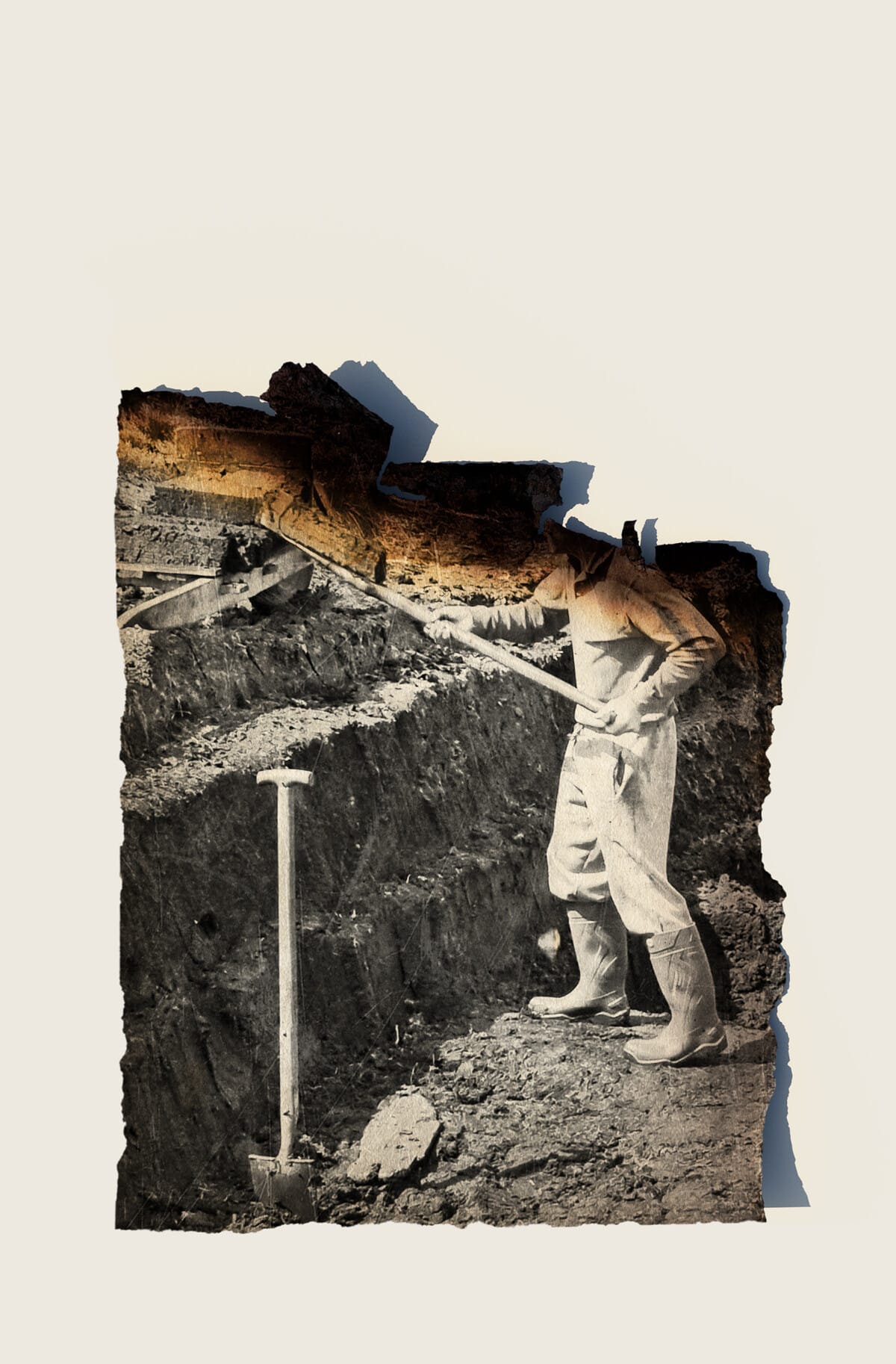
Turf is the Hiberno-English name for clods of combustible peat. The word is derived from the medieval Latin turbarium, which connotes both the bog and the right to its usage. A similar doubling occurs in Irish, where móin and the more commonly used plural móna mean both bog and the domestic fuel source it yields. Formed over millennia from the decomposing mulch of organic material, turf is also a signifier in Ireland for fading rural ways of life and the basis of a fractious dispute over the country’s cultural and economic identity. Traditionally cut by hand by pairs of workers—one operating the right-angled sleán spade, the other throwing sods from the trench—during the drier vernal months, then stored in piles outside the home, turf is simultaneously a practical energy supply, a link to premodern forms of Irish life, and an inanimate muse for countless poets, artists, and songwriters. To heat one’s home with the stuff today is as much a statement of belief in the value of old ways as an act of expedience—nowhere more so than in Gweedore, a Gaeltacht, or Irish-speaking district, at the northwestern tip of Donegal, the island’s most northwesterly county. It is a region famed for its sandy beaches, musical heritage, and Republican identity. Each summer, buses of teenagers arrive from across the country to attend language schools only to struggle with the local accent. As they pass their long break flirting in Gaelic Athletic Association jerseys and recording covers of Ed Sheeran hits as Gaeilge, an aging cohort of residents moves across the bog in pairs, cutting and throwing bricks of earth onto banks to dry before ferrying them home by the tractorload.
The end of the turf has long been prophesied. It is decreasingly relied upon, burned mostly by elderly and poorer households in remote areas of the country. In 2011, ninety thousand homes—mostly in the rural west and agricultural midlands—used turf as their primary fuel source, down to sixty-eight thousand in 2022 and understood to have fallen further since (Ireland’s population during the same period grew from 4.6 to 5.1 million, with an average household size of 2.74). Be it by turf, kerosene, or a mixture of the two, heating your home off-grid in Donegal is an expression of a certain frontier mindset (shown also in the population’s disregard for planning laws and affinity for country music), a display of distrust in national structures that have repeatedly neglected the region’s interests, and a way of retaining control over costs in a county with one of the country’s lowest levels of disposable income.
Arriving in turf-burning areas like Gweedore used to mean stepping off the plane or out of the car and being hit with an unmistakable aroma. (Think of the scent of the peatiest whisky you’ve tried, then imagine walking into a cloud of it.) For the turf-minded today, the smell is notable through its absence—a cause for comment when a waft arrives through an open window. The reasons for this diminishment are, as with all socioeconomic changes, multifarious but fall generally into two camps: a waning appetite for the backbreaking work entailed in gathering the turf, particularly among the young, and a series of legislative changes aimed at decarbonizing the Irish economy.
Premature, Daft, Unworkable, Senseless
In October 2022, Dáil Éireann, the lower house of the Irish Parliament, passed legislation banning turf’s commercial sale. In a confusing attempt at compromise, it would henceforth be legal to buy sods from one’s neighbor but not from one’s neighbor’s shop. The bill allowed for private sale of turf between individuals but not its retail or advertising; an informal market was thus formally recognized as an economic necessity to alleviate the tensions caused by the green transition. On the bill’s passage, Eamon Ryan, its author and then-leader of the country’s liberal-centrist Green Party, conducted a victory lap. His adversaries, mostly independent members of parliament or representatives of Sinn Féin, lined up in a series of tempestuous chamber and prime-time debates to denounce the move as “premature, daft, unworkable and senseless,” per Sinn Féin’s Darren O’Rourke. Nothing, he noted, “is worse for health than poverty.”
Acquiring turf means either cutting it yourself or knowing someone who will sell it to you.
The bill, which also extended prohibitions on the retail of cheap but noxious bituminous coal, was constructed on public health grounds but interpreted by its critics as an out-of-touch ecological attack by the middle class on tradition, Ireland’s energy independence, and the balance sheets of those households that still use turf as fuel—often alongside, or in place of, kerosene, the price of which more than doubled in the aftermath of Russia’s invasion of Ukraine. At between €200 and €250 each, six to seven tractorloads of turf will power a family home that runs on a range system for the year. Since autumn 2022, however, acquiring the stuff means either cutting it yourself or knowing someone who will sell it to you.
It also means having a house equipped to burn it. While Dublin’s astronomical property prices have been the focus of international reporting, Ireland is suffering from a nationwide housing crisis driven by an unregulated rental market and reckless private development projects undertaken in lieu of affordable public initiatives, especially during the years of the Celtic Tiger. When the bubble burst, cul-de-sacs of new builds were left unfinished and ghost estates haunted the edges of towns where residents lacked the income to support gargantuan mortgages; people, meanwhile, struggled to find homes. In Donegal, the problem has been worsened by the “mica scandal”: an estimated twenty thousand properties constructed, since the late 1990s, with concrete blocks that contained high levels of the mineral muscovite, or mica. Such blocks crack when exposed to damp conditions repeatedly, meaning houses across the coastal county are falling into the ground, unmortgageable and uninhabitable.
Turf, then, is cheap, but only if you can get it, and effective at heating your home, but only if you have one. Access to a hearth on which to burn it is yet another complicating factor: in 2014 the government introduced legislation that did not amount to an outright ban on chimneys in new houses but severely tightened conditions for their inclusion. The 2022 bill preserved the system of turbary rights, an amalgamation of custom and law by which families are permitted to cut turf for domestic use. Concentrated around the flat bogs of the country’s Midlands, the industrial-scale extraction of peat was already being wound down, however. Beyond limiting the volume of carbon inhaled in the home, the “turf ban” was also a means of complying with EU regulations on peatland conservation and an affirmation of Ireland’s pivot to a green economic model, prioritizing wind power in particular as an abundant national resource.
This was a period of technocratic green optimism in Irish political life, as it was across the European Union. Leo Varadkar, taoiseach (prime minister) at the time, had made investment in renewable energy a cornerstone of his political campaigning, and the formation of a historic three-way coalition between Fine Gael, Fianna Fáil, and the Green Party in 2020 seemed to confirm the development of green energy as the nation’s obvious direction of travel. At the same time, tech money was flooding into Ireland through the eruption of new data centers, structures well suited to the cooling winds of the nation’s climate and the permissive regulatory tax attitude of its government. Appeasing Brussels while courting Cupertino: Ireland was decarbonizing and digitalizing in one elegant maneuver. What could go wrong?
Data Center Molochs
It’s a question taken up by Patrick Bresnihan and Patrick Brodie in From the Bog to the Cloud: Dependency and Eco-Modernity in Ireland, a pathbreaking account of the development of Irish capitalism within the world system. Ireland is an outlier within that system: a former colony in Western Europe that jump-started its economy by offering itself up as a repository for foreign direct investment (FDI) without passing through a phase of postindependence industrialization. As such, some of the hallmark tensions of neighboring countries’ decarbonization programs are absent from the Irish situation. Unlike in the UK, where the culture war has shaped climate politics, or Germany, where energy costs and security do the same, in Ireland the primary determinant is the ownership and control of land. While this might have provided fertile terrain under different conditions for a national, publicly owned system of renewable energy, Ireland’s economic structure is not just open to, but entirely constructed around, attracting multinational capital investment. The result, as Bresnihan and Brodie show, is the creation of a shadow private renewable-energy sector in which American tech firms reap the rewards of public investment in green fuels while the population remains tethered to an inflation-sensitive fossil energy system. In the authors’ hands, Ireland’s outlier status proves a salutary lesson in the cunning paths global capitalism will take to ensure that both the green and digital transitions prioritize private profit over public good.
One story covered in the book is instructive. In 2020, a series of disastrous peat slides occurred at Meenbog, an area on the border between Donegal and Tyrone. Over eighty thousand cubic meters of peat cascaded from the bog, triggered by earthworks to install a set of wind turbines. The avalanche devastated wildlife in the local area, polluting an EU-protected salmon spawning ground in nearby rivers. Nature, as it is wont to do, ignored the political bifurcation between north and south, though the origins of the disaster are part of a story that is thus far unique to the republic’s recent political economy.
That is because the wind turbines intended for Meenbog were intended for one purpose: to provide renewable energy for Amazon Web Services (AWS) through a corporate power purchase agreement, a contract that provides a company with a private electricity supply—in this case, one generated by wind power—rather than buying energy from the national grid. (As Brodie and Bresnihan point out, this arrangement contravenes the 1927 Electricity [Supply] Act, which prohibits the development of private electricity infrastructure.) Since the peat slide, AWS has remained quiet about its involvement, but in the run-up to the construction work the company was in full green PR mode, advertising the agreement as a historic breakthrough for both its ambition to run a service powered completely by renewables by 2030 and for contributing to Irish green-energy infrastructure without costing the taxpayer a penny. “We will be the largest single corporate buyer of renewable energy in the country, and we won’t stop here,” read the 2020 press release. The appetite of Amazon and other large tech companies for Irish wind power has indeed proved voracious. In 2023, 21 percent of energy on the Irish grid (35 percent of which currently comes from wind power) went to data centers, which are pressing for yet further opportunities to circumvent regulation on energy use. This is the highest proportion of energy supply used for such purposes in any nation on Earth, and it is rising year to year. Other countries, such as the Netherlands, enforce regulations to manage supply and ensure a fair distribution to its population (7 percent of its supply went to data centers in 2024). Do this here, the tacit threat from the data center Molochs seems to be, and we’ll leave Ireland. The economic results of this for a nation whose budgetary surplus balance is generated entirely by Big Tech firms and the onshore registration of their intellectual property would be a disaster (though one that might revive the question of what form an Irish economy unmoored from American corporate clientelism could take).
By now it is a truth universally acknowledged that the effects of new green regulations are rarely as logical or linear as policymakers might have hoped. Much of this essay was researched and written in Gweedore, at the new digital coworking space built on the edge of Derrybeg. The Gteic, as the building is known, sits in the shadow of a rolling bog on which squats a troop of wind turbines. The office of Pearse Doherty, Sinn Féin’s deputy leader in the Dáil and one of the staunchest opponents of Ryan’s 2022 ban on the commercial sale of turf, lies a few minutes down the road, beyond the station of Raidió na Gaeltachta and the premises of a local waste disposal company. One lunchtime this summer while working at the Gteic I stepped outside to phone my aunt, with whom I share a home in Gweedore. In the car park was the van of a local turfman, who seemed—from the shoes left by the doors of his vehicle—to be taking a nap within. I called to tell her that our application to the Sustainable Energy Authority of Ireland for a grant to cover insulation works had been approved. Because we have an open hearth, however, the contractors would have to install trickle vents for the house to meet with public health regulations aimed at preventing us from choking on smoke. Happy to comply with this codified common sense, my aunt had just one question: If the green grant meant the fireplace was back in action, would I look into getting hold of some turf?
It’s clear, then, that turf has proved tricky to eliminate from Irish life, even as the national political culture has pivoted toward environmentalism. To understand why requires recalibrating a number of prevailing assumptions about the nature of a green transition, particularly one conducted under the regulatory auspices of Brussels and with corporate interests at its heart. It is to remind ourselves that, despite the fanfare made lately of its skyrocketing GDP, Ireland is deeply divided in wealth between the metropolitan Dublin area and the “under-developed” West, a country whose politics and economy continue to be shaped by British partition and a decades-long commitment to the strategy of attracting FDI. It is also to throw into doubt the binary division made between a fossil fuel and a renewable resource, by virtue of the bog’s own unique temporal character, and to raise the thorny issue of what it is that conservation projects should conserve.
A Long Day’s Cutting
For a period in the mid-twentieth century, turf was Ireland’s future. Under British imperial rule, the bogs had been dismissed as vast wastes of space, a geographical metaphor for native fecklessness in the eyes of the colonizers, who between 1809 and 1814 conducted a survey of Irish peatlands to identify areas that could be converted into arable plots for the supply of linen and food to the British Army. These surveys, which contributed to making Ireland one of the most mapped countries on the planet, were to have a second life following independence. In 1934, the government established the Turf Development Board—renamed Bord na Móna (BnM) in 1946—as part of a move to end Irish dependency on British coal, which, as the curtailment of exports during the Second World War demonstrated, was neither an economically wise nor politically palatable industrial strategy.
Ireland’s economic structure is entirely constructed around attracting multinational capital investment.
For those wondering how clods of hand-cut peat replaced industrial imports of coal in the Irish energy system, the answer is directly. When, during the 2022 energy price spikes, independent member of parliament Michael Fitzmaurice described possessing turbary rights as like having “an oil well in your backyard,” he was echoing the arguments of Seán Lemass, the mid-century minister and taoiseach credited with bringing technoscientific modernity to Ireland, who expressed his commitment to “any possible outlet for the utilisation of peat” in a speech to the Dáil in 1953. Coal remained in use, particularly in heavy-industry work such as shipbuilding, but, as the climate historian Jean-Baptiste Fressoz has recently shown, a transition from one fuel source to another is never a full switch. In the 1950s, BnM began constructing a network of turf-fueled power plants across rural Ireland. Peat extraction ramped up, and mechanical cutters were introduced. Digging down to the rock, these machines were much more damaging to the bog than the sleán spade, whose use replenishes topsoil in traditional practice.
In rural areas such as Gweedore, where one of the country’s first four turf plants opened in 1958, this was the first taste of a modern Poblacht na hÉireann, or Irish republic, in which traditional knowledge and methods would be harnessed to create a national energy supply and badly needed jobs, not dismissed as they had been by the British. In the first years of its operation, two hundred local cutters delivered around thirty thousand tons of turf to the station each year, which, combined with the nearby Clady hydroelectric plant, produced a total of nine megawatts annually for the Irish electricity grid. Taking place against a backdrop of rural electrification that transformed domestic life, these jobs helped to stymie working-age male emigration from the area and increase living standards in one of Ireland’s poorest regions.
The optimism of the early Irish state with regard to turf’s ability to power the nation was shortsighted, however, if not short-lived. The Gweedore power plant never made a profit over its thirty-eight years of operation, and in the mid-1970s, amid a nationwide recession and global oil crisis, tensions between turf cutters and Electricity Supply Board directors came to a head. Turf prices on the local market exceeded those offered by the ESB, which had not kept pace with inflation. In 1974, the Gweedore turf cutters’ spokesman, Seán MacAoidh, demanded a 100 percent increase in the price per ton for turf, work that the Donegal News described as “backbreaking, tiresome and arduous.” Fewer and fewer men could be drawn to work the bog, a decline that continued in the decades to come.
The Gweedore turf plant closed in 1996. Never truly economically viable, the project had begun to be seen as a remnant of a charitable impulse from Dublin to provide jobs during the harsh years of the mid-century rather than an effort at creating a national modernization scheme with its roots in rural cultures and resources. The view of the bog itself was also undergoing a shift, as environmental movements oriented toward peatland conservation began to apply pressure to the Irish government, and BnM in particular, to protect bogland flora and fauna and cease industrial peat extraction for export. Bogs cover nearly 20 percent of land in Ireland; around 80 percent of this peatland is degraded as a result of extraction, meaning it emits carbon dioxide at an estimated rate of 21.6 million tons a year. Restored, “rewet” bog is capable of acting as a carbon sink, in which a low-oxygen environment traps the gas as it is released from decaying plant material. Estimates on the volume of CO2 contained within healthy peatland vary depending on the bog type—Ireland’s are mostly “raised” bogs, though the country also has 8 percent of the global total of the rarer “oceanic blanket” type—but a general working figure is 172 kilograms per cubic meter of peat. BnM has committed to rewetting eighty thousand acres by 2030, having now closed all sixty-two of its working bogs.
The transition from exploiting bogs as a source of carbon to protecting bogs as sinks for carbon sequestration seemed like a rare example of progressive ecological policy that would come at little to no cost to livelihoods or existing patterns of behavior. Sleáns and stories of how the tae always tasted better after a long day’s cutting could be absorbed into the Irish heritage industry, oral histories taken down by the fire as ministers got on with attracting a new wave of IT companies to the country’s shores.
In 2020, BnM rebranded itself as a “climate solutions company” under the leadership of Tom Donellan, a self-described “poster child of foreign direct investment” who after a lengthy career in telecoms himself transitioned to assuring audiences at Ireland’s Development Authority that the former turf board was now “very much a commercial organisation,” one that believed “that the whole sustainability journey can be very commercially rewarding.” (This turns out to have been true for public-minded Donellan in particular, who—until press caught wind of his behavior this year—had formed a habit of claiming around €57,000 per annum of benefits in kind on top of his €225,000 salary.) The role of BnM as a semiprivate state body was now to mediate between EU-friendly conservation initiatives and U.S.-owned multinational renewable-energy clients. The bog would stay wet, and the wind farms built on top of it. A plan that’s hard to fault—unless those turbines damage the bog.
When hastily constructed sites like Meenbog collapse, destroying thousands of years of peat formation, releasing innumerable tons of CO2 into the atmosphere, and creating a hazard zone for locals that takes years to clear, the tech firm clients are nowhere to be found, hiding behind the third-party contractors who deal directly with the state. Accountability barely meets the bar for nominal: the fine issued to site developers in the Meenbog case was €1,500. As Brodie and Bresnihan write, “‘Modernity’ and ‘modernisation’ have always looked something like the split, differentiated landscapes and geographies of uneven development.” In the case of Meenbog, a wind farm designed to power an American tech firm put the bog out of action for any other use, be it domestic turf harvesting or conservation. These two ambitions are often presented as contradictory, a tussle between environmental activists who overlook the social and financial importance of the bog to locals, and locals who are reckless about the natural damage their practices incur. But this reading obfuscates the commonality between the groups, both of whom care deeply about the bog as a landscape and a way of life. Activists and locals alike want to find, as the great Irish geologist and botanist (and author of the magnificent The Bogs of Ireland) John Feehan has written, a way of “living on the land without heartbreak.”
The timeline suggested by a battle between cultural traditionalism and environmental modernity also obscures the way that the bog functions in areas such as Gweedore not as a resource but as a character with near-mythological qualities, whose existence defies the mortal frameworks of policy agendas. “Conservation,” Feehan writes, “was not part of the outlook of a community living with the bog in its blood. It didn’t need to be, because the bog was infinite: it went on forever and would last forever.” Conserving the bog means conserving some of this relation to time and the land as part of a cycle of renewal and seasonal patterns in the community. As the generations involved in turf cutting age beyond the point that the practice makes much meaningful difference to the preservation of the land, it’s clear that the ecological threat comes not from those who still depend on peat to heat their homes but rather from those who see the bog—as the British once did—as terra incognita, wasteland ripe for neocolonial development, whatever the cost to life, be it plant, animal, or human.
One Meter, One Millennium
How long should it take for a fuel to generate for it to be considered renewable? In Finland in recent years, peat has pivoted from fossil fuel to renewable and back in response to advances in peatland restoration as well as energy security concerns. Viewed in this light, peat starts to seem less like a soggy form of coal and more like a naturally occurring form of wood-chip biomass. The substance sits at the heart of ongoing regulatory battles over how and where emissions are quantified: At the point of production or combustion? But the production for wood-chip biomass, from planting suitable trees to selling burnable pellets, is around thirty years; for one meter of peat to grow on Irish bogs takes roughly a millennium. Those who continue to cut the bogs know, of course, that na móna are not infinite, that they will not last forever. They know also that each incision takes one deeper into the geological past, hundreds of generations of natural processes burned for the sake of a few evenings of warmth. Rather than being ignored, this awareness of the bog’s deep time, its vastness, and the scale of one human life within it is embedded within the culture of turf cutting, part of what makes it a fossil fuel unlike any other.
Fewer and fewer men could be drawn to work the bog.
This summer, on a rainy afternoon in the run-up to Donegal’s Gaelic football semifinals appearance, as the gable ends of houses were being painted in county colors, I visited the Dunlewey Centre, a Gweedore heritage site and visitor attraction that lies at the foot of the Glenveagh Mountains. I was joined by Peter, Paul, and Bríd, all middle-aged employees of Dunlewey and locals of Gweedore, in the café, which on summer evenings doubles as a venue for traditional music events. Without discussing it, we gravitated toward the fireplace at the center of the room, on which clods of turf, naturally, were burning. Paul pointed out the fact of the flames’ magnetism—a radiator, he said, would never have the same appeal—as the trio agreed that a way of life would be lost when open fires ceased to be a standard feature within Irish homes (the Irish word for household, teaghlach, is a derivation of the word for hearth, teallach). The tradition of turf cutting would likely die with them, but they would continue to do it for as long as they were physically capable. “It’s in the blood,” as Bríd said, echoing Feehan.
All three were stoical in the face of this change, just as most Irish bog conservationists are sensitive to the pathos that talk of the end of turf inspires. Neither side claims total victory over the other. Conservationists will have to learn to live with the small damage incurred by those who continue, for however long, to cut turf; cutters, for their part, accept that they are likely the last generation to undertake the work. Pain is felt on both ends, but, unlike that caused by the reckless profiteering that underlies catastrophes such as Meenbog, it is a pain born of conflicting models of care for, not exploitation of, the bog. Heartbreak may then turn out to be a condition endemic to living on the land, the romantic price of the risk taken by loving it. But when it comes to the political-economic relationship governing how the land is used—and used up—the terms should be set by those who live on it.