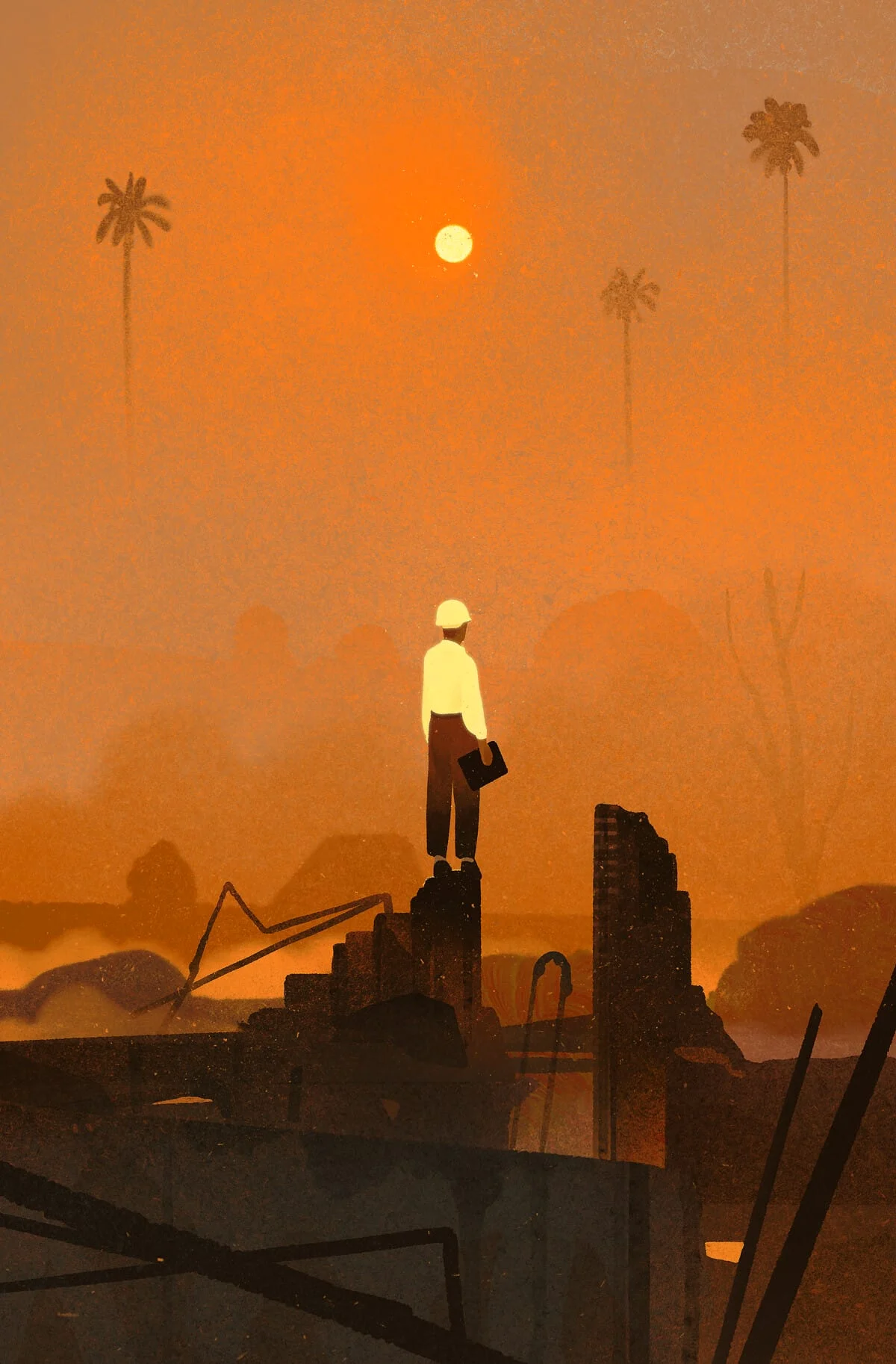
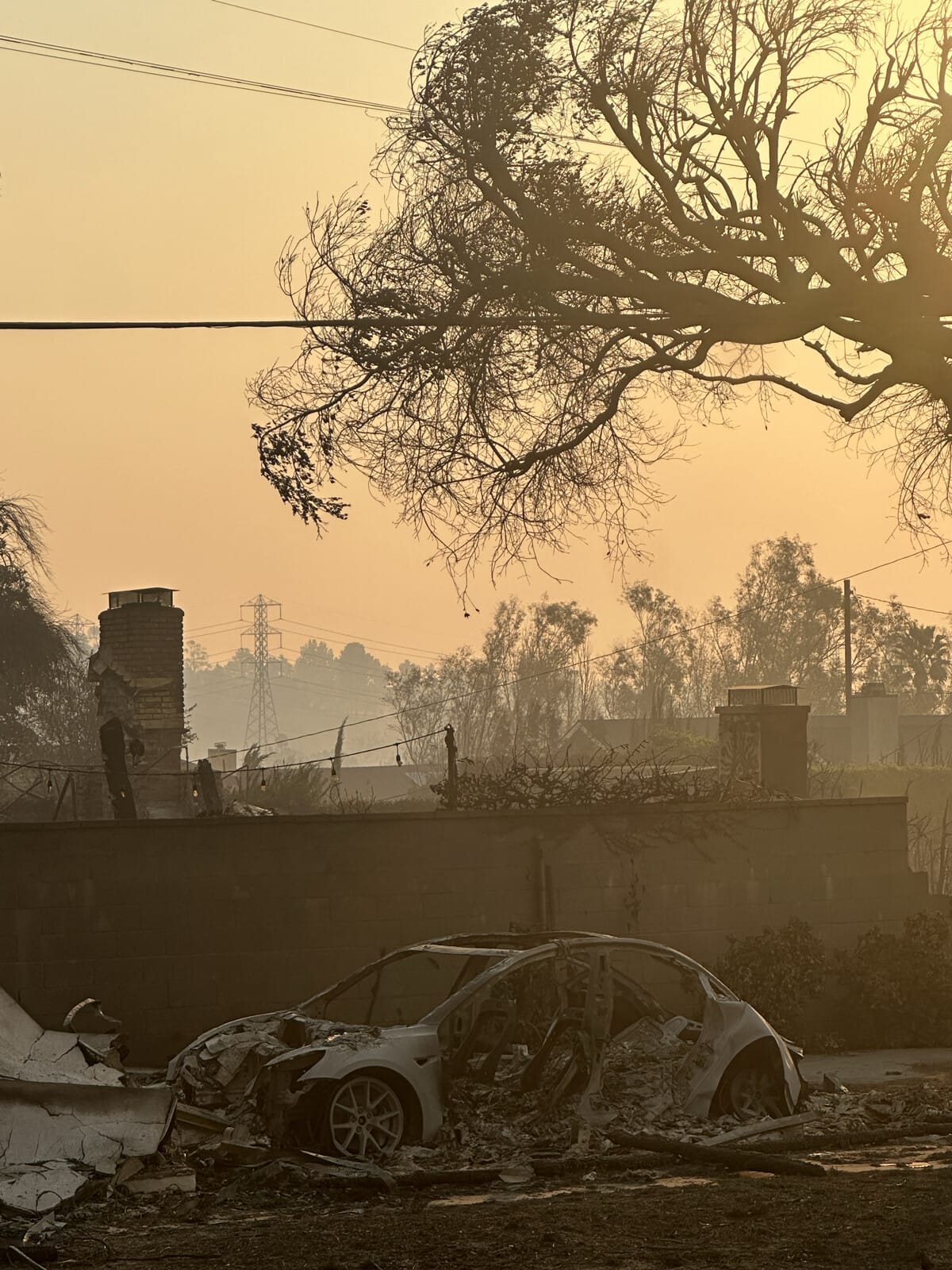
Just off a hiking trail, not far from where Sunset Boulevard meets the sea, a fuel and an oxidant combine and combust. The underbrush is dry and dusty, and within an hour flames engulf your home. Smoke fills your kitchen and your garage. Flecks of wallpaper from your children’s bedroom float down onto a nearby parking lot. Your wedding photos melt, as does your car battery. The glass windows of your dining room shatter and temperatures reach a thousand degrees. The root cause might have been a mountaineer who burned his toilet paper at dawn, a spark at a faulty transmission line in the foothills, a discarded cigarette fanned by the Santa Anas, or, simply, arson.
But it is too early to assign blame. Your attention is elsewhere. You are not home and you cannot get there, as the fire department has evacuated your neighborhood, the Pacific Palisades in Los Angeles. Your mind races, and you reach for your phone to ensure your family is safe even if you have already heard from them. Maybe you call the police, even though you hear the sirens throughout your neighborhood and see the caravans of emergency vehicles filling the streets.
When you do manage to get home, you stand on the sidewalk watching your rafters collapse and, covering your mouth with a shirtsleeve, you make your next call, to your insurance company to file a claim. You don’t know what this process entails. You have never filed a homeowner’s or business insurance claim, you have never read your policy, and you do not know if your policy covers what has happened, since you do not know what has happened or what caused it.
You are unaware that the insurance industry has been, in recent years, denying more claims and more coverage, exiting major markets, and raising premiums. As governments and corporations continue to enable fossil fuels, throttle renewable-energy sources, and deny long-established climate science, the related catastrophes (fires, floods, droughts, storms) and social effects (mass migration, war over natural resources, economic and demographic stratification) are increasingly commonplace and metastasizing. This new world order transfers the risk and harm of the disaster business by way of the insurance industry onto you, the consumer. On an episode of the climate science podcast A Matter of Degrees, Dave Jones, a former California insurance commissioner who is now the director of the Climate Risk Initiative at UC Berkeley, said, “For many Americans, the single biggest financial asset you have is your home. If you don’t have insurance or you can’t afford enough insurance and that home is destroyed, then you’re left with basically nothing. Insurance is the climate crisis canary in the coal mine, and the canary is just about dead.”
Days later, as embers still burn and you begin to accept that not one object will be recovered or salvaged from your home, your insurance company sends one of its employees or contractors, called an adjuster, to assess the damage, value what is or was, and (hopefully) make an offer of payment. While insurance companies defend their adjusters as necessary agents who help them evaluate claims, critics label them as conflicted loyalists who will undervalue losses, delay settlements, and pressure policy holders to settle quickly.
He is part private detective, part lawyer, part psychologist. All of this sounds reasonable, so you take his card and tell him you’ll be in touch.
But as you stand there, a man in business-casual attire emerges from the smoke and approaches you apprehensively. He introduces himself as someone who can help. His title, too, is adjuster, but if you are able to focus enough on his pitch, he tells you he is not an employee of your insurance company or of a roofing company or a general contractor. If you would like help navigating the ashes of your new life, he will help you rebuild: independently value your losses, handle communications and negotiations with your insurer, draft paperwork, and take care of the settlement of the claims. He is part private detective, part lawyer, part psychologist. All of this sounds reasonable, so you take his card and tell him you’ll be in touch.
That evening, as you make plans for your family to sleep at a nearby friend’s house or in a hotel, some quick internet research teaches you this “public” adjuster is indeed part of a legitimate industry (although sometimes public adjusters, you discover, are known as “private” adjusters). Staff adjusters, you learn, are the ones that work for insurance companies, and independent adjusters are contracted for certain projects by insurance companies.
This ecosystem of adjusters is baffling, but you decide to retain the public adjuster. As you sign his contract, he informs you that he will take a significant cut of any claim settlement he negotiates. Your calculation is that outsourcing the administration of the recovery of your life is worth the cost—so long as the insurance company agrees to write a check.
I recently spoke with the president of a large public adjuster firm in California that represented victims of the Palisades and Eaton fires that broke out in early 2025 and destroyed about sixteen thousand buildings on nearly forty thousand acres, causing tens of billions of dollars in damages. This conversation has been edited for length and clarity.
—Tyler Maroney
Tyler Maroney: How many claims does the average public adjuster typically handle in a year?
Adjuster: It depends on the size of the claim, but some will do a hundred claims a year, mostly smaller—$10,000 claims or $50,000 claims. But if you’re talking about somebody who’s handling complicated claims, I’d say an average load for an adjuster is somewhere between twenty and fifty a year.
TM: And you handle more than just massive disasters, right?
Adjuster: We respond to disasters every day, 365 days a year. Some of them are disasters that affect a hundred people or a thousand people. Those are big events. But there are buildings that burn down every single day. It doesn’t matter whether you’re in Minnesota or if you’re in New York, there’s water damage, there’s flooding, there are fires, there are robberies. It doesn’t require a hurricane or a wildfire for there to be a need for our service.
TM: I’ve read that clients don’t really know that public adjusters exist until they are desperate. Is part of your job getting the word out that this is an industry?
Adjuster: We’re luckier now in today’s world of technology because people can search for things online. I’ve been doing this thirty-three or thirty-four years, when there was no internet to search. If you had an insurance claim, you only had the connections you had, but today people can type into Google, “Can I get any help with my insurance claim?”
TM: I presume you go out into the field to attract clients?
Adjuster: Yes, part of the job is to be out there when an event happens or shortly after an event is over, to let people know that we exist.
TM: When a large fire like in the Pacific Palisades in Los Angeles breaks out, you go as quickly as possible to the scene?
Adjuster: Yes. When you show up at somebody’s house and the family is in the front yard crying and trying to save things that aren’t savable, it’s sad. Sometimes it’s total loss, and you find people sifting through the rubble, lining up bits of pottery.
TM: And when you approach these suffering people, how do they respond?
Adjuster: You get a wide range of emotional responses, from “Get the fuck off my property, you ambulance-chasing vulture” to “Oh my God, we’re so lost. We don’t know what to do. Thank you so much for being here. Can you help us?”
TM: That must be a difficult emotional minefield to wade into.
Adjuster: Yes, and when you’re walking up to meet these people, most of the time they’ve never heard of a public adjuster. They have no idea who we are or what we do or that it’s a licensed profession. It can look like we’re trying to prey on people when they’re at this vulnerable point. The reality is that’s when they need help the most, because often they do whatever the insurance company tells them to do. That puts them in the worst spot they could be in.
TM: Worst spot?
Adjuster: So, say someone calls us six months after a fire. They have been arguing with their insurance company about the value of a claim and then, out of nowhere, they get a $65,000 bill from the restoration company [a third-party, for-profit vendor] and they want us to deal with that too. We have to say: You already agreed in writing and signed for them to do that work. That money’s gone, you spent it. We can’t take that back because it was an agreement you made before we were involved.
Most people just know they have an insurance agent that sold them some insurance, and they do what they’re told. Often that results in mistakes.
TM: What kinds of mistakes?
Adjuster: I’ll give you the easiest one. There is a fire in your house, but it burns only part of your house down. There’s still stuff in it. It’s not like a wildfire where it burns all the way to the ground. So the insurance company comes out, and they bring a restoration contractor. He’s going to help you get your stuff out of the house, store it, and get it cleaned up. Seems like an incredibly important service. He says it’s going to get worse if we don’t get your stuff out of the environment. Just sign here.
TM: Okay.
Adjuster: If the owner asks, “Who pays for this?,” the automatic response is “Oh, don’t worry about it, the insurance company pays for it, it’s part of your policy.” It makes perfect sense at the time. What they don’t share is that it erodes your contents limit [which means it reduces how much money the insurance company is likely to pay out]. You have given them carte blanche, and they can bill the insurance company directly. They charge not only for clean-up but for storage. And there’s no language that protects the homeowner if they’re not happy with the service.
TM: The homeowner is vulnerable at this point.
Adjuster: What they don’t understand is that six months from now, their stuff has all been cleaned, and the restoration company charged maybe a thousand dollars to clean something that was worth four hundred dollars and they don’t even want anymore. They could have just said, “Oh, a thousand dollars to clean that item? I don’t care about that anymore. Give me the thousand dollars.”
TM: And what can you do as an adjuster to prevent this?
Adjuster: You can say to the insurance company that our client wants to select items that have intrinsic value or that we believe are valuable enough to save and restore. We can advise that often the cost to clean something is more than its value or that it’s too damaged to properly restore it. Otherwise, a homeowner will find out that the restoration company has charged $65,000 when they have $300,000 of coverage for their contents, and that $65,000 is coming right off the top, and the cleaning costs reduces the amount of insurance they have for the things that they’ve completely lost.
TM: Back to the field, is the pitch as simple as “Hi, this might be awkward, but my name is x and I’m a public adjuster, which means I help people like you”?
Adjuster: Yeah. Often it’s “Your insurance company’s going to come out here, they’re going to assign an adjuster. That adjuster works for the insurance company. They don’t work for you. You have the opportunity and you have the right to hire your own public adjusting team that counterbalances the insurance company’s team so that you have an advocate who’s a true advocate for you to level the playing field.” That’s the pitch.
TM: Do you have a sense for what percentage of people who’ve been victimized by a catastrophe are able to engage public adjusters? I assume that most people, when they’ve gone through something like that, call their insurance company, right?
Adjuster: That’s traditionally what happens, yes. They either call their agent, if their insurance agent is somebody who they’re close with, or they call the insurance company and give notice that they have a claim. And some agents will refer clients to us in a secretive way. Some brokers [who work for policy holders, not insurance companies] think that if the carriers see that they’re recommending a public adjuster, that will be bad for their reputation with the insurance carriers. Some brokers don’t care.
TM: So how does that work?
Adjuster: Some brokers say, “Hey, don’t tell anybody I told you this, but you should talk to x public adjuster.” Or sometimes it’s more open, like, “Hey, [this public adjuster company] helped a lot of my clients, so you might want to talk to them.”
TM: So how do the brokers respond to you?
“The world doesn’t move without insurance. Title insurance, medical health insurance, workers’ compensation insurance, everything is tied around insurance.”
Adjuster: There are insurance brokers who haven’t worked with us or don’t know us. Or they feel threatened because they were hired to do this job, and by bringing or inviting you in as a public adjuster, they’re admitting that they don’t know what they’re doing. If you’re a salesperson and you’re selling insurance policies and you’re a credible person, you want to believe that what you’re selling is the best product available. You want to hold your head up high and say, “I represent x insurance company and they’re great insurance.” So for some insurance brokers, saying “Maybe you need help getting money” is saying something negative about the insurance company. For some insurance agents, that doesn’t feel right.
TM: Do you feel you are adversarial to insurance companies?
Adjuster: We are advocating for the policy holder, not the insurance company. The insurance companies like to say, “Why do you need a public adjuster? We’re going to pay you all the money you’re owed anyway.” But if that was true, then why would they care? Why would they even have that discussion if they’re going to pay the same benefits regardless of whether somebody has somebody helping them put it together? The reality is that they’re going to pay as little as they can. So are we adversarial, or are we just taking the workload off the policy holder? It’s an arduous process. Imagine a family where everything is gone, disappeared into the smoke, and you have the burden of sharing with the insurance company everything that you lost. Where would you start?
TM: But there are fair critiques of the industry, right? Premiums are rising, carriers are pulling out of entire markets. What can you do?
Adjuster: I don’t know what I can do about it other than lobby. We go to Sacramento where we talk to [lawmakers] about the plight of people and their need for access to affordable insurance, pushing and encouraging them to pass legislation that helps people get insurance.
TM: And policy holders are struggling. As large, climate-related disasters causing property damage increase in number and scale, has the industry changed?
Adjuster: In some cases, the cost of insurance has tripled. And a few years ago, people were underinsured because they didn’t know what they needed. But now people are purposely choosing to buy less insurance and taking that risk because it’s so expensive.
With all the disasters we’ve had, insurance policies have been reduced, and diminished policy benefits have changed. Insurance companies have restricted coverage in Florida, for instance, with all the hurricanes. Some of the policies don’t cover roofs in a hurricane. How do you not cover a roof? We have had a lot of insurance companies pull out of California, at least for a while. You’ve got the California FAIR Plan that’s trying to fill the gap, and the coverage is not good. The FAIR Plan was established [in the late 1960s] for people who couldn’t find insurance from primary carriers. It was always meant to be a choice of last resort. It was never meant to do what they’re now doing.
TM: What is happening that is scaring you, that is worrying consumers about the insurance industry in connection with climate change and more frequent disasters?
Adjuster: The scary thing is people not having enough insurance to rebuild their lives.
TM: Are you able to help everyone who calls you?
Adjuster: I don’t have statistics, but I think half the people in the Palisades, for instance, were just woefully underinsured.
TM: Including wealthy people, since the Palisades was a wealthy neighborhood?
Adjuster: Including wealthy people. This is not just a poor man’s problem.
TM: It’s societal.
Adjuster: Modern society doesn’t exist without insurance.
TM: I’m sure the insurance companies would be happy to hear that.
Adjuster: The world doesn’t move without insurance. Title insurance, medical health insurance, workers’ compensation insurance, everything is tied around insurance. Anything you buy, anything you build, anything you do for work—there’s insurance that is tied around every single thing that you do.
TM: Can you give an example of how home insurance has changed?
Adjuster: You can’t close escrow in California on a property unless you’ve obtained insurance. If you talk to real estate agents, it used to be that, whether for a commercial business or apartment complex or just a house, they’d tell you that the last thing they ever thought of was insurance. Insurance used to be something that happened two days before the escrow would close, and it was just to check the box.
TM: And today?
“The truth is that after disasters, insurance companies have always done pretty well.”
Adjuster: If you talk to real estate agents, especially in California, they’ll say insurance has never been more important. One of the considerations as you’re going into escrow is what’s insurance going to look like? How obtainable is it and at what cost? The requirement to have insurance has killed real estate deals because brokers couldn’t get the right amount of insurance, or the coverage was so exorbitantly expensive that the person who was making the home purchase didn’t realize that was going to happen.
TM: And has that change become even more pronounced in the last five to ten years? And if so, how?
Adjuster: Oh, absolutely. If you go back again prior to 2017 in California, we wouldn’t even be having this conversation. You wouldn’t be able to find a real estate agent who could tell you that a deal went sideways because of insurance.
TM: What happened?
Adjuster: A series of wildfires. You had the Glass Fire in 2020, you had the fires in Malibu. If you go back to Santa Rosa in 2017 [knowns as the Tubbs Fire in Northern California and often cited at the time as the most destructive wildfire in California history], those homeowner policies were significantly better than the policies that are out there today. They had much broader coverage, much bigger coverage. But if you go back even before that to the Oakland wildfires [in 1991], everybody had what was called guaranteed replacement costs.
TM: Can you explain that?
Adjuster: It didn’t matter how much your insurance coverage was for: if you could prove it, they owed it. Say your house had $100,000 worth of insurance on the building, it didn’t matter whether it cost a million dollars or $100,000 to replace it. That has basically gone away, because the insurance companies had to pay a lot more money than they wanted to pay. So now what we have is extended replacement costs. Different insurance companies have different percentages [past your stated limit]. It could be for 20, 25, 50, 100 percent depending on the insurance company and what they want to provide. So that gives you more coverage than the stated limit, but to a limit.
TM: So the insurance industry was dealing with a financial situation that they didn’t want to manage. Is it fair to say that their business model was not what they thought it was going to be because their margins were shrinking?
Adjuster: Yeah, I mean, the funny thing is, I think insurance companies always come out well from a disaster. They have an opportunity to raise rates and get rates changed, and between changing coverages to their benefit and getting rate changes, they generally do fine in these disasters. But, yeah, you’re right, they want to contain the risk and make sure that they know what their exposure is. And with guaranteed replacement costs, they had a harder time knowing what their real exposure was because you could be paying coverage for one-tenth of what your payout was. The math was not good for them.
TM: I imagine you’re in a difficult place, because even though you’re averse to insurance companies, you also depend on them. If the insurance industry goes away, then your industry disappears.
Adjuster: It’s too tied into every financial move. You can’t get a mortgage on a house without insurance, so if insurance goes away, the real estate market’s done or close to done.
TM: What does the future look like?
Adjuster: Well, State Farm recently got approved to raise rates [in California]. A couple of years ago, they stopped writing new policies and now they are coming back into markets. The truth is that after disasters, insurance companies have always done pretty well, even when they pay out billions of dollars. Somehow it all works out for them.
TM: Sounds like the insurance industry is resilient after all. Why is that?
Adjuster: Disasters give them opportunities to raise rates and then people keep buying insurance. I think we’ll keep negotiating with insurers and letting them take rate hikes when they need to. And I don’t see it going away.