I followed my friend Tom Lewis through a field of weeds. It was mostly mugwort, with stalks that reached our shoulders and foliage that smelled like sage. We were at the Mawignack Preserve in New York’s Hudson River Valley. The 144-acre park sits just north of where Catskill Creek meets Kaaterskill Creek to form a river that flows through the nearby town of Catskill before emptying into the Hudson.
Tom is the founder of Trillium Invasive Species Management, Inc. He was there with his colleague Pat Salaway on behalf of the nonprofit Scenic Hudson, an organization founded in 1963 that, according to its website, “is credited with launching the modern grassroots environmental movement.” Scenic Hudson works to preserve and improve the landscape in the region. To that end, Tom and Pat were on a weed-eradication mission. It wasn’t the mugwort that concerned them. They were looking for one of the most dreaded of pervasive plants: Japanese knotweed.
At their pickup, Pat pulled out jugs of the herbicide glyphosate, branded Roundup Custom. While Tom consulted site maps, Pat blended the Roundup with a luminous blue dye and poured the mixture into backpack tanks. The two donned overalls and rubber gloves. Tom explained that they needed the dye so they could see what they had sprayed—or if they got any on themselves.
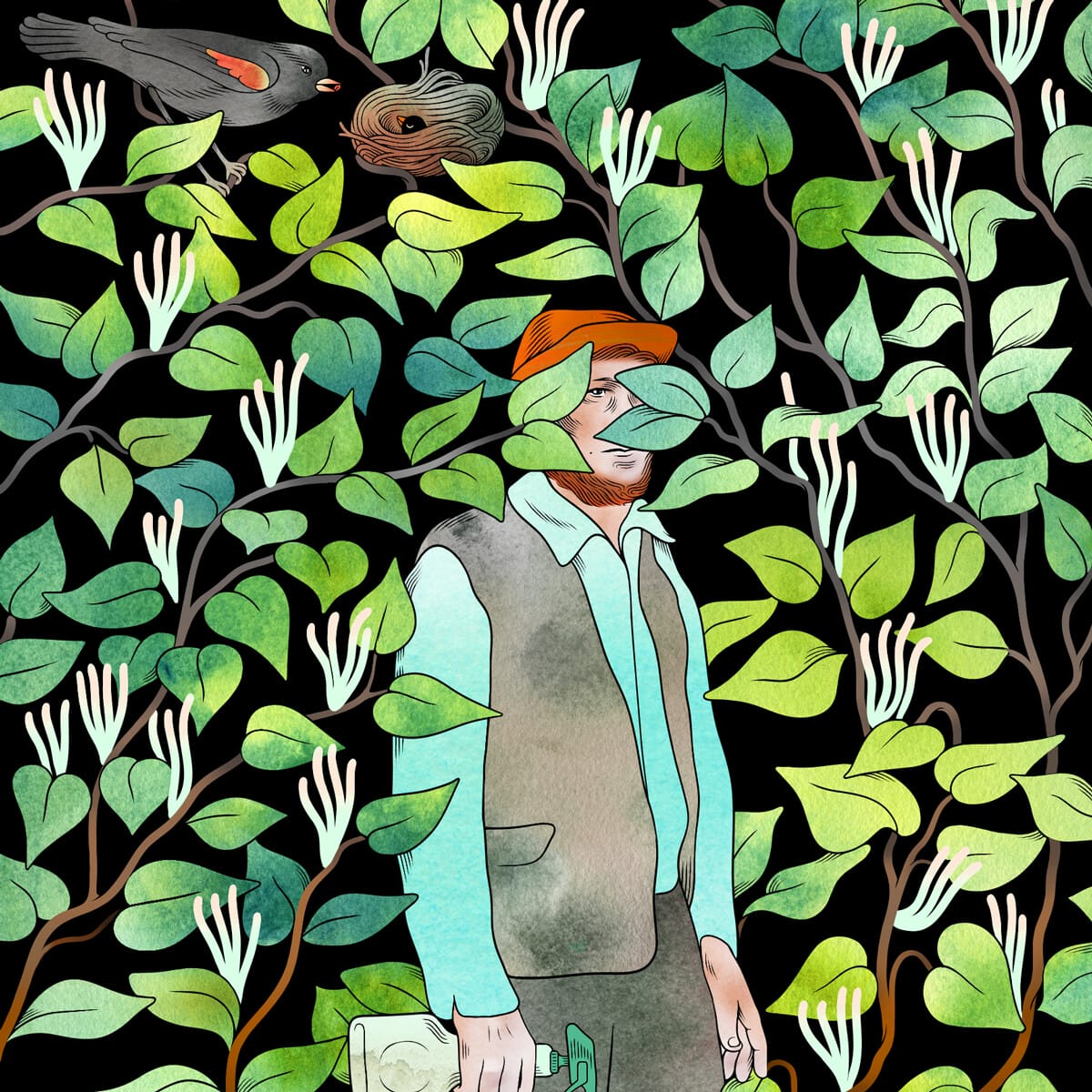
Tom’s pack sloshed with its cerulean poisons as I followed him into the weeds. He says that three years ago the site was covered in knotweed—about twelve acres of it. This time, we found only puny specimens. Pat squatted, searching for them in a nearby field. He had a red beard and a gold nose ring and was wearing an orange trucker cap. Genial and self-effacing, with a stubbled round face, Tom lit a cigarette on the side of the path.
Tom comes here twice a year for knotweed eradication—stem injections in the late spring with a giant hypodermic needle to pierce the stalks and foliar spray in the fall. In a wetland, he headed for a knotweed arcing gracefully toward the light. He sprayed. The dye turned the knotweed’s heart-shaped leaves an otherworldly jade.
We reached a stream. Tom lit another cigarette. Across the water, a thick stand of knotweed rose, and I asked if there was less on our side because it doesn’t like shade.
“It doesn’t care where it is,” he said. “It just loves living.”
Nightmare Fodder
Knotweed especially loves living near human industry. The plant tracks our unnatural terrain: highways and roadsides, railways and power lines, old mines and coal tips, abandoned factories, new subdivisions, and parking lots. It travels through the places humans have transformed or degraded and thrives where soil is moved and disturbed, where highway departments mow and plow. It flourishes with fewer frosts, warmer temperatures, humidity, and floods. High waters wash the rhizomes—the endlessly prolific underground stems and nodes—downstream, where they establish new colonies and start again and again.
Knotweed is nearly impossible to kill. It can grow up to eight inches a day.
And the plant terrifies people. Friends tell me their fears about it. One suspected it was growing in her garden and started having dreams of “Jack and the Beanstalk.” Another emailed: “A patch creeping towards my driveway is giving me nightmares. Let me know if you land on a way to kill it.” There’s a stand of it on my road, and I worry about the snowplow pushing it up toward my house. I fret about the town crews mowing it each year, leaving tiny fragments in their wake. People have so many feelings and direct such charged language toward the plant that an anthropologist at CUNY, Alyshia Gálvez, is studying how it maps onto our fears. A weed scientist tells me about the knotweed growing at the terminus of his dead-end street in Philadelphia. A group of people he knows decided to get rid of it. “Now it’s ‘We’re going to sneak out,’ and someone says, ‘I’ve got a whole tank of glyphosate,’ and they’re going to spray it in the middle of the night.”
Knotweed is nearly impossible to kill. It can grow up to eight inches a day. It’s also allelopathic, meaning it exudes a chemical that repels other plants, a bit like having its own herbicide. In many regions, the plant is clonal; it regrows from the smallest pieces of stem or rhizome, a fragment the size of a fingernail, as if each piece contained a miniature version of the whole. There is so much contradictory information about it—how to kill or stunt it; how it spreads, whether by seed or vegetally or both; even whether it is truly a problem—that it seems to be one more example of how hard it is in this political moment to find agreement on basic scientific facts.
In dozens of places, like New York or the Netherlands, knotweed is criminalized, illegal to plant or grow or even to move. In the UK, it’s been governed by multiple regulations since 1981 and now is covered in part by the country’s antisocial behavior laws that started when New Labour wanted to crack down on teens in hoodies. Given that so much middle-class wealth is held in real estate, the plant is seen as a mortal threat to the workings of capitalism. Finding knotweed on a property, or even near a property, can make it impossible to sell a home in Britain. Banks might refuse to offer a mortgage. And if you don’t reveal there’s knotweed, the new owner can sue you.
By the stream in the Mawignack Preserve, while Tom and I waited for an area he sprayed to dry, he asked why I was there. I told him I was trying to understand the plant and my feelings about it. I love weeds and have been reading and writing about them: I can’t even bear to weed my own garden, and I wonder how specific plants came to be called weeds when they’re often edible and nutritious and have medicinal uses. I resist using the loaded term invasive. I worry, too, about the lengths we go to eradicate these vilified plants and what that says about us. But knotweed puts my tenderhearted sentiments to the test. “Maybe if I know where it comes from and its history . . .” My voice trailed off. We stared at the mass of green across the water. “I used to want to understand it,” he said. When he started this work, he was curious about each weed he was targeting, wondering where it came from. “Now I just want to get rid of it.”
Some Mammoth Asparagus
Knotweed, though, is beautiful. It’s graced by delicate sprigs of dainty white flowers that drape from its boughs, angling in elegant fountains. Bees love the blooms, which have been called a crucial fall food for the pollinators. In the fall, the dead branches turn a brilliant copper red, transforming an otherwise dormant, dulled world.
The thing that thrills me about the plant: wherever it grows in Europe, in whatever country, all Japanese knotweed is part of the same original plant, carried from Japan in 1829. That first plant was female. Because most Japanese knotweed in Europe is clonal, it is genetically a single plant, so taken together it adds up to what could easily be the largest single female organism in the world. Much of it in the United States, too, is derived from that very first specimen that traveled thousands of miles from Japan, where it often grew on the sides of volcanoes. That plant, Reynoutria japonica, has also been able to hybridize with giant knotweed, Reynoutria sachalinensis, and those hybrids can backcross with their parents.
In Japan it is called itadori, which means “pain puller.” It was known to be not only edible but medicinal. Today, its roots and rhizomes are being used to treat Lyme disease. Knotweed is a rich source of resveratrol. Long before it was known as a nuisance weed, botanists and plant collectors were attuned to its benefits.
One of the first was Philipp Franz Balthasar von Siebold, a German doctor who worked for a Dutch trading mission. In 1823, Siebold traveled to Japan as a twenty-seven-year-old, landing on a tiny island near Nagasaki surrounded by walls and guards. Siebold served as the trading post’s doctor, but his job was also to amass information on the country, which might be called espionage at a time when Japan controlled all access to its resources. It was an era when information on plants could be national secrets and people like Robert Fortune would steal tea and roses from China.
In 1829, he packed his collections, including hundreds of plants, onto ships headed to the Netherlands. Not far from Nagasaki, one of the ships ran aground and its contents were discovered. Siebold was arrested for spying and ordered by the shogun to kill himself. Eventually, he got a reprieve: banishment.
In Europe, he moved to Leiden, in the Netherlands, and was often broke and bitter. He spent years writing the multivolume Flora Japonica with Joseph Zuccarini, though it was only finished and published after Siebold’s death. In 1863, he described knotweed’s “shining foliage” but also noted that it was “inextirpable.” It was, he said, being tested for stabilizing “railroad tracks and sandbanks,” which seems darkly prophetic.
He sent a box of plant samples, including knotweed, to London’s famous Kew Gardens in 1850. The staff was unimpressed with most, but knotweed arrived just in time for the “wild garden” movement of the late Victorian era. Knotweed was championed by Gertrude Jekyll, still a legendary horticulturalist in the UK today, and I’ve read that at the time it was recommended “for association with vigorous things on the turf in the pleasure ground” and called “handsome in rough places.” That last line makes me think of the Ramble in Central Park, where it lately proliferates. Knotweed came to be called, too, “a sad rambler.”
Its path to America also tracks to geopolitics. The United States forced Japan to open its economy to foreign trade with the threat of invasion in 1854, and sometime later the plant made its way to New York. Knotweed specimens arrived that were from Siebold’s original plant. Others were shipped back by a New York horticulturalist, Thomas Hogg, whom Abraham Lincoln had sent to Japan. Hogg’s brother ran a botanical garden on the Upper East Side and advertised knotweed as “some mammoth Asparagus.” He talked about French experiments with the shoots as a substitute for the vegetable. Even in the 1980s, New York magazine praised a wild Japanese knotweed dish as “unsurpassed.” By this time, knotweed was almost everywhere: there were only a few states where it had not yet proliferated, including North Dakota, Texas, and Nevada. But as a substitute for asparagus, it has not caught on. Some foragers sing its praises, likening it to rhubarb, but even I, who eat most weeds—mugwort and docks, dandelions and garlic mustard—can’t quite acquire the taste. When cooked it turns a sickening slick green.
Don’t Use Loppers
I made another foray in upstate New York, this time with another friend, Timothy Furstnau. A few years ago, he got a grant from Greene County’s soil and water agency for a study of the different ways of eradicating knotweed: glyphosate or cutting it back regularly in the growing season. This year, he lost his funding, but he’s still there working, consumed by the knotweed problem. Outside, I watched him cut into a wall of knotweed. He was bent double, holding a small Japanese scythe and slicing at the stems. With a flick of the wrist, a branch fell. He showed me just where to cut at the base, an inch above the ground. “Avoid the node,” he explained, “to keep the plant from regrowing from the downed limb, and don’t use loppers—they’re too much work.” He tossed the limb behind him, and it floated away like a paper airplane.
We were standing in a postapocalyptic landscape. A mound of old tarmac was stacked like a cairn guarding the site. The road ran to dust and weeds, ending in a river, and Timothy joked darkly that the three sisters here are knotweed, mugwort, and black locust. It’s a place of floods and eco-fatalism in Prattsville, not far from where I live in the western Catskills.
Before us, the branches grew ten, twelve feet high, so packed they were impossible to push through. Timothy tossed back another stalk. We gathered them, and behind us, the dead, dry ones dangled upside down, bound together like heads on pikes hung in warning. Rusty red against an aching blue sky, they were also starkly beautiful. He guided me around the branches, and they looked like something out of a Millet painting. We came to a scrappy pavilion built of Tyvek tarps, and I told him people joke that tarp is just another word for roof in the Catskills. He pulled out something like an apple corer, designed to split bamboo. He sliced a knotweed stalk into staves and wove them into a fence. He also carried a bag full of dried plant pieces for making paper. He spoke of the possibilities, everything we could create with this weed: mulch, steam-molded furniture, building materials, biofuels. He has what might be the state’s only license to transport knotweed in order to experiment with such projects.
Sitting on the tailgate of his Ford F-150, I admitted my confused feelings about the plant. Which was better: cutting the plant or poisoning it with Roundup? And how bad is knotweed, really? He said he did consider getting licensed to spray but prefers the scythe. He said there are studies of wastewater treatment plants using knotweed to soak up toxins. So many possible uses. “But I don’t have a start-up mentality. I’m interested in shared knowledge and a culture of management, but this amount of biomass could be transformative for this region.” His hair was spangled with tiny knotweed flowers. And then a preacher’s ardor rose in his voice. “Stewardship needs to spread faster than the plant, so the idea of proprietary values is antithetical to that.”
He waved at the sea of knotweed. Its flowers frothed like foam in the breeze. Zadock Pratt, he noted, built an industry in the nineteenth century here on tanning, which required the peeled bark of hemlocks. “Prattsville’s history, like that hemlock economy, could be a knotweed economy—and I am joking,” he said, but also he was not. “This place has this history of being denuded with extractive capitalism, and here is a dream of biocultural restoration.”
Noxious or Nice
I met Tom on a September morning. I crossed a mountain pass as the fog burned off. One knotweed glistened in the light, and I nearly had to pull over because of the flowers’ sheer splendor. I wondered about the limits of human perception, and my own perception. What are the ideas of value or beauty held in certain plants? A grass lawn is unnatural and deadly to many other creatures. As I drove, the maple leaves burned red, and the sky was so clear it felt like you could see to the outer atmosphere. It was a big migration day for birds. The route I took tracked to where Earth’s first forests emerged 380 million years ago, before the trees were even trees (they were essentially giant ferns). Those plants depleted oxygen in the ocean, which is said to have led to a mass extinction.
One might ask which is scarier: living with knotweed or losing the bees?
It seemed a good moment to check in with naturalist Erik Kiviat. Through Hudsonia, and his work with Bard College, he has studied knotweed in this region for more than twenty years and written several papers on the plant. He has also written studies of birds nesting in knotweed and how it interacts with mosses. Species do benefit from it, just not so much ours. He explained that knotweed grows so densely that it keeps us out. “The larger animals, predators and humans, may not be able to get in there,” which might be why the plants seem so forbidding. But as for smaller creatures, “they adapt,” he said. “It can be behavioral and sometimes genetic. That happens when a weed like this has been here for 100, 150 years.” He’s not convinced of some of the worst things knotweed is accused of, like stream-bank erosion, which can cause flooding, or even allelopathy. “That someone has shown in the lab that knotweed’s root extracts kill mosses or radish seedlings may or may not happen in the field, and if it does, it may happen selectively, depending on the environment. We don’t know much about how allelopathy works in nature.” Kiviat distinguishes between knotweed in different locations—Oregon or Wales—because they have different ecosystems. But few researchers register this, as if what the plant does or how it interacts is the same everywhere.
I asked him about Roundup, and he sent me a literature review on glyphosate, which is still employed in many Roundup products in the United States. I read about the dangers it poses to bees and monarchs and other species, dire warnings about coformulations of the pesticide with other surfactants. Even nonlethal doses inhibit bees’ thermoregulation, so it can lead to death. Glyphosate, though, is likely the most common pesticide in the world. The United States deploys 300 million pounds of it each year, according to the Center for Food Safety. Originally discovered in 1950 by a Swiss chemist, Monsanto separately developed it in the early 1970s. The chemical attaches to an enzyme in plant cells crucial to creating amino acids for growth and then basically kills the foliage. It also works as a desiccant and has been applied to dry grain crops like wheat and oats.
The U.S., Canadian, and EU governments all say, used correctly, glyphosate is fine. But in 2015, a World Health Organization study declared it was “probably carcinogenic.” Bayer bought Monsanto a few years later. Since then, the company has been losing court cases in the United States that tie Roundup to non-Hodgkin’s lymphoma, including one this year in Georgia for $2.1 billion. Bayer controls about 40 percent of the global production for glyphosate, but in the wake of all the legal costs, the company keeps threatening to stop making it.
Dan Jones is a Welsh scientist who has published studies advocating for glyphosate to kill knotweed. His company is called Advanced Invasives, and he’s billed as an “expert witness” in the language of fear knotweed engenders. He does not address fears of Roundup, but even with his support of chemicals to control the plant, he wonders why we are so scared of it. Unlike foxgloves, common garden flowers that can kill us, or giant hogweed, whose sap causes long-lasting burns and scars, “knotweed is not a ‘deadly plant’ . . . nor, is it inherently hazardous,” he wrote. “Japanese Knotweed is a plant, not a disease.”
One might ask which is scarier: living with knotweed or losing the bees? Tom says waiting to see what happens will be too late. Alyshia Gálvez, the anthropologist, says, “The problem isn’t the plant. We’re the problem. . . . We create the vacuums through which it takes hold.” And Timothy has a shining hope for a different world that sounds like a romantic postindustrial future, postcollapse.
I keep thinking of those primordial forests I drove past. There is a display of fossils that sits by the road just outside a small museum in Gilboa, New York. I think of how they mapped to a geological age, a different moment of climate collapse, and of how urban soils are now so similar, often sharing the same DNA across continents. Knotweed grows in those places with contaminated soils, phytoremediating what we’ve done to the world. Most people on Earth have glyphosate in their bodies—and this substance is another thing we have lived with for only fifty years. What do we know about its long-term impacts? I don’t have answers but more questions, questions that in this Make America Healthy Again era won’t get answered—or whose answers I won’t necessarily trust. Some of the questions, too, are about what it means to try to live with a plant that makes us so uncomfortable. I think of Timothy’s vision of knotweed as a usable crop—the paper, the materials, and the fuel, all of which could be a boon to our world. I still haven’t emailed back the friend who asked for advice about killing it.