Less than two weeks before the 2024 election, Joe Biden delivered a formal apology at the Gila River Indian Community in Arizona, south of Phoenix. Though Biden had traveled to dozens of countries throughout his presidential term, this trip to the reservation of the Pima and Maricopa peoples, whose ancestral roots here go back to approximately 300 BC, was his first diplomatic stop on tribal lands. In 1859, a few years after the United States acquired parts of southern Arizona from Mexico, an act of Congress relegated the Pima and Maricopa to the reservation, which comprised just 372,000 acres. At the same time, the United States took more than three million acres from the tribes. This land grab occurred in the context of Manifest Destiny in the 1800s, when the government used warfare, treaties, acts of Congress, and other seizures to expropriate around 1.5 billion acres of Native homelands. During this period, most of the tribes that made treaties with the United States—documents often signed under duress and frequently violated by the U.S. government—gained federal recognition, affirming their right to self-governance and stating U.S. responsibilities toward them. But the Gila River Indian Community never signed a treaty, and the tribe wasn’t federally recognized until 1939. There are now 574 federally recognized tribes within U.S. borders, but they can lay claim to only approximately fifty-six million acres of reservations and land trusts, roughly equivalent to the size of Utah.
Biden’s visit wasn’t explicitly about stolen land. Instead, he focused on the federal government’s 150-year-long history of using coercive and propagandistic education against Indigenous peoples. In 1819, Congress passed the Civilization Fund Act, apportioning $10,000 annually to boarding schools run by Christian missionaries that sought to assimilate Native children. Sixty years later, the federal government began operating its own assimilative boarding schools, after Army officer Richard Henry Pratt proposed repurposing military properties for an economically efficient answer to the “Indian Problem.” Indeed, the Secretary of the Interior at the time, Carl Schurz, estimated that it would cost just $1,500 to send an Indian child to boarding school for ten years, as opposed to about $1 million to kill an Indian at war. Carlisle Indian Industrial School, the first federally run boarding school, was established in 1879 on the site of a former army barracks in Pennsylvania near the Susquehanna River. Superintendent Pratt provided the informal motto: “Kill the Indian in him, and save the man.” Children from 140 tribes, including the Pima and Maricopa, were shipped off to Carlisle during its nearly forty-year run.
The United States stopped operating Indian boarding schools only in 1969, after a Senate report titled “Indian Education: A National Tragedy—A National Challenge” traced the government’s use of education to further its goals of stealing Native land back to the country’s founding. Assimilationist education, the report explained, “was considered ‘advisable’ as the cheapest and safest way of subduing the Indians [and] helping the whites acquire desirable land, and of changing the Indian’s economy so that he would be content with less land.” The report came amid a reckoning forced by Native activists: the same year had seen a group called Indians of All Tribes occupy Alcatraz Island during a larger fight for self-determination. Still, most non-Natives first learned about federal Indian boarding schools more than fifty years later.
In May 2021, the Temlúps te Secwépemc First Nation announced that ground-penetrating radar had found what appeared to be 215 unmarked graves at the site of the Kamloops Indian Residential School in British Columbia. Within weeks, U.S. Secretary of the Interior Deb Haaland, an enrolled member of the Laguna Pueblo and the first Native American cabinet secretary, announced the creation of the Federal Indian Boarding School Initiative. Over the course of three years, the initiative traced the government’s operation and support of Indian boarding schools, investigated Native children’s deaths at such schools, and invited survivors to share their experiences during a Road to Healing tour to a dozen Native communities. The resulting reports have publicized for the first time how federally funded education was used to assimilate Native children with “systematic militarized and identity-alteration methodologies” at 417 boarding schools across the country. The investigation identified by name 18,624 children who attended such schools and 973 children who died at them. These figures are undoubtedly undercounts. A 2024 Washington Post investigation puts the number of deaths at 3,104. And though comprehensive attendance estimates remain elusive, we know that in 1926, nearly 83 percent of Native children were enrolled at boarding schools. Haaland, whom Biden nominated for interior secretary following a campaign by Native activists, understands all too well that the abuses children faced in boarding schools decades ago continue to affect tribal communities today. Her maternal grandparents were taken away to the St. Catherine’s Industrial Indian School in Santa Fe, New Mexico, at age eight. “Federal Indian boarding school policies have touched every Indigenous person I know,” Haaland said at a Road to Healing stop in 2023.
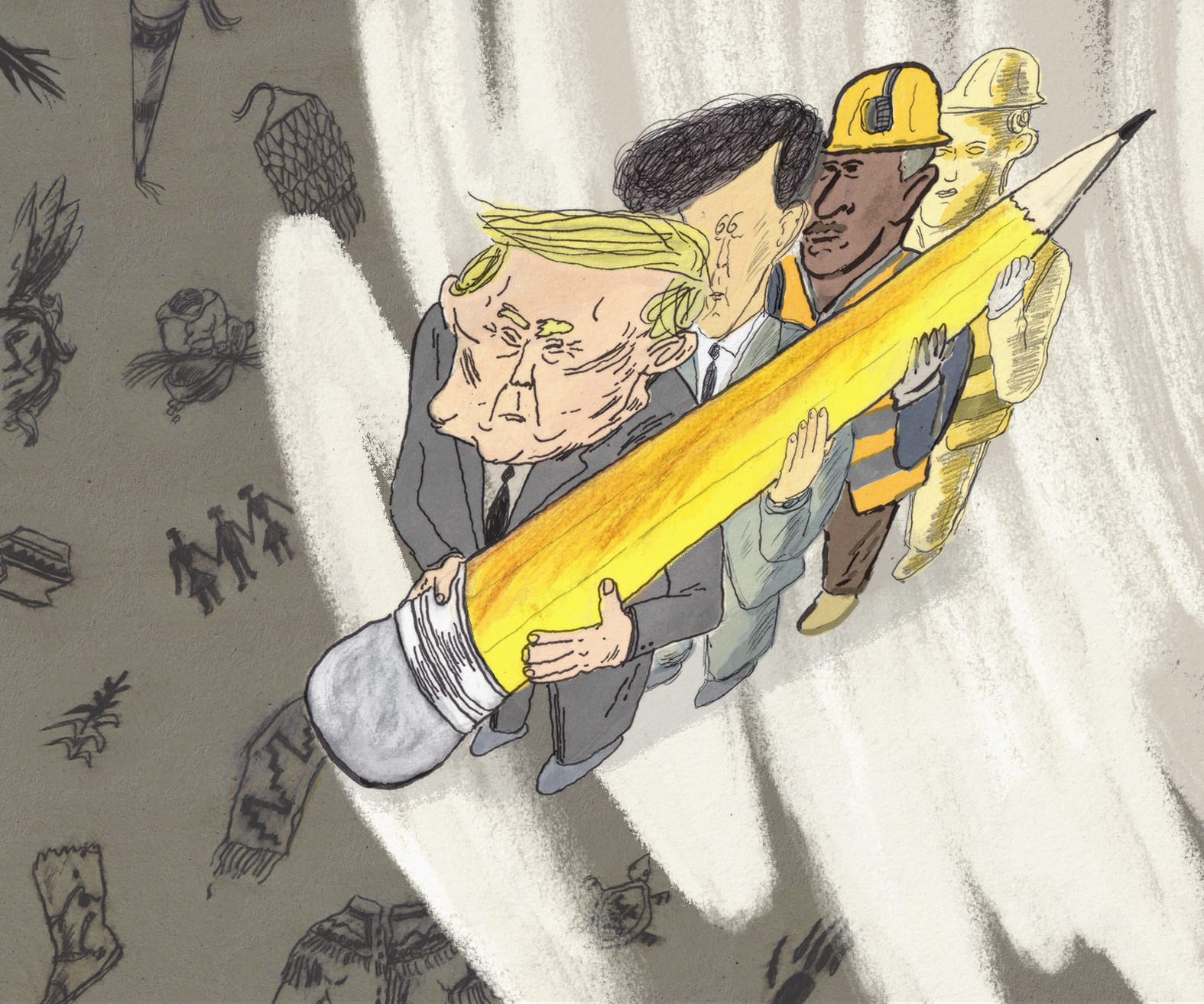
Biden’s October 2024 apology on the grounds of the Gila Crossing Community School was prodded by the Federal Indian Boarding School Initiative’s recommendations. As the president proffered this historic apology, the crowd, which included boarding school survivors and their ancestors, erupted in applause. But the federal government’s brief period of recognition ended just as it was getting started. Three months after Biden’s apology, Donald Trump was sworn in as president for a second time. Since his inauguration, it has become all too plausible that the American public will forget what we have learned about our country’s forced assimilation of Native children. Trump is taking the United States on a historical amnesia tour, suppressing and rewriting our past and overlooking tribal sovereignty. The administration’s erasures serve a larger project—yet another plunder of land, this time without even the pretense of honoring promises to tribes.
Save the Man
Among the first students to arrive at the Carlisle Indian Industrial School in October 1879 was a Lakota boy named Ota Kte, or Plenty Kill, whose English name was Luther Standing Bear. Accompanied by Richard Henry Pratt himself, he made the train journey to Pennsylvania from the Dakota territory along with eighty-three other children from the Rosebud and Pine Ridge reservations. Standing Bear later recalled, “I could think of no reason why white people wanted Indian boys and girls except to kill them, and not having the remotest idea of what a school was, I thought we were going East to die.”
Trump is taking the United States on a historical amnesia tour, suppressing and rewriting our past.
Ezra Hayt, the commissioner of Indian Affairs, had directed Pratt to recruit from the Sioux peoples, who were coerced into ceding to the United States the Black Hills—where gold had been discovered—following the Great Sioux War in 1876. Per Pratt, Hayt’s rationale was that “the children would be hostages for the good behavior of their people.” Tribal leaders like Standing Bear’s father scarcely had a choice but to enroll their children. Not all Native parents acquiesced, but that was no obstacle—Pratt was not above his agents’ use of “severe measures.” Notoriously, in 1886, President Grover Cleveland ordered that tribal leader Geronimo and his band of Apache be removed from their land in present-day Arizona and locked up as prisoners of war in Florida, though they had surrendered in the Apache Wars. Their surviving children were shipped by train to Carlisle.
In Pennsylvania, Native children underwent rapid identity alteration. Pratt employed a local photographer to capture before-and-afters of the transformations and sold the portraits to advertise the school. The first shot was taken upon arrival, when the youth were still wearing their traditional tribal garb; the second was taken after the school cut the boys’ long hair and clothed the children in military-style uniforms with brass buttons for boys and dresses with frilled collars and white pinafores for girls. The portraits were labeled with both the students’ Native names and their newly imposed Anglo names. “We’d lost our hair and we’d lost our clothes,” recalled Asa Daklugie, who was among the Apache who entered Carlisle in 1886. “With the two we’d lost our identities as Indians. Greater punishment could hardly have been devised.”
In addition to physical erasures, Carlisle students were forbidden from speaking their tribal languages in and out of the classroom. The school placed children in dorms with members of other tribes, such that their only shared language would be the English they were forced to learn. Children who spoke their native tongues were subject to abuse. In 1892, an elocution teacher attempted to blow the whistle on harsh disciplinary measures, writing to Theodore Roosevelt, then in the Civil Service Commission, about “punishments of keeping the children on a diet of bread and water for one or two weeks, and flinging them into cold cells from two weeks, to a month, and dungeons, until they are chilled to the heart, so that many cases of death have resulted from pneumonia, catarrh, and consumption.” The teacher was likely referring to the Guard House, a stone magazine said to have been built by Hessian prisoners of war on the Carlisle Barracks in 1777. Roosevelt forwarded the complaint to the commissioner of Indian Affairs, who tasked the superintendent of Indian schools, David Dorchester, with investigating; Dorchester alleged the teacher was “unbalanced.” Yet the school’s own records demonstrate that students were regularly confined in the Guard House and that at least one student died as a result of punishment. The first Federal Indian Boarding School Initiative report confirmed that the disciplinary measures at Carlisle were not unique: “Indian boarding school rules were often enforced through punishment, including corporal punishment such as solitary confinement; flogging; withholding food; whipping; slapping; and cuffing.”
The curriculum at Carlisle was its own form of abuse, dedicated to preparing students to work in the white man’s world—and to abandon the ways of their tribes. Even English and math lessons revolved around industrial training, as evidenced by the samples of schoolwork by Carlisle students that I leafed through in the Cumberland County Historical Society’s archives while conducting research. Spelling tests for first graders used vocabulary from the industrial laundry; seventh-grade math word problems were based on tailoring; student artwork depicted blacksmithing tools. These lessons complemented the manual labor the children were subjected to for hours each day. Students were even put to work making wagons and harnesses to be used on reservations, supplying the needs of the Bureau of Indian Affairs.
Not only did boarding schools like Carlisle exploit Native children for labor, they allegedly made tribes fund the abuse: the BIA used tribal nations’ trust monies, raised by selling Native land, to bankroll federal Indian boarding schools. In May, the Washoe Tribe of Nevada and California and the Wichita and Affiliated Tribes of Oklahoma filed a class-action lawsuit in a district court in Pennsylvania against the Interior Department, among other defendants, demanding a full accounting of how trust monies “taken from the Nations themselves, and held in trust for the Nations’ collective benefit” were spent on boarding schools that systematically sought to destroy Native cultures.
Carlisle’s entire apparatus, from its location hundreds of miles from the nearest Indian reservation to its mixing of tribes and industrial curriculum, was designed to speed assimilation. Before Carlisle, most schools were located on reservations and primarily educated single tribes. As Secretary of the Interior Schurz complained in 1879, “It is the experience of the department that mere day-schools, however well conducted, do not withdraw the children sufficiently from the influences, habits, and traditions of their home-life, and produce for this reason but a comparatively limited effect.” Manifest Destiny demanded harsher measures. In the 1880s and 1890s, as the Dawes Act broke up Indian land into individual allotments, the government established military-style boarding schools, many of which were off reservation. As Ojibwe historian Brenda Child explains, “Indian people lost ninety million acres of land during the half century that assimilation policy dominated Indian education in the United States.”
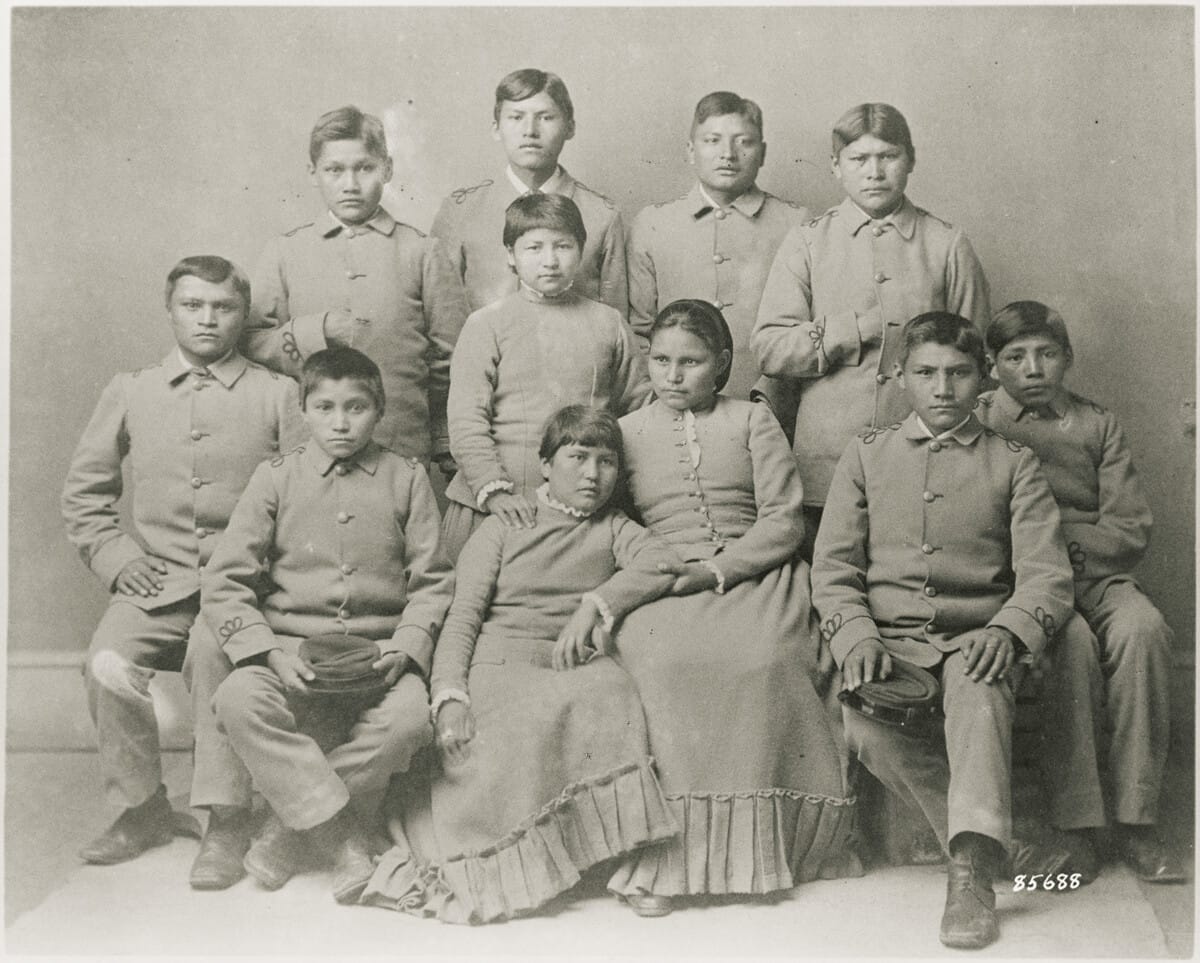
Photo courtesy of the U.S. National Archives.
Manifest Density
Since retaking office, Trump has left no room for an honest appraisal of the government’s construction, and relentless expansion, on stolen land or of how its methods of expropriation continue to affect Indigenous peoples. His administration’s posture toward Native America is one of disrespect and ignorance. In July, presumably seeking to distract from the Jeffrey Epstein scandal, Trump demanded that the Washington Commanders football team change its name back to the Washington Redskins; that same month, the Department of Homeland Security’s X account posted the Manifest Destiny–era painting American Progress by John Gast, depicting Native Americans being driven off their land by settlers, which it captioned, “A Heritage to be proud of, a Homeland worth Defending.”
The Trump administration’s posture toward Native America is one of disrespect and ignorance.
This isn’t just a case of rhetorical whiplash. On his first day back in office, Trump issued an executive order terminating federal diversity, equity, and inclusion programs, calling them “illegal and immoral.” The order’s antiwoke logic has fueled a project of Native erasure, most evident in the administration’s censorship of information, documents, and data on government websites. In March, a Washington Post investigation found that the Pentagon removed several web pages honoring Native American service members, including one about Ira Hayes, a member of the Gila River Indian Community who was one of the six Marines to raise the American flag at Iwo Jima. In June, thirteen members of Congress called on the Justice Department to restore to its website the Not Invisible Act Commission Report, which issued recommendations about how to respond to the missing and murdered Indigenous persons crisis. Trump himself had signed the Not Invisible Act into law in 2020 to develop recommendations on combating an epidemic of violent crime against Indigenous people, who go missing at disproportionate rates and for whom homicide is a leading cause of death. And in May, the Department of the Interior yanked down a page dedicated to the Federal Indian Boarding School Initiative, formerly hosted under a section about the department’s “priorities.”
While the administration has often focused its meddling in the digital world on clear-cutting anything that might be possibly construed as promoting DEI or “gender ideology,” it is also dedicated to an active reshaping of how the country remembers its past and tells stories about itself. Under the banner of complying with the DEI ban, the National Endowment for the Humanities canceled $1.6 million in awards for the digitization of archival records from federal Indian boarding schools and the collection of first-person accounts from survivors. Among the tribal nonprofits affected by NEH rescissions was the National Native American Boarding School Healing Coalition (NABS) in Minnesota, a leading advocacy group for those subjected to the schools. The NABS lost nearly $283,000 in unspent funding on their National Indian Boarding School Digital Archive project; their grant supported the effort to find and digitize more than 120,000 pages of relevant documents from the National Archives. As NABS CEO Deborah Parker, citizen of the Tulalip Tribes, told Native News Online, “This loss not only hinders education, but also deepens the gap in our national understanding, allowing cycles of erasure, misunderstanding, and invisibility to persist.”
That gap in national understanding will soon be yawning if Trump gets his way. In a March executive order titled “Restoring Truth and Sanity to American History,” Trump directed the interior secretary, who also manages public lands and the National Park Service (NPS), “to ensure that all public monuments, memorials, statues, markers, or similar properties . . . do not contain descriptions, depictions, or other content that inappropriately disparage Americans past or living (including persons living in colonial times), and instead focus on the greatness of the achievements and progress of the American people.” As part of this review, NPS employees have flagged descriptions and displays per Trump’s instruction to review material presented to visitors at 433 sites nationwide, marking them for potential revision or removal by mid-September. A display at the Castillo de San Marcos National Monument in St. Augustine, Florida, was flagged for how it described the imprisonment of Plains Indians in the late 1800s, referring to tribes having a choice between extinction or assimilation. This description is accurate. Castillo de San Marcos, once known as Fort Marion, was where Richard Henry Pratt developed his ideas for using education to assimilate and subdue Native peoples.
One wonders how the NPS under Trump will attempt to sanitize history at the newly created Carlisle Federal Indian Boarding School National Monument. In early December 2024, Biden signed a proclamation establishing the monument. At the White House Tribal Nations Summit, where he announced the proclamation, Biden said, “I don’t want people forgetting [in] ten, twenty, thirty, fifty years and pretending it didn’t happen.” Under Trump, forgetting and pretending is an active project. In May, it was reported that the White House had scrubbed Biden’s apology from its website. Currently, visiting the site of the boarding school—now home to the U.S. Army War College—requires passing a federal background check. When I visited in November 2022 to conduct research, the few acknowledgments of the boarding school’s history might have passed muster with Trump. In downtown Carlisle, the only placard about the school focused on its athletic history (Jim Thorpe attended). In a small museum in the Guard House, where Carlisle students were confined for discipline, a different placard stated that “Richard Pratt’s vision was to provide training for Native American youth who could then sustain themselves in industry, trades and farming,” whitewashing the superintendent’s “civilizing” mission.
Beads and String
If the bigger-picture goal of the federal boarding school era’s reeducation campaign was making tribes be “content with less land” so that settlers and prospectors could stretch across the country and reap profits, the Trump administration’s censorship and suppression go as far as to enforce pride in oppression. When Americans do not have to confront the ways that our government attempted to exterminate Native peoples and their cultures, we are more liable to view westward expansion as our historic destiny. As journalist, author, and citizen of the Cherokee Nation Rebecca Nagle told me:
There’s research showing that people who aren’t exposed to information about Native people or examples of contemporary living Native people actually have less support for tribes and tribal sovereignty, and are more likely to support things like the idea that all reservations should be abolished, all treaty rights should be abolished, and then Indigenous nations should no longer exist.
Ignoring the existence of sovereign Native nations would make Trump’s goal of opening up public lands for oil, gas, and mineral extraction much more achievable; many of the public lands that Trump is eyeing for private drilling and mining are protected by national monuments that tribal nations lobbied for, seeking to protect their ancestral burial grounds and their use for ceremonies, hunting, fishing, and foraging.
Trump has meddled with national monuments before. In his first term, he ordered the largest national monument reduction in U.S. history, cutting down the Bears Ears National Monument by more than a million acres, to 15 percent of its original size, and slicing Grand Staircase-Escalante roughly in half, to about one million acres. Bears Ears is on land that is sacred and ancestral to the Hopi Tribe, the Navajo Nation, Ute Indian Tribe, Ute Mountain Ute Tribe, and Pueblo of Zuni, among others; Grand Staircase-Escalante is also on land that is sacred and ancestral to many communities, including the San Juan Southern Paiute Tribe, Kaibab Paiute Tribe, and Pueblo of Acoma. Both monuments sit on land rich with minerals, oil, and gas that Trump sought to open up to private extraction. “Some people think that the natural resources of Utah should be controlled by a small handful of very distant bureaucrats located in Washington,” Trump said when proclaiming the monument reduction. “And guess what? They’re wrong.” He added, “We will usher in a bright new future of wonder and wealth.” That future would not include tribal nations trying to exercise their sovereignty.
Though Biden restored the boundaries of Bears Ears and Grand Staircase- Escalante in October 2021 after pressure from Secretary Haaland and tribal leaders, under Trump 2.0, the monuments are once again in danger. Nor are these monuments the only federally held lands at risk of destruction. The Western Apache are currently fighting a legal battle to prevent the U.S. Forest Service from transferring land in the Tonto National Forest in Arizona containing Oak Flat, a site where they have gathered for thousands of years for ceremonies, to a copper-mining company. And in June, the Trump administration rescinded a regulation that protected nearly sixty million acres of national forests from logging, mining, and roadbuilding. Meanwhile, oil and gas companies got $18 billion in tax breaks in the so-called “One Big Beautiful Bill” that the president signed into law on July 4, while companies that drill on public lands will save about $6 billion in the royalties they pay the federal government. In addition to winding down tax credits for solar and wind projects, the law claws back unobligated funds in the Tribal Energy Loan Guarantee Program, which supported federally recognized tribes’ investments in energy infrastructure. These programs were especially crucial as Native people living on tribal lands are extraordinarily cost burdened when it comes to energy, spending 28 percent above average, and face 6.5 times more electricity outages per year. Approximately seventeen thousand households on tribal lands have no access to electricity at all.
These and other cuts to federal programs for tribes are already putting treaty obligations in jeopardy, Nagle told me. “You know, these things weren’t free. They weren’t handouts,” she said. “In exchange for land, the United States made certain assurances to tribes.” Yet for most of U.S. history, our government has been content to renege on its word to Native nations. It promised to provide education but allegedly used tribes’ trust monies to abuse their children in the 1800s and 1900s and is now proposing a $161 million cut to the Bureau of Indian Education’s budget for tribal colleges. It has promised health care to a population that suffers disproportionate rates of chronic disease and mental health problems—especially among boarding school survivors and their children—yet the Indian Health Service has been chronically underfunded by Congress for decades. Though the shift to Trump 2.0 has been one of marked upheaval for Indian Country, the four years of Haaland’s tenure at Interior were in many ways a departure from centuries of federal policy and posture toward tribes. If Trump succeeds in his campaign of collective forgetting, those years will remain a blip.