, February 11, 2026
Wild Facts
Varieties of spiritual cinema
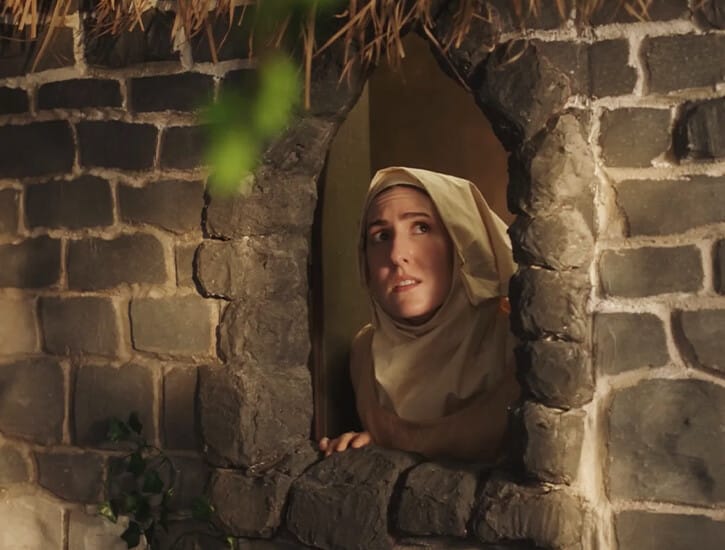
Still from Revelations of Divine Love (2025). | Neon
The Testament of Ann Lee directed by Mona Fastvold. Searchlight Pictures, 137 minutes. 2025.
Revelations of Divine Love directed by Caroline Golum. Several Futures, 73 minutes. 2025.
Sirāt directed by Oliver Laxe. Neon, 114 minutes. 2025.
“The peculiar grace of a Shaker chair is due to the fact that it was made by someone capable of believing that an angel might come and sit on it.” Thomas Merton wrote this in 1966, when the sect of millenarian Christian egalitarians known officially as the United Society of Believers in Christ’s Second Appearing were in the process of dying off, and their resurrection in antique furniture markets had just recently begun. Yet Merton the monk had something greater in mind. The Shakers designed their tables and cabinets for everyday use in dozens of self-sustaining communities which had once spread from Maine to Kentucky. Theirs were not ecclesiastical chairs, to be set aside on the altar. Yet because they suffused the course of their days with deep spiritual conviction—because they believed it possible that an angel might step down to rest beside them—they filled their lives with objects of peculiarly austere beauty. No angels, no chairs.
I am not a Shaker, or a monk, or an authority on pretty much anything. But I take Merton’s quote to mean that even simple things can be formed with great import, if their makers mean them to. Yet they must mean to. The shape of the Shaker achievement was (and, for the remaining few, still is) defined by the relationship between expectation and aspiration—by what they believed to be true, and what they hoped to accomplish. However familiar the shape of a Shaker chair, it required an angel to bring it into being. However humble the materials, they must point toward paradise.
I think this is true for all artists, and for any work of art. To a profound extent, what an artist believes to be possible—in their art, and in the world—will determine not only the shape but the extent of what they can hope to make. They must have some angel beside them if they hope to reach out to the beyond. Such belief need not be dogmatic, or even clear of doubt. Merton’s own phrase trembles with uncertainty: capable of believing in angels who might come and sit. Yet for the Shakers, as for any artist, there must be that capacity, that yearning for contact. In order to make a film worthy of the Shakers, one must first believe in the possibility of grace.
That’s how I see it, anyway, and I think that Mona Fastvold might agree. The director and cowriter of The Testament of Ann Lee has constructed a mythical portrait of the visionary ecstatic Mother Ann Lee, who began her life in the Manchester textile mills, and died a Shaker prophet in the woods north of Albany. Fastvold’s Ann (Amanda Seyfried) is a woman of minor means and impossible aspirations. Shackled first to her father and then her husband, Ann’s life from an early age is trapped in a circuit of sex, abuse, and death—a loop interrupted only by her flights of religious fancy, and at the mass meetings held by local Quakers.
Spiritual cinema is fundamentally an aspiration: it must reach out toward something it cannot ultimately depict.
The real Ann Lee never learned to read or write; the only record we have from her is the X she marked on her marriage certificate. Yet in liberating herself from the confines of marriage, emerging industrial capitalism, and the petty limits of her own body, Lee expressed a vision that would speak to thousands over more than two-and-a-half centuries—and which speaks to us now, if we let it. Her aspiration essentially involved freedom from the cycles of the flesh: no marriage, no sex, no childbirth, and none of the pain and compromise all of that involves. In Fastvold’s Testament, this vision appears as a consequence of her own disastrous marriage, and the deaths of four infant children. It frees her from toil in both mill and marital bed, and promises others the same. Together, they will build a community from the lost people of the new world, exteriorizing their wickedness, and moving from dreams to reality.
Ann’s is a demanding creed, and its values of abstinent communalism and redemptive toil will likely clang off the ear of many modern witnesses. So Fastvold takes her cues from Shaker worship itself, and tells her Testament through the full-body experience of music and dance. The choreography is wild and expressive, all swinging about the room and climbing up the walls. Dancers strike their chests and twirl on their heels and collapse onto one another in divine euphoria, trilling out in song adapted by composer Daniel Blumberg from existing Shaker worship music. In the depths of her grief, Ann retreats to dance, and the slow dragging of knees and hands stands in for a rage she cannot otherwise express. Fastvold follows her lead, subordinating description to experience, and allowing the musicality of her subject to guide her.
Dance and song allowed the Shakers to express their most profound aspirations, literally acting out together their shared desire for community, and their yearning for union with God. Fastvold uses them to take Ann seriously, to allow her to express her own world-devouring hunger for divine justice, and the utopian scope of her vision, through the quivering of her voice, the upward reach of one hand. She imbues the best sequences of Testament with the same skipping rhythm, presenting a musical life where all experience might follow the beat of a secret drum.
This is a film of deep longing for communion, of a yearning so profound it can shake the body, and cause the soul to scream. Testament is less interesting as a biopic of Ann Lee or a history of the Shakers, than as an expression of their existential mode. Fastvold takes for granted Ann’s visions and the depth of her insight; she wants the viewer to know how mystical ecstasy feels, so that we can see for ourselves how such an experience would fundamentally reorder our sense of the world. It’s all there in the dancing: the vividness of ecstasy, the fearsomeness of belief, and that profoundly human desire to support, to uphold, to belong. What begins in chaos is channeled gradually into a halting dance of retreat and approach, and it ends as the Shakers did, reaching skyward, interlocked and interwoven, a community knitting itself together, or at very least trying to.
Spiritual cinema is fundamentally an aspiration: it must reach out toward something it cannot ultimately depict. Yet it reaches all the same. Practitioners of the art pursue what William James called “wild facts,” that mixture of the impossible and the unassimilable which crops up in any study of the affective dimensions of human culture. Levitation is a wild fact; so are mystic visions, holy apparitions, and inexplicable physical transformations. James called such events “paradoxical absurdities,” yet he sought to understand them all the same. In his book They Flew, the historian Carlos Eire attempted to parse what such impossible absurdities meant to the people who believed in them—and what it might mean for those on the other side of modernity, with its redefinition of the line between the rational and the irrational, to allow themselves at least the potential for belief.
I’d venture that anyone who hopes to make a great work of art must do something similar: to believe, like the Shakers, in the possibility of impossible things. In taking seriously the visions of Ann Lee, Fastvold does this. So does Caroline Golum, the director and cowriter of Revelations of Divine Love. Golum’s film is many things: a dramatization of the life of the fourteenth-century anchoress and mystic Julian of Norwich; a catalog of her holy visions; a plague story; a rebellion story; an expression of the persistent supremacy of love in a world of nearly unbearable suffering. It is both period-accurate and pointedly anachronistic, carefully handmade and plainly artificial. It is totally remarkable, and then some.
Revelations tells, more or less, the story of a real woman named Julian, who at “thirty and a half years old” fell sick and nearly died. Lying for days in the depths of fever, she received a series of visions and apparitions. She saw a crucifix weep real blood, felt herself strangled by the devil, and was handed “a little thing, the size of a hazelnut,” a stand-in for “all that is made” and sustained by God’s love. These visions and more she described in the two manuscripts now collected as the Revelations of Divine Love. They are the oldest surviving English language texts written by a woman, and without them, her life and its import would have disappeared from the record. Her visions, and her nearness to oblivion, have (paradoxically) preserved her.
Golum freely adapts these texts, embellishing what is known of Julian’s life and work with considerable fiction. In her telling, Julian is a landed Lady (Tessa Strain), fussed over by her mother Mary (Mary Jo Mecca) and maid Sarah (Isabel Pask). Her visions begin in sickness, yet remain ever-present throughout the course of her life. She can read and write, and lives in an age which takes such revelations seriously—so seriously that her priest and confessor encourages her to devote the remainder of her life to them, by walling herself in a cell off the church and becoming an anchoress.
Ours is a culture of persistent literalism, a society which routinely mistakes surfaces for depths.
To explore the vast dimensions of her vision, in other words, Julian had to enclose her own life—to reduce it, in the grammar of her visions, to the size of a hazelnut. Golum subtly contrasts Julian’s literal confinement with the infinite grandeur of her visions, shooting Strain through windows, and positioning her on the far side of any gap. Noblewomen, foreign visitors, even Sarah and her own mother desire to reach her, to be with her. Yet the intensity and the profundity of Julian’s experience has set her apart from them all. In the film’s most moving sequence, Julian consoles a woman who is grieving the loss of her entire family to the Black Death. Poised on either side of a wooden casement window, each woman’s face is visible only through the frame of the cross-shaped gap carved into the shutters. Just as Julian’s visions mediate the holy truths imparted, so does her confinement mediate the ability of others to receive and understand her. But still they keep trying, and the message delivered to the woman in grief—that Mary mourned for all mothers, who suffer as she once did—carries across the gap.
Golum made her film with a group of friends in a Queens County warehouse; the whole thing cost under two-hundred-thousand dollars, and the film does not hide the fact. The stonewalled sets are clearly made of painted plywood; the actors speak in their own contemporary voices; Julian’s anchorage is often depicted as papier-mâché model, with a sky of hand-painted stars. Yet the film’s homespun nature embodies the modesty of Julian’s life. Like the vision of the hazelnut, it takes what seems vast and incomprehensible and reduces it to something you can hold in the palm of your hand, bringing Julian’s time into our own, and vice versa.
This goes double for Julian’s visions, which Golum and her team interpret as both art-historically artificial and vividly, transcendently real. Julian was a devout Christian, and her revelations are directly, unmistakably religious in both content and orientation. She witnesses Christ’s Passion through a hole in the wall; she drinks the blood from his side; she meets him in the cloister of a cathedral, and takes from him the crown of thorns. When she speaks of love, as she so often does, she means the love of God, “most certainly . . . and in everything.” Hers is a surpassing, universal vision, without room for ambiguity, and certainly not doubt.
Golum chooses to treat them directly, placing you alongside Julian, within her revelations. Not every director would have the courage. Fastvold and cowriter Brady Corbet tread lightly around the actual text of Shaker religion for fear of totally alienating the modern viewer. For all their film’s intense and overwhelming empathy, it often holds the audience at a distance, turning us into observers when we ought to be participants. They show us the chairs, not the beliefs that shaped them.
Despite being made for many millions less than Testament, Golum’s Revelation achieves a far greater access to the lifeworld of its subject. Embracing the spirit of her modest means, Golum creates intimacy through obscurity, and uses blatantly false imagery to depict moments of blinding truth. The miraculous finds its home in the minute, in the ink-stain stigmata and the mystery of the hazelnut, without ever reducing it down to size. In her modest, sincere way, Golum reaches for these wild facts, and takes their paradoxes in hand, for they are all that has ever been made.
Our age is not fit for angels. I don’t mean this literally, or even spiritually. I’m talking about art here. Ours is a culture of persistent literalism, a society which routinely mistakes surfaces for depths. We celebrate finely formed but ultimately shallow novels, films that serve only to demonstrate their maker’s formidable technique. Whether secular or religious, such artists are incapable of reaching beyond themselves, because they do not believe any other world to be possible.
This is not just about the presence of miraculous or impossible events, such as those our ancestors routinely allowed themselves to experience. You don’t have to be religious, and you certainly don’t need to be Christian; Fastvold and Golum certainly aren’t. But you must have the sense that something—anything—might reside beyond the visible world, and that we might attempt to reach it. Such is the meaning of the angel, the virtue of that art of wild facts. A Shaker chair begins as a blatant impossibility. You take what otherwise could not exist, what will never exist, and make it real. If you never expect more from the world, how could your art ever hope to? In an age without angels, we are left only with chairs: dead wood, facing eternity.
Fastvold and Golum bring plenty of the present day into their films, but they are ultimately telling stories about the past, when mystical revelations and miraculous events were still taken seriously, if not always believed. Those twin lodestars of western spiritual cinema, dire Dreyer and Tarkovsky the mystic, are now so far in the rearview that their stylistic and formal tics have been almost entirely assimilated and defanged by general cinema culture. How, then, to bring the art of wild facts into our own day—to design a Shaker chair for an age without angels?
It might require a new grammar, a set of symbols whose significance we will not immediately recognize. For nearly two decades now, the Galician filmmaker Oliver Laxe has been pursuing a cinema of pure experience. His films are short on explanation and long on observation, following nontraditional actors through ambiguously defined but definitely real places: urban Morocco, rural Spain. He has us watch as these seemingly regular people—farmers, firefighters, taxi drivers—go about their daily business, and asks us to find meaning in their labor. I don’t know that I have ever seen a filmmaker find so much emotion in an image of a mechanic lowering a motor into the hood of a car.
Sirāt tells us so little, and asks us to experience so much, that many have missed its spiritual aspirations.
His latest, the Cannes-prize-winning and Oscar-nominated Sirāt, is a considerably hookier affair. A Spanish man named Luis (Sergi López) is traveling with his son Esteban (Bruno Núñez Arjona) across North Africa, driving from rave to rave in search of his missing daughter. Somewhere in the southern Atlas Mountains, they meet a group who have committed their lives to traveling from party to party. There’s a chance, they say, that his daughter might be at a massive rave, down in the desert near Mauritania. Luis is not ready for such a journey, but when the others head out, he follows them into the desert wastes. He has to.
Sirāt is a film about pushing out into the unknown—and then further, and further, and further out, until the destination has been lost, and you cannot return. Their Atlas rave is interrupted by the military, who have arrived to evacuate, or possibly detain, all EU citizens. A war has broken out, a conflict which quickly goes global. They come across wrecked military outposts and miles-long gas lines, people flee the cities and disappear into the mountains. Is this how it feels, they wonder, to live through the end of the world? Still they drive on because where else are they supposed to go?
With its images of massive trucks grinding through mountain passes, Sirāt calls back to convoy films of the past, especially Henri-Georges Clouzot’s The Wages of Fear. But where those films mine their masculine metaphysics for grander meaning, Laxe is after something more intimate, and thus more existential. Sirāt identifies the spiritual within the physical, embodied best in the pure movement of his ravers, and the wide-open pulse of Kangding Ray’s electronic score. It milks bone-rattling suspense from literally nothing: a child playing with a dog, a man walking in a straight line, a woman dancing in the desert waste. Laxe’s images do not rely on an existing spiritual vernacular, yet they remain powerfully evocative. He is creating his own set of wild facts.
Sirāt tells us so little, and asks us to experience so much, that many have missed its spiritual aspirations. As a title card informs us, the sirāt is the bridge that all must cross on the day of judgment if they hope to reach paradise. Thin as a strand of hair and sharp as a knife, this bridge passes always over hell; any misstep will lead to damnation. As love and hope fall away, so does Luis’s sense of himself; he loses everything, and then he loses everything, and only then does he begin to go on. Like all of us, he is crossing the sirāt; he has been crossing it the whole time. Laxe spells none of this out, yet it is everywhere in his film. He expresses it through dance music, and physical movement, and that constant forward motion which goes on and on, even once the destination has long been lost. Like Julian’s mystical visions, they concretize the abstract, make the spirit flesh, locate the metaphysical in what is defiantly, mundanely physical. By his film’s end, nothing is left, not even cars they drove into the desert. Yet still they go on, as we all must, rattling along together, hoping one day to reach paradise.
This is what I mean when I say that all artists must have their angel. Like Fastvold, like Golum, like Julian and Ann Lee, Laxe could not have made what he did if he did not hope, even in some vague way, to transcend his circumstances, and transcend himself, and arrive, ultimately, at a vision of the impossible. Without the expectation of more, how could he have known to try? I want this: an art of expectation and aspiration, an art that levitates and revelates, that shakes and speaks in unknown tongues—a miraculous art that pushes beyond itself, that reaches toward the impossible, and makes contact. I want the art of wild facts. Don’t you?