, January 15, 2026
Unstable Coalitions
The right-wing opposition in Mexico
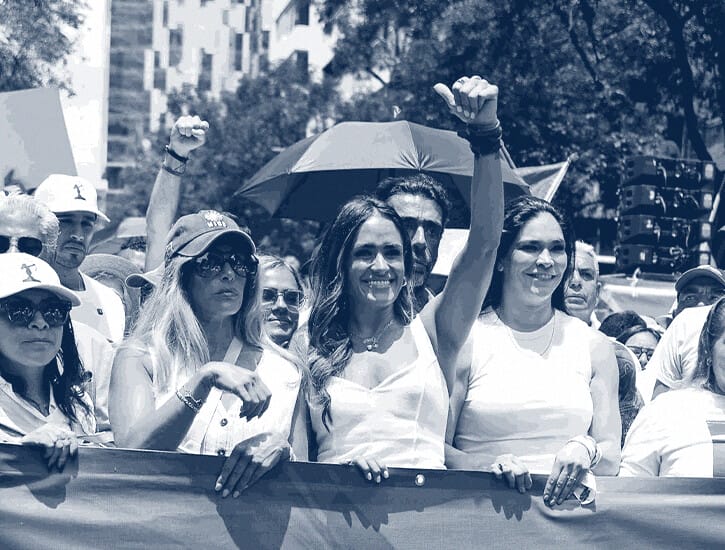
Alessandra Rojo de la Vega marches in Mexico City, August 2025. | Instagram/The Baffler
You’d think that Alessandra Rojo de la Vega, the mayor of Mexico City’s central Cuauhtémoc district, would have known better than to plan a march in the middle of her district on the same day as the Mexico City marathon. By noon on August 31, when the marathon’s stragglers were still sweating up Paseo de la Reforma, hundreds of demonstrators cut through the race to where de la Vega stood on a platform clutching a microphone, welcoming the crowd to the launch of her new political movement, Resistencia Democrática. “It hurts to see that this country is repeating the steps that led Venezuela, Nicaragua, and Cuba to lose their democracy, their voice and their future,” she proclaimed. “We’re not going to permit that in this country.”
De la Vega is just one of several rising political figures opposed to Morena, the left-wing party currently in power. Amid escalating dissent and repression throughout the country, the party’s founder, Andres Manuel López Obrador, known to most as AMLO, was elected to the presidency in 2018, promising an end to the rule of neoliberal elites and a restructuring of the Mexican state to address corruption, poverty and inequality—the so-called “fourth transformation.” He expanded social programs, increased the minimum wage and pushed through a series of infrastructure projects; those projects drew criticism, however, for overriding indigenous consultation processes, and they were overseen by a military with a growing role in public life, while violence continued to spread across the country. The 2024 elections brought his successor, Claudia Sheinbaum, to the presidency and gave Morena the majority of the legislature and governorships throughout the country, a shift not seen since the rule of the Institutional Revolutionary Party (PRI) that lasted from 1929 to 2000. The PRI oversaw the consolidation of collective rights, including collective landownership, until a neoliberal turn in the late 1980s. It was succeeded by the National Action Party (PAN) taking the presidency in 2000.
The opposition has found allies in international right-wing movements.
To combat Morena’s grip on power, a coalition has formed across ideological divides between the once-hegemonic PRI, the center-left Party of the Democratic Revolution (PRD), and the historic right-wing PAN. They dispute the reorganization of institutions that has occurred under Morena, including reforms to the nation’s courts that they argue gives the party in power unfair sway over the judicial branch. As Will Noah points out in a recent essay for n+1, reviewing a book by anthropologist Claudio Lomnitz, it’s difficult to pin down the lines of division between support for Morena and the opposition. From afar, support for Morena seems broadly divided across class lines, but Lomnitz posits that the division has more to do with support for economic integration with North America: Morena, at least in rhetoric, fiercely defends Mexico’s national sovereignty, though in practice, it continues to promote close trade integration with the United States.
The opposition has found allies in international right-wing movements. This summer, for instance, de la Vega traveled to Spain for a conference hosted by the Fundación Internacional para la Libertad, an organization that advocates for limited government, individual liberties, and free-market policies. While in Madrid, she put out a social-media call for the August march to launch the Resistencia Democrática. She returned to Mexico with a burst of anticommunist sentiment: on July 16, she removed statues of Fidel Castro and Che Guevara from a park that marked the Cuban revolutionaries’ meeting place.
The Sunday morning found a crowd of several thousand dressed in white, per Rojo de la Vega’s call, and awaiting instructions. Not all of them were merely concerned citizens, though: it’s common practice for political parties to bus in members of party-affiliated base organizations to fill out marches, paying them a day’s wage to hold up signs and pad the numbers. This reporter confirmed the strategy after running into an acquaintance who worked charging customers at a neighborhood taco stand. “Did they invite you too?” she asked. No—who? Officials had invited district street vendors, who are organized into associations that often require presence at political acts.
Alongside the paid protesters, other demonstrators were motivated by a wide array of concerns, domestic and international. Some passed out glossy fliers warning of the risks of Covid-19 vaccination and masking. To them, the effervescence of the 2018 election of AMLO gave way to disappointment that international forces—from BlackRock to the United Nations—still held sway in the country despite AMLO’s criticizing them. They were more loose electrons than party adherents: “We like to participate in demonstrations that show discontent, because here we find eyes and ears ready to understand the root of these evils,” explained Balam Bocanegra, a business owner. “Obviously in this march there will be people who still believe in some political party, and we respect it, but it’s really not about changing political parties.”
Alongside him was Juan Marcos, who works as a maintenance man at a school outside of Mexico City and for whom the Covid-19 pandemic was an inflection point. He was once an avid supporter of AMLO. Among the campaign promises that most inspired him was AMLO’s promise to restore Luz y Fuerza del Centro, a state-owned electric company whose dissolution in 2009, as part of a privatization push by PAN President Felipe Calderón, left thousands of workers unemployed and pensionless. Juan Marcos’s faith began to dwindle, though, when he failed to follow through during his six-year term. When he started watching videos on Facebook that called into question the legitimacy of the pandemic shutdown in Spain, he found himself led down a path that further undermined his support of the former president’s political project.
Juan Marcos’s explorations took him to Telegram, where he came upon content questioning the World Health Organization, the United Nations, and the Davos Forum’s role in global governance. Suspicion of international organizations stoked Juan Marcos’s concern over a recent, Morena-led legislative package to implement a biometric system linked to Mexican residents’ individual identification numbers (CURP). Its passage in June stoked Juan Marcos’ fears about global surveillance and tech hegemony. “Their objective is that they want to enslave us with biometric data,” he assured me.
Minerva Guzmán, a seventy-two-year-old retired university administrator, shared Juan Marcos’s concerns. “With the biometric CURP they’re going to know even when you go to the bathroom. They’re going to see how much money you have, how much money you spend each week,” she warned. Despite being eligible for a pension for the elderly, one of Morena’s hallmark social programs, she has never collected it. “It seems to me like buying people to have them on their side,” she explained, characterizing such programs as “blackmail.”
Such programs aren’t distinct to Morena. The PRI began conditional cash transfers as the basis of social welfare in the 1990s. Morena has significantly expanded the benefits, though, as well as building out a public banking infrastructure instead of distributing benefits through private third parties. Nor is the biometric CURP symptomatic of Morena’s unique interest in surveillance technology: PAN and PRI administrations had unsuccessfully proposed versions of the program in the past, and the proposal was financed by the World Bank.
The Resistencia Democrática march also capitalized on ongoing concerns about violence in Mexico. A few days before the demonstration, PAN Senator Lilly Téllez, a former television personality, appeared on Fox News accusing President Sheinbaum of ties to drug cartels and expressing her support for Donald Trump’s designation of drug cartels as foreign terrorist organizations. The president responded in her morning press conference, condemning Téllez’s calls for intervention.
In her attempt to manufacture consent for U.S. intervention, seemingly fancying the PAN the beneficiary of such meddling, Téllez overlooked the tight existing cooperation between the Sheinbaum and Trump administrations. Also present at the August march was the former PAN-PRI-PRD presidential candidate Xóchitl Gálvez. When asked about Téllez’s declarations, she pointed out that “the president herself is accepting the support of the US to incarcerate [and] investigate the drug traffickers that have our country suffering.”
In order to gain ground in the 2026 and 2027 elections, the right has chosen their tactics: casting themselves as a return to democracy and reason.
As the cooperation continues, so, too, do the human rights crises that took off under President Calderón, in cooperation with the United States’ drug wars. Police, prosecutors and the justice system continue to facilitate violence and impunity, nowhere more starkly than in the current crisis of 133,000 disappeared people. Tens of thousands of unidentified bodies languish in state custody, the lack of forensic identification allowing disappearances to remain unsolved indefinitely. Mothers of disappearance victims, organized in local search collectives and national networks, typically staunchly avoid allying themselves with political parties. A rare exception is Ceci Flores, a mother from Sonora who searches for her two missing sons. She made public appearances during the 2024 presidential campaign with Gálvez, and she also attended the Resistencia Democrática march.
One of the most prominent opposition figures is billionaire media and business magnate Ricardo Salinas Pliego, who in September announced the creation of his own political organization, the Movimiento Anticrimen y Anticorrupción. In an interview with journalist Ramón Alberto Garza, Salinas Pliego laid out his platform for a potential 2030 presidential run. To fulfill his vision of “a country of freedom that permits innovation, competition and prosperity,” he hinted at a voucher scheme for financing private schools, and he derided the national teachers’ union—one of the strongest bastions of organized labor power—as extortioners.
Pliego may also have the backing of an emerging religious arm of the opposition. Among those hopeful about a Pliego presidential run is Raúl Tortolero, a former PAN official, right-wing ideologue, and the founder of the National New Right Council. The nascent organization, founded this summer, promotes what Tortolero calls a “Christian counter-revolution” against the historically secular Mexican state. Their vision includes a reduction of state social spending, replacing cash-transfer programs with loans, and dismantling access to abortion and LGBTQ+ rights.
“He’s someone on the right, always pro-business,” Tortolero said of Pliego in a phone interview. Most significantly, Salinas Pliego’s businesses cater to the working class: his TV Azteca channel is the second-most viewed channel in Mexico; his Grupo Elektra’s companies are among the principal providers of financial services to people without bank accounts in Mexico; the retailers Elektra and Coppel are best known for selling household appliances in installment payments. A 2007 Forbes profile credited him with innovating debt-collection schemes. “Salinas says, unapologetically, that his bank charges customers—the poorest inhabitants of a poor nation—an average interest rate of 50% annually, or 1% per week,” Forbes noted.
The Council includes members of several political movements seeking to build right-wing platforms for 2030. Shortly before de la Vega’s march, she also participated in a prayer session with the National New Right Council. The organization requires members to be professing Christians, whether Protestant or Catholic, and to subscribe to seven points, which include the defense of life starting at conception and the defense of the heterosexual family. Those are points of tension with de la Vega, who has participated in abortion and pride marches. “We approached her because she is opposition in terms of political parties, but we’ve been trying to push her towards conservatism, towards the right or at least center-right, and that’s why we’ve prayed with her,” Tortolero said.
For Raúl Tortolero, cultivating anti-elitism is key to a new right agenda. To that end, he has released on digital platforms a handful of songs espousing his ideas. “Somos la derecha popular” boasts, to a rock-ska backing track, of being friends with electricians, plumbers, waiters, and mechanics. “No elitism here, much less racism, just pure Christianity, love, idealism, solidarity and community,” sing the AI-generated vocalists. On Spotify, as of mid-October, the page had just ten listeners.
Next June will bring congressional elections that will be the opposition’s first major test against Morena’s majority in the legislature; seventeen states will also choose their governors. In order to gain ground in the 2026 and 2027 elections, the right has chosen their tactics: casting themselves as a return to democracy and reason, in opposition to a corrupt “communistic” threat fueling the rise of crime. But for now, it’s unclear where they would draw the broad support necessary to oust Morena, especially as a movement aligned with Trump’s brand of far-right leaders. Sheinbaum’s skillful negotiation of the relationship with Trump, a roundly unpopular figure in Mexico, seems likely to keep Morena in good graces.