, March 5, 2026
The Darkness from the Darkness
Pain and passion in the limbo of suffering
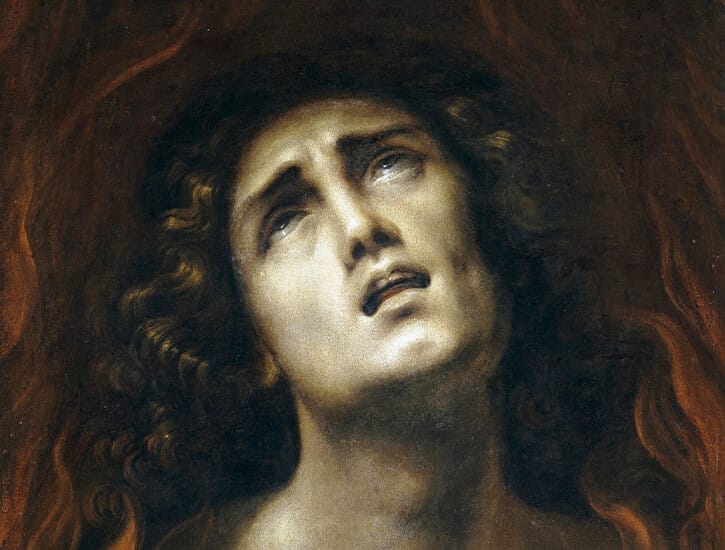
El Alma En Pena by Francisco Ribalta. | Wikimedia Commons
.jpg)
This Is the Door: The Body, Pain, and Faith by Darcey Steinke. HarperOne, 288 pages. 2026.
There’s a line by Heinrich Heine that irked me when I first read it and irks me now when I read it again: “Psychical pain is more easily borne than physical; and if I had my choice between a bad conscience and a bad tooth, I should choose the former”—which, if I didn’t know better, makes Heine sound as if he’d never been truly torpedoed by psychical pain. Psychical pain, the real thing, causes physical pain: the heaviness of the head, the tautness of the chest, the gnarling of the intestines, the constriction of the throat, and all those bruises from banging into objects because depression warps your vision. Besides, there’s opium and extraction available for that bad tooth; I have yet to come across an opium or extracting method for the diseased soul.
Orwell’s Winston Smith, though, concurs with Heine: “Of pain you could wish only one thing: that it should stop. Nothing in the world was so bad as physical pain. In the face of pain there are no heroes.” But Marx, in an 1881 letter, reverses Heine’s preference: “The only antidote to mental suffering is physical pain.” Hypothetically having to choose between mental torture and physical torture is rather like hypothetically having to choose between death by water or death by fire. Next question. Whichever your preference, evolution by Darwinian natural selection did a terrifically atrocious job confecting us. Our broken backs, busted knees, frail ankles, and impacted teeth are a resounding rejoinder to the notion that we were tenderly created in god’s own image, unless you’re prepared to accept a god with a broken back, busted knees, frail ankles, and impacted teeth.
In her beautiful new book, This Is the Door: The Body, Pain, and Faith, novelist and memoirist Darcey Steinke, author of the classic Suicide Blonde (1992), writes, “I am an ad hoc, jerry-rigged creature, one who carries with me, like all of us, every creature I have ever been.” She’s right: what wrecks we are, inside and out. What physical failures, to say nothing of our faulty psycho-emotional kit. Steinke claims that pain itself is a kind of failure, though definitely not a failure of our nociceptors, those industrious nerve endings responsible for sending the stabs and stings straight up to our brains. No, the nociceptors are successful beyond all measure.
Although Steinke has been battered by fluorescent migraines, knifing menstrual cramps, the asphyxiating pain of heartbreak, and the fogged anguish of melancholy, it was back pain that stopped the clock: “Pain brings us to our knees physically but also spiritually. I have often wondered if kneeling in a religious sense is a pantomime of the way pain can drive a body down to the earth.” Steinke dedicated the book to her back surgeon. Her potent descriptions of her back pain and the motley pain of others will put you in mind of Lear’s lines to Cordelia: “I am bound/ Upon a wheel of fire, that mine own tears/ Do scald like molten lead.” Edgar says to himself when beholding a blinded Gloucester in the same act: “The worst is not/ So long as we can say ‘This is the worst.’” In other words, suffering is better than being dead. If you say so.
Having to choose between mental torture and physical torture is rather like having to choose between death by water or death by fire.
How did Steinke’s back feel in its worst moments? “Like a nail was lodged in my hip socket,” “a hot coal was smoldering inside my buttocks,” and “a sparking electrical wire was running down my right leg.” Anyone with sciatica, blessed prescriptions for gabapentin and oxycodone, and a pocketful of prayers will immediately know what Steinke means. “Pain,” she writes, “is prayer’s fuel,” and continues, “Suffering, no matter its cause, separates you from the world you knew and pushes you into a limbo between what was and what might be. Prayer and meditation are attempts to make a hole inside that abyss, to make a space inside the claustrophobia of suffering, to cut the cut.” Not just any limbo but, she later writes, “a theological limbo.” Suffering maneuvers you to the midpoint between belief and heresy.
So the worldwide legion of sufferers counts Steinke as one of its dues-paying members, and she has interviewed scores of her fellows with brutalized bodies, cracked hearts, throbbing souls, and ailing minds—interviews, she contends, that took on a “holy atmosphere.” Steinke has divvied the book into ten luminous chapters: Spine, Knees, Heart, Brain, Skin, Breast, Heartache, Suffering, Soul, Healing. She rolls out a procession of artists, writers, musicians, and seers whose lives were violated by suffering: Frida Kahlo, Franz Kafka, Bernadette Soubirous, Friedrich Nietzsche, Alice James, Fanny Burney, Simone Weil, Audre Lorde, Carolee Schneemann, and Kurt Cobain, among a chorus of scholars and researchers attempting to comprehend why we suffer and what it all might mean.
Steinke’s father was a Lutheran minister; the theological thinking she sponged from him while growing up became “part of how [she] tried to understand pain.” There’s an ancient and fruitful nexus between religion and suffering—in Donne’s day, this species of depression was tagged “religious melancholy”—though one of religion’s selling points is that it’s supposed to help the afflicted become less so. “Although I don’t consider my pain sacred,” Steinke writes, “the stillness it engenders may be. Pain made me realize I was less a creature with a reliable inner identity than a penetrable ecosystem.” She calls pain “a malevolent force”—pain as iniquity, a scourge straight from the hellmouth.
Suffering prods you to the very lip of despair, and as you kneel at the precipice, looking over into the void, you confront despair not as a mere synonym for depression or dejection, but as the sin of Catholic doctrine, the voluntary sin of denying God’s grace, God’s mercy, God’s goodness. There might be only one problem with that doctrine as it relates to pain but it’s a doozy: pain is not voluntary, and so neither should be the repercussions of that pain, even when those repercussions mean a repudiation of the god who lets it happen. Steinke quotes Martin Buber: “What do we expect when we are in despair? Surely a presence by means of which we are told that nevertheless there is meaning.” The Jewish philosopher is free to think that; the despairing Catholic, eschewing the virtue of hope and divinely mandated mercy, knows he’s damned.
Steinke confesses that her pain “is also a kind of passion”—a Passion in the spiritual, sacrificial sense—“one that can be quieted somewhat by memories of bliss,” by which she means that the memories are a reminder that her body “has many capabilities.” I have to admit that she somewhat loses me there, and then loses me again when she quotes Frida Kahlo: “Pain does not chase out pleasure.” But of course it does, in the same way that food chases out hunger, though I suppose it depends on its severity. Severe pain has no memories of bliss; severe pain, per Winston Smith, has only hope for cessation. Steinke is more on the mark when she contradicts herself, disclosing that her pain is worsened by “memories of earlier periods of suffering, and my fears about what the future might hold for a damaged body like mine.”
Speaking of pleasure—Paul Valéry asked this in 1942: “What golden hour of life, what glittering moment will ever equal the pain its loss can cause?” And since those golden hours and glittering moments—our pleasures—are always slipping away from us, denying our desire to abide in them, it follows that living is mostly pain produced by loss. In his heroic drama The Indian Emperour, Dryden has these lines: “For all the happiness mankind can gain/ Is not in pleasure, but in rest from pain.” The unbending stipulations of existence flat-out refuse the request of the hedonist; none of us can safely rely on pleasure, or at least not on its lasting. The avoidance of pain is the best we can strive for.
Our pain has such chromatic variety we’ve concocted chromatic synonyms, each singing of the same state and our wish to reverse it: anguish, agony, ache, affliction, misery, suffering, torment, torture, throe. As her mother dies of a mutinous heart, of coronary arteries gridlocked with calcium, Steinke knows that “the word pain seems inadequate to describe the body’s sensations as it transitions from life to nothingness.” What do we call the onset of obliteration? Steinke makes the astute distinction prior to an astute diagnosis:
Suffering is complex: Wider than pain and sickness, it’s a premonition of the ultimate disorder of one’s person; it’s the frustration of the fulfillment of one’s being, an experience of alienation, helplessness, hopelessness; it’s a threat to one’s social position; it’s a loss of a former self and a former way of life; it’s the uncertainty of the focus and hope in one’s life; it’s the nexus where finitude and infinity meet.
And what of illness, a category with breadth enough to accommodate sundry sufferings? “Illness grasps people by the soul as well as by the body and upsets both.” By upsets, Steinke means upends, unstrings. Some of the most moving and memorable portions of the book are those devoted to the dying of her father from cancer and the dying of her mother from heart disease. A decade before her mother died, she required a mastectomy for breast cancer, and here Steinke shows herself at her loving best: “I’ve suffered menstrual cramps, abortion pain, labor pains, hot flashes, the anxiety and exhaustion of sexual harassment, but the female somatic pain that has most affected me was not mine but my mother’s. Pain not in my own body but in the body that made mine.”
The nineteenth-century British wit Sydney Smith saw that “there is not the least use preaching to anyone unless you chance to catch them ill,” but Steinke’s minister father, as with others she details, proved an inverse case: his belief absconded with his health, and he seems to have accepted that. With the wasted body, in the desert of anguish, “our spiritual ideas are shaken, possibly even obliterated.” In his astonishing “Child Harold,” written in High Beech asylum in 1841, John Clare refers to “Pale death the grand phis[i]cian” who “cures all pain”—because for the succorless afflicted in the fist of terminal disease, only one physician will do. You don’t need to be a lunatic genius to see it.
The world appears to prefer us in pain; Steinke quotes one of Kafka’s aphorisms: “In the fight between you and the world, back the world,” which recalls Philip Larkin’s declaration that “Things are tougher than we are.” They always have been. The unjustly neglected 19th-century British poet and Catholic mystic Francis Thompson has this dourly accurate final stanza in his songful poem called “Daisy”: “Nothing begins, and nothing ends,/ That is not paid with moan;/ For we are born in other’s pain,/ And perish in our own.” Good luck contradicting that.
Hannah Arendt, with characteristically unblinking acuity, in her 1958 book The Human Condition (which I’m surprised Steinke does not consult), imparts this: “The human condition is such that pain and effort are not just symptoms which can be removed without changing life itself; they are rather the modes in which life itself, together with the necessity to which it is bound, makes itself felt. For mortals, the ‘easy life of the gods’ would be a lifeless life.” To which one yearns to respond: Do speak for yourself, Ms. Arendt.
You see what Arendt is doing here, precisely what thinkers and sufferers have been doing since Solon uttered “Count no man happy until he is dead” in roughly 440 BC: she is attempting to attach meaning to the ineluctable suffering that precedes ineluctable death, because if one can locate meaning in suffering, one can locate meaning in living. Christianity’s contribution to this (suffering begets deliverance) is also the chief reason it’s the most successful brand in history—everybody suffers and pines for deliverance—making Coca Cola look paltry by comparison. Steinke is worth quoting at length here:
I walk a tightrope between raging against my pain and trying to search for any scraps of meaning that might be left in its wreckage [. . .] Pain, like an extreme version of modern secular life, forces me to exist without foundation or certainty. Does pain educate? Is pain always a physical experience of negation? What can we learn from wounding, from winnowing, from the stillness, the de-creation that intense pain brings? Does pain obliterate me but also somehow re-create me? [. . .] The pain of my birth brought me into life. Now pain transforms me again, changing my values, my empathy, my idea of the world around me, even the depth and intensity of my ability to love.
The bodybuilder’s bumper-sticker mantra, “No Pain, No Gain,” refers to the ecstatic physical hurt of tearing muscle tissue with iron so that the tissue will self-repair with greater bulk. Steinke embraces the psycho-emotional version of this, one that’s downright false at least as often as it’s dubiously true. In her closing pages, she sanctions the cliché that suffering is conducive to art. Even William Blake, no stranger to the fangs of melancholy—in his study hung a print of Albrecht Dürer’s 1514 engraving Melencolia I—knew better: “I sometimes try to be miserable that I may do more work, but find it is a foolish experiment.” One of Steinke’s interviewees, a dignified nurse with a ravaged knee, is fed up and bitter enough to say plainly, “There is nothing, as far as I’m concerned, to learn from pain.”
It is only too human that we wish our suffering to be gravid with significance, to indicate meaning beyond the apparently wasteful stranglings and strafings.
Steinke loses her footing here: “People are destroyed not by suffering but by suffering that is devoid of meaning. Meaning is bigger than a diagnosis or a cure.” She isn’t normally on familiar terms with fatuity, but here they are bedfellows; just ask any stage-four cancer victim if she’d prefer the meaning to the cure. Nor is Steinke above the handy stereotype that says the artist is a depressed half-maniac who creates to quell the soul’s sharp ache: “Creativity itself is nurtured by suffering.” No it isn’t. Flaubert insisted that the writer must be placid in his life so that he may be turbulent in his work. Intense suffering makes rag dolls of artists just as it does of everyone else. Try selling that suffering-artist stereotype to the jolly old ghost of John Updike, his prolificacy so epic his detractors no doubt considered paying him not to write.
About Kurt Cobain, whom she profiled for Spin in 1993, Steinke says: “Kurt wrote songs to process his pain.” No he didn’t. No artist does that, or not consciously, and if he tries, it will be bad art, “a foolish experiment”—bad because desperately sincere, crammed with genuine feeling at the brink of bathos. And you’ll remember what Wilde taught us about sincerity, art, and genuine feeling: “A little sincerity is a dangerous thing, and a great deal of it is absolutely fatal.” And: “All bad poetry springs from genuine feeling.”
Cobain made art because he was helpless not to, because the inventive itch was in his blood. He would have composed songs even if he’d been as jolly as Updike; they might have been different songs, okay, but they would have been songs just the same. “Kurt,” Steinke believes, “was drawn to the precipice between life and death”—another cliché, the very one that neutered Oliver Stone’s film about Jim Morrison. Narcotized rock stars are not shamans armed with abracadabra, whirling on the demarcation between life and whatever comes next. That’s silly. The Doors (Blake’s “doors of perception”) and “this is the door”: the door to what? Steinke doesn’t say but it’s clear enough: to the other side of her pain—“Break on through to the other side.”
It is only too human that we wish our suffering to be gravid with significance, to indicate meaning beyond the apparently wasteful stranglings and strafings. When Emily Dickinson writes “After great pain, a formal feeling comes,” she means that great pain morphs you into something almost “mechanical”; it hollows you out, turns you into a blinking automaton. There’s nothing to be learned, nothing to be gained from that species of torment.
I’ll leave you with the sapient last stanzas of “90 North,” one of Randall Jarrell’s unimprovable poems, the final two lines coming down like a gavel:
Here at the actual pole of my existence,
Where all that I have done is meaningless,
Where I die or live by accident alone—
Where, living or dying, I am still alone;
Here where North, the night, the berg of death
Crowd me out of the ignorant darkness,
I see at last that all the knowledge
I wrung from the darkness—that the darkness flung me—
Is worthless as ignorance: nothing comes from nothing,
The darkness from the darkness. Pain comes from the darkness
And we call it wisdom. It is pain.