, December 10, 2025
Superlatively, Actually Awake
Solvej Balle’s petri dish of time and memory
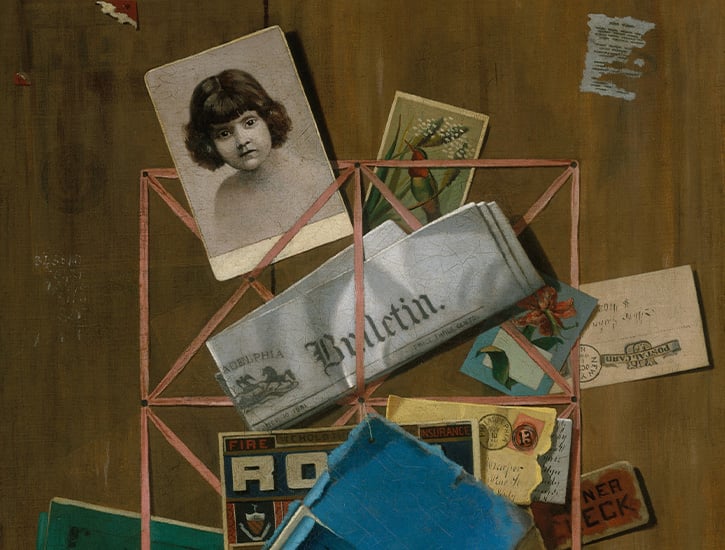
Old Souvenirs by John F. Peto (ca. 1881–1901) | Metropolitan Museum of Art
On the Calculation of Volume (Book I) by Solvej Balle, translated from the Danish by Barbara J. Haveland. New Directions, 160 pages. 2024.
On the Calculation of Volume (Book II) by Solvej Balle, translated from the Danish by Barbara J. Haveland. New Directions, 176 pages. 2024.On the Calculation of Volume (Book III) by Solvej Balle, translated from the Danish by Barbara J. Haveland. New Directions, 144 pages. 2025.
For the last forty years, Clive Wearing has lived in something like a state of perpetual rebirth. After his nervous system was attacked by the herpes simplex virus in 1985, he became incapable of storing new memories or accessing old ones. The accomplished musicologist was left with a memory span of only a few seconds, and now lives quietly in a care home, where he keeps a diary:
8.31am NOW I AM
REALLYCOMPLETELYAWAKE (1ST TIME). PATIENCE.
9.06am NOW I AMPERFECTLY,OVERWHELMINGLYAWAKE (1ST TIME).1STSTROLL.
9.34am NOW I AMSUPERLATIVELY,ACTUALLYAWAKE (1ST TIME). LOO CALLS.
Reading the first three volumes of Solvej Balle’s septology On the Calculation of Volume, I was struck by how the predicament suffered by the narrator, Tara Selter, is almost the exact inverse of Wearing’s. She awakens every morning on the same date, November 18—though with memories of all the iterations of November 18 that have accumulated since she became stuck in time. After 121 days, Tara begins keeping a diary to monitor her condition: “I have written the eighteenth of November again and again and still the nineteenth hasn’t come.”
Previously, Tara was an antiquarian bookseller and resident of the fictional French town Clairon-sous-Bois, where she lived with her husband, Thomas. But after waking up in a Paris hotel room on what should be November 19, she discovers that the calendar has rolled back, and she’s fallen into an inexplicable Groundhog Day-like rift. She calls Thomas, who feels faint and uneasy that she has a memory of a phone conversation that he doesn’t recall. He does, however, believe she’s telling the truth. The couple discusses and discards possible explanations: “hallucinations or memory blips, misunderstandings or misinterpretations, temporal loops or parallel universes, but we could get none of these to make sense.” They conclude the only reasonable solution is for her to return home.
Initially, Tara is satisfied waking up next to Thomas and explaining the nature of her situation at the turn of every day. He listens, and makes pains to establish a sense of normalcy. At first, Tara tries to mimic his forgetfulness in “an unconscious exercise in fuzziness” and so manages to extend her “sense of neutral, indefinite morning,” wandering through her recurring November 18 in a “a cloud of theories, observations and interpretations.” Together, they try to determine the laws of the time loop: how some objects stay with her overnight while others disappear, or the exact moment at which the calendar resets, which is never quite the same. Eventually, however, the fog lifts from Tara, and their routine becomes too much: “We were living in two different times . . . we could not find a way forward.” She secludes herself in a guest room, and begins to write the books we read.
Many of the English-language reviews of Balle’s series have focused on its speculative narrative engine and the broader notion of time. In 4Columns, Ania Szremski writes, “Time has stopped, glitched, stuttered, suddenly contracted to a single point. It has ceased acting like a river for Tara—it has become a room, a vessel, a container.” But this description is only partially correct. Tara does characterize time as a “container,” which aligns with the prevailing view, post-Einstein, of a “block” universe where time is not an “arrow” with forward momentum but an infinite plane of simultaneous discrete coordinates. Yet Balle is more interested in the nature of memory—that is, human perception of time, rather than the fundamental nature of time itself. Though it seems silly to say that time does not “move” and our perception of “movement” is a function of how our consciousness attributes causality, ex post facto, this is the ancient fact that Tara’s absurd condition makes explicit: how storytelling systematizes our memories, our sense of self.
The first three volumes of Balle’s series are anchored by a rhythmic torpor, in both content and form.
Tara’s circumstance, then, is not remarkable for the fact that she stands outside of time, because she doesn’t; she is more bound to it than ever, anchored by her memory of all the reruns of November 18, while everyone else has developed anterograde amnesia not unlike Clive Wearing. For the brief period that Tara is able to achieve a semblance of peace after returning to Thomas, it is for her effort to mimic this condition of forgetting, to occupy the haze of “gray morning light” in a routine that abides to “no memory and no plans.” Tara is challenged, like many of us, by the persistent tension between the comfort of what is known and the dissociation borne by a life without vividness; she can only endure her self-appointed brume to a point. She knows that she cannot live forgetfully, resigned to “a state of the utmost naivety” and “the gentle grip of apathy.” If she does, she will lose her sense of self.
To construct an illusion of temporal progression, Tara travels to Sweden in search of “winter.” Her movement—from Sweden to Norway to Finland and then south—is driven by equal parts attraction and repulsion. “Seasons are not scenes and locations,” she reflects later in the second volume. “And you cannot construct a year out of fragments of November. Of course you can’t.” Tara’s path is set, in part, by a meteorologist she encounters, explaining that she’s searching for the shooting locations of a film. The meteorologist anticipates Tara’s later reflection with the observation that seasons are not “meteorological phenomena” but “memory concentrates. Accepted stereotypes. Conglomerates of experiences and feelings, perhaps.” Tara remembers the feeling of each season, but it is never satisfied in reality. She seeks a phantom ideal held in the territory of memory that becomes more potent for the impossibility of its actualization.
After a sojourn in the South of France, Tara abandons her experiment and, settling for a while in an apartment in Düsseldorf, takes up an obsessive study of Roman history. Despite her profession, Tara had not previously possessed a particular interest in history as a social force. To her, history was the objects that had dropped out of the past, objects that lacked depth and “had not been anything except the period that had produced them.” But now she sees herself and a Roman sestertius coin she had bought for Thomas as “two of a kind”: a substance crystallized in time, “Stop. Fixed. Chink.” Tara’s historical investigations give her a new feeling of movement, of her brain growing through both remembering and forgetting.
As Tara begins to view history as discrete moments contained in time, she sees containers everywhere. “Everything has become a container,” she observes, including the loop that she has found herself caught within. But these containers are porous, mutable, and incomplete: the sestertius disappears after she first gives it to Thomas, while the borders of the Roman empire shift, collapse. What Tara wants is a life with clear and abiding rules. Like with her seasons, her dilemma arises from the fact that her desire for consistency and permanence competes with her simultaneous need for chaos and disintegration, “as if it is the dissolution that holds things together.”
If the first volume of the series roughly corresponds to Tara’s concerns about love lost when memories can no longer be accumulated between two people, the second volume shifts its concern to planetary memory; that is, the ways in which the earth maintains a historical record of human activity. On one level (and the novel has been broadly billed as being about climate change), the symptom may be the inclemently warm British weather that allows Tara to experience spring weather in November. Or it could be how everything Tara consumes does not replenish once the clock resets. In this sense, she attempts to calculate and minimize her own volume in terms of her ceteris paribus exhaustion of the world. “I don’t want to be a monster,” she says, “I walk a fine line, I tread carefully through the world, I leave as small a trail as I can.” Like the narrator of H. P. Lovecraft’s novella The Shadow over Innsmouth, Tara slowly and horrifically awakens to the depth and scope of her monstrosity, emptying grocery stores and produce markets. Even her consumption of Roman history is described as “monstrous.” Otherwise, Balle characterizes Tara scantly. She is conceivably not so different from you or me.
In the third volume, Balle broadens her thematic scope. Tara falls into a new rhythm after she meets a man called Henry Dale at a lecture. He is also stuck in the time loop, and introduces a charge of potential to Tara’s routine. He is in Düsseldorf from Oslo for a sociology conference to discuss his theory of “abruption,” the human capacity for identity ruptures, and to his mind a distinctly human evolutionary trait. He also shares a name with the Nobel laureate recognized for discovering neurotransmitters as the material that puts us into communication with our own bodies and the world. Strangely, Tara and Henry have two different sets of rules governing their days—what is remembered by digital devices, what objects follow them. Their calendars are slightly different too. Henry has been trapped in November 18 for longer, although they acknowledge their systems of measurement are imprecise. They recognize the seemingly inconsistent nature of the loop, and describe their circumstance as “a world of cracks and inconsistencies.” After two hundred days together, the pair separates and return to their families, promising to reunite in Düsseldorf on the anniversary of their first meeting.
Stylistically, the first three volumes of Balle’s series are anchored by a rhythmic torpor, in both content and form. Although Balle employs cliffhangers as a narrative gambit to propel the reader from one volume to the next, she often accretes details toward some sense of mystery or suspense only to abruptly reorient her focus, like in the case of Henry, or the rather sudden ending to Tara’s seasonal pursuit. By nature, Balle seems uninterested in developing tension, or other conventional aspects of the novel, like character or plot. Instead, she treats her speculative framework like a petri dish—another container—wherein she can experiment with new lines of inquiry in clipped, plain language, without ever intending to arrive at an absolute solution or a unifying theory. In fact, the deeper mystery of the books is not the cause of the time loop but the elusiveness of a distilled language to accurately describe the feeling of the condition.
Balle treats her speculative framework like a petri dish wherein she can experiment with new lines of inquiry in clipped, plain language.
Part of Tara’s trouble comes from the fact that she is someone, like many in a hyper-therapized Western world, that can describe her feelings with precision while at a remove from their embodiment. She often investigates the notion of longing, and the longing of others, but it is always treated as a noun: something that can be exchanged with one person or another (Henry: “Maybe he would take the longing with him when he left”) or found in the sounds in the streets of Düsseldorf or the garden behind her house in Clairon (“They had begun to sound like longing”). The only time Tara discloses she has longed—when her desire is not a possession, but an experience—comes in the second volume, when she’s squatting in Bergen and rain turns to snow. She has traveled to Scandinavia in search of winter, and amid “all the whiteness” she realizes “I really longed to escape.”
Balle’s approach shares overarching similarities with writers like fellow countrywoman Inger Christensen, who used mathematical form and repeated language in works like alphabet and The Painted Room, or with Georges Perec’s idea of the “infra-ordinary”: “what happens every day and recurs every day: the banal, the quotidian, the obvious, the common . . . the background noise, the habitual.” But more than either of these authors, Balle’s project is perhaps most reminiscent of the nouveaux romans of Alain Robbe-Grillet, which sought to reorient novels from a focus on plot and character toward a method of objective description that aroused readers to their role as subjective meaning makers of the text.
In Robbe-Grillet’s novel Jealousy, the narrator watches the interactions between his wife, A, and their neighbor, Franck, with whom he suspects A is having an affair. He obsessively repeats observations of events and his suspicions such that it becomes impossible to distinguish between the two. Robbe-Grillet’s repetitions are vertebral, giving structure to the text, while at the same time subtly implying the destabilizing emotional perspective of the narrator by calling to question his supposed objectivity. In Roland Barthes’s essay on “objective literature,” he refers to this as Robbe-Grillet’s preoccupation with apprehending “the object as in a mirror.”
Barthes argues that Robbe-Grillet’s focus on precision in place of lyricism is in the interest of inspecting the surfaces of objects impartially, without any apparent hierarchy of detail. As opposed to the conventional novelist who makes a point of curating a clear informational hierarchy, Robbe-Grillet favors an observational equality—invariably precise, unadorned descriptions—that increases ambiguity. Without traditional markers of time, precise and discrete descriptions of the environment evoke concrete imagery that coheres and contradicts between one and the next, leaving it to the reader to interpret and construct a sense of narrative time. In his introduction to his script for the film Last Year at Marienbad (1961), Robbe-Grillet writes of what this is intended to evoke:
In reality, our mind goes faster—or sometimes slower. Its style is more varied, richer, and less reassuring: it skips certain passages, it preserves an exact record of certain ‘unimportant’ details, it repeats and doubles back on itself. And this mental time, with its peculiarities, its gaps, its obsessions, its obscure areas, is the one that interests us since it is the tempo of our emotions, of our life.
On the Calculation of Volume is a project that seeks to both mimic—and elicit a recognition of—this mental time. Sometimes Tara’s entries cover hundreds of days in a relatively short span; sometimes a single day unfolds over many pages. This is for the fact that in the boredom of a staid routine, Tara recounts little, and her sentences become clipped and sparse, the entries gauzy and thin. But when Tara is confused by the world and ignited by curiosity (her travels, her study of the Romans), her experience of life becomes longwinded, superabundant with repeating detail, creating—paradoxically—an effect that is engaging for its monotony, as a reader negotiates with Tara’s account to converge on an orientation of her mental time.
In For a New Novel, Robbe-Grillet writes that in modern narratives “time finds itself cut from its temporality. It no longer flows.” The flow, or lack thereof, is obscured or confused, granting the reader interpretive freedom in imposing their own mental time on the narrator’s experiences. This freedom allows the reader to apprehend the book as an object, or “a mirror,” a “rapture of a surface.” It is an experience of reading that is synergetic and thrilling, a feeling that conflicts with the inherently belated nature of reading. It allows you to arrive as a participant to a series of moments that are at once past and present; moments in which you are superlatively, actually awake.