, May 12, 2026
Rent Check Opera
The quagmire of New York City’s rent-regulated housing stock
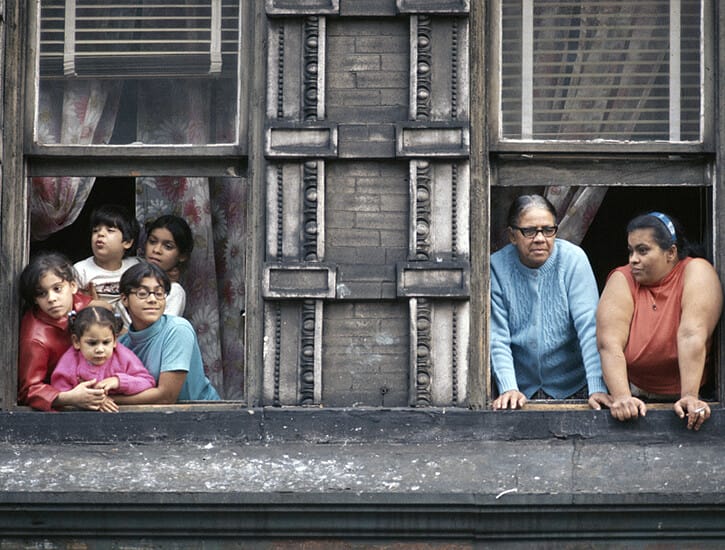
Tenants on the Lower East Side, 1970. Camilo J. Vergara. | Library of Congress
Last spring, I spent an afternoon watching two contractors install a drop ceiling in a derelict prewar apartment in Crown Heights. The new, lower ceiling would conceal the old one, which had sustained water damage over the years. It was a superficial—and very common—fix. The resident-to-come would probably lose about a foot of the room’s height, along with some tasteful old crown molding. The work was part of a maintenance blitz: Its landlord, Pinnacle Group—one of the city’s biggest holders of rent-stabilized units—had put up a majority of its properties for bankruptcy, and this building, along with ninety-two others, would be going to auction in a few months.
Foreclosures are a common enough occurrence in New York, but the Pinnacle case drew more attention than most due to the scale of its neglect, its CEO Joel Wiener’s astronomical wealth—he is one of New York’s chief slumlords—and its history of debt issuances in Israel. There’s also the ire of Mayor Zohran Mamdani, who hosted his first press conference in office at 85 Clarkson, a Pinnacle-owned building. It was there that he announced three of his administration’s first executive orders and vowed that his office “would be taking action in the [Pinnacle] bankruptcy case” to support the tenants involved.
Much ink has been spilled over the debacle, about the state of rent-regulated housing in New York in general, and about its future under the new mayor. Cea Weaver, now chief of the revitalized Office to Protect Tenants, wrote for Phenomenal World about the impasse that opposing agents of speculation and stabilization find themselves at. “New York City’s housing market,” she explained, “remains unaffordable for renters, and the cost of building and maintaining housing is higher than ever before for owners—but the financial struggles of the former are fundamentally different to those of the latter, and most proposed solutions to the second problem tend to intensify the first.” Charlie Dulik, a tenant organizer and former member of Mamdani’s transition committee on housing, wrote for n+1 on the mayor’s apparent openness to development and the attendant possibility of coalition-building. And Samuel Stein, a housing policy analyst, wrote for the New York Review of Books on Mamdani’s vision of “comprehensive planning,” of building up without necessarily engaging in the protracted process of rezoning neighborhoods.
Everyone seems to agree on a few things: For one, the current situation—in particular the growing gap between rents and operating costs—is untenable. While people differ on whether Mamdani’s election has exacerbated the problem, it is something of a consensus that it has accelerated into a so-called “death spiral.” And it is consensus, too, that the relevant landlords’ declining profits have presented a significant problem to their lenders—like Flagstar, the regional bank that financed much of Pinnacle’s growth. But disagreement starts to arise when you look at probable causes. Is it a supply problem—would more housing and less bureaucracy be the answer? Is it the greed of slumlords? Or is it, as many technocrats will argue, the product of the Housing Stability and Tenant Protection Act (HSTPA) of 2019, which curtailed landlords’ ability to deregulate housing and jack up rents?
Did the passing of the HSTPA really end the deregulatory trade, or did it merely accelerate its demise?
There was a time not too long ago when profit could be extracted almost at will from rent-regulated housing stock. Landlords would acquire buildings with distressed or vacant units and then undertake improvements to push rents above the deregulation threshold, allowing them to charge market rates and turn a hefty profit. Lenders were happy to pony up the necessary capital for this kind of speculation in a period defined by low interest rates. The HSTPA ostensibly put an end to all of this, presenting a crisis for landlords because the five- and ten-year mortgages many had taken out on had been priced explicitly with the expectation of deregulation. With that trade essentially eliminated, turning a profit at the anticipated rate became harder and harder, especially amid persistent inflation. Few people stray far from this basic outline. But it’s also worth complicating: Did the passing of the HSTPA really end the deregulatory trade, or did it merely accelerate its demise?
In 2018, the year before the HSTPA was passed, a little over 4,500 units were deregulated, a far cry from the nearly 13,000 in 2010. The decline, which occurred steadily over those intervening years, can be explained by a variety of factors, including the fact that not all of the existing rent-regulated housing stock was worth deregulating—some distressed stock was too expensive to be fully reengineered into a profit. This supply issue itself suggests that maybe the material decline commonly attributed to the passing of the HSTPA was already coming, albeit maybe more slowly. “At some point, you can’t pull blood from stone,” a New York landlord and investor told Bloomberg in 2024, referring to this shrinking pool of buildings.
For the past fifty-odd years, much of the declining profitability of rent-regulated buildings has been mediated by the nine-person Rent Guidelines Board (RGB), which is tasked with every year setting the allowable rent increases on one- and two-year leases for New York’s approximately one million rent-stabilized apartments. When Mamdani ran his campaign on a promise to “freeze the rent,” he was really promising to stack the board, as mayors normally do, and as he eventually did in February. There is precedent: When Mayor Bill de Blasio was in office, his RGB voted three times—in 2015, 2016, and 2020—to not allow increases on one-year leases and only allow marginal increases on two-year leases. It looks as if Mamdani’s board will do the same—in its preliminary vote earlier this month, it set a range of 0-2 percent on one year leases, and 0-4 percent leases, suggesting the final number will land at or near zero.
But freezing the rent only alleviates tension on one side of the equation. As Mark Willis, senior policy fellow at the NYU Furman Center for Real Estate and Urban Policy, said during his testimony to the New York City Rent Guidelines Board last April, “In a world of no inflation, no increase in operating costs, no increase in general inflation, I think the decision would be relatively easy: zero rent increases.” But in the current world, he continued, any reasonable rent increase “is below what is needed to cover increasing operating costs and inflation.” And while the administration has gestured at helping with costs—Mamdani announced a city-backed insurance program in April that promises to help landlords of rent-stabilized units save money on premiums—the relief will not arrive until 2027 and will start at just twenty thousand units. The fallout of this worsening crisis will be distributed unevenly; indeed, it already is.
What was once a battle fought between two, maybe three consolidated sides (tenant versus landlord or tenant versus landlord versus government) has devolved into a more complex negotiation. This is because of how the debt around these buildings is structured—how, more specifically, lenders and borrowers jointly signed off on overleveraging the housing stock in question.
Tensions between lenders and different borrowers hit a high last year. In March, the Spanish bank Santander took the unusual step of refusing to take the keys to a rent-stabilized building after the landlord, L+M Development, defaulted on a mortgage. L+M sued Santander and accused the bank of trying to seize some of its other assets instead, thereby breaking the mortgage terms. Santander responded by pointing to a “bad boy guarantee” in the contract terms which states that a bank can go after a borrower in the case that fraud, willful misconduct, abandonment, or physical waste of property is involved. A real estate analyst I spoke with described this as highly unusual.
Santander was not the original lender on the mortgage. The bank had purchased it along with other mortgages at a steep discount from the government, who had taken over Signature Bank’s portfolio of rent-regulated housing after it collapsed in 2023. Signature—which failed because of “poor management,” according to the FDIC—was one of a consortium of New York regional banks involved in rent-regulated lending. Among the biggest is Flagstar, which today has nearly $9 billion in outstanding loans to rent-regulated buildings. That exposure is part of a larger problem: According to Flagstar’s latest investor presentation, roughly 80 percent of Flagstar’s portfolio of rent-regulated buildings comes due between this year and 2029, including $2.9 billion in 2027 alone. And most of those loans were originated at rates far below the current market rates meaning that refinancing today would doom many borrowers. This “maturity wall” is partially why the SEC requested information from Flagstar (along with other regional banks exposed to rent-stabilized housing) in 2024.
Flagstar has significantly cut its rent-stabilized lending over the past few years and has pledged not to underwrite more, but of its total $27 billion multifamily portfolio, around a fifth is still in its interest-only period, according to the most recent data. And since Flagstar disclosed earlier last year that nearly three-quarters of its then-$11.5 billion in interest-only loans would begin amortizing by the end of the year, it would seem that borrowers are in the thick of the payment squeeze right now.
It doesn’t come as a surprise, then, that the bank has spent the past year trying—and often succeeding—to get these mortgages off their books. Earlier this year, Flagstar offered one of its borrowers a nearly $5 million discount to refinance a $80.5 million loan on a 465-unit, five-building Brooklyn portfolio with a different lender, despite the fact that the buildings were essentially fully occupied and the loan was current. The strategy appears to be paying off: Flagstar returned to profitability in the fourth quarter of 2025, after eight straight quarters of losses. They aren’t alone in getting out. The Real Deal reported this March that “lenders are now . . . pushing borrowers to sell, even at a discount.”
Dwindling profits move up the chain, all the way out of the country—to pay for war crimes, no less—while the consequences are imposed on low-income tenants.
The maturity wall will only add to the growing number of foreclosures on rent-stabilized buildings in New York City. That’s why many lenders, who would prefer to avoid foreclosing on buildings and seizing depreciating assets, have spent the past few years offering borrowers the option to “extend-and-pretend” (otherwise known as “delay-and-pray”) by pushing their loan maturities further into the future. The hope for both borrowers and lenders was that, eventually, interest rates would drop—or favorable legislation will be passed—money would start moving, and we’d return to something that economically looks like, at the extreme, the zero-interest rate policy (ZIRP) of the second Obama administration. That seemed unlikely then and today looks nigh impossible, so instead we have a crisis that looks to take renters and many borrowers with it. The homes of hundreds of thousands, if not millions, of New Yorkers will further deteriorate, and as lenders or poor management force those mortgages off of more books, savvier landlords will impose further austerity on buildings or will even avoid more distressed buildings altogether.
Watch enough RGB hearings and you’ll recognize that this crisis is only exacerbated by the lack of answers coming from technocrats. Take the testimony of Robert Riggs, a senior managing director at the Community Preservation Corporation, a nonprofit housing lender that also acquired some of the old Signature stock from the FDIC (with some financial help from the real estate giant Related Companies). In April of last year, he pushed for “slightly lower rent increase as opposed to a slightly higher rent increase” but told the board members that, regardless, lenders “are going to absorb a lot of pain.” That a nonprofit lender charged with preserving affordable housing finds itself lobbying for rent increases that undoubtedly have wider or more immediate consequences for tenants tells you something about the structural bind these buildings are in. As Shlomo Chopp, an expert in distressed commercial real estate, told BisNow: “At the end of the day, everything has to work out from a monetary perspective . . . they need to break even.”
Senior lenders like Flagstar and slumlords like Joel Weiner are not the only ones who are exposed to this growing crisis. While the ZIRP rush around rent-regulated housing was buttressed by relatively stable cash flows from American banks, the riskier elements of the rush—the tail end of the spike in the deregulatory trade—attracted hungrier, less risk-averse capital. ZIRP was not confined to the United States, but it was uniquely positioned insofar as it had more places for capital to find returns. There was Silicon Valley, of course, but also, downstream, New York real estate, and, even further downstream, New York rent-stabilized housing, which itself attracted particular foreign investment—mostly, it happens, from the Israeli bond market. How did this come to be? In 2008, Israel’s government passed a law requiring private companies to pay into employees’ pensions, injecting massive capital into a market too small for a country of under ten million. New York real estate writ large provided an accessible destination, and for landlords, bonds issued at the Tel Aviv Stock Exchange (TASE) were not only cheaper but unsecured—bondholders couldn’t take the building in the event of default. Personal ties between a number of these landlords and Israel, Weiner included, helped grease the connection.
Pinnacle Group raised over $500 million through TASE bonds, issued not by Pinnacle directly but by Zarasai Group, a Caribbean-incorporated shell company sitting above mostly building-specific LLCs. Flagstar, the senior lender, was owed by the building LLCs; the Tel Aviv bondholders are owed by Zarasai. After Pinnacle defaulted in early 2025, it was eighty-two LLCs representing ninety-three buildings and over 5,200 units that filed for bankruptcy—not Zarasai. That’s why Flagstar filed foreclosure actions against them, alleging that Weiner had shuffled money through Zarasai to LLCs outside the proceedings and paid $12 million to Israeli bondholders while in default.
A number of these bondholders, primarily insurance funds, are invested directly in ongoing genocide and the displacement of Palestinians. And this should not be handwaved away as merely correlative, detritus of the longue durée of financialization: Some of the very funds that bought Pinnacle bonds were key in the rapid expansion of illegal settlement infrastructure in the West Bank during the ZIRP years. Within Israel and the occupied territories, privately managed insurance and pension funds had investments in settlement infrastructure. Lower domestic yields, relative to the United States, and Israel’s growth demands pushed the search for higher returns abroad—hence the willingness to pay a premium for unsecured, opaquely structured American debt. That this capital landed in neighborhoods like Crown Heights and Flatbush is no coincidence. In more economically depressed parts of New York, funds looking to round out their portfolios found weakened pre-HSTPA rent stabilization protections guarding assets from which value could be quickly extracted.
The metaphor some reached for after the 2008 crisis—when many, many more financial products were piled on top of many more mortgages—was a house of cards. Enough of the underlying debt went bad that the house came crashing down, but that metaphor implies that everyone goes down with it, and that isn’t what happened in 2008, nor is it what’s happening right now in New York. Rather, what we have here is a sort of late stage financialization: billions of dollars in debt layered on top of crumbling prewar buildings. Dwindling profits move up the chain, all the way out of the country—to pay for war crimes, no less—while the consequences are imposed on low-income tenants.
When it comes to New York City’s rent-regulated housing stock, it’s important to understand that the debt is only half of the issue: What’s at stake is in fact access to reliable cash flow in the form of a “decent” rent. Cash flow is why we hear about private equity rolling up HVAC installers or private creditors giving big tech companies anything they want: In a world where financial products are only getting opaquer, cash is king.
The process of financialization is incomprehensible by design because its violence is routed through enough intermediaries such that cause and effect become nearly impossible to trace.
The story in New York is at one level, and most obviously, related to this more conventional narrative of broader financialization. But on another, albeit related, scale, this is a story about portfolio management within a moment of transition. There appears on the horizon a limit to how much money, via debt, can be pulled out of rent-regulated housing in older buildings. (As there should be, obviously.) Yet one can easily imagine a world where borrowing and lending in the rent-regulated housing world could still be profitable. According to court filings, the buildings in Pinnacle’s bankruptcy would’ve been profitable had it not been for the costs of servicing its sky-high debt. It is precisely for this reason that, in front of this year’s RGB, the Fiscal Policy Institute’s economist Emily Eisner testified that “sources of financial distress for rent-stabilized landlords emerge from the conditions of a building’s financing,” and that it would not be “appropriate for the RGB to increase rents to cover debt service in buildings where rents are already more than sufficient to cover building operations and maintenance.”
So, something must be done. This is much of why the Pinnacle case was so enrapturing. It offered the chance to consider unconventional solutions: Could the forced sale of the buildings be an opportunity for tenants to step in—to form limited equity co-ops, community land trusts, or even to become publicly owned? That’s what tenant unions like the Union of Pinnacle Tenants (UPT) have called for. (There’s also a bill pending in Albany that, if passed, would establish a New York State Social Housing Development Authority, creating an infrastructure to sustain more of these kinds of conversions.) The opportunity to collectively bargain is relatively simple in New York rent-regulated housing. Tenant protections facilitate taking legal action for missed maintenance on things that landlords actually won’t be able to pay for given their payments on over-leveraged debt that they’re prioritizing. It’s a rare source of realizable power in a city where landlords have outsize sway.
But despite pressure from tenants and the mayor, Pinnacle’s buildings were auctioned off. In early January, a judge ruled that, despite the efforts of the mayor, Pinnacle could sell off their buildings for $451 million to Summit Properties to pay down their debt to Flagstar. A number of red flags were cast aside. First, there was the somewhat shocking admission by the Department of Housing Preservation and Development that “the proposed sale would not lead to a supportable business as long as the Properties continued to have exclusively rent stabilized or rent controlled units because the current rents are very low-averaging.” Then there was the fact that Summit had employed Jonathan Wiener, Joel’s brother, on multiple deals, though the firm denied his involvement on these specifics ones. There was also the more basic fact that Summit has been consistently ranked one of New York City’s worst landlords in terms of maintenance and treatment of tenants. (Also, no surprise, Summit shares a numbers of backers with Pinnacle.) The UPT did however extract meaningful concessions: commitments to repairs in the tens of millions, with a further revolving line of credit from Flagstar to help. But whether they follow through on their $30 million commitment to improve these buildings remains a question, despite the fact that it was made under oath.
Normally the process of financialization is incomprehensible by design because its violence is routed through enough intermediaries such that cause and effect become nearly impossible to trace. The Pinnacle debacle offered a legible case study, however, for these machinations: how a rent check paid in Brooklyn made its way from an LLC to a shell company in the Caribbean to an insurance fund building settlements in the West Bank. Whether this legibility translates into sufficient force for change is another question.