, December 29, 2025
Odd Girls Out
The new golden age of lesbian pulp fiction
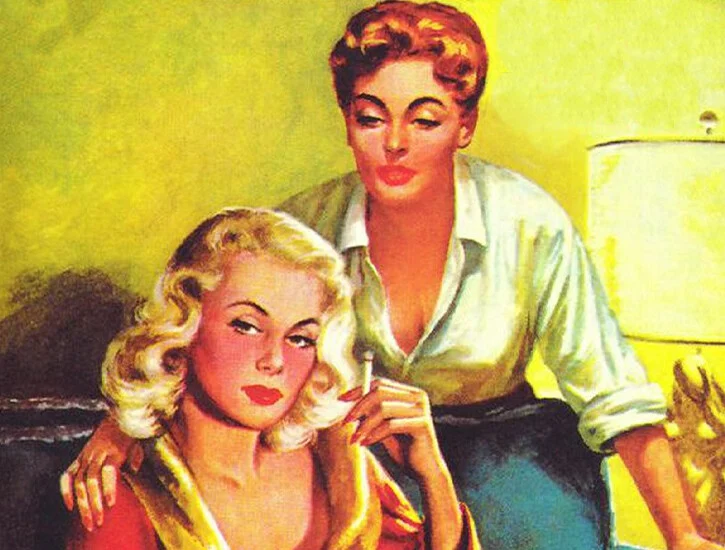
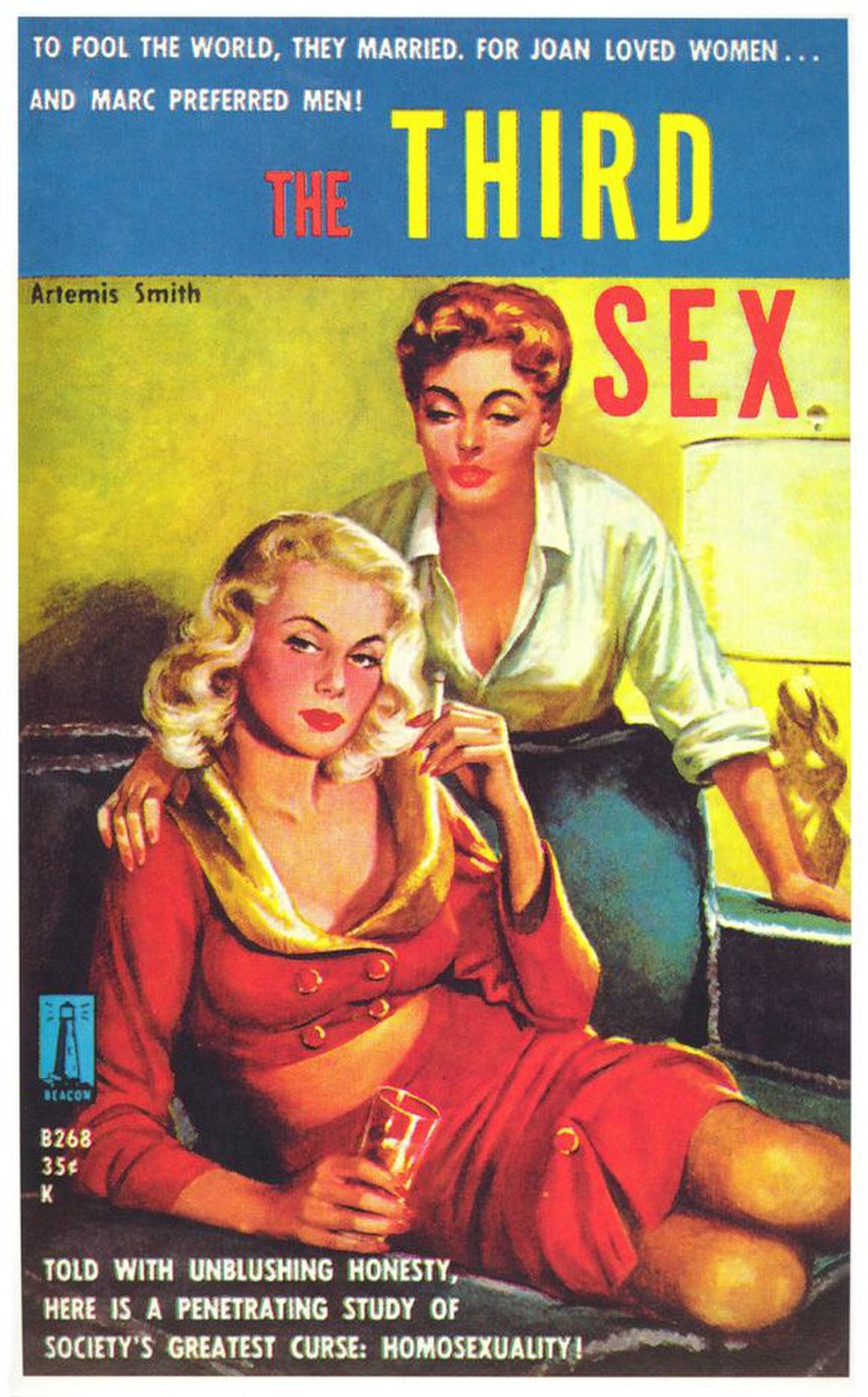
From the cover of The Third Sex (1959) by Artemis Smith. | Wikimedia Commons
The scene was something out of a seedy film noir. I was late to meet a friend of a friend—a woman I did not know—and found her seated on a velvet banquette inside the wood-paneled bar. A mass of curls twisted down her back as she leaned over the table, swirling something amber in a glass and looking me up and down with a sharp, inquisitive appraisal. She was undeniably glamorous. I could practically hear the saxophone playing. Perhaps an hour in, as she placed an empty glass down beside two others, her expression turned conspiratorial. “If I tell you something, do you promise you won’t judge me?” A tipsy giggle. “I love men, like, so much,” she said. “It’s embarrassing to tell a real lesbian that. I feel like a bad feminist.” The sax music collapsed into a flatulent jumble.
I turned her words over in my mind on my way home. Mistaking heterosexual friendliness for homosexual interest: a rookie mistake. But what stuck with me more was her tone. She had called her desire for men embarrassing; she had feared that I would judge her; she thought that my status as a lesbian would lead me to deem her lacking as a feminist. It occurred to me that the woman had interpreted my own homosexuality—probably that of all lesbians—as a kind of righteous achievement. To her, lesbianism was not about sexual desire. It was about political purity.
The lesbian seems to have been toppled, at least for now, off the pedestal of political purity to which the pop-feminist sex politics of the 2010s assigned her.
I may had failed in my own star turn as a noir hero, but the notion that a lesbian might find herself as trenchcoat-clad scion of the underworld has achieved new pop culture purchase. Over the course of the past few years, there has been an explosion of films that cast lesbians not in their traditional roles as do-gooders—high priestesses of feminism, granola-eating hippies, or librarianish scolds—but as protagonists possessed of dark pasts, indifferent moral principles, and potent sexual charisma.
The lesbian seems to have been toppled, at least for now, off the pedestal of political purity to which the pop-feminist sex politics of the 2010s assigned her. Now she’s more capable of behaving badly in a new genre: the lesbian pulp revival plot. In these new works, lesbians appear in smoky, dark bars, cast as hard-drinking detective heroes, as slashing serial killers, or as the messy lowlifes and sex fiends of lore. They never wind up walking home alone, and one mistakes their desire for virtue.
The opening salvo of the new lesbian pulp revival may have been 2024’s Love Lies Bleeding, an A24 thriller about a femme bodybuilder, played by Katy O’Brian, going on a murder spree with her girlfriend, a puny butch played by Kristen Stewart. The film contains quick cuts between graphic sex and fight scenes, depictions of grimy desert-town drug culture, and gym shots that linger on O’Brian’s deltoids, culminating in a surrealist fantasy in which Stewart and O’Brian run, hand in hand, through outer space. Next came a pair of neo-noir lesbian movies starring Margaret Qualley as gay women ensnared in the underworld, directed by Ethan Coen and cowritten by Tricia Cooke, his wife (who identifies, confusingly, as a lesbian). First there was 2024’s road trip buddy movie Drive-Away Dolls, in which Qualley and Geraldine Viswanathan play a pair of best friends who accidentally steal a hatbox containing a severed head. Then there was 2025’s detective action-comedy Honey Don’t!, in which Qualley—this time a hard-boiled, hard-femme private eye—takes time out from investigating a series of mysterious deaths linked to a sketchy Bakersfield preacher to pleasure a diffident butch cop played by Aubrey Plaza.
The new vogue for lesbian ultraviolence isn’t confined to celluloid. In August, the Feminist Press published The New Lesbian Pulp, an anthology of lesbian pulp fiction that mixes excerpts from twentieth-century works with contributions from young queer writers looking to revive the genre. These stories feature lesbians as murderers and kidnappers, heiresses and ne’er-do-wells, out for revenge or a good time.
Entries in The New Lesbian Pulp are short, and the sex scenes are frequent, prolonged, and vividly detailed. Trae Higgs’s story “pH” is dedicated almost entirely to the who-did-what-to-whom details of a hookup between two college-aged women who meet at an Orlando nightclub, following them as they proceed first to a parked car outside. August Clarke’s “Pale Horse,” meanwhile, shows two women, once romantic rivals, having sex after the funeral of their shared lover. “The pallbearers wear miniskirts,” it begins. “It’s what Anaïs would’ve wanted.” You can almost run your fingers along the birdcage veils and black velvet.
This emerging genre of lesbian gore, sex, and sleaze—both in print and on screen—marks a departure from the lesbian pop culture of the 2010s, which leaned toward high emotion and sexual innocence. This tendency was typified by the genre of the lesbian period drama, in which gay women’s desire was represented as authentic and noble, the more virtuous for being forbidden. Set against a backdrop of historical homophobia, secret lovers shared not just sexual intimacy but the titillating thrill of defying a taboo.
The lesbian period drama—as typified in 2019’s Portrait of a Lady on Fire or 2020’s Ammonite—did not eschew sex scenes. But it did tend to portray lesbianism as an ascent into heights of rapturous feeling that was as much about the characters’ souls as it was the place between their legs. In Portrait, Céline Sciamma depicts Adèle Haenel and Noémie Merlant’s sexual trysts like a vision of heaven. The women lounge dreamily in soft focus; sometimes they gasp daintily. We see their affair the way they remember it years later, as the lost pinnacle of their happiness. As a rule, the lesbian period drama maximized romantic sentimentality: picture a woman standing on a beach, chest heaving with repressed longing and desperation, in petticoats and a corset.
The lesbian pulp story is not like this. In the stories included in The New Lesbian Pulp, love is not on offer so often as obsession, characterized not only by lust but also fear, self-hatred, resentment, and deep ambivalence. In Grace Byron’s “Rookie Mistake,” one of the stronger entries, Hannah, a young trans woman, finds herself overwhelmed by an affair she’s having with Margo, an impetuous vixen she met in the party scene and whom she does not quite trust. After fleeing an abortive orgy at Margo’s house, Hannah tries to comfort herself with a manicure, only to be unnerved on her walk to the salon by the sight of a “writhing mass” of snakes in the bottom of an empty pool. She’s disgusted, and she can’t look away. “The image of the snakes intertwining their slick bodies through one another like SpaghettiOs was imprinted on her mind. It was almost impossible to see their black almond eyes; they were moving in a terrible, hypnotic whirlpool.”
When sex happens, its pleasure carries a malignant charge. When Priya and Charlie, the onetime high school nemeses of Nadine Santoro’s “Jouissance,” reunite in the alley behind a bar, their sexual chemistry is matched only by the violence with which they wind up murdering the drunken male stranger who ogles them. When Sharon, a grimy, rough-and-tumble Canadian highway maintenance worker, finally gets revenge on the pedophile who molested her as a child in Rose Jeanou’s “Revenge of the Roadkill Bodysnatchers,” she finds her vengeance arousing, and proceeds to go down on Missy, her childhood friend turned accomplice, on the couch in the man’s living room—which the pair have desecrated with the entrails of dead animals. This sense of danger and temptation toward evil lurking within lesbian sex persists even when the sex itself is not very good. “I lost my virginity to a guy, two years ago,” says the teenage narrator of “Girl in the Slayer Jacket” by Astrid Anne Rose. “I remember lying there and wondering when the good part was gonna happen. . . . It didn’t. . . . And now, with Alice slurping at my cunt, all I feel is . . . nothing.” Nevertheless, when Alice asks the young narrator to help murder her boyfriend’s ex, she agrees.
Lesbian sex carries a darkness to it, too, in Honey Don’t! The film’s first act sets up a villain in Chris Evans, a slimy local preacher whose drug and sex trafficking operation has entrapped several local women. But heterosexual misogyny is too banal for Coen and Cooke, and the plot is quickly abandoned. Instead, the film finds its real foe in Aubrey Plaza. A masculine cop, Plaza is revealed to have been torturing and killing women she doesn’t think are independent enough: a straight woman’s terrified fantasy of lesbian judgement. Honey hits her in the face with a hot kettle, and shoots her; a decent summation of the movie’s politics.
In contrast to the lesbian period drama, which drives much of its narrative energy from the characters’ repressed passion, there is not much noble yearning in the lesbian pulp revival. These women do not weep and sigh, they do not idolize the women they sleep with, and they do not achieve any rapturous authenticity in their lovers’ arms. Instead, they are jaded, dishonest, violent, rapacious, and frequently cruel. They have no hope for a brighter future; they’re still fighting against the darkness of their past, or trying to survive the perils of the present.
Why this return to lesbian pulp now, in the mid 2020s? Maybe it’s because our own era’s possibilities feel newly constrained. In the 2010s, the heyday of the lesbian period drama, social justice movements seemed to have secured some real progress for queer people and women, that Venn diagram in which lesbians occupy the uneasy overlap. Gay marriage’s nationwide legalization in 2015 was the culmination of a decade of feel-good, love-is-love acceptance, in which straight people made ostentatious displays of their own tolerance in well-intentioned, if patronizing, terms. #MeToo renewed feminist analyses of sexual violence, and seemed—briefly—as if it would usher in a new era in which women would not be expected to simply shut up and take it. Amid the anti-racist uprisings of Black Lives Matter, the massive size of street demonstrations testified to the widespread desire for a more just world. We thought, for a little while, that we might get it.
But even recounting such progressive mobilizations feels risky in the bitter present. From the vantage point of 2025, while the Trump regime consolidates a repressive authoritarian state and culture swings dramatically into backlash and retrenchment, the memories of the 2010s can seem oppressively optimistic, like an offensively cheerful “Good morning!” when you have a hangover. Lesbians’ hope and determination have turned to disappointed resignation. It makes sense that the stories about them would be darker, more cynical.
Maybe one reason lesbian pulp has reemerged now is because American lesbians in 2025 feel a lot like they must have in the 1950s, when pulp fiction reached its commercial zenith. The heyday of lesbian pulp fiction is widely understood to span from 1950 to 1965, an era when women’s gains were facing a dramatic backlash. At the end of the Second World War, women were pushed out of the workforce, steered away from independence and education, and encouraged to get down to the more important work of making babies. Gay life, too, was coming under increased scrutiny as the Red Scare raged and homosexuals were cast as threats to children, family life, and national security. Psychiatry and culture looked newly askance at homosexuality, as those who had once been pitied as poor, pathological inverts were recast as nefarious and untrustworthy perverts. Under the double bind of misogyny and homophobia, lesbians felt the tightening noose of such a regressive culture. The whole world was a closet.
In this era, lesbian pulp fiction—paperbacks with lurid cover illustrations, like that featuring a blonde leaning over a reclining brunette on the cover of Odd Girl Out or the half-dressed girl soldiers in jaunty garrison caps on the cover of Women’s Barracks—served as one of the few public nods to lesbian existence.
Maybe one reason lesbian pulp has reemerged now is because American lesbians in 2025 feel a lot like they must have in the 1950s, when pulp fiction reached its commercial zenith.
It wasn’t that these were especially affirming books, or even good ones. The conventions of the genre were strict: lesbian sex led inevitably to disaster, and stories generally ended with madness, prison, or death. Such was the plausible deniability that allowed lesbian pulp books to skirt both societal homophobia and the gray areas of obscenity law. The books themselves catered to a presumptively male readership, who treated them as softcore pornography; most titles were written by men using female pseudonyms, and their depictions of lesbian sexuality catered toward male fantasy. But gay women in the 1950s and early 1960s had to take what they could get. “It was an era of just incredible isolation,” recalled Katherine V. Forrest, a writer of lesbian detective novels, in 2018. “A lot of us grew up thinking that we were the only ones.” The lesbian erotica author Joan Nestle, who was a teenager at the peak of the pulp era, famously referred to the books as “survival literature.” Women bought lesbian pulp novels by the thousands, smuggling them home to read with the hunger of the starving.
But lesbians are not starving now. One question raised by the return of the lesbian pulp genre in 2025, an era of abundant lesbian content and eroded taboos, is the utility of turning away from more utopian or politically committed visions of lesbian desire. At their worst—among which we must include Honey Don’t!, a film that fails to cohere—some aspects of the lesbian pulp revival seem to be seeking to uncouple lesbian sex from political aspiration entirely, and shake off, once and for all, lesbianism’s bothersome entanglement of lust and virtue. Instead, the genre sometimes seems to be seeking out something different: a lesbianism without feminism.
This is not, to be clear, the account that the lesbian pulp revivalists would give of themselves. Some of the original lesbian pulp books, of course, were written by real-life lesbians, writers of considerable talent publishing under assumed names, including Patricia Highsmith and Lorraine Hansberry. On their face, this is the version of lesbian pulp fiction that The New Lesbian Pulp and its film corollaries are meant to evoke: that rare space for queer women’s self-expression and self-definition, where lesbians could defy a repressive world to create a literature that spoke to both the intensity of their desires and the complexity of their moral lives.
In part, the reemergence of the genre seems to be born of nostalgia. The new lesbian pulp productions are self-conscious, highly stylized, and densely crammed with references to bygone eras. Love Lies Bleeding is set in the late 1980s, complete with pay phones and Katy O’Brian’s hair styled like a Jheri curl; Drive-Away Dolls is a 1999 period piece, with jokes about Ralph Nader; and Honey Don’t!, though technically set in the present, is exaggeratedly old-fashioned, with Qualley wearing 1940s-style house dresses and rifling through a Rolodex, rather than an iPhone, for the number of a source. In this way, the lesbian pulp revival seems to be partaking of the same impulse that the rest of a rightward-shifting culture is: working to evoke an imagined past, when politics were supposedly less oppressive, and sex was simpler, more fun.
But it is a selectively rosy image of the past. When lesbian consumers snuck the original lesbian pulp books home and read their male-authored scenes furtively under the sheets, part of what they were doing was capitulating to their own exploitation, accepting—and taking pleasure in—a vision of themselves created on men’s terms. Some of the lesbian pulp revivalists seem to be hoping to give their beloved genre a better past; to reclaim pulp for women, and to erase, through their own insistence and willfulness, the reality of its historical use by men. But if anything, this revision seems contrary to the genre’s lessons: there are few things more foreign to the pulp fiction spirit than refusing to cop to your own sins.
Nostalgia, of course, has its dangers. Exploitative fantasy is not the same as real progress; not all appropriations of misogynist work can successfully subvert the sexism of the source material; no one ceases to have obligations to feminism just because feminism is degraded, diminished, and unfashionable. Lesbian desire can never really be disentangled from women’s liberation—not even in those moments, against the dark-wood panel of the bar, when feminism’s solemn uprightness is decidedly unappealing. But for my part, I find it is hard to begrudge the lesbian pulp revivalists for these lapses. They are having too good a time.