, December 18, 2025
Mob Rules
The Chicago Outfit’s second life as nostalgia—and as presidential politics
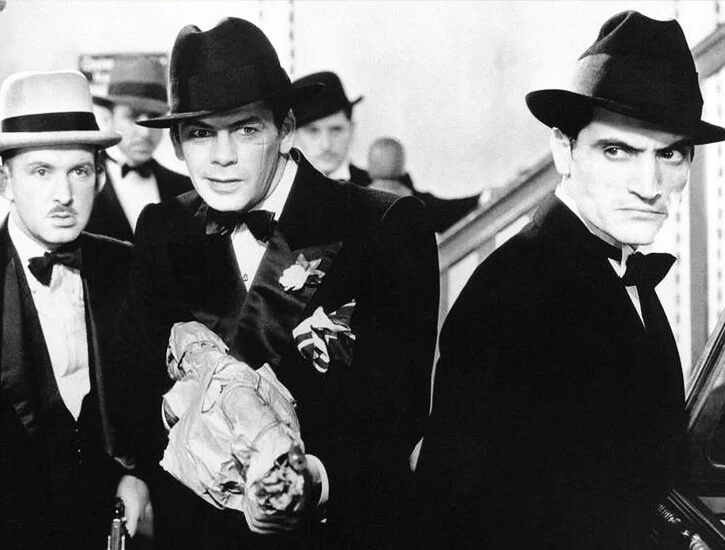
Still from Scarface (1932). | United Artists
In the Chicago suburb where I grew up, I was always wary of this one house. At face value, the home matched the other postwar abodes that dotted the avenue: a wide, two-story bungalow with a tile roof, clay-colored bricks, and short, boxy hedges that formed a tight perimeter beneath the windows—not unlike the moat of a medieval castle. Its only remarkable detail was, unlike the other real estate in the neighborhood, its yard was unfenced, allowing any passerby to view its garish, Mediterranean-style stone terrace. I can’t recall ever seeing anyone entertaining guests there. Decades prior, a mobster had been murdered in this unassuming structure’s basement, supposedly gunned down while making himself a midnight snack of fried sausage and peppers. I pictured a stocky, graying man in a bathrobe, humming to himself as he fussed with the pan, completely unaware of the muzzled .22 caliber pistol being aimed at his skull.
I was simultaneously enthralled and horrified; when you’re an adolescent, the consequences of death feel both urgently profound yet so distant as to be inconceivable. The bungalow’s function for me was not unlike that of Boo Radley’s shack in To Kill a Mockingbird: a void your imagination fills with abstract violence. The mobster house hinted at an almost illusory provenance, flappers with gaudy pearls and the flash of bulky Tommy guns, where cabals of scar-faced Sicilians ruled the city from the faint glow of a jazz club. The reality was even more cinematic: the mobster who was whacked a few blocks from my elementary school wasn’t some irrelevant lieutenant resigned to a few lines in B-list noir, but Sam “Mooney” Giancana, who came of age during the reign of Capone before climbing to the highest peaks of the Chicago Outfit’s hierarchy in 1957.
For nearly a decade, Giancana was not only grand poohbah of a gangster imperium that stretched from Lake Michigan to the Pacific Coast, but maintained ties with a president, influential pop stars, sex symbols, and CIA apparatchiks. It was the historical apex of the Outfit’s power: the trade unions, municipal governments, Hollywood, and the national sports gambling circuit were just items in a vast portfolio at the heart of the mob’s dynamic, interdisciplinary hyper-racket. But despite how thoroughly the Outfit had assimilated into the fabric of American life, it inevitably fractured with the advent of Racketeer Influenced and Corrupt Organizations (RICO) laws in the early 1970s, market competition from casinos, and the decline of labor. Under neoliberalism, national criminal syndicates struggled to handle the end of history. By the time Giancana was meeting his maker—an event that marked its fiftieth anniversary this past summer—the empire’s structural integrity was eroding. Like all great empires, the Outfit didn’t so much collapse as it did unwind; by the time I heard about Giancana, the geriatric remnants of the golden age leadership were at last being brought to justice.
Like pirates, ninjas, or cowboys, the mobster has become a folk character that allows the consumer to imbibe in a kind of essentialist make believe.
Yet even in its obsolescence, the residue of the Outfit’s reign occasioned spectral allusions and spectacle tourism, especially in Chicago. Al Capone—maybe the most internationally recognized resident of the Second City next to Michael Jordan—has been relegated to the status of unofficial mascot. Cutthroat avarice has been replaced with a confabulation of noble mobsters who help old ladies pay for their groceries, and where camaraderie and community are enforced through an informal system of loyalties. And it’s here, not in some vague reference to the German American Bund or Charles Lindbergh, where we might find referential fragments of a past that modern reactionary movements like MAGA nod to, when a class of unscrupulous and retributive traditionalists acted as mediators between capital and labor.
The decadent and gore-filled half-century that was Chicago’s mobster heyday is still a family affair. The children and grandchildren of the mob (and their victims) have formed a loose social network held together by patrilineal ego and solidarity. When I reached out to Giancana’s grandson, Carl Manno, for his perspective on his family’s turbulent history, he expressed frustration that stories like his grandfather’s homicide had become cynical cash grabs. Nostalgia for the broader American gangster tradition still has plenty of pull; in May of this year, a prominent Chicago TV journalist named Chuck Goudie announced that he had unearthed evidence that pointed to Anthony “Big Tuna” Accardo as Giancana’s murderer. Goudie’s two-part TV special essentially reheated old details, but did provide previously unreleased documentation from FBI surveillance of Accardo, indicating he left his mansion in the neighboring suburb of River Forest around eleven at night—just before the killing—and returned to his home shortly after Giancana was believed to have died. Giancana had been wrapped up with the Church Committee, a Senate investigation into abuses of power by the CIA, which included collaborating with the Chicago Mob to overthrow Fidel Castro’s then-nascent communist state. The theory was that Giancana was going to reveal just how immersed the Outfit was in the CIA’s geopolitical sabotage. Accardo, the Godfather of the Chicago mob, feared this would make him vulnerable, something corroborated by Frank Calabrese Jr., son of one of the Outfit’s most prolific hitmen: “Sam was the one that could really get Tony in a lot of trouble.” Not necessarily a groundbreaking revelation, but it made for entertaining basic cable.
Manno was beside himself when we spoke over the phone, his throwback Chicago accent piercing through the speaker. His anger was aimed particularly at Calabrese Jr., who had made himself out to be a martyr when he testified against his own father during the 2007 Operation Family Secrets trial, an FBI investigation into an assortment of mob crimes that included several murders committed by Calabrese Sr. It would be the death knell for the Outfit as an institution. (The younger Calabrese now has a residency at the National Museum of Organized Crime and Law Enforcement, a gimmicky attraction on the Las Vegas strip.) Carl insisted that Calabrese wasn’t to be trusted, calling him a “snitch” and a “rat.”
Goudie was probably still on a federal government payroll, he added—after all, this was the same government that he believed had assassinated his grandfather. Nor was Manno’s bitterness reserved for Calabrese: even his own mother, Antoinette Giancana, had sought to exploit her father’s celebrity in her 1984 mobster memoir, Mafia Princess: Growing Up in Sam Giancana’s Family, in which the eldest daughter of the Giancana clan divulged the inner drama of the mobster’s domestic life. “My mom was out there. She did other things and against family rules. My mom decided at one time to knock on her dad,” Manno somberly explained. “She didn’t help her father out. She got him in more trouble than he got himself in.”
Conversely, Manno spoke of his grandfather with an ecclesiastic admiration. “While we were growing up, we were called Little Camelot. There’s only two families back in those days: the Giancanas and the Kennedys. And my grandfather helped everybody out, not only through the family, he helped a lot of charities out, a lot of churches out,” he said, noting that Giancana had once paid for clean Italian marble to be installed at a nearby cathedral.
This revisionism isn’t necessarily partisan. On the other side of the coin are the Seifert brothers, Joe and Nick, who became enmeshed in the mobster milieu after they testified at the same Family Secrets trial as Calabrese, Jr. The Seiferts were just children in 1974 when their father—a business associate of the mob—was executed by Joey “The Clown” Lombardo over fears that he would testify in a fraud case linking the Outfit to an embezzlement of Teamster pension funds. Joe has written books, produced documentaries, and appears on podcasts, all dedicated to the intricacies of mob history—the Family Secrets trial in particular. His strikingly nuanced perspective extends to his father’s own killer, whom he believes was wrongfully convicted. “Take Joe Lombardo: if a lady couldn’t pay her rent or she didn’t have Christmas presents for her kids or she needed groceries, he’d be the first one to take money out of his pocket . . .That’s not always stuff that’s shared,” Joe said. “It’s always . . . ‘Oh, he’s a terrible guy. He killed this person, that person.’ But, you know, there’s a duality to where they were really genuine, nice guys. But they did have a bad side to them.”
This sense of dichotomy is not uncommon among the community of mob aficionados. Often, according to the younger Seifert, the forums and Facebook groups are teeming with former Outfit members and family: there are retired judges and one-time feds, cops who had partaken in the mob’s corruption, and those who had sought to break its stranglehold on the city. An underlying throughline, besides their masculinized true crime obsession, was a strangely romantic logic, according to which the Outfit maintained order, provided a certain predictability, and would never tolerate the kinds of gang activity that have made modern Chicago notorious.
Meanwhile, Nick, the eldest son, maintains a fiery, vindictive anger over his father’s killing—but is less preoccupied with the perpetrators and more with the systemic duplicity that permitted the murder to go unpunished for decades. For Nick, the truly guilty parties were the Chicago Police Department and the Cook County Sheriffs, the prosecutors and city officials, even those in the FBI. They knew all the names and addresses—even the model of tires on the cars the Outfit drove—yet enabled this cabal of homicidal tyrants to run roughshod. “I mean, everybody was involved. Everybody got money to look the other way, not just in my father’s murder, but in any other murders,” Nick told me. “I mean, think about this. There were what, thousands? . . . I’m talking about thousands of mob murders in Chicago . . . You know, the only thing that changed with it all is by that time, by the time the Family Secrets trial came out, all the political corruption was gone.”
Just how much the Outfit dominated every facet of society at the height of its ubiquity can be difficult to fully grasp. On one end of the spectrum was a quotidian but gobsmacking genre of naked corruption: a retired Chicago police detective relayed to me a story of mobsters walking straight into a precinct with an envelope of cash and exchanging it for reams of criminal records and murder files related to Outfit members, a practice so common that it made countless unresolved killings by the mob nearly impossible to investigate. On the other end was a brand of clandestine kingmaking out of a Dick Tracy strip. Take the illegal wiretaps orchestrated by J. Edgar Hoover that picked up a discussion between Giancana and his associates. A former Chicago FBI agent named William F. Roemer Jr. wrote in his 1989 tell-all Man Against the Mob that Giancana planned to help win the election for then-candidate John F. Kennedy in exchange for “[backing] off from the FBI investigation of Giancana.”
Exactly how the Outfit generated its social, political, and economic power is rarely discussed. The obvious answer is money, of course, but plenty of syndicates have generated illicit profit without achieving total primacy. In fact, the Outfit was almost accidentally Marxist insofar as it understood the innate push and pull between the owners of the means of production and those who toil in service of it. In its initial rise during the Great Depression, it was believed that Outfit-organized labor czar, Murray “the Camel” Humphreys, purportedly oversaw more than sixty-one unions. Such tactics would be extended to far-off lands like Hollywood, where control of the stagehand union enabled bosses in Chicago to extort the captains of show business, an industry that they did not prohibit from producing sensational gangster movies. It was through their hijacking of labor power, not in some smoke-filled room of wise guys, that the fulcrum of their power rested. After all, it was the very same Murray, per Seymour Hersh’s book The Dark Side of Camelot, who coordinated with the Teamsters to get the vote out for Kennedy in the 1960 presidential election. It was a technique familiar to those at the Kennedy compound in Hyannis Port; both Robert and Jack had overseen a 1957 United States Senate Select Committee to investigate mob influence in labor unions. The Kennedys’ patriarch had clearly taken notes.
Just how much the Outfit dominated every facet of society at the height of its ubiquity can be difficult to fully grasp.
True power elites—the national politicians, the financiers of capitalism, and the ivory-tower intelligentsia—sanctioned the Outfit’s rise: kingpins were incredibly useful for disciplining the radical potential of organized labor. As retired criminologist Alfredo Schulte-Bockholt told me, it’s only when organized crime oversteps its boundaries within broader economic structures that crackdowns like the RICO Act or the Select Committee become necessary. Schulte-Bockholt’s research demonstrates that across the twentieth century, from Colombia and Bolivia to Sicily and Shanghai, organized crime has worked hand in glove with the capitalist class to suppress unions and left-wing political movements. For example, the Kuomintang under Chiang Kai-shek mobilized mobsters as a means to eradicate the Chinese Communist Party following the unification of China in 1927. “In return for their help in the elimination of Communists and unions in Shanghai,” Schulte-Bockholt writes, “the new leader gave the Green Gang and its most prominent leader, Du Yue-sheng, free reign in that city’s underworld and the narcotics trade.”
This sentiment, that politicians and the mob exist along an ideological continuum even as the latter has disintegrated, still has its advocates. Following Zohran Mamdani’s victory this November, a former capo of the Colombo Crime Family, Michael Franzese, took to X to denounce the newly elected democratic socialist. According to Franzese, who has become something of a conservative social media influencer, the New York’s Five Families would have “not allowed” Mamdani to be elected. Once upon a time, the mythological Al Capone expressed similar ideological leanings:
Listen . . . don’t get the idea I’m one of those goddam radicals. Don’t get the idea I’m knocking the American system. My rackets are run on strictly American lines and they are going to stay that way. . . . This American system of ours . . . call it Americanism, call it Capitalism, call it what you like, gives to each and every one of us a great opportunity if we only seize it with both hands and make the most of it.
It’s here where mob fascination is the most pervasive. Like pirates, ninjas, or cowboys, the mobster has become a folk character that allows the consumer to imbibe in a kind of essentialist make believe, divorced from their repressive and bloodstained sociology. But beneath this fantasy is a certain, comforting stasis under capitalism, where parallel institutions operated by unelected enforcers smooth out the barbarous edges of the market. Where social relations—the Chicago Outfit famously was “progressive” insofar as it allowed communities on the racial fringe to operate at the lower rungs of their hierarchy—and violent crime were adjudicated by a protectorate raised on old-world moralisms. Where ad hoc, localized welfare was dolled out to those who really deserved it.
The illusion of a hustler’s meritocracy made the American Dream seem attainable, even to those without blue blood. Was this the America that Trump, acting as a gangster diplomat between the everyman and the fat cat, is offering when he calls for revanchism? A culture run by and for bullies supervising the schoolyard? How else should we process his weaponization of tariffs in service of fealty, his granting of clemency to scores of known hucksters, his enshrinement of legalized bribery? This brand of conservatism is reflective not of a society soon to be ruled by Übermensch, but one where citizens are encouraged to participate in a massive game of three-card monte. Either swindle or be swindled.
Since the late 1980s, visitors to the Windy City have been able to take the Untouchable Tour, a curated drive through Chicago’s downtown that highlights historical landmarks and stories that defined its Prohibition era. The guides have adopted characters in period fedoras, pinstripe suits, tight garçonne dresses, and feather hair clips, with fleshed-out backstories and names like Winnie Westside and Johnny Three Knives. At the end of the ride, you can buy souvenirs like a fifteen-dollar Tommy gun tie pin. As the tour moves through Michigan Avenue traffic down to the South Side, where Al Capone got his start, a chaperone to a class of schoolchildren will sometimes get nervous. “So, how far south are we going, exactly?” they’ll sometimes ask. For them, contemporary gang violence could be lurking around the corner. The old kind, the kind that got Mooney Giancana, that might as well be a ghost story.