, February 18, 2026
Last House on the Left
Learning on tablets at The People’s House
Courtesy the White House Historical Association.
“It was late in November, and all through the garden,” the sound of a canned turkey gobble fights to overpower the narratorial voice-over but fails to reach a meaningful enough decibel level to register as anything more than a mistake in audio mixing. The narrator continues: “People came to see the president give a turkey a pardon.” The image of a turkey is projected against the cross-sectional diorama of the White House, its head and wattle occupying the miniature version of the Blue Room dead-center. The voice continues to monologue about the various holiday traditions of the White House. Another photograph appears: Nancy Reagan and Mr. T dressed as Santa Claus. By the end of the presentation, I have learned little more than the fact that holidays are celebrated at the White House. Another presentation begins. Actors playing enslaved laborers fill the screens in a sepia-toned shadow play underscored by a solemn acknowledgement of their role in the construction of the White House. Despite the serious sentiment, they’re inescapably compressed both in size and time given the limitations of the self-guided museum tour model. In the end, they are afforded the same weight as the turkey.
The People’s House: A White House Experience is a $56-million venture from the White House Historical Association that opened in September 2024 with the goal of offering a radically more accessible experience of the president’s mansion than the limited availability of walking tours. Said Stewart McLaurin about the mission of the museum: “Our founder, First Lady Jacqueline Kennedy famously said: ‘The White House belongs to the American people.’ But we also know the very real challenges with making the actual White House open to everyone.” But a startling disjunction has become obvious from Trump’s meetings in the actual White House with the moneyed technocratic tax bracket. Seeing the real thing still inescapably costs more money than most people can dole out.
The museum’s exhibits were constructed by Ralph Appelbaum Associates, a familiar name in interactive museum experiences like D.C.’s National Museum of African American History and Culture and the United States Holocaust Memorial Museum—both good museums, which is why the state of the People’s House is so confounding. Passes are free with timed entry, so as not to overwhelm the touch screens that most of the exhibits are accessed through. This is by design; for one thing, even a cursory look into RAA’s more recent museum work shows a prevalence of screens as a vehicle for dispensing information to visitors. The museum’s website also invites guests to snap pictures in front of inferior reproductions of iconic parts of the building, like the Rose Garden, the State Dining Room, and the colorful rooms of the State Floor, largely displayed through projection with the “ambience of an Apple store.”
Who is the ideal patron of The People’s House? Perhaps someone unoffended at the haphazard, and at times patronizing, reduction of the powers of the executive branch.
A user’s review featured on the RAA webpage notes: “This is a place that makes you feel connected—to democracy, to history, and to each other. I left inspired and grateful that this space belongs to all of us.” How do we define a “place” or “space” in this case? Yi-Fu Tuan, the writer credited with coining the phrase “sense of place”, says that “undifferentiated space becomes place as we get to know it better and endow it with value.” If a space is monumentalized from the so-called primitive accrual of time, of events of notoriety, then we’re out of luck; our “space” has no tangible roots in American history. The Mills Building that houses the museum belongs to the real estate firm Akridge, which, in lieu of uncovering some previously undiscovered populist history, touts its “Abundant Natural Light.” Undifferentiated space becomes a place when its value has been determined by the commercial real estate market.
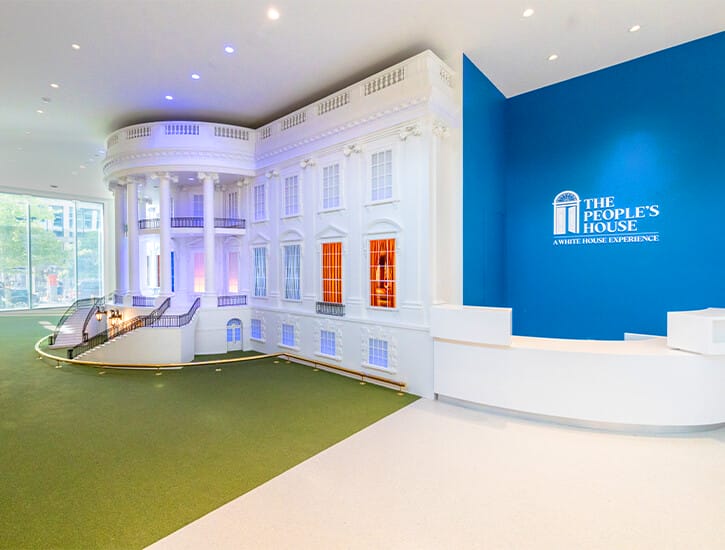
The lobby boasts a massive floor-to-ceiling 1:5 scale model of the White House with such a narrow viewing space that it can’t be seen in its totality from any single vantage point. Its imposing presence is made even more grandiose with the appearance of Melania Trump in several of its windows to deliver the welcome address. Martin Sheen takes over to give a brief history of the White House before inviting us in. “Welcome,” he says, “to not just a house but your house, the People’s House. Welcome home.”
It’s worth mentioning that the phrase “People’s House” actually refers to the House of Representatives, “the only branch of federal government elected directly by the citizens of the United States since its founding in 1789,” according to the History, Art, and Archives website of the House of Representatives. Conversely, in a 2020 conversation with White House Historical Association director Stewart McLaurin, historian Matthew Costello attributed the phrase (in the context of the White House) to a plea by John Quincy Adams for an appropriation of $25,000 to finish the East Room. “Their core argument was that the White House is the ‘People’s House’ and that the President of the United States needed a fully completed house to represent the people.” In the context of this argument, “ownership” is only tangential. Trump’s reasoning for demolishing the East Wing to replace it with a ballroom is constructed around a similar sentiment:
For 150 years, Presidents, Administrations, and White House Staff have longed for a large event space on the White House complex that can hold substantially more guests than currently allowed. President Donald J. Trump has expressed his commitment to solving this problem on behalf of future Administrations and the American people.
“The People” serve as a mere rhetorical fodder for the accrual of capital to be expressed as neoclassical pastiche. This is unlikely to change with the radical accessibility promised by the People’s House. Upon entering, all I see is a rectangular strip of astroturf alongside the reproduced, and significantly shrunken, West Colonnade. It’s not until I walk closer to the starkly white wall that I notice that a part is raised from the otherwise uniform surface: cut-out lettering that reads “The Rose Garden” in Times New Roman, painted the same color white as the wall. The rest is totally blank, comically destitute like a bird’s eye view of the concrete patio put into place at the White House at the request of President Trump. A second look and I realize that the Rose Garden is actually represented by a few vinyl window decals of rose bushes next to the entrance: one pink and one white. A few signs offer a brief history of the Rose Garden, from its inception as the West Garden to its remodeling into its namesake during John F. Kennedy’s presidency. It’s not barren to compensate for Trump’s recent concrete remodel, just a happy coincidence, and if they wanted to preserve verisimilitude, they would outfit it with patio furniture from the liquidation of a Club Med.
Next, I go to the West Colonnade exhibit. “The 45-Second Commute,” as it’s called on the display plaque, has been shrunk to fit the dimensions of the square footage between the Rose Garden and an immersive theater. It only took me sixteen, an ironic mirror to the exhibit’s broader impulse to minimize power as novelty; my brief stroll ends at the doors to the Oval Office, wherein the line for pictures behind the desk is held up by a guest attempting the perfect shot of his saying “You’re fired!” into the desk landline. The walls of the stairwell to the exhibits upstairs display a few archival White House photos and quotes from its previous occupants. “A President can never, obviously, be more than a caretaker or a tenant in this house, for the White House belongs, as it has for 200 years, to every American,” reads one by President George H. W. Bush. The irony is not lost on me that it’s positioned directly above a picture of Donald and Melania Trump.
On the second floor, I decide to begin with the facsimile Cabinet Room. It’s set up in an almost entirely darkened chamber, giving the exhibit an immediate intensity and the feeling for participants that the ceiling has been substantially lowered. The room is illuminated by a thin projection screen that displays a beige wall with windows, behind which is the pixelated movement of leaves in the wind. It illuminates a center table with seven chairs for participants to sit, with seven chairs on the opposite end, separated by a piece of glass. We’re in a simulated bunker with a small vantage point to our own brutality, surrounded in total near-darkness such that we can’t bear witness even to one another. Perhaps from an induced raising of my cortisol, my eyes are drawn to the focal point: the center chair’s leather back, a few inches taller to suggest the notoriety of the president.
We watch newsreel footage about the Cuban Missile Crisis. An unconvincing JFK appears with members of his cabinet to brief us. They appear as holograms, caught in panes of glass mounted on the chairs to appear as sitting figures. The actor playing JFK sounds like he’s orally boxing with a tongue depressor. Robert McNamara suggests surprise airstrikes. McGeorge Bundy offers a rebuttal full of um’s. A docent reprimands a woman for sitting in her boyfriend’s lap, I assume due to the structural integrity of our chairs: “Only one person per seat!” Besides, there can be no distractions as we’re briefed on the missiles Khrushchev has planted in Cuba. “Now I want to hear from you,” says Kennedy. We are given a few moments to select one of three available choices on our tablets: “Get Military Leaders to Weigh In,” “Use Diplomacy and Enforce a Blockade,” or “Carry Out Immediate Airstrikes.” My group votes to take immediate aggressive action. A man to my left pumps his fist in celebration and whispers: “That’s the one I voted for!”
I end my tour in the exhibit titled “Stories in Objects,” a walkthrough gallery of symbols meant to serve as visual indexes of the historical fact they reference. Numerous guards in such a small space gives the sense that something of value is housed inside, but the rooms are almost literally empty save for the props that are merely incidental to the triggering of a narratorial sound bite. All are coated in a chalky paint like they’ve been dipped in Wite-Out. I admire a collection of blank picket signs. In place of a slogan, one has a television screen that plays a short loop of images of protests in Lafayette Park: “For more than a century,” orates a disembodied voice that sounds inordinately cheerful for the subject matter,
Americans have gathered in Lafayette Park across from the White House to exercise their First Amendment Rights and bring the fight for their respective causes to the President’s doorstep. Starting with the very first protest for Women’s Suffrage in 1917, the park has seen demonstrations related to war and peace, personal freedoms, Native American rights, government accountability, racial equality, and much more.
The narcotic undercurrent of the narrator’s voice is perhaps most the egregious about this display, but in retrospect, it’s not unexpected for a protest sign that has been intentionally left blank.
In softening the explicit display of the power of the American public, the White House Historical Association unintentionally troubles its own mission. Protest, relegated to the free-moving, discontinuous aesthetic of a loop of aimlessly marching bodies obfuscates the role played by the president in the situational eruptions of public dissent. Truthfully, the White House is more than a benevolent audience to the opinionated masses. To reduce its role to a simple parenthetical of its presence obscures the fundamental truth that a protester requires something to protest. It’s telling that the presentation leaves out what came of any of the displayed protests: the political gains, the losses, the inevitable mobilization of state violence against the populace. In the stated mission to offer a radically accessible vision of the White House, the White House Historical Association has only managed to acquaint a larger number of people with an all-encompassing institution paradoxically removed from the political process and a necessary steward of global and domestic prosperity. By this logic, it can be nothing but an unchangeable monolith; if it truly is only an audience to dissent, where does that leave the rest of us?
I leave the museum, but not before being accosted by a donation ask in the form of a poll about my favorite White House pet. For a modest fee, I can cast my vote for Socks the Cat, Liberty the Dog, or Macaroni the Pony. Does this actually work on anybody? I wonder to myself. Then I see that nearly seven hundred thousand votes and counting have been cast.
It’s an uncanny, totally disjunctive mishmash of ideas in an attempt to synthesize a meaningful spectacle out of factoids that most people know anyway.
It’s not lost on me that the timing of the People’s House’s opening was a period defined by a dangerous opacity from the White House: the truth of Joe Biden’s mental capacity was obfuscated in a desperate bid to keep a Democrat in the seat of executive power, while his administration continued to provide military support to Israel despite its decreasing popularity with the general public. The divide between the People’s House and the actual White House is made even more evident in the disjunction between the aesthetic reality of Trump’s renovations and what is presented to viewers. Despite their promise to “recreate the Oval Office exactly to be as it exists” following the 2025 inauguration, they have yet to outfit their model’s walls with the gold trim added by President Trump at the beginning of his term. Even accounting for the ideological possibilities of any person who might come through the museum, watering down its narration to a platitudinous lull, the curation team behind the People’s House cannot displace the observable reality that is one singular street crossing away.
So who is the ideal patron of the People’s House? Perhaps someone unoffended at the haphazard, and at times patronizing, reduction of the powers of the executive branch. Really, the museum was always intended to be little more than a teleology of the accrual of furniture. This is what Jean Baudrillard calls a “clean” America, “which benefits from an enhanced moral power to exploit the rest of the world (even if it does so democratically).” There could not be a more apt parallel to his words: a romp through the digitized nexus of power of the Western world, watered down into tidbits about the lifestyles and aesthetics of the first families of American history.
Take the “Holidays at the White House” presentation: an artificially enlarged stock image of a turkey’s head projected against the neoclassical dollhouse furniture of the White House’s Blue Room is conflated with the power of the state in rhyming form. Such is the contradiction of the politics of the discontinuous image: everything, equally worthy of attention, is weighted with the same value and thereby devalued in the process. A turkey is afforded the same weight as the enslaved person. It’s an uncanny, totally disjunctive mishmash of ideas in an attempt to synthesize a meaningful spectacle out of factoids that most people know anyway. It’s a catalog of the displaced mythology of a complacent, benevolent American politics.
I receive a survey in my inbox the day after my visit, asking me to rank a few statements on a scale of one to five, among them: “I learned something new about the White House and its history.” Is this possible to quantify? By the admissions of its visitors, it doesn’t do a very good job. One writes: “A Gem in Washington DC! There’s even a replica oval room [where] you can sit behind the desk or sit in chairs like you’re doing a fireside chat!” But had they paid attention at the diorama exhibit, they would know that the fireside chats primarily took place in the Diplomatic Reception Room.
The People’s House belongs to us only as much as we believe it does, undergirded by a superficial proximity to the idea of power. Power is accessible, ossified in a personal photograph taken behind the desk of the Oval Office, undergirded entirely by its endowed value. If the goal of this museum is education, it fails at that. If it’s placation, then it does an excellent job. It’s almost too on the nose that in an era where access to the White House is contingent on wealth, the rest of us are left to play pretend across the street in a building full of empty rooms.