, January 14, 2026
Language Arts
The lethal power of Elaine Kraf’s fiction
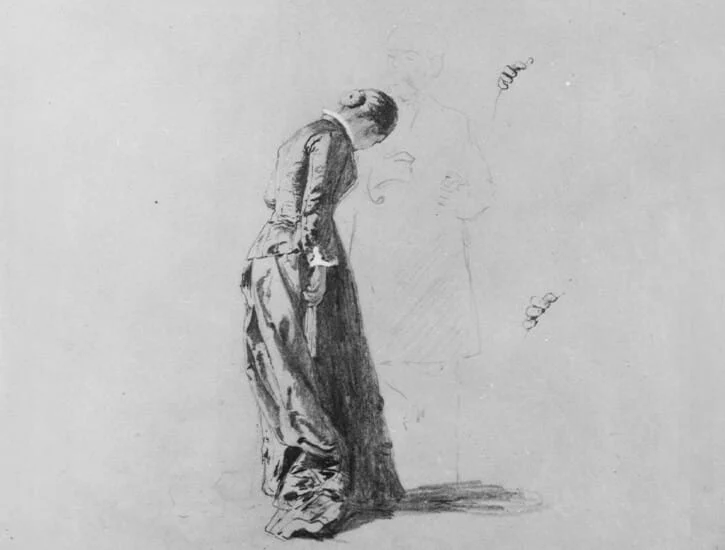
Standing Woman with Man in Outline by Thomas Hovenden. | Metropolitan Museum of Art
Find Him! by Elaine Kraf. Modern Library, 240 pages. 2025.
In the beginning, God created man, and from a part of him, woman, and they lived in the garden of Eden. The man’s name, for our purposes, is Oliver. The woman was not given a name, and Eden is the house of a missing woman named Edith. This isn’t Genesis, it’s the world of Elaine Kraf’s nearly lost 1977 novel Find Him! Our narrator, an amnesiac, wakes up one day in the house Edith and Oliver once shared, fully grown but childlike, with no past and no language. Her first memory is of Oliver teaching her to eat; he teaches her, too, to use the bathroom, and to have sex (“It is possible,” she says, “to have sexual relations with someone without knowing what it is.”) Edith herself is nowhere to be found, though she’s left things behind. There are the letters, locked away in drawers, with the dates ripped off. There is the bracelet, which the narrator suspects is her own, though she can’t quite remember. There is the violet dress Oliver takes from Edith’s closet to give to the narrator, which fits her perfectly; there is the reproduction of Botticelli’s Primavera, which resembles both the vanished Edith and this narrator, a woman “from another star,” who woke up alone with Oliver in a house with no windows and no doors.
A questionnaire for you:
- Where is Edith? _________
- Do you have words for what’s gone wrong? _________
- Have you heard of Elaine Kraf? (Yes or No) _________
Elaine Kraf is a writer, painter, and educator who published four novels in her lifetime. The last novel she published, The Princess of 72nd Street, developed something of a cult following after it was published in 1979, but Kraf’s work fell into more-or-less obscurity until Hannah Williams resurfaced her writing in a piece for The New Yorker in 2022. In the wake of her rediscovery, all her novels are being republished by Modern Library, which will also publish Kraf’s unpublished work beginning this year. Her novels share a manic, madcap sensibility; her narrators are all delirious women of dubious sanity, and their disintegrating holds on reality are mirrored in her work’s fragmentary, dreamlike, and disorienting formal qualities. The latest of Kraf’s novels to be republished is Find Him!, which recounts the nameless narrator’s time with Oliver, her teacher, lover, and abuser, as she slowly learns to think and speak for herself. Eventually, Oliver disappears, leaving the narrator to wander out into the world alone, where she seeks the help of a lawyer in locating him. Her story is addressed to “you,” and so we search alongside her, wading through the dissembled fragments of her recent past to construct something like the truth.
Elaine Kraf is particularly attuned to the ways men exercise social control over women, and how a self can fragment and fracture under such conditions.
The narrator is determined to find Oliver. She loves him—he is all she has in the world. “You would think Oliver loathsome,” she notes, describing in detail his mountains of earwax, claw-like toenails, and endless drooling, but he “was my culture and my society.” As a narrator, she is simultaneously forthcoming and evasive—or, rather, is forthcoming about her evasions. Caught between her desire to find Oliver and her wish to protect him and the life they shared, she lies to and misleads the reader; she lies to and misleads herself. She parcels out information sparingly, partly as a result of the gaps in her memory and knowledge, and partly because she is deeply attuned to the economy of secrets. “I am afraid that you will go away just like Oliver did if I don’t show you something interesting; that is why I will show you some of the letters right now,” she says, before revealing some of Edith’s letters, which suggest Edith, once Oliver’s wife, was institutionalized. All of Kraf’s narrators are unreliable; they hide things or forget things; they obscure reality or reality is obscure to them (“Do you believe my story?” the narrator of Find Him! asks at one point in a quiz).
Kraf’s sleight of hand renders the narrator’s search for Oliver an echo of the reader’s search for Edith. Clues as to Edith’s whereabouts are hidden in plain sight: the narrator researches lobotomies and notes similarities to her own condition, there is something familiar about the house she wakes up in, her appearance matches descriptions of Edith, the two share a dress size, and Edith’s personal effects leave the narrator with an uncanny sense of familiarity. It comes to seem likely that the narrator is Edith post-lobotomy or something like it, someone Oliver is trying to reform into the perfect woman. The narrator tries to deny this rather unconvincingly, but her deceptions flag against mounting evidence to the contrary.
The narrator, living life as her own reincarnation, struggles against the mold Edith left behind, and also against Oliver. Her struggle for identity also finds form in a conflict with the reader, whose assumptions about her identity she is loath to confirm. Oliver never gives the narrator a name, and she names herself at some point, but she won’t reveal it, not even to the reader—a gesture toward a hard-won notion of a private self, but a gesture, too, of her ambivalence about that self-making (“I have a name now . . . but I don’t care about it,” she says).
Oliver teaches her language, but stingily, and she finds inventive, clever ways to use her limited resource. The narrator writes that “he gave me words—that was Oliver’s gift,” but he gave them “carefully apportioned. I blasphemed by finding intricate ways to use his measured vocabulary. I began to realize that he kept the best for himself.” She seeks words that Oliver doesn’t know, words that can be hers alone, her “secret revenge,” but suspects that he knows them all—“that would be just like you, to have stolen every one,” she thinks, of Oliver. But, she vows, “if you will not share your words, then I will take all of them, every single one,” and she will use them “over and over again as though I am putting a knife into your throat where words come out.” She begins to take words and weave “them into patterns in her head,” developing her own idiosyncratic syntax, as in passages set in what she calls the “foamworld,” a limpid, dreamlike space. In a sense, Find Him! is the record of a struggle for self-identity waged with imperfect weapons—words.
This linguistic awakening leads to a growing distance from Oliver. As he increasingly withdraws his affection and attention, the narrator comes to regret her “terrible struggle for an autonomy that I did not want.” At one point, Oliver rapes her and calls her Edith, a woman in absentia, and thus everything he believes a woman should be. “Had he not called me ‘Edith,’” she writes, “which even I knew was not my name, I could forgive him. But I who hardly existed at all, whose image in the mirror was vague, who was unnamed—even I felt a sense of being exchanged, eclipsed, turned into something that was nothing.” Her ambivalence strikes again here, though, she also comes to “wish he had done it again and again, calling me ‘Edith,’ until I would have grown used to it and become the beloved. Yes, a sacrifice, and an illusion”—a sacrifice, that is, of her own self-identity for the illusion that is perfect womanhood—“but think of it! . . . he would have never ever gone.”
Kraf is fascinated by women divided against themselves. Alongside the narrator of Find Him! is the protagonist of her novel The House of Madelaine, a woman named Elaine who finds herself stuck in the house of a terrible force of a woman named Madelaine (read: mad Elaine) with whom her identity blurs. And the titular free-spirited Princess Esmeralda of her masterpiece The Princess of 72nd Street is, at other times and to the supposedly sane world, a prudish, moralistic woman named Ellen. Her women struggle with and against convention, a conflict which has consequences that unfold on a primordial, existential plane. Kraf is particularly attuned to the ways men exercise social control over women, and how a self can fragment and fracture under such conditions. Find Him! is an exploration of how language constitutes and complicates the effort to bring these fragments together.
The development of a feminist consciousness, for Kraf, is the fall from Eden.
Men, for Kraf, are granted an undivided existence. “He is what he is in motion, deed, physiognomy, eccentricity—apparent and unified,” the narrator says of Oliver, “while whatever I am lies hidden beneath my education and his instruction.” Oliver is an archetypal male figure writing an archetypal male sort of history book—“Oliver’s Historical Encyclopedia of Great Men”—with entries about his personal friends Hitler, Wagner, and Van Gogh. Oliver’s totalizing, self-authorizing account of history stands in stark contrast to Kraf’s project, which features the memory-less narrator’s disjointed effort to create an account of herself through language.
There is an Edenic analogy in the narrator’s musings about Oliver, and his eventual disappearance. “I have thought,” she notes, “Oliver might be Adam that first man half sleeping watching green things growing all day puzzled but not unhappy walking around a limited creation surrounded by huge waves howling then receding. . . .Then Oliver made a woman Eve or Edith to witness these changes.” But like Eve, who eats from the tree of knowledge, our nameless narrator destroys Oliver’s garden with her language, her curiosity, her quest for self-understanding, and forces him to leave.
The narrator sometimes yearns for the ignorant bliss of her life with Oliver. “I don’t want a past before Oliver,” she insists, “I never wanted a future. Oliver, I—timeless—I want.” When he leaves, she attempts to reconstitute their existence in Edith’s house as an imaginary garden, but the utopic illusion cannot hold. Kraf intercuts the narrator’s search with Edenic reveries that become increasingly haunted and harrowing. “The garden,” the narrator comes to realize, “is something which never existed.” The development of a feminist consciousness, for Kraf, is the fall from Eden, out of a blissful, childlike ignorance and into the unbearable knowledge of the impossible condition of womanhood—to be constructed out of someone else’s parts, always divided against oneself.
Kraf traces men’s control of women’s knowledge back to the first man, and through films and literature from throughout the ages—Find Him! seems to take inspiration from the Bible, Pygmalion, Victorian-era “Dear Reader” romances, Frankenstein, Rebecca, and Vertigo, to name a few. In style, too, Find Him! is collage-like; the novel is made up dreamlike fragments, interludes in the imaginary garden, letters, pieces of musical notation, Oliver’s encyclopedia entries, the aforementioned quiz, and even a prompt to draw a picture of Oliver in the space provided. Not all these are successful (her lapses into baby talk can grate), but this pastiche is a consequence of Oliver’s piecemeal language instruction. “Perhaps,” the narrator suggests of her story of self-fashioning, “a style will develop as I go along.”
As the search continues, the narrator reveals that, eventually, Oliver found her too willful, her lobotomized memory not quite clean enough a slate. He decided to start from scratch again, constructing a lifelike doll made from decaying animal parts, designed to look like the original Edith (and so, like the narrator). When he finishes building his doll, the narrator reports that her “construction was perfect. . . . I won’t disclose to you the details of her anatomy—proof of my Oliver’s ingenuity. I will never betray his deepest secrets. Let me state, although I may have stated it before, that every bit of her anatomy was as satisfying to a man as that of a real woman.”
In this inanimate facsimile of Edith, Oliver finally found the combination of beauty and “total passivity” that no living person, much less the narrator, could ever be. “Oliver could do what he wished to this Edith of his own genius,” she writes, “nor did he have to fear her thoughts. He could invent them, project them inside her as he chose. Of all Ediths she was the best for his particular erotic needs.” Oliver begins to spend all of his time with this new, permanently inarticulate Edith, a deathly double of the narrator, before deserting the house, leaving the narrator to slowly starve alongside a decomposing doll double.
Kraf’s women are all, in some way, trapped—in a madhouse, or in a man-made world. In Princess, Esmerelda is in and out of Bellevue, Roosevelt, and St. Vincent’s Hospital; the single mother of her first novel I Am Clarence spends time under psychiatric care in an unnamed institution; and the house in The House of Madelaine has the “endless green hall” and pleated cups of pills of a hospital ward.
Read together, Kraf’s novels have a chimerical, hall-of-mirrors feeling, as if each book were a draft of the next. Kraf is aware of the power and peril of language games; she writes as if looking for a way out of its trap. Beyond creating herself through language, the narrator constructs and contains Oliver too, and achieves a radical reversal of the violence of Oliver’s creation of her. “I will never lie about Oliver,” she writes. “I will never change his name, soften his toenails, clean his ears, or keep his bottom lip from sticking out almost inside out very wet. I have never lied about Oliver.” She will tell her story her own way, with revealing truths and concealed secrets. There is a lethal power in this storytelling strategy. It is the ultimate expression of how language, for Kraf, is double-edged, simultaneously a tool wielded against women and also the knife they can hold to the throat of the world.