, March 20, 2026
La Vida Loca
Jaime Hernandez’s punk alt-comic epic Locas
From Locas. | Courtesy Fantagraphics
Locas: The Maggie and Hopey Stories by Jaime Hernandez. Fantagraphics, 720 pages. March 2026.
I’ve come to understand that when a self-described nerd says that they like to read, if they’re not talking about Barnes and Noble-branded box sets of A Court of Thorns and Roses or Tolkien, they’re probably talking about lore. By lore I mean continuity: elaborate (fictional) biographies and histories cobbled together from offhand dialogue and descriptive set dressing—storytelling boiled down to data points, compiled by fans, cataloged on wikis, and argued about on forums. On days when I’m feeling generous, I find this oddly beautiful. The former graduate student in me could probably even muster some words about hypertextuality and collaborative authorship. Other days (most days) it just pisses me off.
This growing impulse to treat lore as in-and-of-itself important strikes me as the natural end point of our era’s dwindling literacy. We’ve arrived at a cultural moment where thirty-year-olds collect Funko Pops, compulsively reread Percy Jackson novels, and mistake memorizing inscrutable backstory as understanding art. If this take makes me sound jaded, know I’m coming from a place of respect. Because I love genre fiction—from the schlockiest horror to the most hokey, sentimental space operas—and hold it to a high standard. There have always been works where worldbuilding is important, even artful. The problem is that for every VaatiVidya Dark Souls analysis or brain-busting Alan Moore comic, there are a thousand Star Wars fanboys using Disney rebooting their beloved canon as an excuse to be racist online.
Although Love and Rockets, the long-running comic series by brothers Gilbert and Jaime (and sometimes Mario) Hernandez, is far from hacky pulp, it’s a perfect example of the narrative heft forty-plus years of continuous storytelling can have. Since 1981, the art comics publisher Fantagraphics has released well over two thousand pages of Love and Rockets, with Gilbert and Jaime each writing and illustrating their own self-contained, decades-spanning arc. Gilbert is the more literary of the brothers. He has a scratchy pen that renders his characters’ defining traits pointedly, even exaggeratedly, and his narrative sensibility pulls equally from Latin American “boom” novelists and junky 1950s B-movies. The Palomar stories, as his half of Love and Rockets is known, follow Luba, the hard-headed matriarch of the titular Central American village, jumping across time, national borders, political registers, literary genres, and even “story within a story” metatextual layers.
Jaime, meanwhile, is the duo’s beating heart. His half of Love and Rockets, known collectively as Locas, follows Maggie Chascarillo, a Mexican American woman living in Southern California, and an extended cast of her friends, family, lovers, and frenemies. Since her first appearance in the early 1980s, Maggie has aged alongside her author in something like real-time—from a teen hanger-on of the local punk scene through a whirlwind of relationships and jobs and into something like middle age. The slice-of-life approach means Jaime’s work can at times read more like a newspaper strip than the novelistic work of his alt-comics contemporaries. In contrast with Palomar’s at-times-difficult headiness, even the longer-form Locas stories feel approachable, like a telenovela with familiar characters you can drop in and out of at will. They’re romantic, both in subject matter and tone. Even as the stories gets dark, Jaime’s linework maintains a tangible lust for life.
Neither half of Love and Rockets has enjoyed the mainstream visibility of cartoonists like Art Spiegelman or Alison Bechdel. But the scope of what they’ve published, combined with the singularity (dubularity?) of their styles, have made both Gilbert and Jaime into cult favorites. Critics like Sam Thielman and Dan Nadel have done much to proselytize the word of Los Bros Hernandez in more traditional literary spheres. Still, due in no small part to the sheer volume of what these reviewers are recommending, the critical conversation around Love and Rockets often feels superficial, stuck in the register of “here’s an under-appreciated gem everyone should know about.” In a similar way, other writers (especially academics) tend to hyperfocus on the identity politics in both Gilbert and Jaime’s work—the stories are about Chicana punks, barrio turf wars, body positivity, female hetero- and homosexuality, after all. This tunnel vision is a shame. Boiling Love and Rockets down to its context is a disservice, one which mistakes the lore surrounding the comics’ creation as being more significant than the work itself—the masterful illustration, script-writing, and way that each Bro toys with comics’ serial form.
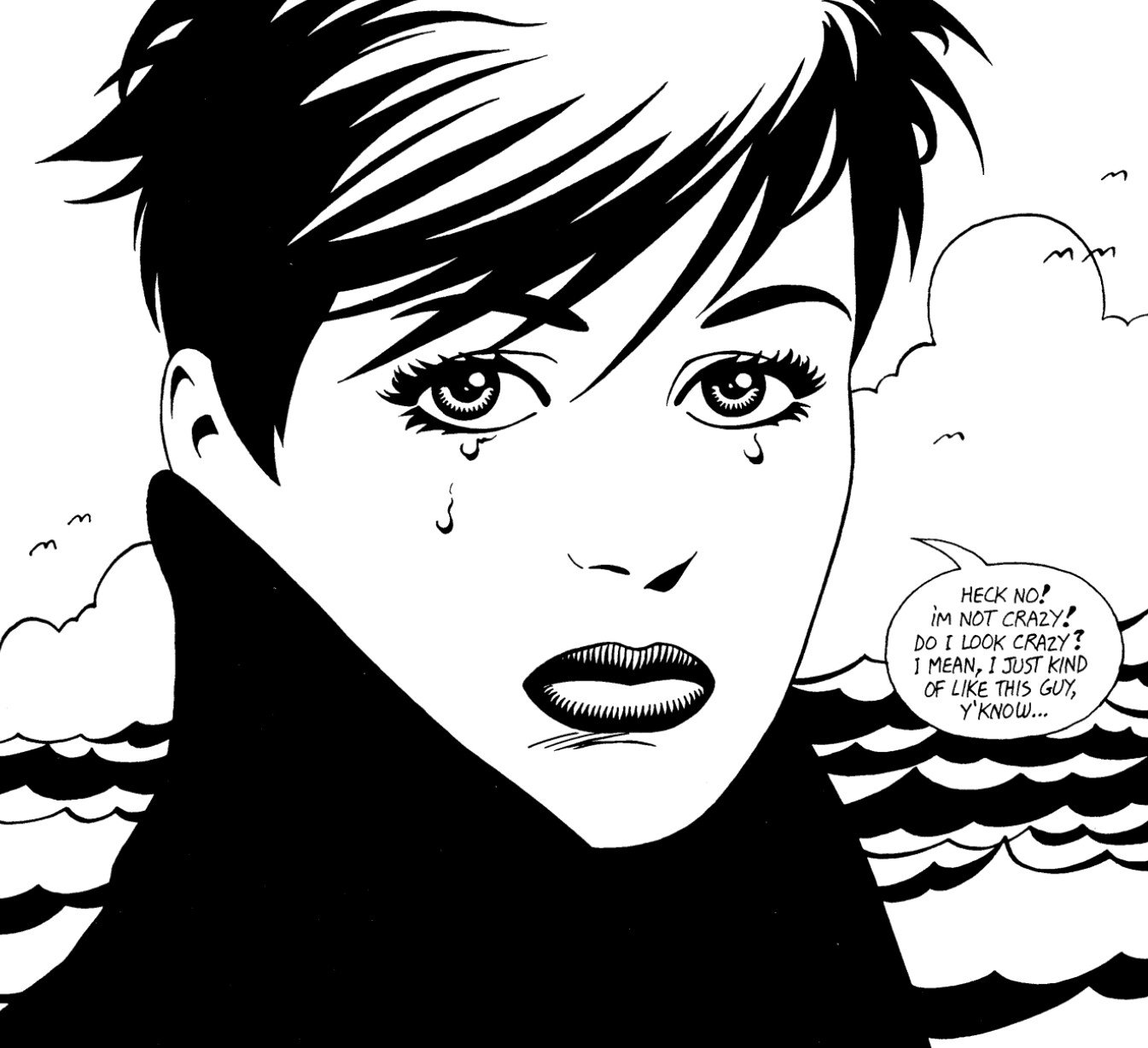
This is especially apparent when you read the work sequentially. A new hardcover reissue of the first “act”—roughly fifteen years, or seven hundred pages—of Locas is interesting because of how, by including everything from those early days, both good and bad, Jaime’s skill and artistic preoccupations evolve on the page. Much of Locas’s cast is present from Love and Rockets’ first, self-published issue: Maggie, her punk rock maybe-girlfriend Hopey Glass, and Isabelle Reubens, a depressed, witchy, wannabe mystery novelist. The narrative, however, is unrecognizable. Stories like “Mechanics” and “100 Rooms” are straight 1950s pastiche, with Maggie working as a plucky “prosolar mechanic” on flying cars in a world populated with dinosaurs and devils. While there are occasional three- or four-page palette cleansers intermixed—depicting Hopey, back in the “real” world—the first two-hundred or so pages of Locas are functionally Jaime’s juvenilia.
These early moments of Locas aren’t entirely without merit. At a purely technical level, it’s amazing that a twenty-two-year-old was churning out dozens of what look like John Buscema panels. And it’s telling that even in the earliest issues, Jaime was unwilling to reconcile the disconnect between his campy comics and punks-in-the-barrio influences. Both coexisted, at times uneasily, from Locas’s very first pages. Yet it is admittedly a tough sell that getting into Locas—which, collectively, might be considered one of the great novels of the late twentieth century—entails a first two hundred pages are simultaneously crucial setup and totally unimportant sci-fi schlock. Maybe just this once, a wiki summary wouldn’t hurt.
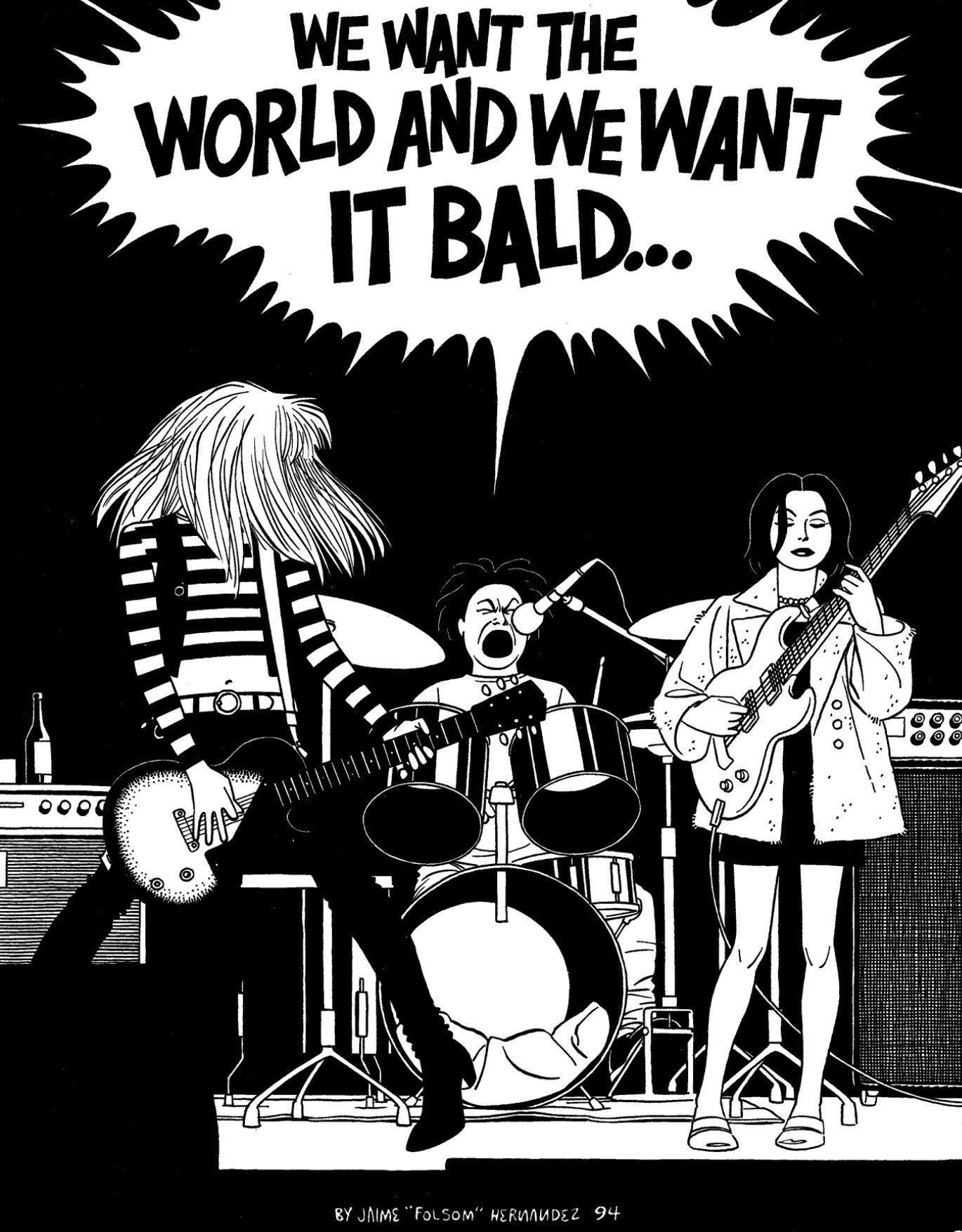
By the mid-eighties, however, both Jaime and his work have grown up. The swashbuckling pulp is never totally explained away, but Maggie, Hopey, and the rest of the cast are suddenly grounded. In a series of shorts, their history together is fleshed out—that Maggie, Hopey, and Hopey’s first girlfriend Terry meet as teenage runaways in a punk house in the rough, Chicano neighborhood of Hoppers (nicknamed for the local vatos’s hydraulically lifted cars). They form a sort of defensive unit against the world they’ve landed in. Hopey is a skinny, buzz-cutted girl ready and eager to fight anyone about anything. Maggie is a wide-eyed recent arrival from the SoCal countryside, enthralled by the punk scene. And Terry is the ambitious musician, a little older than the others and thrust into the role of impromptu den mother, jealous of Maggie and Hopey’s burgeoning relationship. It’s here that the two most important strands of the Locas stories are established. On the surface is the relationship drama—love triangles (or quadrilaterals, or pentagons) complicated by Hopey’s hard-headedness and Maggie’s uncertain sexuality. And bubbling just below that is a startling violence at the edges of las locas’s lives, in Hoppers’s punk and cholo scenes, which the girls are more than aware of yet refuse to slow down for.
The sequence of stories beginning with “The Return of Ray D” is where Locas truly hits its stride. In a series of shorts depicting Maggie and Hopey’s misadventures couch surfing after getting kicked out of their last apartment, tensions are running high between las locas. Hopey, as if to prove just how free-spirited she can be, abruptly leaves Hoppers to go on tour with Terry’s (her ex’s) band without leaving so much as a note for Maggie. It’s the closest thing she can muster to a breakup. While Hopey is crisscrossing the country, Maggie, in Hoppers, ends up involved with two men resurfaced from her past: the charmingly bummy artist Ray Dominguez and the gangbanger Speedy Ortiz.
From here, Maggie and Hopey’s narratives unfold in parallel, a sort of split-screen storytelling effect that coincides with Locas’s first real moments of darkness. Drivers chuck glass bottles out their windows, teenage skinheads show up at shows with swastika armbands, lead singers get hooked on drugs, and neighborhood beefs heat up as cholos start getting a hold of guns. Yet even as things get real in the background, Jaime smartly keeps his pen aimed at his character’s emotional cores. Hopey gets in a spat with Terry somewhere in the Great Plains, with the band down to its last hundred dollars and crashing on their tourmates’ floors, but refuses to call Maggie out of pride. Maggie quits her dead-end fast-food job and, during a boozy night celebrating, her ex-coworker Danika asks, “I don’t mean this bad, but . . . are you a fag?” Maggie cackles with laughter, but you can see the hurt in how Jaime frames her droopy face against the dark background. “I made love to my best friend,” Maggie tries to explain, on the verge of blacking out. “But you don’t understand. I don’t think I could do it with just any girl other than Hopey.”
The way this conversation is presented is important too: with the grid’s last panel functioning an unmarked smash-cut into a flashback of Maggie and Hopey as kids, scratching their names in wet concrete and catcalling neighborhood boys. The sorts of stylistic flairs that Jaime starts experimenting with here—subtly messing with the closure, or rhythm, of his grids of panels, undermining the “punchlines” to his page composition’s “jokes”—will come to define his mature style.
The same is true for his character drawing. From the beginning of Locas, kiddie comics like Archie and old-school Marvel artists like Jack Kirby and John Romita Sr. were obvious influences on Jaime’s crisp linework, curvy women, and eye for physical comedy. But as his narratives get more complex, he starts pulling from the illustrative style of more sophisticated artists too. There are shades of Alex Toth in the noir-inflected way he inks wide swaths of black and white. And the experiments with nine panel grids and non-sequitur page compositions feel lifted straight out of the work of auteur-ish contemporaries like Frank Miller and Dave Gibbons. Jaime’s character drawing is so unfussy and (at first glance) effortless—looking equally good zoomed into a single panel or taken in as a two-page magazine spread—that his skill obscures just how intentional and subtly boundary-pushing his art has become.
If there’s one criticism to be leveled against Jaime’s work, it’s that he’s not more ambitious. Reading Locas sequentially, you detect a rhythm to how Jaime works. His arcs build to a big, dramatic moment, but after that story is complete, he reflexively shies away from the realist heft, the darkness, he’s developed. The tone of subsequent stories bounces back to that silly, Archie-ish register that many Love and Rockets readers admittedly love but which, to me, feels overly safe.
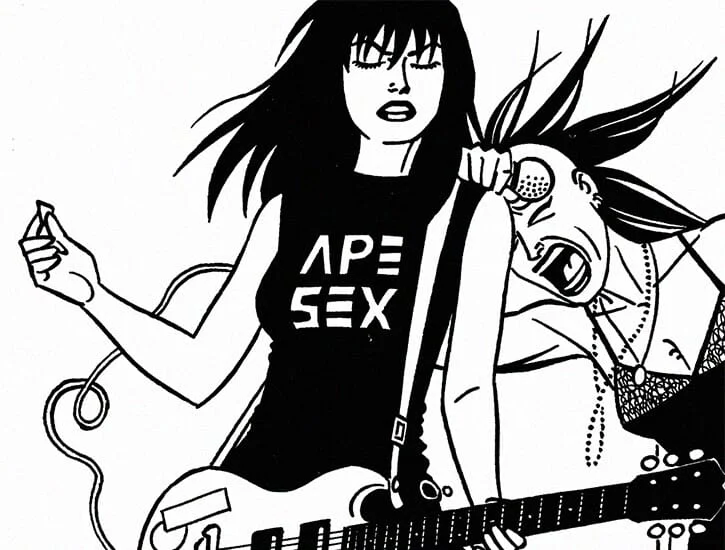
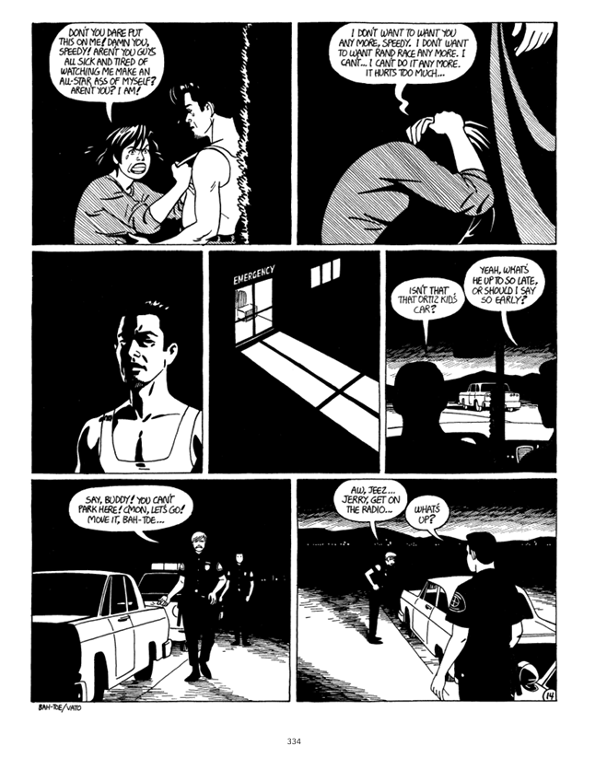
“Vida Loca: The Death of Speedy Ortiz,” probably the narrative and illustrative highlight of this era of Locas, ends starkly, with what’s likely (though not definitively) a suicide depicted with a sequence of pages rendered almost totally in black, save for a police cruiser’s headlights. But the next story, “The Night Ape Sex Came Home to Play,” is a total tonal one-eighty, with a bunch of underage kids trying to score liquor and sneak into a punk show. The formalist attention to page composition disappears with the narrative weight—despite the moody, cinematic style Jaime had honed in the stories preceding it, “Ape Sex” looks like a newspaper strip, with balloons of chatty jokes filling the top half of panels and characters pantomiming their feelings in the bottoms.
This pattern continues through all of Locas, both the first act as collected here and beyond. The Love Bunglers (serialized 2011–12, published as a graphic novel in 2013) depicts a middle-aged Maggie and Ray Dominguez finally reconciling and will likely go down as Jaime’s masterpiece. This is due in no small part to the sheer emotional heft of the thirty years of “will they, or won’t they?” that preceded it. Yet while few authors can boast an oeuvre as long as Los Bros Hernandez, or a fanbase committed enough to stick with it, the unfortunate truth is that for every great Locas story that built to that point, there were probably two more that amounted to little more than jokey schlock. Continuity, then, is the key tension in all of Jaime’s Locas comics. When it’s channeled coherently—long-simmering beefs and teenage crushes coming to a head in “Vida Loca,” long-delayed closure in The Love Bunglers, or even the simple fact that much of Locas’s cast from the 1980s are still, aged up, in the new comics released today—Jaime’s work reads unlike anything else. But the flip side of the coin is that, even with a reading guide, the work can be confusing, even unapproachable, for new readers.
And yet, is this even really a fault of the author? Jaime’s characters’ messy shared history—with fuzzy details, but then again, whose history isn’t a little fuzzy?—is by design. They reflect their creator’s interests and aesthetic sensibilities being recontextualized as he ages. In a form like alternative comics, where even the masterworks rely a bit too heavily on visual gags and adolescent angst, Jaime’s earnestness is applaudable. As is his refusal to retcon his juvenilia or write off the kiddie comics that inspired him. Even when the continuity is daunting, the Locas comics are held together by Jaime, who is always unabashedly himself, and how he draws with a heart that’s obvious on every single page.