, February 25, 2026
It’s His Turn
Gavin Newsom sets his sights on the Oval Office
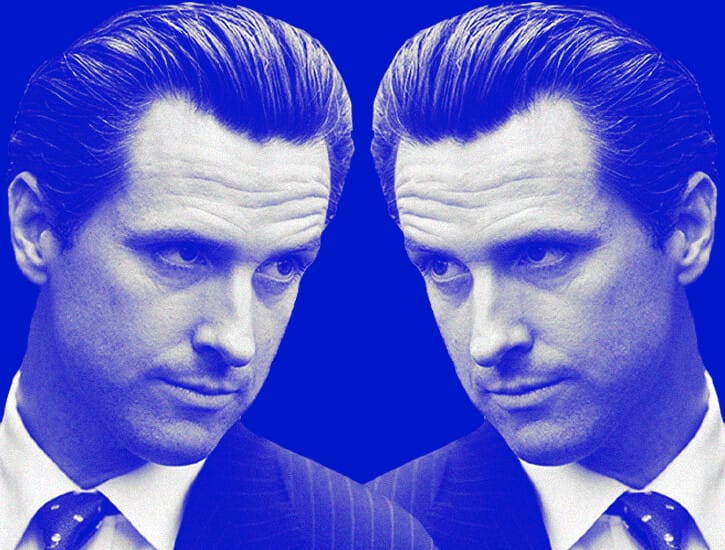
Newsom on Newsom. | Flickr/The Baffler
Young Man in a Hurry: A Memoir of Discovery by Gavin Newsom. Penguin Press, 306 pages. 2026.
You don’t need a crystal ball to divine Gavin Newsom’s ambitions. “Yeah, I’d be lying otherwise,” he told CBS News last October when asked whether he was considering a 2028 presidential bid. As things stand, he’ll enter the Democratic primary with the wind at his back. He’s polling near the top of the field, buoyed by the success of his retaliatory gerrymandering push and his trollish social media presence. He’s got a surprisingly popular podcast to boot: recent guests include Bill Clinton, Ben Shapiro, and Jasmine Crockett. For the moment, at least, he’s the face of the quote-unquote resistance.
As is customary for those eyeing the Oval Office, he’s written a book, Young Man in a Hurry: A Memoir of Discovery. The long and short of it is that Newsom is the guy. He always has been. And you’re going to like it. That’s not because he’s forcing anything on you—perish the thought. It’s more like he’s leading you on a guided meditation. A proper understanding of Newsom’s hardscrabble upbringing and his business-minded pragmatism will, in any reasonable mind, lead to the correct conclusion. You’ll think it was your idea all along.
You wouldn’t be the first. In high school, Newsom recalls, his classmates nicknamed him “El Presidente.” It was around that time that he began gelling his hair, drawn, he explains, to “something about the translucence.” On the baseball diamond, he was a star—so promising, he claims, that a scout for the Texas Rangers kept tabs on him. Come halftime, the cheerleaders would break into a personalized anthem: “Dippity-do, Dippity-do! Gavin, Gavin, we love you!”
Gavin Newsom doesn’t tend to attribute his victories to the force of his ideas.
Young Man in a Hurry exists for another purpose, though: to explain, and if possible defuse, the story of Newsom’s connections to the Getty family and the advantages that flowed from them. As Newsom puts it, his “entry into the Getty world would rob me of my own hard-earned story.” Their “theft,” as he puts it, is “one of the very reasons for writing this book.” The backstory he presents is as follows: Gordon Getty and John Paul Getty Jr. had been his father’s close friends since childhood. The Getty boys’ father, the ever-absent J. Paul Getty, had divorced their mother—wife number four—and occupied himself with becoming the richest man in the world. How exactly this arrangement came about is unclear, but the task of clothing and feeding the Getty boys fell to Newsom’s grandparents, who relied on modest payments sent by their globe-trotting father.
The Getty boys came to count William Newsom III, Gavin’s father, as among their brothers. (It was he who helped coordinate the delivery of $2.9 million to the Calabrian mafia to secure the release of John Paul Getty III.) When William divorced Gavin’s mother and departed San Francisco, Gordon Getty and his wife returned the favor. Each summer, the Gettys whisked Gavin and his sister between royal palaces and luxury hotels, traveling by yacht, limo, and their private jet, nicknamed the “Jetty.”
Young Newsom moved with ease among the ultra-elite. He passed for Gordon Getty’s “fifth son,” he writes. In fact, the actor Jack Nicholson once assumed as much during a fête in an opulent Venetian palazzo. He’s remained in those circles ever since. But here’s what Young Man in a Hurry needs you to understand. That’s not who he is, not really, not deep-down. His mother held three jobs, and he began earning his own keep at thirteen—first delivering newspapers, then busing tables and digging trenches for a local landscaper. As he puts it, “We inhabited a lower station.”
Not for long, anyway. Out of college, Gordon Getty invested in Newsom’s first business, PlumpJack Wines, which included Billy Getty among the cofounders. It wasn’t smooth sailing at first, he assures us. But soon Newsom found himself a rich man. Fortuitously, he hosted a fundraiser at the wine store for Willie Brown, the then-mayor of San Francisco, who returned the favor by extending Newsom an appointment to the chairmanship of the city’s Parking and Traffic Commission. “I had no desire to become a mogul,” Newsom writes, and so he made the leap into city politics.
The animating thread of Newsom’s career, if there is one, is a knack for finding the right side of the culture war. Newsom, to his credit, backed same-sex marriage long before it became politically safe to do so. “The ‘go it slow’ admonition was the mother’s milk of Democratic politics,” he complains. As lieutenant governor, he pushed a ballot proposition legalizing weed. Two years later, as governor-elect, he recalls telling supporters that “we don’t criminalize diversity” and “we don’t regulate a woman’s body more than we regulate an assault rifle.” That’s all well and good. But here’s the thing: this appears to be it. Newsom’s political imagination, at its most expansive, amounts to something like the final year or two of Joe Biden’s presidency but with a more dependable relationship with staircases. (There are caveats: in a podcast interview with the late Charlie Kirk, Newsom called the participation of transgender athletes in women’s sports “deeply unfair.”)
Granted, I’m being tough on Newsom here. There’s a little more than cultural warfare to his political vision: In the aforementioned scene as governor-elect, Newsom makes some vague overtures to “the ever-tightening squeeze of automation and wage stagnation.” (The generative AI boom has complicated that pledge: Newsom has clashed with California’s unions and even segments of the state’s business lobby over his opposition to AI regulation.) Earlier, Newsom attributes San Francisco’s homelessness crisis partially to “the concentration of unbelievable amounts of wealth into fewer hands.” One wishes he’d mentioned this to the Newsom who appeared in a photo op personally discarding the belongings of homeless people after an encampment sweep.
On the Board of Supervisors, he aimed to “steer left on issues of poverty and inequality and find the middle on the economy and taxes.” It does not appear to have occurred to him that poverty and inequality are, by most conventional definitions, economic questions. But it’s a moot point, anyway. Two pages later, he backtracks: “On issues of poverty and inequality,” he writes, “I did not always please the Left.” Newsom is similarly undecided on the matter of whether to court or condemn California’s billionaires. In one telling passage, he invokes the “dreamers” who come to California before turning, obliquely, to the conservative billionaires who have made a spectacle of leaving it:
What they find at continent’s edge, in the real and the imagined Golden Land, isn’t always what they were looking for. As a judge who sat on county and state appellate benches, my father saw his share of those dreamers, at their highest and lowest. I’ve seen my share of them, too. Whatever frontier legend invigorates them, they come with the same look in their eyes. They needn’t be completely true, and they needn’t be completely loyal. They tap into our spirit, and hundreds of millions of dollars in subsidies, and sometimes they move on to Texas or Florida. May their landing places greet them with great fanfare, for it is California they take with them.
That’s about as directly as Newsom addresses the politics of Silicon Valley’s billionaires. But what, exactly, is it supposed to mean? I couldn’t tell you. The memoir’s project is plainly to free Newsom from the “Getty vortex,” as he puts it. But Newsom can neither disavow that world nor fully embrace it. Since her 2024 loss, Kamala Harris has grown fond of scolding “the titans of industry” for failing to function as “guardrails” for democracy. That language is sharper than anything Newsom ventures in Young Man in a Hurry. Even more than Harris, he appears determined to be everything to everyone. The result is the kind of word salad quoted above.
In any case, Newsom doesn’t tend to attribute his victories to the force of his ideas. Campaigning for what would become his first term as San Francisco’s mayor, he found himself in a run-off with Matt Gonzalez, a Green Party candidate. Gonzalez, he writes, “was a genius at connecting with people’s fears.” But once the electorate realizes that the man “selling himself as a progressive sleeping on borrowed couches” was in fact “the pampered son of a tobacco company executive,” Newsom cruised to victory. Then, by his own admission, he won his first gubernatorial race through a political sleight of hand. Instead of attacking the other Democrat in the race, his campaign propped up the Republican—just enough to send him into second place and into the runoff. “We didn’t want to run against Antonio,” Newsom writes of his Democratic rival, Antonio Villaraigosa. “So we didn’t focus on Antonio.”
Newsom’s gubernatorial record is not especially formidable, and his memoir doesn’t strain to make it so. Young Man in a Hurry skips abruptly from 2018 to 2020, where Newsom pauses to recount his wife’s medically necessary abortion. He compresses the Covid-19 pandemic into a single, bloodless line: “My time in office has been altered by twenty-first-century pandemic.” It’s a conspicuous move, but not an especially surprising one. The urge to push the pandemic down the memory hole is among the few points of bipartisan agreement left in American politics. The book leaps ahead again to the winter of 2023: There, in a brief vignette, Newsom flips through a book on Leland Stanford’s racial demagoguery and compares it to that of Donald Trump. Moments later, we’re in fall 2024, where Newsom contemplates reading his father’s diary. He reads a few lines. Half a page later, the book is over.
So here we are: stuck with this guy, his unctuous grin, his gelled-back hair. He has never won a truly competitive race against a Republican, and even in deep-blue California—a state that would elect a houseplant with a (D) after its name—his electoral margins are nothing extraordinary. As Nate Silver observes, Newsom has never once run ahead of a Democratic presidential ticket in his entire statewide career. Affordability is the Democratic Party’s strongest line of attack against Trump, and it’s also Newsom’s softest spot. Making data centers help pay for the energy they consume is a political layup, and many moderate Democratic governors have happily taken it. Abigail Spanberger rode the issue to victory in Virginia, and New York Governor Kathy Hochul is pursuing a similar plan. Newsom’s big answer to affordability, meanwhile, has been to fiddle with the zoning code and, currently, campaign against a proposed tax on California’s billionaires.
There is no rational case for Newsom’s presidential candidacy, and anyone with any semi-coherent system of beliefs can tell.
Trump is largely absent from Young Man in a Hurry, largely because it glides past most of the Trump era. But when he does appear, it’s in service of the book’s thesis. “Hope I don’t get in trouble for saying this,” Trump supposedly tells Newsom over the phone, “but that wife of yours is pretty hot.” Even Trump must concede that Newsom is the guy. Insofar as Newsom criticizes Trump for anything beyond his general demeanor, it’s that he’s mishandled classified information. He recounts a 2018 joint trip to Malibu with Trump, during which the president, eager to “impress his guests,” repeatedly divulged “what should’ve been state secrets.” Trump’s “unwillingness to practice the discretion expected of a president,” Newsom complains, “must have presented our nation’s security agencies with quite a challenge.” This is about as specifically as Newsom ever defines himself against the president. He’d be a better custodian of America’s national security state, he tells us. But Democrats have been running this play for years. Recall how Harris courted the Cheney family while branding Trump the favored candidate of “dictators and autocrats.” The play, it turns out, does not work—in 2024, voters consistently favored Trump on foreign policy—though Newsom seems committed to running it again.
Perhaps the most interesting thing about Young Man in a Hurry is that it never quite answers a basic question: What is the actual raison d’être of Newsom’s political career? When Newsom describes his original leap into politics, he writes only that he was “casting about” for “a path that took me deeper into the city and its influence on the West.” You close the book with a nagging suspicion that he isn’t entirely persuaded by his own pitch.
There is no rational case for Newsom’s presidential candidacy, and anyone with any semi-coherent system of beliefs can tell. As far as his chances of winning a Democratic primary are concerned, though, this is not necessarily a terminal condition. Hillary Clinton reportedly found it difficult, in private calls with donors and staff, to articulate the animating rationale behind her own presidential campaign. Clinton, by that point, had built a résumé roughly as formidable as Newsom’s. Her staff ventured that “it’s her turn” might function as a campaign slogan.
The case for Newsom, insofar as Young Man in a Hurry makes one, is a fun-house mirror version of that slogan: It’s his turn. Having conquered sports, business, and state politics, there’s only one chapter left for Newsom to write, and it takes place in the White House. The Democratic Party, for its part, has swung from fretting over toxic masculinity and white privilege to desperately courting white men. (See, for instance, “White Dudes for Harris.”) It’s a perfect storm for Gavin Newsom. It may not matter that he lacks firm political commitments. There’s no substantive platform here because the platform is him. He’s asking you to believe in Gavin, and Gavin, bless him, already does. Dippity-do, Dippity-do.