, February 19, 2026
Into the Danger Zone
What comes after the liberal order?
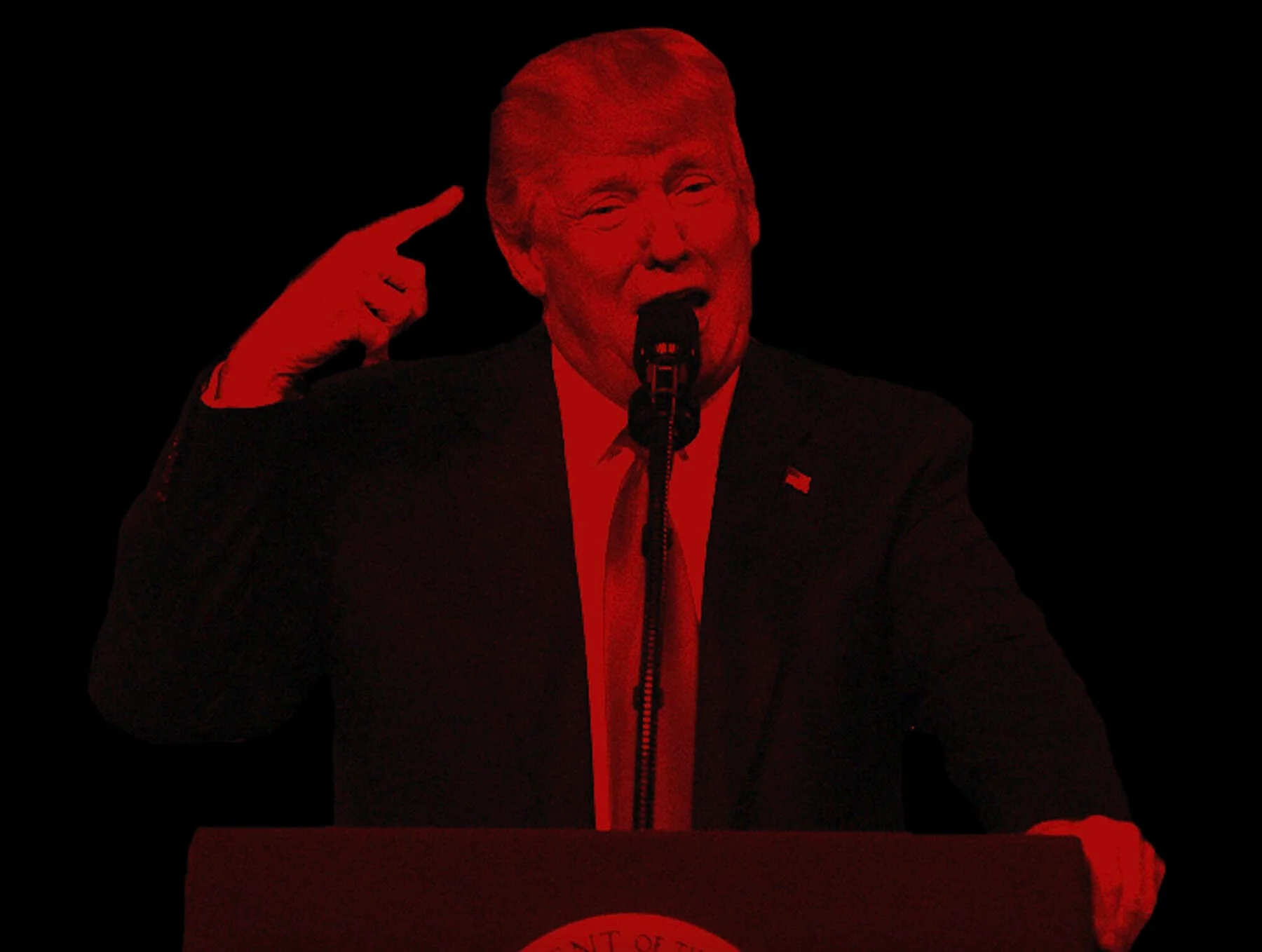
Wikimedia Commons/The Baffler

“We’re going to run the country,” Donald Trump told a press conference, hours after U.S. military forces bombed Venezuela and abducted its head of state. Has there been a more brazen manifestation of American empire this century? Of all Trump’s audacious moves in the first weeks of 2026, this provided the clearest confirmation of a profound and destabilizing geostrategic shift.
There was the oil and there was American security and there was the Monroe Doctrine. There was “the good of the Venezuelan people” too—though euphemism seemed to follow from Trump’s imprecise extemporizing more than from any concern for conjuring a jus ad bellum. And there was loose talk about narcoterrorists, the latest fantasy-antagonist begotten of the rhetorical fusion of villainies. But there was barely any of the institutional melodrama that characterized the previous generation of American interventionism: no PowerPoint presentations to the UN Security Council, no dismissals of international civil servants, no dodgy dossiers cooked up by allied governments.
Coming after the obliteration of fishing boats in the Caribbean, and after Trump’s executive pardon of Juan Orlando Hernández—archetype of the president-cum-drug-lord—the show trial of Nicolás Maduro, regardless of his résumé, would not reflect a claim to legality. No longer willing or able to police the globe, the U.S. government now wields rusty implements of its erstwhile hegemony in a gaudy display of brutishness. Incidental allusions to moral or juristic reason only accelerate the consignment of pretext to redundancy, if not farce. Meanwhile, via the motorcade that transported him to his New York jail, Maduro became the newest involuntary recruit to Trump’s decades-long pageant of fetish.
Relieved of pretext, what are we left with? A sort of truth, perhaps. To be sure, notwithstanding his record-breaking mendacity, Trump has built his base less through lies than through snippets of truth, through an instinctive reading of the conjuncture that occasionally resonates with a discontented middle class. But here we encounter an epistemological paradox: it is precisely when Trump serves up an unadulterated account of his intentions (“We’re going to take back the oil!”) that pervasive confusion sets in among the great many people seeking to understand what the hell is going on. There was no shortage of hot takes in the aftermath of the attack on Venezuela, addressing both the motives behind it and its historical implications—for “international order,” for American empire, for sovereignty. But, in sum, the array of divergent speculation, to which careerist claims to intellectual originality surely contribute, suggests general disorientation.
Trump thrives on this as he spasms to his next move. With his truths granting credibility to his lies, he dares potential opponents and historical allies, at home and abroad, to call his bluff. “FAFO” (meaning “fuck around and find out”) was posted on the White House X account as Maduro was being flown to New York. If, as claimed by Andrés Izarra, Maduro’s former minister of tourism, the dispute for Venezuela is played like a game of poker, not chess, Trump breached the table with all the imperiousness of a shark.
Of course, it was not just about the oil. PDVSA, the Venezuelan state-owned oil company, has estimated that there are between 900 and 1,400 billion barrels of heavy crude in place in the Orinoco Belt, in the east of the country. According to the U.S. Geological Survey, between 380 and 652 billion barrels could be extracted using existing technology. But the calculation of Venezuela’s proven reserves as the largest in the world was contingent: it was almost a decade of high oil prices from 2005, notwithstanding a sharp but brief slump amid the financial turmoil of 2008, that made the tricky extraction of crude in the Orinoco Belt more commerciably viable and enabled PDVSA to set the “economically recoverable” total to between 300 and 303 billion barrels.
Where once pretext contributed to an illusion of unity, there is now just a sequence of memes.
Prices then came down in 2014; despite a spike following Russia’s military invasion of Ukraine in 2022, they remained lower, on average, than the previous decade; and they are not expected to rise soon. Combined with the degradation of Venezuelan oil infrastructure, accelerated by Trump’s expansion of sanctions on the country in 2019, the expectation of low prices no doubt makes control of oil assets in the Orinoco Belt less appealling to foreign interests. In the days after the military intervention, this was pointed out by those who dismissed resource-grabbing as a primary motivation. Adam Tooze argued that Trump was more interested in “feckless reality TV cosplay resource imperialism.”
As always, Trump has been performing for a domestic audience. Despite persistent rumors of popular exhaustion with foreign wars, demonstration of U.S. military might seems to have gone down reasonably well with his base, with two-thirds of Republicans polled by Reuters/Ipsos expressing support for the operation. It has also been celebrated by those Latin-American exiles in the United States—with Secretary of State Marco Rubio as their champion—who have long cheered for violent regime change in Venezuela, and in Cuba. Amid ongoing energy shortages on the island, the extended interruption of oil imports threatened by Trump could produce dramatic political consequences.
But such leverage over Cuba is premised upon American control of Venezuelan oil. So, too, is the opportunity for Trump to strengthen patrimonial allegiances. After the invasion, he granted the first license to trade Venezuelan oil to the Swiss-based Dutch firm Vitol, whose senior oil trader, John Addison, donated more than $6 million to his 2024 reelection campaign. Trump has also previously received donations from Chevron, the only American oil firm active in Venezuela through years of sanctions, as well as ConocoPhillips and ExxonMobil, both of which have sustained claims against the Venezuelan government since it nationalized oil assets in their possession.
And so, of course, it was also about the oil. The Venezuelan crude slate is in fact suited to complex refineries on the Gulf Coast with some of the largest and most advanced delayed coking units in the world. These refineries were developed with billions of dollars of capital expenditure, in part to handle Venezuela’s heavy crude. Without access to it, they have resorted to buying feedstock from Canada, which tends to be more expensive. There is also more-easily-processed oil still to be extracted from Venezuela’s Monagas and Maracaibo basins. And the interest of American firms in controlling this, along with Venezuela’s abundant natural gas reserves, is surely increased by the significant possibility that shale hydrocarbon production in the United States has peaked, or will peak imminently. So, too, is the government’s interest in protecting ExxonMobil’s equity in the Stabroek Block, an offshore oil field adjacent to Guyana’s Essequibo region, which has long been subject to a territorial claim by the Venezuelan government. In a continent rich in lithium and rare earths, as well as fossil fuels, the precedent for exercising military force to control natural resources has significant implications for energy security, but also for energy transition. As the United States prioritizes privileged access to a diminishing global fossil-fuel supply, its attack on Venezuela would seem to suggest a more expansive attack on the future, a desperate effort to preserve the present hierarchy in energy relations.
In geopolitics, such preservation is necessarily an adversarial endeavor. And it is with China, primarily, that the U.S. government is concerned when, as in its recently published National Security Strategy, it asserts its intention “to restore American preeminence in the Western Hemisphere.” China is the concern when the government declares it will “deny non-Hemispheric competitors the ability to position forces or other threatening capabilities, or to own or control strategically vital assets” in the Americas. China has been South America’s largest trading partner since the end of the 2000s. As its economy grew, along with its energy demand, through that decade, South America became a critical source of primary commodities, including hydrocarbons. China has established partial control over South American supply chains, acquiring mining rights and ownership of commodity distribution companies. It has invested significantly in infrastructure, with most South American countries signing up to its Belt and Road Initiative. Having constructed a mega-port in Chancay, Peru, and invested heavily in the Brazilian Port of Santos, last year China signed an agreement with Brazil to explore the viability of a railway that would connect the two, reducing shipping routes. (It was only two days later that Trump threatened 50 percent tariffs on all Brazilian exports to the United States.) And China has become the principal sovereign creditor to South America, offering more favorable conditions to indebted governments than U.S.-dominated financial institutions.
In the geoeconomic dispute to control supply chains, trade routes, infrastructures, and natural resources, it is not the current production capacity, nor even the installed capacity, of a particular asset that primarily determines its geopolitical value. Production is a particularly crucial consideration if it might reduce an undesirable dependence on another value chain (for example, if, by controlling significant Venezuelan oil production, the United States could further reduce dependence on oil from the Persian Gulf, giving it greater leeway to pursue other interests in that region). But of primary interest to a dominant power is negative competition: the prevention of rival advantage through possession, control, or threat. By assuming even partial control of Venezuelan oil, the United States can regulate Chinese access, signaling its intentions for the region. The projection of power modulates adversarial behavior. As Tooze will know, in politics, cosplay is never just for TV.
Of utmost concern to the Trump administration, with respect to the rise of China, is the threat of de-dollarization (or, at least, diversification of the international monetary system). Trump has described the ten-country BRICS alliance as “an attack on the dollar.” Discussions among South American governments about a “common currency” have explicitly centered a need to strengthen regional monetary sovereignty. China has also been bypassing the dollar in its South-American transactions, establishing central-bank currency swap lines with Brazil and Argentina, for example. While the U.S. government is betting on stablecoins to reinforce dollar dominance, fiat-currency transactions in energy markets (new and old) remain key to the dispute for monetary hegemony. Even without the reparation and renovation of Venezuela’s oil infrastructure, American restructuring of PDVSA debt and the channeling of future production into collateral streams could shore up dollar pricing.
With Saudi Arabia deciding in 2024 not to renew its half-century petrodollar agreement, and a growing proportion of trade in hydrocarbons being conducted in other currencies, control of Venezuelan oil assets, independent of their current productivity, could contribute to slowing down de-dollarization in energy markets. While, in 2025, an average of roughly 389,000 barrels of yuan-settled oil were shipped per day from Venezuela to China’s so-called “teapot” refineries, imports have already decreased since the United States imposed a blockade on sanctioned ships in mid-December.
“We do not know what is happening to us, and that is precisely what is happening to us,” José Ortega y Gasset once famously quipped. The Spanish philosopher had concluded by the early 1920s that the modern individual, detached from symbolic references, was afflicted with a profound, vital disorientation, tending toward nihilism. But, with respect to today’s politics of disorder, disorientation is conjunctural, not epochal—not so much a product of the modern shock to mentalities as it is a product of contradictions exacerbated by the relative decline of American empire.
The more we observe Trump’s abstract spectacle of contradiction, the more we struggle to understand the concrete contradiction that has produced it.
There was an apparent convergence of interests behind the complex of motivations for the attack on Venezuela in the weeks leading to it. And yet, Trump’s public appeals to these interests transmit no sense of their interrelation. Where once pretext contributed to an illusion of unity, there is now just a sequence of memes. This reflects Trump’s intellectual incoherence—product of the scramble of his mind to wherever the narcissistic impulse leads it. But it is not simply intellectual incoherence: these interests correspond to different factions of MAGA’s awkward coalition, as well as to elements of the foreign-policy establishment and to fractions of capital often at odds with Trump.
For a decade or so, tensions in the determination of U.S. foreign policy have been most evident in trade relations with China. After withdrawing from the Trans-Pacific Partnership early in his first presidential term, Trump adopted a more bellicose posture toward China, levying tariffs and banning the products of Chinese tech firms ZTE and Huawei. Once the Biden government accelerated “de-coupling” from China, not least by de-risking the production of semiconductor chips and restricting their export to China, it seemed clear that national security was being prioritized over the profit-maximizing export of surplus capital in strategic sectors, big tech in particular.
But, generating criticism from China hawks, Trump’s volte-face on the sale of Nvidia GPU chips last year raised questions about the primacy of America’s national-state prerogatives. As Trump continues to wage a tariff war against China, his government’s stake in Intel and its “pay-to-play” agreements with Nvidia and AMD are obviously not part of a social-democratic program of partial nationalization, regulation, and stabilization. Rather they are suggestive of an ongoing renegotiation of the government’s relationship to the vanguard of American capitalism.
This renegotiation, meanwhile, reflects a broader and growing tension within American empire—between historically enmeshed, but distinct, tendencies, or even logics, of state power and capital accumulation. The transformation of American capitalism through the period of neoliberal globalization—into a regime of debt and asset appreciation, partly through financialization—itself contributed to the emergence of new national competitors, most notably China. If high interest rates and a strong dollar accelerated de-industrialization in the United States, divestment from domestic productive capital also accelerated a new imperial drive for superexploitation on the periphery. But once, in a globalized world, new interdependencies had been established with China, re-industrialization would entail a clash of interests within the dominant class.
Trump is a product of this clash, of the moment of maximum tension once American empire had begun to undermine its own economic ballasts; he is a product of the precarious informalization of work wrought by the transformation of American capitalism and the political conditions it fostered. If he has occasionally appeared to serve as a reaction of the nation-state to the influence of financial capital, he has nonetheless consolidated a quintessentially American political capitalism through which sovereign powers of an increasingly fragmented state are captured by private interests, and these interests, in turn, are domesticated by geopolitical imperatives, increasingly through state purchase (or appropriation) of equity in private firms.
Encouraging cronyism, this form of political capitalism reflects not a unification of state and capital, but an inability of the former to represent the latter while maintaining a functional distinction. Of course, such representation has never been a given. “The capitalist class,” Ralph Miliband reminds us, “has generally confronted the state as a separate entity.” But the state under Trump’s administration is particularly unpredictable in the forms through which it reproduces class domination, not least because the various interests of capitalists themselves seem increasingly irreconcilable. Even in the instance of incidental and sufficient convergence, of the sort that supported the attack on Venezuela, Trump’s politics of spectacle foregrounds this structural tension.
Published in 1967, Guy Debord’s analysis of the society of the spectacle posited that lived reality had “receded into a representation.” In its “concrete manufacture of alienation,” Debord contended, the spectacle obscured social contradictions. But the reproduction of society without consent now involves the formation of a “hyperspectacle”: the reality of contradiction itself becomes an image, a domineering abstract presence; the commodity’s colonization of life is such that it now extends to social contradiction itself. The more we observe Trump’s abstract spectacle of contradiction, the more we struggle to understand the concrete contradiction that has produced it. Amid intensifying alienation, the Trump administration pursues a new geostrategy.
The attack on Venezuela was clearly supposed to generate awe. In the hours after, members of the Trump administration took to social media to praise the “efficiency” and “precision” of the special forces who “extracted” Maduro. Trump added further contradiction to the spectacle by posting a video of Chinooks flying low over Caracas, set to the Vietnam-War-era protest song “Fortunate Son.” Andrés Izarra, meanwhile, wrote that the operation had resulted in “the perfect regime change”: it had achieved “effective control of Venezuela without paying the cost of nation-building.” Regardless of the extent to which Delcy Rodríguez—Maduro’s vice president, who assumed leadership of the government in his absence—is now, as Izarra contends, “subordinated to American diktat,” it is clear that the determination of affairs in Venezuela is more directly subject to decisions taken in Washington. But, for all its gall, the operation also suggested American reluctance to sustain a longer, messier campaign.
Already in 2005, Italian sociologist Giovanni Arrighi argued, with reference to Ranajit Guha, that the United States was exercizing “dominance without hegemony” in the international system. That the Trump administration did not pursue a more substantial regime change reflected an absence of even the partial consent among states that enabled the American occupations of Afghanistan and Iraq. And this bears correlation to the crisis of hegemony within the United States.
It was the material structure of American hegemony that sustained “liberal order.” Trump’s spectacle of contradiction signals that this structure no longer exists.
Through the neoliberal period, capital has placed greater pressure on the American state to “encase” the economy, particularly through legal means, deregulating labor and disciplining workers to prevent their pursuit of collective demands. However, state capacities have also been emptied out, often on the premise that a financialized regime of debt, based on “confidence,” requires tighter fiscal policy. Contributing to the growth of precarity and the erosion of civic consent, this dynamic has also resulted in the state sub-contracting core functions. If the privatization of welfare provides an obvious example, it is also notable in American interventions abroad—for instance, in the strategic deployment of private security firms, as well as the special forces from which they recruit. The vanguard of American war-making for more than a decade, responsible for the abduction of Maduro, covert operatives, largely unaccountable to the state, are now granted licence to target racialized populations in the United States, through ICE, whose budget to 2029 exceeds that of every other federal law enforcement agency. With decentralization of the state’s monopoly on legitimate violence there is a dispersion of claims to sovereignty.
“The United States will unapologetically protect our own sovereignty,” affirms the new National Security Strategy. Trump has often postured as a defender of national sovereignty, complaining in particular about immigration and currency manipulation as assaults on this principle. In light of the threats and violence he has issued against other states, his laments ring hollow. But if American national sovereignty has been undermined, it is primarily from within, by fragmentation of the executive power of the state—which also affects its planning and execution of imperial strategy, its international projection of authority. Historian Susannah Glickman recently noted that “to maintain American empire you need a powerful state.” In fact, American empire has been sustained for some time with weakened state capacity. And its decline should not be overstated, given its global network of military bases, the reference of its currency, and the size and reach of its corporations. But reflecting its structural tensions, the transformation of its internal regime of sovereignty is implicated in its inability to pursue global power in the way it once did.
For the many commentators who, observing the contemporary reconfiguration of great-power relations, have posited a return to spheres of influence, Trump’s invocation of the Monroe Doctrine seemingly provided validation. But although the attack on Venezuela—an unprecedented military intervention in South America—seems to confirm a shift in American strategy, it is not indicative of a reversion. The period of American hegemony, which provided conditions for the imperial situation now referred to as “liberal order,” was a historical exception. However, the legal arrangement of spheres of interest was also historically specific, established during the moment of intense globalization at the end of the nineteenth century. The term was first adopted at the Berlin Conference, in 1885, in an agreement between Britain and Germany to define the division of territories in the Gulf of Guinea under their respective control. It was also then used retrospectively in relation to the division of China into areas of economic control by foreign powers, after the Opium Wars. Although it has occasionally been deployed with looser meaning, it generally referred to the explicit organization between colonial powers of their claims to distant territories.
Since then, subsequent waves of globalization have radically changed the forms of competition exercised by great powers. If, today, there is acknowledgment by the governments of the United States and China (as well as Russia, an obviously lesser power) that the imperial ambitions of each will be pursued most vigorously in their respective regions, there is no tacit pact of non-interference. The United States will not chase China out of the Americas; and it will continue its activities in the South China Sea. China will expand its Belt and Road Initiative; and the United States will intensify its de-risking of American corporations seeking to capture markets in Asia.
Most apparent in the reformulation of American foreign policy, the world is now being shaped by what might be called a “zonal geopolitics,” according to which the implicit rules of great-power dispute are more clearly differentiated across different geostrategic “zones.” Through the attack on Venezuela, the United States government has demonstrated its willingness to use direct military force to assert its interests over the Western Hemisphere. Trump’s claims to Greenland, meanwhile, also appear indicative of another intention, to splinter Europe, subjecting strategic institutions to vassalage and asset-stripping the rest. As he positions a “massive armada” in the Persian Gulf, after a period in which the United States has sought to reduce energy dependence on the region, it seems that the terms of great-power engagement in West Asia are further from being set.
It was the material structure of American hegemony that sustained “liberal order.” Trump’s spectacle of contradiction signals that this structure no longer exists. But it is far from clear that conditions will develop for the formation of a new hegemonic order—under China—that can reproduce the exceptional imperial situation of the American century. And so, despite all the chatter about “The Interregnum,” it seems more likely that we have now entered a time “after order.” Necessarily more unstable, this situation will also be more dangerous. But the reorganization of the world will also create new openings, and their possibility will ignite hopes, particularly among those most subjected to violence exercised in the name of liberal order.
This essay is part of Alameda’s After Order project, which explores the dispute for sovereignty in a fragmented world.