, December 17, 2025
In the Mood for Capital
On Wong Kar-wai’s Blossoms Shanghai
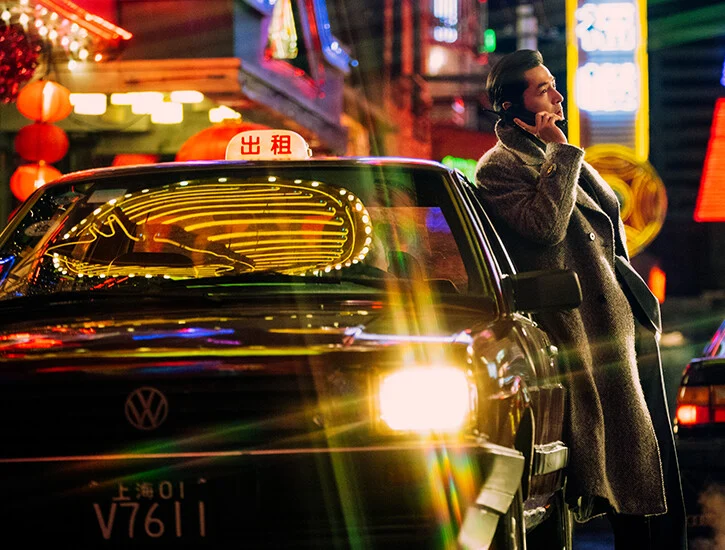
Still from Wong Kar-wai's Blossoms Shanghai (2023) | Criterion Channel
It may be outmoded, or even offensive, but that once-widely debated title “Paris of the Orient” still clings to its five greatest contenders. We have the old French colonials, Hanoi and Saigon. We have Manila, a gateway thrown open to international exchange under Spanish rule. Then there’s Harbin, my mother’s hometown, tucked away in the northeast, rattled awake by the rush of the Trans-Manchurian Railway. Finally, there is Shanghai—glittering from above and blazing street-side, dusty with urbanity and crowded history, its people tempered by the fury of progress, its identity as malleable and uncontainable as the bodies of water that form and split it. Global, shapeshifting Shanghai, throw-of-the-dice Shanghai, layers and layers of Shanghai, unbarred Shanghai, get-rich-quick Shanghai, opulent, lonely, delirious Shanghai. Back when Chinese television was limited to twelve channels, they called the Bund “the thirteenth channel”—one by which to watch the world.
“It’s Wong Kar-wai, but it’s not Wong Kar-wai,” proclaimed a local news article upon the premiere of Blossoms Shanghai, the Shanghainese-turned-Hong-Konger auteur’s venture into (state-sponsored) television, now making its western debut through the Criterion Channel. Across thirty episodes and twenty-two-and-a-half hours, the series follows the eastern city’s cosmopolitan melodrama, brought to boiling by Deng Xiaoping’s economic reforms and the resulting rampant consumerism. Those familiar with Wong’s signature aesthetics will recognize the soft lighting, the use of repetition to create definition, the lingering flurry of a low frame-rate, the grounding vitality of music—but are likely to come away with the feeling that the beloved director has decisively turned away from the tenets of his corpus or at least the suspicion that, in the Wong Kar-wai we love, there has always been many Wong Kar-wais battling for their chance at the helm, an opportunity finally granted by the expanse of broadcast television, the unconstrained media budget of the Party, and a city-muse as schizophrenic as it is illusive.
To speak of Blossoms Shanghai is to address the existential crisis at auteurism’s heart: Can auteurs change?
Throughout his career, the director has been the perfect incarnation of François Truffaut’s “auteur theory.” From As Tears Go By (1988) to 2046 (2004), the greatest part of Wong’s oeuvre is of an immediately identifiable audio-visual language, one suited perfectly to his usual occupations of unrequited love, urban tumult, missed connections, and the crossroads of choice and timing. Today, the director’s name is evoked like membership for tortured lover boys and manic pixies, distinguished enough to appear on critics’ top-ten lists but popular enough to be enjoyed by people who see “movies” instead of “films.” The vivid hues, melancholic voiceovers, and hopelessly alluring pop soundtracks are emblems of consistency coupled with auteur theory’s insistence on the absolution of directorial authority. As for the critics who point out that cinema is a mass production and collaboration—that vision requires a mélange of perspectives—Wong has rebuffed their criticism with the singular obsession that has persisted throughout his films: what critic Tony Rayns has described as the need “to rhyme nostalgia for a half-imaginary past with future shock.”
To speak of Blossoms Shanghai, then, is to address the existential crisis at auteurism’s heart: Can auteurs change? Before I watched the series in its entirety, I would’ve never believed that the sentimentalist, whose concerns had been the ones of poetry, would devote an assaulting percentage of the narrative to a near-religious account of the stock market or that an entire plotline would fret over the price of a pair of pearl earrings—but such is the winding, congregate, and sociological procession of Blossoms, which sets out to capture those transformative early years of 1990s Shanghai. This is not a story of people, of their intimacies and inclinations; this is the story of a country, a Marxian historical materialism. Blossoms is adapted from a Mao Dun Literature Prize-winning novel of the same name by Jin Yucheng, an enormously influential narrative of three generations and three different classes. Wong, however, has placed one individual, the wealthy businessmen Ah Bao, at the center. The majority of the novel’s vast trajectory is scrapped, and Shanghai is cast crystalline, luxe with chiaroscuro and lush palettes. Whereas Jin’s city is thick with the sensual overwhelm of human disarray, Wong’s is slick, clean, gleaming, neon. He opens with a mention of Deng Xiaoping’s “Southern Campaign Speech” in 1992, in which the former leader fortified his internationalist economic position after the horrific events of Tiananmen Square and the resulting global fallout: “Securities, the stock market—are these things are good or bad, are they dangerous or safe, are they solely proprietary to capitalism, can they be co-opted by socialism? We can test this out, but we must do so resolutely.” In the following episodes, there will be romance, friendship, and humanism, but ultimately, the core of Blossoms is economics, of the country that disassembled and reassembled to “test out” the mechanics of capitalism, and Shanghai as its frontline.
What the market catalyzed in 1990s Shanghai was the sudden possibility of tremendous wealth, the emergence of instantaneous ruin or prosperity, and the growing magnitude of luck. The influx of money and financial opportunity into China exerted a seismic effect on all levels of society, but the strand most pivotal to Blossoms is its consequence on interpersonal relationships. In Chinese, relationship is 关系 (guanxi), an omnipresent and subtle phenomenon that goes beyond the Western conception of human connection to synthesize, in varying degrees, considerations of power, status, benefit, harm, loyalty, respect, kinship, lineage, history, honor, social order, advantage, weakness, and deception. Whereas certain societies may rely on law and order (or so go their ideals), Chinese society, in many ways, continues to be held together by a clandestine and inconsistent rhizome of guanxi. The process of seeing a medical specialist—that’s guanxi. Getting a permit to build on your land or a visa to go abroad—that’s guanxi. Going over to your friend’s house and thinking about what to bring, gossiping with a neighbour, fighting over the bill—all part of the intricate dynamics of guanxi. Which is to say, one is forever dealing with another complex, unpredictable, and duplicitous individual instead of a predetermined logic or rules; guanxi is a praxis of human possibility.
Guanxi as we know it today developed amid the Cultural Revolution, when relationships were the deciding factors between relative comfort and prestige or a lifelong stint at the labor camps. In the wake of the money economy of the 1980s, guanxi metamorphosed gradually to incorporate the new considerations of cashflow and capitalist ambition, amalgamating a definitively arbitrary, non-human value project into the messy emotional volatilities of human interaction. Instead of a long concatenation of debts and exchanges, the profit-motivated relationships of money came with clean, quick conclusions—but also an unavoidable, regular diagnosis of every relationship as either transactional or affectionate. As Jin wrote in the epilogue of Fanhua:
Eating Chinese food means sitting at a round table with a big group—people from all walks of life, a dozen pairs of chopsticks moving before you, wine glasses all filled—while their backgrounds flow ceaselessly past. One must pay attention to this movement, the weaving of all these relationships. But western food is served on a long, narrow table; you face one person, and you focus on them.
The novel, he goes on, is essentially a banquet of Chinese and western confluences, because with capital, one is no longer dealing with the individual as a limb of their familial or tribal body, but a standalone entity. As China shifted from a 熟人社会—a society of familiarities—to a 生人社会—a society of strangers—in the era of rapid commercialization, industrialization, and growth, people had to confront themselves, and one another, without the fabrications and vast archives of their communality. What came to the forefront then were our most private and egoist predilections: ambition, desire.
In Blossoms, the art of guanxi mostly takes place between our main man and the three women in his life. The first, Miss. Wang, is an employee at the foreign trade office who aids Ah Bao in his business deals; the second, Lingzi, runs a small izakaya that Ah Bao owns; and the third, Li Li, is a mysterious new arrival who announces her worth by immediately purchasing one of the most extravagant restaurants on the city’s infamous Huang He Road. They orbit Ah Bao in a gradation of potentially romantic gravities, playing out the significant Shanghai-isms of 空门 (kongmen, or bad timing) and 不响 (buxiang, or willful silence). But of course, Ah Bao is a stocks man, this is a stocks story, and as such there is always a price leering in the background of the motions and motives.
Much of the wealth-focused storyline unfolds with the Wongian techniques of seduction, with lasting glances, pregnant pauses, coded dialogue, and sudden, dramatic gestures—but the overall relationship paradigms, revolving constantly around the presence or potential of cash, are grating; I found Blossoms nearly impossible to sit through. Watching from my rental in Shanghai at the end of 2023, I struggled to avoid looking at my phone during the prolonged Wall-Street theatrics, enduring the repetitive, insipid commercials (starring the very actresses who appear on the show), and scrambled to follow all the various plotlines, densely codified with cultural patterns and fiscal trends, that veer hysterically and consummate sporadically. It wasn’t uncommon for a character to be depicted first as wretched, then pathetic, then sympathetic, then dignified, then disappeared—yet this instability of human nature isn’t enacted through coherent narrative motions or intelligent writing but tropes and stereotypes: the trader, the manufacturer, the worker, the rich and the poor, the lucky and the self-made, all at the mercy of time.
It’s Wong Kar-wai in his soap opera mode, intensifying the median into the spectacular. If, to borrow a sentiment from André Bazin, faithful depiction is derived from a love and profound knowledge of a director’s subject, then Wong has approached with curiosity and fascination instead of erudition. The result is a facile, two-dimensional stratification that mutes the emotional impact of pivotal moments with the basest conventions of drama. There are soaring montages memorializing friendships, slow-motion shots in the rain, and even a dance scene set to the Cantonese equivalent to the Backstreet Boys’ “I Want It that Way” called《喜歡妳》by Beyond.
While I was decisively not enjoying Blossoms, I scrolled through comments and reviews after each episode. The majority were of effusive praise, not only for the customary beauty of the images but the poignancy of the storylines. A horrible thought then occurred to me: Am I not Chinese enough to like this? Despite any familiarity with the cultural overtones and historical markers, the behaviours and eruptions of distinctively Chinese histrionics, or the fact that Faye Wong’s song《执迷不悔》always gets to me, I couldn’t get past the pervasive centerpiece of money—commonly thought of as an ugly, uncouth subject in the West. Part of me refused to believe an artist could care that much about money, or that there was any ars poetica in market exchange, or that capitalism enacted anything but inhumanity.
Thinking back to the lyrical, instinctual Wong Kar-wai of Chungking Express or the phantasmagoric, hypnagogic Wong Kar-wai of Fallen Angels, I felt a violent disappointment that the highbrow themes of lieux de mémoire, lifelong symmetries, and heterotopias had been abandoned for the philistine obscenity of money . . . until I remembered that in China, money—even if only by its relative novelty—is a metaphysical curio, ontologically exacting its consequences on guanxi and other traditional strongholds of nationhood and identity. Reluctant as I am to evoke that brutally ineffective term “cultural difference,” or the self-defeating “untranslatability,” there is an oil-and-water level of impasse between the strange liminality of contemporary China “communist” capitalism and the West’s coherent and overarching neoliberalism.
Chinese cinema is made for China, and Hong Kong cinema is made for the world.
Wong Kar-wai, whose corpus is so well-respected in the West, has seamlessly elided any notion of a cultural divide with everything from a Cantonese cover of “Take My Breath Away” (in As Tears Go By) to the universal chicness of qipao (via Maggie Cheung’s svelte silhouette in In the Mood for Love). So what to make of a director eschewing aesthetically rebellious, groundbreaking work in favor of insipid, typical melodrama?
In an interview, Blossoms screenwriter Qin Wei confessed: “Previously, I had thought that Director Wong was only capable of making those kinds of delicate, artful relationship works—but through our collaboration, I found that comedy, action, or more aggressive genres also come easily to him. It’s a quality typical of Hong Kong filmmakers.” Wong left Shanghai for Hong Kong at the age of five, but in his interviews on the making of Blossoms, he insists on an unbreakable connection and an unceasing nostalgia for the city of his birth. While reading Fanhua, he had felt an immediate resonance with this life that he was largely excluded from but which was woven into the fabric of his being, elucidating the times and experiences of his family (including his siblings, who remained in Shanghai). Elegiac behind those square-framed sunglasses, Wong spoke as if he were exiled, ridden with perpetual longing and spiritual orphanhood, and for an artist under exile, their life’s work is to make the break comprehensible, displacements tenable. If the alienation of homeland ultimately unbearable, the exiled filmmaker must eventually reaffirm his origins and his place in civilization; he must make something that evinces his belonging.
To generalize, Chinese cinema is made for China, and Hong Kong cinema is made for the world. With the arrival of Blossoms into the West, I expect that the “world” will experience the same shock and disenchantment I felt when the first seven-minute monologue about stock inflation unfurled into televisions throughout the nation—but the fact remains that the Shanghainese director, for better or for worse, has come “home.” Blossoms is for a Chinese audience, for the CCTV, an excavation of Wong Kar-wai’s missing Chinese self. Hong Kong remains in play, but the affliction of golden hues, affluent garnishes, and multicultural elegance is only the superficial sheen of what is fundamentally a Chinese operation. From the incisive use of dialect to the value (re)orientations of a still infant economic “miracle,” the lurid fixation on regional cuisine to the cerebral manipulations of landlord-tenant relationships, Shanghai appears exactly as it is adored by a Hong Kong director with a predilection for glamour and enshrinement.
As per one virtual comment: “It’s so beautiful. . . But is it Shanghai or Hong Kong?” Despite the acclaim of Blossoms in China and its obfuscation of the realities of Chinese-Hong Kong relations, one can only conclude that in its meanderings and adulations, Wong Kar-wai made the series for himself, to feel at home in a city that has long been beyond him and his work. Whatever successes and failures that exist in the series, they are personal. It’s not artistry—it’s auteurism.