, February 10, 2026
I’m Not Done with You
Israel uses the dead to attack the living
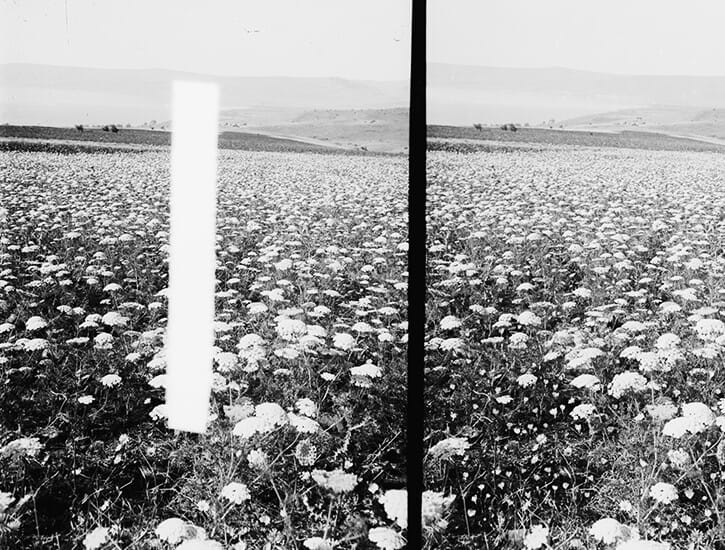
Wildflowers of Palestine. | Library of Congress
The surgeon runs a scalpel from sternum to pubis in a smooth, single motion. They cut through and through until flesh gives, and chest and abdomen splay, revealing lungs, liver, the diaphragm separating them, and a heart that’s stopped beating. Before this, a woman working for a company called Gift of Life lists off what we are here to do, as is done for the living. For the living, the name belonging to the body is confirmed. Here, it doesn’t matter. The woman requests a moment of silence so brief that, by the time you start to clasp your hands or—for those bound by the sterile field—lower your head, the moment is over. It is time, she says with a solemnness foreign to this place, to begin.
The transplant surgeon operates at a threshold: the extension of life for someone thanks to the death of someone else. Some, given pause by this threshold, write about it, grapple with How Death Becomes Life, as one transplant surgeon (or someone on his publishing team) titled his memoir. Most surgeons step across it without issue. I once asked one, while we were waiting for someone’s heart to stop, if the ethics of this work ever weighed on her. “Not really,” she dismissed the question, crinkling her eyes. “We save lives.”
We are here to procure organs. Before making the first incision and after it is confirmed lifeless, we drape the body. It is strange, if you think about it, that there is no anesthesiologist at the head of the bed, no breathing tube, no breathing. You learn not to think about it. This gets easier with time.
In Gaza, Israel claimed it was taking truckloads of Palestinian corpses to perform DNA tests on them, to make sure none of them were Israeli. And then it kept them.
The body becomes a thing. It helps when the reasons for what you do are clear. A surgeon saves lives. Soldiers, who also stand at the threshold between life and death, learn to see this way as well. They stop seeing the baby, its chubby cheeks, generous rolls of fat where bones meet. As a soldier pulls the trigger, they see concentrated potential for future harm; they act today, in the name of prevention. One Israeli soldier, in a testimony given to the Knesset following the suicide of a fellow soldier and friend, said that he and others would “run over terrorists, dead and alive, in the hundreds.” When one does this, he explained, “everything squirts out.” After a semester or year of cadaver dissection, it is common for medical students to be unable to stomach stringy meats for a while. I couldn’t eat chicken for over a year. The Israeli soldier shared that he could no longer eat meat. “Meat” was the word he used to talk about Palestinian bodies: “When you see a lot of meat outside, and blood,” he said, “both ours and theirs . . . it really affects you when you eat.”
Body donation, meanwhile, is a business, its regulation half-assed, which benefits the state. In 2019, a man learned his mother’s body, which he’d thought was donated to advance Alzheimer’s research, had ended up exploded by the U.S. military, to test the efficacy of a new weapon. And in October 2025, it was revealed that the United States Navy, through a deal with the University of Southern California medical school, was providing the Israeli military with cadavers through which its medics could practice saving lives in a simulated trauma setting, fake blood pumping through corpses’ re-perfused vessels. The Navy and USC have been collaborating, since at least 2002, to strengthen “trauma care that saves lives both in combat zones and here at home.” The Israeli military’s surgical training courses in Los Angeles started in 2013; the first contracts to mention “fresh dissection training” are from 2017. Still, the 2025 report, based on information leaked by a doctor who requested not to be named, caused something of a stir. These people, the reports went, hadn’t agreed to be used like this. People were upset; Israel is different from, say, Ukraine, for whom the U.S. and other NATO countries also host these trainings. In Israel, a heavily militarized settler society built around its army and where almost everyone is, was, or will be a soldier, it takes no time to get from A to A, from helping Israeli medics get better at saving soldiers’ lives to sustaining mass death.
Our military does a good job of keeping people from thinking too much about what it does, and this is an ignorance people are happy to oblige. These things are happening all the time—the U.S. military has arrangements like those with USC with other medical schools around the country. It hosts medical training sessions for allies, including Israel, around the world, at bases like Ramstein in Germany. It provides bodies to international partners in the name of “bolstering security,” and while they’ve claimed to try in recent years to shift toward fake bodies, nothing’s quite like the real thing.
Since October 2023, Israel has taken thousands of Palestinians from Gaza hostage. Some of them, Israel had disappeared alive and detained at camps like Sde Teiman, a military base frictionlessly repurposed for torture since the start of the genocide. At Sde Teiman, hostages have been subjected to gang rape, solo rape, beatings, delays in (and denial of) medical treatment necessitated following torture, mutilation disguised as medical care, amounting, inevitably, to too much for a body to bear. Among the hostages taken there was Dr. Adnan Al-Bursh, an orthopedic surgeon whose expertise, shaped through necessity, centered on treating war injuries. Surgery is all about reps; I am told he was a lifeline, literally and psychologically, for his people. Dr. Al-Bursh was likely sodomized to death after months of regular torture supervised by Israeli doctors.
To extend Palestinians’ suffering, Israel must keep their bodies out of the ground. Israel has systematically disinterred thousands of bodies in cemeteries across Gaza. After it takes the bodies, it holds onto them indefinitely, a carryover practice from British Mandate times. Israel keeps some of these bodies in morgues, others in unnamed, numbered graves inside military zones called “cemeteries of numbers.” Between Palestinians in the West Bank and those who are citizens of Israel, estimates place the number of bodies in Israel’s collection, ever-expanding since 1967, in the hundreds, although no one really knows, especially as Israel has been careless by design in how it stores these bodies. Many of the graves are shallow. Some graves are empty—where did the bodies go?—some have multiple bodies or fragments of bodies in them.
In Gaza, Israel claimed it was taking truckloads of Palestinian corpses to perform DNA tests on them, to make sure none of them were Israeli. And then it kept them. No one knows how many bodies have been taken since 2023. Israel says that it holds Palestinian bodies in case it needs them in future negotiations. Sometimes, Israel hand-waves at “security reasons,” sometimes it claims that the burial of this or that Palestinian might spark high valence emotions that might become a security threat, and sometimes Israel doesn’t offer anything at all. Dr. Adnan Al-Bursh’s body remains in Israeli custody; his people have been waiting to bury him for over a year.
What does Israel do with these bodies? In her book Over Their Dead Bodies, Meira Weiss—who served as an officer in the Israeli military before pivoting to academia[*]—writes that during the first intifada, the Israeli army gave license to the state’s main forensic institute, called Abu Kabir, to harvest “organs from Palestinians using a military regulation that an autopsy must be conducted on every killed Palestinian.” The policy of performing an autopsy on all Palestinians killed “politically” (i.e., by Israelis) during the first intifada was also a carryover from their colonial patron: the British during the Mandate period required autopsies on all “suspicious” Palestinian deaths. These, back then, were conducted by a British surgeon. During the first intifada, Israel insisted on its doctors conducting them, infrequently permitting international pathologists to participate in high-profile cases. The autopsies, Weiss writes, were “accompanied by the harvesting of organs” and sometimes used for medical training. Later, as with the destruction of medical infrastructure in Gaza, Israel continued to test the limits of what it could do. The answer, it seems, is whatever.
After the bodies and their organs are taken, according to Weiss, “[Israel’s] skin bank and other organ banks [use] these organs for transplantation, research, and teaching medicine.” The skin—the eager medical student will tell you—is the largest organ in the body, and Israel has the largest skin bank in the world. It has existed since 1986 and was founded jointly by its military medical corps and ministry of health. Skin grafting falls under the practice of the trauma surgeon and is used primarily to “treat burn victims incurred at war or during mass casualty incidences”; Israel also provides skin to patients injured outside these contexts. In 1931, the chief Jewish rabbi of Palestine claimed that the prohibition against desecrating the dead was “unique to Jews. . . . gentiles [had] no reason to be particularly careful about avoiding [it] if there is a natural purpose for doing so, such as medical reasons.” In the years since, there had been disagreement in Israel about how and when it is religiously permissible to desecrate, in the name of science, the Jewish corpse. Traditionally, a body should go into the earth whole and stay there. Nonetheless, today Israeli medical schools acquire enough bodies for their trainees.
Examining the bodies returned to their people after the most recent so-called ceasefire, Palestinian doctors noted that, in some bodies “the rib cage and ribs were clipped with a sharp saw—a medical saw, a bone saw—and the sternum, along with the central part of the ribs, [were] lifted to allow for the removal of the heart and lungs without damage to the organ being taken.” Organ procurement, with few exceptions like skin and cornea, requires that the body be either alive—via brain death—or just-dead—via circulatory death. It is plausible that some Palestinian prisoners’ torture led to brain death. It is also possible their torturers felt no need to wait. Palestinian witnesses have reported that some prisoners were alive at the time they were taken for organ extraction. In one batch of bodies, the organs removed were those commonly transplanted: heart, liver, lungs. The transplant surgeon waits for a person to die; the soldier can’t. The settler surgeon wields his mastery over the body to serve the state. Here, the surgeon acts as—is—a soldier.
After the first intifada, there was a notable drop in Palestinian organ harvesting at Abu Kabir, according to Weiss. One reason she offered was the opening of a Palestinian forensic institute after the Oslo Accords. Another, given by the then-manager of the Israeli forensic institute, was the persistent, precipitous decline in Palestinian health—guess from what—which rendered their organs unfit for harvest. Another reason: the shift from reliance on Palestinian to foreign laborers introduced a new “source for skin and other organs.”
Israelis aren’t the first to repurpose corpses. In the nineteenth century, European surgeons often engaged in what was called “body snatching” to acquire the bodies necessary to teach anatomy to the next generation of doctors at a time when cadaver dissection was largely illegal. What is different about Israel is how it systemizes this extraction in service of the nation. Michel Foucault offered the term “biopower” to describe the state or sovereign’s mechanisms to “make live and let die.” In Foucault’s formulation, “death is outside the power relationship.” Once a person dies, you can’t really hurt them anymore. Instead, it’s through mortality, the specter of death, that the state asserts control.
Life becomes a privilege or threat, something to be titrated. Foucault writes in Society Must Be Defended, the transcript of a lecture he delivered in March 1976, that “the very essence of the right of life and death is actually the right to kill: it is at the moment when the sovereign can kill that he exercises his right over life.” If the sovereign’s power over a person through their body ceases once a body is buried, Israelis have found a workaround: they pull the body out of the earth. Come here, I’m not done with you. This does a few things: it allows Israelis to feign omnipotence. In their play at god, they bring the Palestinian back to hell. Achille Mbembe introduced “necropolitics” some decades after we got Foucault’s “biopower,” to name the vampiric logic of, not how death becomes life exactly, but rather how the life of some depends on the death of others. How the settler soldier, like their doctor and the people for whom they fight, come to see what they do as good.
For Foucault, racism—the basis of Zionist supremacy—naturalizes the logic of war (that some must die for others to live) and turns it biological. It is not simply out of necessity that Palestinians must be killed. It’s right, and it should feel rewarding to do what’s right; Israeli soldiers ring in the new year by firing machine gun rounds at random at Palestinian homes, laughing. It’s especially hard to sustain a supremacy without obvious phenotypic difference—many Israelis are Arab, look just like us. As such, the differences between our bodies must be imposed.
The Palestinian body can be nothing like the Israeli body. It starts with the cradle. Before the soldier is born, he is carefully selected. Zionism, in its early days, described itself as “muscular Judaism” and continues to subscribe heavily to eugenics. Today, Israeli society is obsessed with fertility. About 60 percent of Israeli women go through some kind of genetic testing (usually amniocentesis) before delivery and, as of 2002, held the world record for the number of tests per pregnancy and fertility clinics per capita. The threshold for abortion is minor physical deformities, like a cleft lip, and when testing shows even a low risk of things like Down syndrome (one study showed that 68 percent of Israelis believe it is “socially wrong” to give birth to such children). The fixation on the body follows them to the grave. At the Israeli forensic institute, Jewish and non-Jewish bodies are handled separately.
Israel’s systemic mutilation of Palestinians, especially children, who today represent the largest pediatric amputee population in the world—a previously unimaginable term made possible by Israel’s knack for cruelty—emerges in part because it inflicts pain, in part because it transfigures the Arab body into a marker of Jewish supremacy—think of the permanent disfiguring of the pager attacks—and in part because it drives a wedge between the Israeli and their enemy. Israelis only recognize themselves against our image. In a world like that, everything becomes relative: a limbless Palestinian child is a way to see strength in your own.
Chances are, the Israeli child grows up to be a soldier, and some soldiers fall. In The Chosen Body, Meira Weiss explores the embodied politics of Zionism, how this is articulated through the social handling of the Jewish body. The soldier’s corpse, she writes, is kept “as complete and intact as possible.” As evidence, she cites the prohibition against skin harvesting from the soldier, “even when the available skin meets the required standard, and even though this operation might save the life of other soldiers.” And it goes beyond skin: “Soldiers’ bodies also cannot be used for the development of medical skills.” Speaking with the head of plastic surgery at the hospital housing Israel’s major skin bank—also the former chief of medicine of the Israeli military—she learned that while the forensic institute has long used corpses to practice on, he “had only recently learned that it never used soldiers’ bodies . . . despite the fact that the skills learned might save the lives of other soldiers.”
Israel’s approach to the Palestinian body emerges from a cross between the utilitarian logic of how death becomes life—here not between individual bodies but through them, for the nation—and the retrofitted justification to kill, in life’s name. Israel denies the entry of items—like vital signs monitors, pre-pregnancy supplies, crutches, wheelchairs—into Gaza in the name of these being “dual use,” i.e., repurposeable into weapons. The Palestinian body, for the Israeli, serves two functions: First, there is the psychological impact on the settler, the gratification of unearthing a body that’s nothing but pathos, that does not resist, kidnapping it and making it serve you, then discarding it, arms zip-tied, into a pile of other bodies. Then there is the body as a thing, the way it can be used in death to fuel the Israeli economy, grow a booming medical industry, train a generation of doctors committed to the right kind of life, and extend the lives of Western bodies.
Israel’s approach to the Palestinian body emerges from a cross between the utilitarian logic of how death becomes life and the retrofitted justification to kill.
If bodies keep a score, Israel uses the Palestinian body to say it is winning. At each stage of its Israeli afterlife—the seizure, withholding, and return of the Palestinian body—the Zionist state forges unique opportunities to desecrate. You cannot harm a corpse, though you can use it to harm others. In October, the math was fifteen Palestinian bodies for each dead Israeli. Israeli bodies were returned in caskets, Palestinian bodies in bags. Israel has bombed and detonated cemeteries in Gaza and Lebanon, taken bulldozers to graves. It resurfaces bodies in varying states of decomposition for their families to see. Israel uses the dead to attack the living. It’s hardly alone: the United States, in a recent wave of airstrikes on Venezuela that included the capture of the country’s anti-imperialist president, took a detour to bomb Hugo Chavez’s grave. Empire is petty; it lives for—and through—spectacle.
On October 10, 2025, Israel returned some four hundred bodies it had taken over the last two years, as part of its ceasefire agreement with Hamas. Dozens of families gathered at Nasser hospital. Because Israel has denied the entry of forensic materials into Gaza, these families would have to identify the corpses of their loved ones themselves. Across a screen flashed photographs of bodies, often dismembered, frozen in haunting positions, decaying—in whom these people insisted on recognizing people.
According to Bessel van der Kolk, trauma alters your brain through your body. What you and your traumatized psychic interiority leave behind is your body and other people, who see what has been done to you. Israel understands that what happens to the individual body happens to other people. Palestinians also understand this, albeit differently. Martyrdom is another iteration of how death becomes life—in place of extraction, we have sacrifice. Martyrs, in our tradition, do not die—by surrendering yourself, through your body, for your people, others live through you, you through them.
Once, before the genocide, a mother walked at the front of her son’s funeral procession, weaponizing her immense loss to defy an enemy that tried to wield the very body she had delivered to this earth to break her. This is only part of it: she was there, first, not to face her enemy but to honor her son’s life, to signal with her body to her son, who was somewhere beyond his body, and then, to everyone else seeing her, that she would carry him until he could rest.
[*]Correction: An earlier version of this story incorrectly characterized Meira Weiss as having served as the head of the Israeli Forensic Institute.