, January 20, 2026
Gimme More
Is the energy transition a hoax?
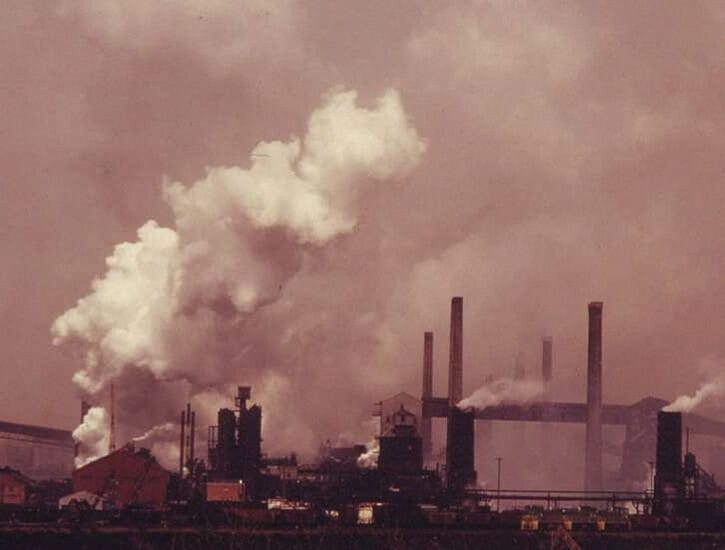
A power plant in Clairton, Pennsylvania, 1973. | Wikimedia Commons

More and More and More: An All-Consuming History by Jean-Baptiste Fressoz. Penguin UK, 320 pages. 2025.
“To hell with the environment, give me abundance.” Out of context, this sounds like a fitting tagline for our moment’s reactionary liberalism, an elite worldview that has reframed its own organized constituencies and regulatory achievements as so many fetters on prosperity, innovation, and American dominance.
Learning the actual source of the quote induces a sense of vertigo, as past and present link in a flat circle. The exhortation appeared in a 1970 issue of Science in the midst of an “energy crisis” that a tactical alliance of the nuclear industry, the oil and gas lobby, and pliant politicians blamed on a then-nascent activist movement. In the wake of a series of blackouts in the mid and late 1960s, environmentalists, who had just celebrated the first Earth Day, proved an easy scapegoat for electricity outages and the deeper crisis of energy sources they ostensibly augured. Analogous to contemporary “abundance” discourse, the narrative dramatically simplified complex matters of supply and demand, regulations and finance, profit models and project delays. But despite its questionable empiricism, the concept of energy crisis would only gain currency in the years to come. Between 1972 and 1974, oil prices nearly quadrupled. This time, a new scapegoat was identified: the uppity leaders of the postcolonial world, who had formed a transnational oil cartel, nationalized their country’s oil sectors, and renegotiated with the major Western oil conglomerates from a newfound position of strength.
A concerted “energy transition” appeared as the only escape from OPEC’s tightening stranglehold. This term, like energy crisis, has an unexpected genealogy. It was coined years earlier by Harrison Brown, a nuclear chemist and avid neo-Malthusian. Far from a fringe ideology, the Malthusian revival benefited from the largesse of John D. Rockefeller III and reached a mass audience via the 1968 bestseller The Population Bomb, which (wrongly) predicted that uncontrolled population growth would breach the planet’s carrying capacity, leading to environmental degradation, famine, and mass death. Brown was likewise concerned about resource constraints on population growth—and convinced of the looming specter of “peak oil.” He saw the rapid development of nuclear and solar power as the only solution to the ensured exhaustion of fossil fuels.
It’s impossible to explain the durability of coal, gas, or oil without attending to the imbrication of fossil fuels and fascism.
It’s a testament to the cunning of capitalism that these doomsday scenarios resulted not in the reduction of resource use but instead in new vistas of accumulation. In the early 1970s, promoting an energy transition performed an impressive sleight of hand. It metabolized fears of resource shortages and geopolitical volatility into renewed belief in American ingenuity and primacy. To the rescue were solar panels and offshore oil, domestic coal and nuclear power, energy efficiency and synthetic fuels. Namely, anything and everything to reduce U.S. dependency on oil from the Middle East.
In the twenty-first century, the notion of energy transition has regained salience, this time as a solution to global warming. But in transposing the term across these varied figurations of crisis—too little energy, too expensive oil, too much carbon—a questionable history sedimented into common sense. There had been multiple energy transitions in the past, so the story goes. Humans once burned wood, then combusted coal, then ignited oil. If the grand sweep of time could be periodized into so many epochs distinguished by the prevailing form of primary energy, then a future energy transition was practically inevitable; the only question was how fast it would come.
The problem is twofold. First, this just-so story of energy history bears almost no resemblance to the factual record. Second, positing technological innovation as a deus ex machina absolves us from the responsibility of a frontal confrontation with fossil capitalism—and capitalism itself.
This is the compelling argument of More and More and More, by the French historian of science and technology Jean-Baptiste Fressoz. The title announces object and method. Rhetorical structure is as relentless as the process it describes: the advent of coal power increased demand for wood; the growth of the oil sector meant more need for both wood and coal; today’s global expansion of renewables likewise occurs amid record fossil fuel extraction while relying on hardware manufactured in factories powered by coal. Through the mid-twentieth century, underground coal mines were supported with wood props; the first oil derricks were likewise made of wood and later steel, which requires metallurgical coal as fuel and reactant; oil-powered global trade meant unprecedented demand for boxes and pallets made from wood pulp and wood, respectively—meanwhile, oil-powered machinery made faster work of cutting down trees. More and more and more.
This is not just a story of simple energy addition, in which new energy sources accumulate rather than substitute. That happens. But Fressoz’s more precise phrase is “material symbiosis.” Peer closely enough at the processes of extraction, production, and consumption, and witness an intimate intermingling of not only wood, coal, and oil, but all manner of their derivatives and refined products, so-called “synthetic” inputs that in actuality trace their origins back to the same earthly gunk. The relative shares of primary energy sources may rise and decline; but in absolute terms, the pile of material stuff used to harness those sources grows and grows, as does the increasingly material-intensive consumption they enable.
From one perspective, the advent of petroleum-derived kerosene replaced lamps illuminated by whale oil; from another, the advent of oil-fueled ships enabled an unprecedented massacre of whales, a mass murder that peaked in the 1960s—decades into the supposed “oil” age. Sure, the blubber was no longer used for lighting, rather for industrial lubrication, food chemistry, and cosmetics. But that fact offers little solace for the eighty thousand whales slaughtered annually during the industry’s mid-century height.
Living in a fugitive state of exile from fascism that he ultimately only escaped by suicide, Walter Benjamin described history as “one single catastrophe which keeps piling wreckage upon wreckage.” Progress names the willed forgetting of this wreckage. Admirably, More and More and More forces us to stare unflinchingly at the pile, describing in ruthless detail its baroque yet teetering construction that threatens to close in on us all.
Breaking free from the labyrinth of endless, interlocking material accumulation would seemingly entail some understanding of its origins, its internal logic, and, hopefully, the weaknesses that render it rickety. Why, exactly, does more beget more and yet more? Fressoz does not provide an answer. Coal drives the consumption of wood; coal mining depends on oil; oil extraction depended on trees. Sentences such as these recur throughout the book. Materials are the dramatis personae of this story.
Politicians, lobbyists, and technocrats play their part, but historical causality, when it is discussed at all, takes the form of an apparently mechanical law. This law is the rebound effect: the phenomena whereby improvements in the efficiency of resource use are counteracted by increasing resource use, also known as Jevons paradox. William Stanley Jevons, a nineteenth-century English economist, observed that more efficient use of coal led to more, not less, demand for coal. The seeming paradox is explained by market fundamentals. When coal is utilized more efficiently, less of it is required, which puts downward pressure on prices, which in turn makes it more affordable, incentivizing its use in a wider range of industries and activities.
Zoom out to the longue durée, and it seems that once introduced into the mix, no material ever disappears; it is only redeployed in new forms. “The history of energy symbioses is made up of loops; it is a story without direction.” Case in point: AI systems are becoming more efficient, but AI deployment is scaling so rapidly that any potential efficiency gains are wiped out by metastasizing demands for that computational power—and all the energy, minerals, water, and land required to feed the slop machine.
For Fressoz, this symbiotic, directionless looping, a snake that eats its own tail and becomes bigger at the same time, is capitalism—a word that appears with some frequency but is defined nowhere in the book, and thereby implicitly conflated with the upward trendline of material growth and symbiotic complexity. But as a social formation, capitalism is both more and less than sheer growth. More, because growth does not illuminate the class and property relations central to capital accumulation; less, because equating capitalism with growth simpliciter has difficulty accommodating the system’s tendencies toward quite the opposite: crisis, stagnation, and recession. Capital also rarely if ever acts alone. The material history of the global economy is undergirded by the actions of powerful states—a fact that gets little attention in Fressoz’s account.
Since returning to office, Trump’s government has buoyed global coal demand to a record annual high; promoted electricity-hungry AI that has proven a boon for gas producers; and orchestrated an invasion of Venezuela, framing the brazenly illegal act as opening up investment opportunities for U.S. oil companies.
It’s impossible to explain the durability of coal, gas, or oil without attending to the imbrication of fossil fuels and fascism; without noting that the United States is the world’s top oil and gas producer and confronts a geopolitical rival that in the first half of 2025 installed more new solar power than the rest of the world combined; without observing that U.S. politicians from far right to comfortable center have coded renewable energy as unreliable, woke, elitist, and Chinese. For Fressoz, transition is the ideology of capital; but it seems even more apropos to say that more and more and more has itself become the explicit worldview of mainstream Democratic politicians and their pundits. Whereas the MAGA right rejects solar and wind altogether, reactionary liberals embrace energy triangulation—“all of the above” rather than a full-throated embrace of clean energy—dressed up as so-called climate realism.
“More and more and more” serves as a pithy five-word definition of capitalism, conjuring its drive to endlessly accumulate and gobble up the earth in the process.
In a political system marked by extreme polarization, bipartisan support for fossil fuels merits explanation. Hundreds of millions of dollars’ worth of oil industry lobbying is one reason. Another is the relative political disorganization of green industries—which at the firm level includes an unwieldy mix of corporations making a bet on the energy transition (solar developers or EV battery manufactures) and companies that benefit from the fossil status quo but are receptive to subsidies for decarbonization (utilities or major carmakers). A third is the state of climate organizing, which, exceptions notwithstanding, over the past several years has declined precipitously in scale and intensity. And a related but perhaps distinct factor is the declining saliency of the climate crisis on the U.S. left.
This infelicitous balance of political forces is not unrelated to the investment structure of the oil and gas industry. As Andreas Malm and Wim Carton detail in Overshoot, fossil capital is highly vulnerable to the stranded asset risk. Fixed and sunk costs accumulate before extraction even begins, as firms seek increasingly “unconventional” deposits—which are also more energy, and therefore capital, intensive to explore and exploit. Banking on several decades of returns on towering initial investments, oil and gas companies are keen to avoid disruptions let alone the curtailing of project time horizons. “Phasing out fossil fuels” sounds anodyne—but anything approximating it would pose an existential threat to some of the world’s largest companies and investment institutions. A dynamic in which sustained activism and consciousness raising combines with an increasing intensity of cataclysmic weather events and effectively cajoles politicians to take some kind of action is a nightmare scenario for not only fossil titans but their financial backers (banks, asset managers, private equity firms, hedge funds, and governments). It isn’t a stretch to claim, as Malm and Carton do, that an actual energy transition—of the sort that Fressoz shows has never occurred—would challenge the basic power structures of global capitalism and geopolitics.
Unfortunately, that proposition has yet to be tested. The activist dynamic described above lasted only briefly: stretching things a bit on either end, 2016 to 2022. That’s not to say that anti-pipeline protests and organizing for a Green New Deal had no political impact. They are one vital strand of the larger story that delivered the Inflation Reduction Act, which provided a massive boost to clean energy sectors before being summarily dismantled by Trump 2.0. But even before Trump took office, the fortunes of fossil capitalism had brightened significantly. Pandemic recovery measures, supply chain delays, and geopolitical conflagrations triggered a global oil and gas boom. Record profits coursed through company earnings, to banks and funds, and ultimately into the financial portfolios of the world’s wealthiest—and disproportionately American—1 percent. It’s not hard to connect the dots. The economic boost at the top shielded the rich from inflation, widening domestic class inequality amid a cost-of-living crisis. The political effects were likewise predictable. Unprecedented profits enabled a $445 million-dollar lobbying blitz, including $96 million alone for Trump’s reelection campaign.
“More and more and more” serves as a pithy five-word definition of capitalism, conjuring its drive to endlessly accumulate and gobble up the earth in the process. But to neglect the system’s other defining features—the exploitation of labor, the mute compulsion of markets, the ruling class corralling of politics, the neocolonial distribution of resources and power on a global scale—is to overlook the lively domains in which fossil capitalism is daily reproduced, contested, and potentially transformed. Fressoz is honest on this front: in the final passages, he admits that his foray into “materialist history” offers neither a transitional program nor a path to green utopia, just a sobering account of the grim reality lurking behind the fairy tale of human progress.