, December 11, 2025
Georgia’s New Normal
Politics after the unipolar order
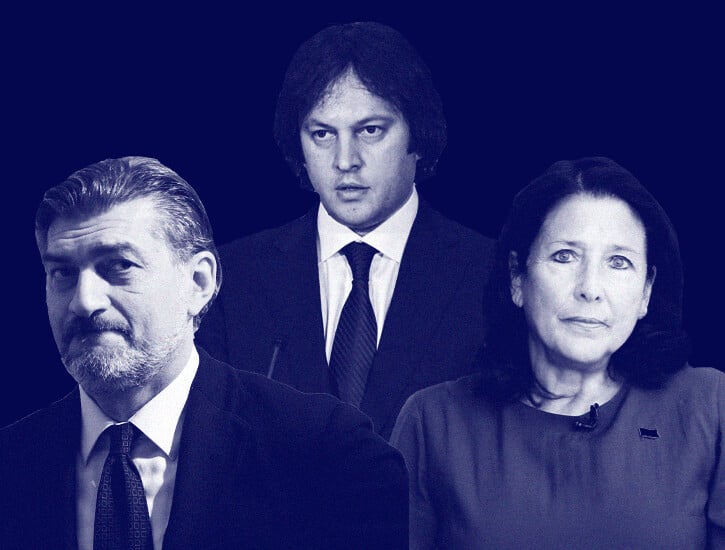
Clockwise from top center: Irakli Kobakhidze, Salome Zourabichvili, Mikheil Kavelashvili. | Photo illustration by The Baffler
Protests in Georgia have continued daily since last October’s election, in which a coalition of four mainstream opposition parties lost to the incumbent Georgian Dream (GD), the party that has governed the nation since 2012. The election was marred by accusations of a pro-Russian realignment by GD and preceded by massive street demonstrations against laws requiring groups receiving funding from abroad to register as agents of foreign interests. Then-President Salome Zourabichvili, a critic of GD, rejected the results of the election, alleging vote rigging and Russian interference, but vacated her official residence while declaring herself the only legitimate authority. She relocated her office to the same street as the Soros Open Society Foundations-affiliated Civil Society Foundation, formerly known as the Open Society Georgia Foundation.
On November 28, the European Parliament passed a resolution calling for sanctions against GD, new elections, and nonrecognition of the government. In response, Georgia’s Prime Minister (and GD chairman) Irakli Kobakhidze announced a pause in EU accession talks until 2028. Although he pledged to continue fulfilling the EU Association Agreement, and while GD said that if there was an accession on the table they would immediately sign it, Kobakhidze criticized the EU institutions as a place of “blackmail and threats,” prompting the opposition to accuse the government of shifting away from Euro-Atlantic integration. This would conflict with Georgia’s constitution, which since 2018 has mandated that the country join NATO and the EU.
Zourabichvili has refused to recognize the newly elected President Mikheil Kavelashvili, GD’s nominee, or his government. She has also played a key role in persuading European and U.S. officials to withhold full recognition of the election. Meanwhile, the opposition coalitions have rejected their mandates in parliament, alleging the 2024 elections were rigged. The nine opposition parties that boycotted the 2025 municipal elections, held in early October, held a protest where some of the opposition leaders attempted a coup the same day as the elections. This backfired, with one leader arrested, and was condemned by other opposition leaders including Zourabichvili and members of the public.
Protesters initially hoped to replicate the mass mobilizations of Ukraine’s Maidan or Georgia’s 2003 Rose Revolution but have since been outmaneuvered and defeated on the domestic front. Their remaining hope for victory lies in heavy-handed U.S. intervention, aided by the import of an American-manufactured Russiagate myth. Within this context, the opposition projects a deep nostalgia for its “golden child” status in the West, lamenting its decline with the performative anguish of expelled honor-roll students.
The blame for this perceived fall from grace is placed by the opposition squarely on the ruling GD party. This narrative is tirelessly amplified by a self-indulgent and self-referential Western media, whose recent headlines—like the New York Times’s “How Georgia Went from the Vanguard of Democracy to the Front Lines of Autocracy”—do little more than regurgitate the simplistic and misleading fable of a democratic paradise lost. As a longtime observer, watching from an American think tank, commented, “I can’t recall another case with such a discrepancy between a country’s actual levels of freedom and the international coverage of it.” The West’s favoritism was precarious and contingent on a powerful American-led world order dating to the Bush administration and the zenith of the neocon project.
For today’s opposition, comprised of several parties and dozens of personalities, Georgia’s fabled era of normalcy began during the rule of then-president Mikheil Saakashvili of the United National Movement in the first decade of 2000s. Then the press, governments, and financial institutions of the West lauded Georgia as the little country that reformed—energetic young leaders dragging the backwards masses of Homo sovieticus into a pro-Western democratic (read: capitalist) future. The United States encouraged Georgia’s harsh neoliberal reforms. These were not reforms, of course, but punishment imposed on a society already battered by the collapse of the Soviet Union: privatization of health care, deregulation, public sector layoffs.
Georgians had barely scraped through the 1990s. This was the darkest period in their living memory, both figuratively and literally: it was a time defined by power outages and rampant crime. Jobs were scarce, and even those who had them often weren’t paid. The per capita GDP collapsed nearly 80 percent from 1988, when it was still part of the Soviet Union. For comparison, during the Great Depression in the United States, real GDP fell by 29 percent between 1929 and 1933, and industrial production declined by 47 percent. In Georgia, industrial production plummeted even further, by 80 percent. Discontent grew among the people, and the government answered not with relief but with repression.
Georgian Dream has been scrambling to define their ideology, borrowing issues and language from conservative movements in Europe and the United States.
Washington praised Tbilisi all the same, celebrating its pro-Western course and their own successful promotion of democracy. There was a palpable sense of optimism—both in Georgia and among Western leaders—that history had finally reached its end point. With the right leader, the right marketing, and enough glowing media coverage, Georgia could make the leap. The gamble was not just for a general security guarantee from the United States but an opportunity to assure Georgia’s territorial integrity. With the United States—and maybe, one day soon, NATO—behind them, South Ossetia and Abkhazia could be reclaimed. (This backfired: Putin recognized both those states as independent.)
The opposition’s golden age coincides with the height of the war on terror, as neoconservatism reached the peak of its influence in Washington. In 2008, President George W. Bush called the Georgia “a key ally” and Colin Powell, Bush’s secretary of state, declared a “strong commitment to Georgia” during the “transition period” of Saakashvili’s presidency. Saakashvili adopted a new flag—five crosses, identical to the banners of the Crusaders—and positioned itself as a Christian fortress in the Caucasus. This campaign included PR tools like full-page ads in The Economist calling on the United States and Europe to “invest in Georgia”: a demand not only for foreign capital but a political stake too.
And the West responded, with hundreds of millions in security and development grants. Bush visited Georgia, the first U.S. president to do so. John McCain and Hillary Clinton even nominated Saakashvili for the Nobel Peace Prize. But all ordinary Georgians got from Saakashvili was neoliberal spectacle: an ostentatious obsession with transparency, minimizing the state through by eliminating progressive taxation (though he had a secret fund from extorted businesses), and, of course, extensive privatization. In this atmosphere of sanction and approval, personal relations with the Bush administration, Georgian hardliners moved with confidence. The Russian invasion of 2008 was not an accident but the outcome of a system that rewarded ingratiation abroad.
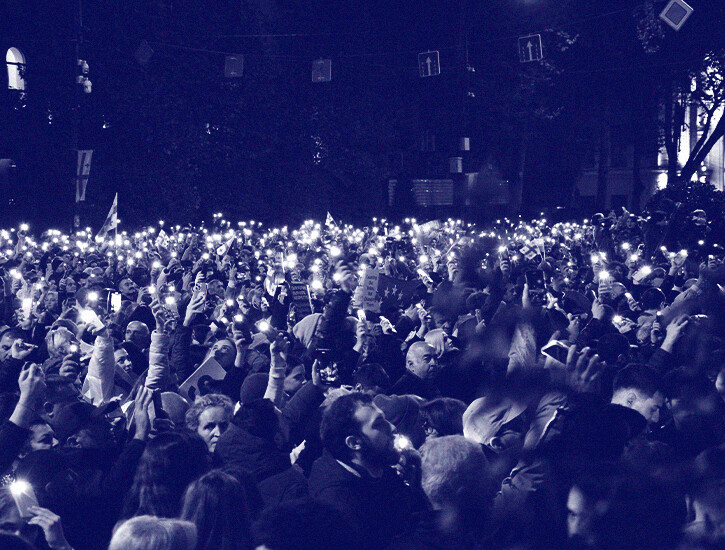

The party now held responsible by the opposition and the West was born out of similarly fractious circumstances. In 2012, Georgian Dream came to power helped by the shocking videos broadcast on Georgian television—graphic scenes of brutal rape in prisons that outraged the public. The violence under Saakashvili’s government was already known directly by many, but all of Georgian society found the videos of men being raped for sport unforgivable. Massive street protests erupted. Several former government officials were charged or could potentially be charged, many of whom fled to Ukraine and came to occupy government positions there. The West explicitly warned GD not to prosecute former government officials: as Reuters put it, “The West has warned [GD’s founder Bidzina] Ivanishvili, a political novice, not to lead a witch-hunt of officials loyal to Saakashvili.”
Ivanishvili was first known to Georgians as a philanthropist: he built churches and financed arts and sports. Originally a backer of Saakashvili, he built his party’s base out of the businessmen who were harassed and extorted by Saakashvili’s United National Movement. Bidzina is a businessman, a committed neoliberal without the spectacle of Saakashvili. He and his party colleagues adored Europe and the United States, worshipped Reagan, and hated communism. They followed the EU/NATO line: signing the EU Association Agreement, participating in NATO exercises, and winning visa-free travel in the EU for Georgians. He did all this without trying to make the Georgian people embrace a neoliberal identity and adopt it like a religion. Partly because it wasn’t necessary—his predecessor had already done that, and Civil Society, tied to EU and U.S. grants, was happily doing the ideological work.
Since the collapse of the USSR, Georgia has swung between these two poles: the “move fast and break things” leaders, and the ones who clean up the mess. GD belonged to the latter camp—the “clean up and straighten up” party. GD inherited the mess, only for the party to find that it was not the ruler the West intended. Against neoliberalization and austerity, Ivanishvili’s GD promised universal health care, agricultural development, and an end to police brutality and Sakaashvili’s police state. GD’s track record hasn’t quite lived up to those promises—they have failed to offer an alternative to IMF development diktats, monopolies have grown, and the privatization of industries and natural resources continues—but some labor protections have been restored and universal health care introduced, later reduced to needs-tested. By refusing to define themselves too forcefully and maintaining a big-tent approach, GD left a vacuum—one that others were quick to fill. Since the 2022 invasion of Ukraine, GD has been scrambling to define their ideology, borrowing issues and language from conservative movements in Europe and the United States.
GD’s response to the post-invasion moment began decades ago, when U.S. aid under Soviet First Secretary and later President Eduard Shevardnadze built a civil society whose leaders later orchestrated the 2003 Rose Revolution, bringing the United States-aligned UNM party to power—a regime change widely attributed to Soros and American-backed NGOs. After the revolution, U.S. support shifted from watchdog groups to directly backing the new Saakashvili government, which viewed civil society as a revolutionary tool rather than for governance. Later, Georgia under GD saw a resurgence of a hyper civil society, now purportedly focused on EU and NATO integration and increasingly funded by Western donors.
However, a growing proportion of foreign money over time was going to NGOs rather than to the government—a pattern reminiscent of the era before the Shevardnadze ouster. This flow of funds, followed by political condemnations and accusations by the EU and ultimately to threats to withhold EU accession, signaled to GD that civil society was again being used as a political lever against them, as it had been in the past. This perception led the government to attempt regulating foreign funding through transparency laws, which only intensified antigovernment sentiments.
For years, I’ve seen reports and studies in Georgia about “Russian disinformation” and “Russian propaganda.” I even attended a couple of the presentations—and found the evidence they presented laughable. It wasn’t just me; even some foreign experts expressed their doubts about the reliability of these findings. The American psychosis of Russiagate spread in 2016 via U.S. foreign aid, and the Russian invasion of Ukraine in 2022 entrenched Georgia’s politics into a rigid “pro-West versus pro-Russia” binary. The effects were to make anti-Russian sentiment a daily fixation and the establishment a frame for how elites, media, and international actors were to interpret domestic conflicts.
Even if the opposition were to win and sweep the Georgian Dream from power, the “normal” they promise to restore is a fantasy.
The Russian invasion of Ukraine triggered global uncertainty that reverberated through Georgian domestic politics even more intensely than in the EU. The October 2024 parliamentary elections are being contested on the exact grounds that American politicians once used: Russian meddling. Salome Zourabichvili, the former president of Georgia—and, as far as she’s concerned, the current president—has repeated this claim in the media and in her speeches. When asked for evidence of Russian interference, Zourabichvili responded that Georgia, with far fewer resources than the United States, shouldn’t be expected to provide proof: “It’s very hard to demonstrate. No country, not even the United States or European nations, has been able to prove Russian interference in their elections.” Instead, she offered this: “What’s important is what the Georgian population feels.”
Virtually all Georgians felt deep empathy for Ukrainians during those emotionally charged weeks after the invasion. Despite GD’s expressions of support for Ukraine (some sporting Ukraine flag pins), party member and then-Prime Minister Irakli Gharibashvili made a statement just days after Russia’s invasion that sparked backlash and suspicion: “I would like to state clearly and unequivocally that Georgia, taking into account our national interests and the interests of our people, does not intend to participate in financial and economic sanctions, since, I repeat, this will only harm our country and our population much more.”
What GD later claimed was that they were being pressured behind closed doors by the United States and EU to align with their foreign policy goals. In that context, Gharibashvili’s public statement wasn’t aimed at the Georgian population, but a message to Western partners: Georgia would not be intimidated into cooperation at the expense of its own perceived national interest.
In January 2023, the then-U.S. ambassador to Georgia, when asked about sanctions evasion, subtly stated that the United States was working with Georgian authorities to build up sanctions’ capacity— that is, taking steps to prevent Georgia from being used as a sanctions evasion route. The United States made it clear that Georgia would need to fall in line with the sanctions regime without directly accusing it of wrongdoing. But by the time the October 2024 elections came around, that subtlety had disappeared. The U.S. embassy was openly intervening, warning that Georgia would be isolated from the West if they voted for the GD. Their Facebook page before elections in Georgian read: “Countries don’t develop in isolation.” Isolating Georgia from Europe is against the interests of its people.
Just before last October’s elections, Bidzina Ivanishvili gave a rare interview in which he claimed that a Western leader had urged then-Prime Minister Irakli Gharibashvili to open a second front against Russia from Georgian territory. According to Ivanishvili, the official admitted Georgia would likely fall within days but suggested the war could continue as a guerrilla struggle.
EU and U.S. leaders denied these claims, along with any suggestion that they had pressured Georgia to impose sanctions on Russia. But it is verifiable that several Ukrainian officials went on record in the early months of the war publicly calling for Georgia to open a second front. Georgia Dream’s refusal to sacrifice its people to the West earned swift retribution. In June 2022, an EU resolution was adopted which “calls on the Council to consider imposing personal sanctions on Mr. Ivanishvili as a person directly responsible for current backsliding in the areas of media freedom and ambiguous relations with Russia.”
The GD of 2024 ran on a peace ticket, even showing images of bombed Ukraine and contrasting it to “built” Georgia. GD won. Zourabichvili went on a foreign media tour and claiming it was a Russian “special operation” and “totally” rigged. Evidence wasn’t presented, and it turned out it was not necessary. The campaign to hold off most of Western governments from recognizing the new government in Georgia was successful. However, the opposition can’t win Georgian votes, only the approval of EU bodies and American politicians. The undying hope of opposition rests on the United States imposing sanctions on the Georgian government rather than winning elections. They have been waiting for their rent-a-congressman Joe Wilson to push through the MEGOBARI Act in Congress, which requires the president to sanction GD officials (even going back as far back as 2014), their families, and even foreign persons; it has already passed the House.
Even if the opposition were to win and sweep the Georgian Dream from power, the “normal” they promise to restore—the euphoric, unquestioning embrace from the West epitomized by the Saakashvili years—is a fantasy. The world that made that moment possible has fundamentally changed, and Georgia’s path forward cannot be a return to a past that no longer exists.
The post-Cold War consensus is done. In the 2000s, Georgia was hailed as a “beacon” by the West, which was riding a wave of uncontested neoliberal and neoconservative power. The current has broken. Politically divided, inward-looking, and doubtful of the same “end of history” narrative it once exported, the West itself is now divided. A new Georgian government would be facing a weary, cynical West struggling with its own domestic issues and a growing multipolar world, rather than the self-assured, missionary West of Bush and Blair.
Today, the West must not just command but also compete. The Georgian opposition’s exclusive focus on Euro-Atlantic integration appears to be both tactically narrow-minded and nostalgic in light of this new reality. It disregards a wide range of possible business alliances, diplomacy, and new foreign policy like neutrality which could safeguard Georgia in these transitional and unstable times. Ultimately, Georgia’s opposition political class—and their Western enablers—is trapped in a nostalgic loop, stuck in the liberal triumphalism of the 1990s. For years, they have systematically vilified any deviation from full Western integration, successfully tarring calls for neutrality or even the word sovereignty itself as coded language for a pro-Russian stance. They have weaponized a binary worldview to such an extent that they have now become the least equipped to adapt to a changed world. Their entire political identity is built on an idea that has outlived its moment.