, January 7, 2026
Free Healing
Pop-up clinics for the uninsured
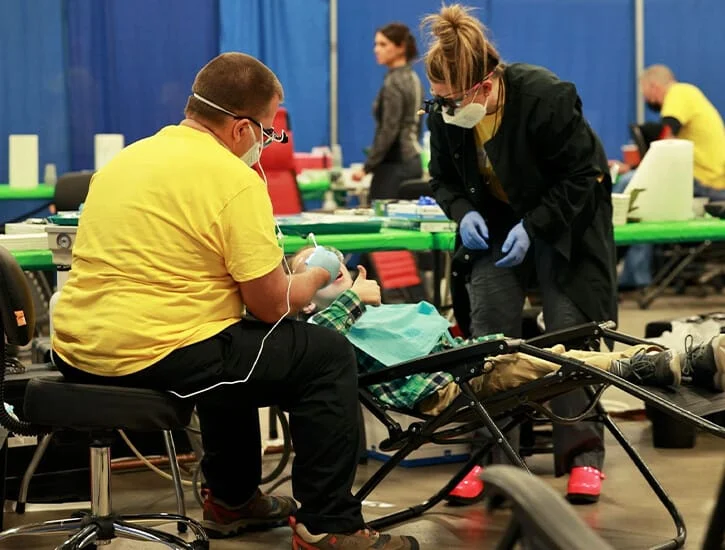
For an uninsured person in America, accessing routine health care might go something like this: First, a person goes online to make a list of every clinic in their county. List secured, they’ll call every clinic to collect information about financial programs—charity care services, sliding-scale payments, things like that—as well as whether such programs are accepting new patients. They’ll ask about the wait times, and then the real calculus begins: Can they wait nine months to treat their anemia? A year to address a painful tooth that needs a root canal?
Madison (not her real name), who has never in her life had consistent insurance coverage, is used to the Olympic Games-level rigamarole that accessing care sans insurance requires. In Boise, where she lives, just four clinics meet her financial criteria; she has a similar roster for prescription services. But the county’s free clinics have exhaustingly long wait times, which usually means Madison goes without care unless something becomes an emergency—not ideal, she tells me, although a part of her does like the chance to prove that she can tough her ailments out. “I’m a farmer’s daughter,” she told me, sitting up a bit straighter. “If I can handle it, I’ll handle it.” She’s been trained in first aid and CPR, skills which she could find herself relying on instead of professional treatment. She spoke about her experiences of finding discounts and researching her way into mostly free care with a tone like she’d leveled-up on a video game. Health care was an elaborate side quest; Madison had figured out how to solve it, and this left her with the quiet confidence of niche expertise—although it might just be a young person’s stubbornness. Madison is about to start college.
That day, she wouldn’t have to wait long. She was at the Love Heals pop-up clinic, a one-day-only bonanza of totally free, first-come, first-served health care. No referrals required—Love Heals is a philanthropy-backed health care provider, and therefore free of the federal reporting requirements most low-cost clinics are beholden to. This was good because it was kind of a big day for Madison: tomorrow, she would fly across the country to Virginia to start her freshman year of university. She was spending her last day before leaving for college alone at the clinic, getting a new pair of prescription glasses and a dental cleaning (her first in eight years). It was 12:14 p.m. She had been in the arena for four hours, and she was only halfway through her list.
For approximately one-third of Americans, there are hundreds of hurdles to health and healing. This is true even for the 78 million children and adults with Medicaid, Medicare, CHIP, or a combination thereof. Because clinics typically receive lower reimbursements for Medicare patients than they do for patients with private insurance, many clinics cap the number of new state-insured patients they can accept. Fewer options are available, and wait times are longer, if you’re poor.
Love Heals is a philanthropy-backed health care provider, and therefore free of the federal reporting requirements most low-cost clinics are beholden to.
There are fewer options still for the uninsured. Pre-Trump 2.0, 27.2 million people in America had no health insurance; now that the One Big Beautiful Bill has rewritten health care funding, the Congressional Budget Office projects that 16 million more people will be uninsured by 2034. Of these 27.2 million, many are served by Federally Qualified Health Centers, where prospective patients face a tangle of barriers: at many clinics that receive federal funding, patients need to present identification, excluding many unhoused people as well as undocumented immigrants. In most FQHCs, they might have to prove they don’t make too much money—most government-run free clinics set income-based eligibility caps, typically at about 200 percent of the federal poverty level, or $31,300 a year for a single person—meaning that many people working jobs without benefits make too much money to qualify for FQHAs.
For the remaining 1.8 million people, there are 1400 free clinics acting as their sole source of health care. (This number will almost certainly swell due to the OBBB’s cumulative $1 trillion in cuts to federal health care spending: an estimated 330 rural hospitals may close, and an estimated 477,000 health care workers could lose their jobs and insurance benefits, due to the loss of Medicaid-funded clients.) For the population they serve, free clinics are most patients’ only option. This has been the case for more than half a century. In 1967, Dr. David E. Smith launched the Haight Ashbury Free Clinic in response to San Francisco’s influx of counterculture kids and hippies who had descended upon the city during the Summer of Love, and who now needed substance abuse treatment and mental health care (the free clinic itself was an idea Smith came up with during an acid trip, though others may have existed elsewhere in the country already). In 1970, the Black Panthers began to follow suit, opening more than a dozen of Peoples’ Free Medical Clinics in response to the rampant anti-black discrimination in hospitals and private practices. At both the Haight-Ashbury and Black Panther-run sites, both patients and providers were subject to police raids and occasional state-sponsored abuse. At one of the Black Panther’s clinics in Los Angeles, the police opened fire, injuring twelve Panthers.
Love Heals operates squarely within the free clinic tradition, prioritizing patient trust over cultural conformity. At a time when the aperture of America’s care network is closing, Love Heals insists on caring for everyone. The organization runs a roguish, sting-operation model, setting up temporary clinics across the country, on Indian reservations, in cities with large refugee communities, and for communities living in health care deserts. The treatments are totally free. They collect no patient data beyond first name and received services. And then the whole apparatus vanishes without a trace.
On a hundred-degree day in late August, 96 volunteers arrived at Boise State University’s ExtraMile Arena just after dawn for their clinic shifts. It was a slate-grey Saturday morning and move-in weekend on campus—at the entrance of the arena, a shipping container-sized dumpster was overstuffed with badly broken-down cardboard boxes. A few feet from the trash heap stood a little, yellow “FREE CLINIC” sign.
The day started with all the anxious fanfare of a DMV office or a TSA line. Dozens of people had arrived early to get a good place in the clinic’s line. When the arena doors opened at 9:00 a.m. that morning, everyone swarmed into the chilly air conditioning. As patients slowly filtered past the check-in table, volunteers escorted them to the clinic’s various rooms in the massive, thirteen-thousand-person arena—the ophthalmologists, camped in a dark interior office; the medical ward, tucked into a long hallway that branched into empty conference rooms; and the dental patients, left waiting in the arena’s bleachers. Within an hour, the line had thinned. And as soon as the several dozen prospective patients had scattered across several thousand bright red seats, the vibes were inverted: suddenly the clinic felt like a badly attended birthday party. One almost pitied the host.
All the long-time volunteers were hypothesizing about this low attendance. They were expecting a blowout—after all, it was the first Boise-based clinic since Trump’s One Big Beautiful Bill, under which forty to seventy-five thousand Idahoans will lose health insurance, had passed. They blamed it on heat, or end-of-summer FOMO, or random luck. It wasn’t a matter of marketing—whereas brick-and-mortar health care clinics are usually found via doctor’s referrals or Google Map searches, Love Heals relies on grassroots advertising tailored to their patient population, hanging multilingual fliers in African restaurants or Latin markets. And their hosting event spaces advertise too: BSU had included this clinic in its standard-issue events calendars, hung in every bathroom stall in the arena. On them, a white square reading “Love Heals,” with no further explanation, was listed alongside a career fair and an upcoming concert by Big Thief.
At a recent clinic Love Heals had held in Maryland, hundreds of people had lined up in the frosty October pre-dawn. Some of them had come from three states away. When I asked vice board chair Dane Thomas what he thought the reason for the clinic’s cold reception was, he made me follow him out of the dental treatment room into one of the highest, furthest-away row of bleachers, and then finally named the red-baseball-cap-wearing elephant in the room: “There is, perhaps, a reluctance among people from, in particular, the Spanish-speaking community, to gather in large numbers,” he said. The clinic didn’t require identification or proof of immigration status, and said so in bright red, capital letters on every advertisement and welcome sign. By doing so, Thomas feared, they had created an easy “hunting grounds” for anybody looking for potentially undocumented people.
During his first week in office, the Trump administration moved to end longstanding protections that prevented ICE from conducting raids in medical settings. (Presumably, HIPAA policies still refuse agents access to actual treatment rooms.) That their brashly no-documentation-needed model might turn clinics into accidental targets isn’t lost on the National Association of Free & Charitable Clinics (NAFC), the loose association that advocates on behalf of the nation’s 1,400 free clinics. NAFC had spent all summer drafting new guidelines to help clinics deter, and potentially respond to, ICE raids. As of this summer, none of the clinics in their network had been targeted yet. But individual patients may have been. In July, the Centers for Medicare and Medicaid Services struck an agreement with the Department of Homeland Security that gave ICE officials login credentials to CMS databases that contained everything from detailed medical records to banking data for Medicaid recipients, though it was subsequently blocked by a lawsuit. Nevertheless, that month, ICE officers raided a surgical center; in August, officers detained a pregnant woman outside a Southern California public health clinic. The woman is documented; her husband, according to NBC, is not.
All of this was a racist insult on top of the inherent injury that is America’s medical system, where care is rationed and cruelty is abundant, and where some of the most vulnerable moments of a person’s life—hurting and healing—are surveilled and weaponized. Then again, maybe it was the clinic personnel that had most internalized the messaging that things were changing. A few days after the clinic had ended, Love Heals’ executive director Caitlin Barnard ran the numbers. Relative to the BSU-based clinic they ran last year, they’d actually treated 40 percent more people than they usually see in a single day, and had provided $208,038 worth of care. The problem wasn’t that they’d had fewer patients; they had just had a larger number of volunteers.
Advertised as medical clinics, dental services are most free clinics’ tour de force, perhaps in part because, even for well-resourced Americans, dental care can feel like a Ponzi scheme. In the belly of the arena, patients sat in four rows of neon green fold-out chairs lined up back-to-back, drills rattling in their exposed mouths. Surrounding the treatment area, all the hidden parts of health care’s operating processes had been daylit. There was a fifty-foot banquet table covered in hundreds of mouth picks and replacement drill heads, where they were sorted for reuse after going through the sanitization station a few paces away from the last row of patients’ feet.
High school students, one week into their dental assistantship program at the local trade school, stood wearing layers of plastic PPE as they wiped down bloody, spit-soaked instruments, giggling nervously. “Ew!” a blond girl with a ponytail yelped when, in her tray of soapy water, she spotted a “floater.” It was almost time to break for lunch and swap the water; her teacher laughed and told her to leave it there. All of it was as nerve-wracking. The young children were visibly nervous; many had never seen a dentist before. To comfort one child sobbing uncontrollably in his neon green chair, a dental assistant blew a rubber glove into a makeshift balloon. Later, I saw the boy walk out of the clinic, one hand pressing a wad of bloody gauze against his mouth, the other still cradling the hand-balloon.
I spent the morning following Maureen Lavelle, one of Love Heals’ two paid employees, around; what we’d intended to be a five-minute clinic tour turned into two hours given how often she was stopped by volunteers and patients. We had barely made it past check-in when the first request came in. A dental patient with diabetes was worried her glucose would be too low for her to be treated. She needed some sugar, stat. We took off for the liminal space that served as a kitchen, a closet filled with giant plastic crates of snacks. But before we had fully left the kitchen, Lavelle was interrupted again, this time by a young volunteer-patient with bright eyes bracketed by eyelashes thick as a painter’s brush.
Sami (not his real name) explained there was a problem: a man here, who was a refugee and wasn’t covered by Medicaid, couldn’t be treated by the clinic’s dentists; his tooth was shattered, and the clinic didn’t offer crowns. (In Idaho, only children are guaranteed crowns by the state’s Medicaid coverage.) Before Sami could finish speaking, his name was called. It was his turn to be screened for his own dental visit. Later, I learned that Sami was also dismissed without treatment—he needed a root canal, and the clinic only offered fillings and extractions. Sami could wait until the tooth was bad enough to pull it, as so many of the clinic’s other patients had—more than half of the clinic’s patients are missing at least one tooth—or try to find a different clinic. I asked him what he would do about his tooth if he was still in Afghanistan. He laughed and told me he would have shown up at the neighborhood clinic, waited maybe twenty minutes, and paid the USD-equivalent of “not even five dollars” to have it fixed. This, he said, was the case for many of the people resettled from countries that had free or almost-free health care: they came to America, got sick, and couldn’t access any help. Since arriving in America, Sami had already had four teeth pulled.
Here lies one problem at the heart of the free clinic model: If indeed it is the only option for its patients, what to do with the people they are ill-equipped to help?
I shuffled to keep up with Maureen as she walked at a bulldozing clip through the arena’s labyrinthine back rooms. In the middle of a long, windowless hallway, we passed a woman standing expectantly with her back against the wall. “She’s doing traumatic brain injuries,” Maureen told me. The woman, Stefanie Shadduck, is the principal investigator for Idaho’s Traumatic Brain Injury State Partnership Program. Shadduck later told me that, at free clinics for underserved communities, an average of 57 percent of all patients had a history of traumatic brain injuries (including more than half of the homeless and as many as 70 percent of incarcerated people). But Shadduck can’t treat, or even properly diagnose them here—there are virtually no meaningful medical interventions the clinic is actually equipped to address. Shadduck offers these patients the suggestion of a new, potentially life-altering diagnosis, and sends them back into the bright, hot day. It is the best that she can do.
Here lies one problem at the heart of the free clinic model: If indeed it is the only option for its patients, what to do with the people they are ill-equipped to help? They refer people to clinics that may or may not have waitlists, to specialists that may or may not offer sliding-scale help. They write recommendations on the backs of the quarter-sheet intake forms, knowing that most of these people will be unable, logistically or financially, to follow up. And so the Love Heals team tries to focus on what they can do, instead of what they can’t. Between 2020–22, 1.9 million Americans visited the ER for dental problems, many of which are preventable—untreated tooth decay, abscesses, gum disease. These patients are most commonly uninsured or on Medicaid; they are, disproportionally, black. An uninsured person could rack up hundreds of dollars in bills for antibiotics and painkillers and subsequently be dismissed with a referral to see a dentist they might not be able to afford. But the 156 patients who had received dental procedures that Saturday would avoid these outcomes for now.
Toward the end of the afternoon, a board member who’d spied my neon yellow name tag beelined toward me, eager to chat. He was a retired physician and had just bought a retirement home in spendy Southern California. He grabbed my shoulder and turned me to look out at the dwindling crowd of patients. “These people are so desperate,” he said, shaking his head. “They’re not like you and me. Health care, for us, is so normal, it’s like air or water,” he said. “We can’t even imagine what it must be like.” I smiled and nodded. Like many of the clinic’s patients, I had only ever had intermittent health care. I, too, had an outstanding cavity, for which I’d been referred for a filling nearly a year ago. Every month since, I had called my FQHC on the day the next month’s schedule opened; every time, I was told the spots had all already been filled. The free clinic that existed to fill in the margins had not existentially addressed society’s gaps. Thomas, the vice board chair, said again and again that everyone in the organization thought it was a shame the organization had to exist at all; he’d prefer to live in a world where it didn’t.
Just before I finally left the clinic, I saw Sami again, standing sentinel in the corner of the dental treatment room just after three p.m. Sami had been in the clinic for seven hours, and the Venezuelan family he was chaperoning had finally been called in for their teeth cleanings. By then, a handful of chairs had been folded up. Their assigned clinicians were losing focus on their clean-up; instead, many of them were now standing around in small clusters, their conversation boisterous, the whole scene dissolved into a kind of final-hour-of-the-party energy. The family walked to the far edge of the room, where a man wearing an orange outdoor-adventure-style headlamp around his neck would take x-ray scans of their mouths with a handheld, portable machine. The elder daughter bounded ahead in giddy leaps as though running to a playground. Sami lingered on the edges, but his eyes stayed trained on the family—protecting them and their privacy. But his body language was relaxed. He seemed to know they would be safe—at least for as long as they were here.
This story was copublished and supported by the journalism nonprofit the Economic Hardship Reporting Project.