, February 4, 2026
Everything Is at Stake
Amit Chaudhuri’s “poetics of unfinishedness”
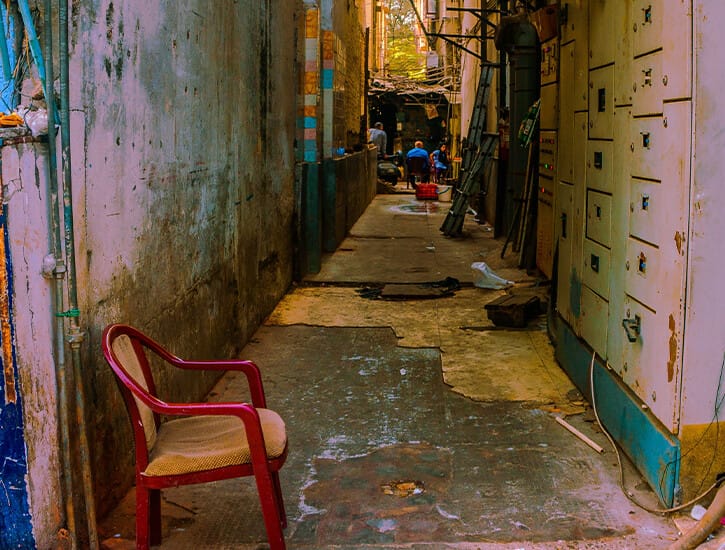
An alleyway in India. | Pexels
Incompleteness: New and Selected Essays, 1999–2023 by Amit Chaudhuri. New York Review Books, 376 pages. 2026.
The publishing industry’s generalized hostility to nuance is nothing new. In his essay “Notes on the Novel After Globalisation,” first published in 2007 in the magazine Meanjin, the novelist and poet Amit Chaudhuri complains about the subsumption of the open-ended to the marketplace’s demands for simplicity and closure. As globalization took hold, critics and authors came to privilege “the narrative and discursive over the poetic, the fragmentary, and the unfinished.” No writer I have ever encountered has been so drawn to, or has so advocated for, the fragment as Chaudhuri.
The fragment might be a mode or an approach or an affinity, and it appears in Chaudhuri’s desire to write a novel composed solely of opening paragraphs, as Walter Benjamin wanted to write a book made up entirely of quotations; it appears in his efforts to encourage “lingering over these entrances and exits,” to pursue what he calls a “poetics of unfinishedness.” This spirit of elusiveness animates his new collection, appropriately titled Incompleteness, which brings together essays on a wide array of subjects, from classical Hindustani music to Joni Mitchell to the intersection of the sacred, the secular, and the literary. But perhaps nowhere is Chaudhuri’s “bits-and-pieces but large-scale engagement with incompleteness” more evident than in the unusual course he’s struck in his own fiction.
In 1973, Georges Perec, a member of France’s Oulipo literary group, devised the idea of the “infra-ordinary”: the habitual, ordinary “background noise” that demanded a kind of heroic level of attention. It was a radical refusal to distinguish between the significant and the insignificant. The following October, he sat down at a café at Place Saint-Sulpice in the Sixth Arrondissement on an overcast weekend to document “what happens when nothing happens other than the weather, people, cars, and clouds.” This perfectly encapsulates the tenor of Chaudhuri’s novels, where the essential and the nonessential converge. His novels are not “about” anything—certainly not about Indianness, globalization, Hinduism, or postcolonialism—although they address all of these subjects. What makes stories possible, he writes, is what lies on the “narrative’s periphery,” warranting scrutiny without necessarily propelling the plot forward.
No writer I have ever encountered has been so drawn to, or so advocated for, Walter Benjamin’s “fragment” as Amit Chaudhuri.
In all Chaudhuri’s novels—from A Strange and Sublime Address to Sojourn—people, time, cars, clouds pass by; dreams float through the rooms of houses, dust and heat descend on the streets, “dogs and children sit doing nothing,” lizards and flies twitch on walls, fans whir lazily. At the same time, India’s economy opens up with liberalization in the 1990s, a middle class is created, the Naxalite movement takes hold of Bengal, historic communal riots erupt over a demolished mosque, and terrorists bomb the south of Bombay in what later grabs headlines as “India’s 9/11.” But the movements of history take a backseat to the everyday. Two women recall childhoods fractured by Partition, commenting on the trajectory of a family business and Communist Party street theater. An Indian professor wanders uneasily through Berlin in the mid-aughts, feeling lost “not in the city; in its history,” confusing museums for department stores and German for Bengali.
The peripheral characters in these stories are just as central as the main characters. In A Strange and Sublime Address, Sandeep, a young boy visiting his family in Calcutta, observes streets that are “theatres full of actors and extras: reckless dogs, insufferable cows . . . families arguing, old women gossiping, children chasing cats, rickshawallas idling,” the city resembling “a work of modern art that neither makes sense nor has utility, but exists for some esoteric aesthetic reason.” These extras pepper all of Chaudhuri’s novels—people who make single-scene appearances, whose “presence had been so subtle in life, so unremarkable, that words could no longer translate them into existence.” Even mundane objects thrum with life, are lavished with attention—a woman’s bangles sing chuk-a-chuk-chuk; pots and pans hold “urgent dialogue” in the kitchen; characters in Bengali script are “intimate, quirky, ancient, graceful, comic, just as . . . the people of Bengal.” This may have been what James Wood was referring to when he wrote, in his introduction to a 2024 reissue of Afternoon Raag, that it was a novel where “nothing much ‘happens’” but “everything is at stake.”
The role of the paragraph is integral to Chaudhuri’s poetics of unfinishedness. In an essay on the paragraph, originally published in 2017 in Granta and collected in Incompleteness, Chaudhuri writes that, like the quotation, the paragraph is less a representative of the larger narrative as it is an “opening out,” both “of the narrative and not of it,” a moment of possibility with an “independent existence.” He recalls reading an excerpted paragraph from V.S. Naipaul’s A House for Mr. Biswas over and over again and thinking it was “a shame that I would have to read the novel.”
Paragraphs are electric because they have an “air of buoyancy that all initial utterances have . . . when you still lack clarity about where you’re headed.” In Chaudhuri’s novels, every paragraph reads like the first; he writes fiction that gives these self-contained fragments “primacy over the superstructure of narrative.” They exist for their own sake; they can be read and revisited independently. Take the following from The Immortals, which could on its own be the entire plot of a novel:
The last teacher who’d come to this new apartment was Dheeraj, a dark man with a pleasant singing voice, a crooner’s voice. He began to teach her new geets. He got her to sing a rather “filmi,” sentimental song on the radio, not really suited to her style and voice (love songs seldom were), but she sang it with seriousness, too much seriousness, almost: “My many-coloured dreams have all shattered / Like a mirror.” He had a problem with his marriage, though; it was breaking apart. One day he stopped coming. They heard he’d had a stroke. She waited to hear from him; he was untraceable; a month went by. Then, when she’d almost forgotten him, she saw him from her car on the road, looking absent, a stick in one hand.
This paragraph marks Dheeraj’s only appearance in the 432-page novel. These kinds of passages seem to spill out of the boundaries of the novel and of the “act of recounting,” as Chaudhuri writes in his essay “On the Paragraph,” by being both irrelevant to the narrative and central to the novel at the same time; they take us nowhere, and yet the novel would not exist without them. They break one of the most basic rules of the novel form, which is that if you introduce a character to the story, you have to bring him back throughout the narrative. “The novel isn’t a form in which you can mention the uncle with a limp and forget about him for the rest of the story,” Chaudhuri writes in his essay “Why I Write Novels.” And yet he does it in his own fiction all the time.
The uncle with a limp is a key aspect of the novel’s “grammar of recounting”; it is what Nabokov called one of the novel’s “subliminal coordinates,” a device that structures the narrative through fixed points. In a linear narrative made up of logical, relevant coordinates, every detail services the plot. Chaudhuri resists this, writing fiction composed not of these subliminal coordinates but with what he calls “outliers”—“a list of redundancies around which the plot is meant to arrange itself.”
The tension, even violence, inherent to the act of recounting is a major theme of Incompleteness. As Chaudhuri notes in his essay “The Origins of Dislike,” based on a talk he gave at Harvard University in 2010, we treat the past as an entity that can not only “be revisited, but, with adequate groundwork, possessed.” We look upon history as spectators, without complicity. We behave, as Borges’s map ironizes, as if reproducing the world is the same as knowing it. The Indian modern, or any “postcolonial,” is anxious about a lost or yet-to-be-recovered history, and at the same time has a sense of security of being on the “right” side of it.
Chaudhuri distances himself from these affiliations—middle class, Bengali, Indian, postcolonial—and comes at history at a slant, obliquely. In his novel Sojourn, the writer-protagonist gets lost in Berlin, losing sense of the divide “between present and past”; in his essay “German Sequence,” Chaudhuri sees a ghost where the Berlin Wall used to stand, disconcerted and “dislocated” by the past as though it’s a person he vaguely knows and keeps bumping into on the street. A character’s childhood home overlooking the sea fades away like a “relic from his past” ten days after it’s vacated; years later, a different narrator looks at the same home through a latticed window because he sees “no point in looking at it directly.” The disconcerting passage of time is a going concern throughout Incompleteness, from the lyrics of Tagore and Lawrence to the author’s childhood relationship with Joni Mitchell, whose scenes are located not in any specific place but in the “damage caused by time.”
Chaudhuri’s resistance to the act of recounting means he also has a tense relationship with the traditional novel. The novel relies on the simple past tense—time is significant in the novel in a way that it isn’t with the essay or the poem, where we only “think we’ve moved from one point to another.” “But, while time can be presented as a recounting, it is also coterminous with the present moment, which is where we encounter time,” he writes in one essay. “Resolving these two things . . . has been my chief preoccupation as a novelist.”
One solution to this challenge is what Chaudhuri calls joins—sentences through which the present can be encountered, sentences with no drama and yet “great, if contained, excitement.” These sentences fulfill what Virginia Woolf called the “narrative business of the realist: getting on from lunch to dinner”—but they also honor our experience of everyday life, in all its small and unremarkable movement and stillness. As Chaudhuri writes in his essay “Why I Write Novels”:
A few times each day, we experience moments that awaken our sleeping selves as we go about our routine. These are moments of anticipation, but they’re unrelated to any actual development. Actual developments in life are rare, and, when they happen, can be confusing, disappointing, or boring. The moments of anticipation that stimulate us in the midst of our daytime sleepwalking have to do with getting up from a chair, changing position on a sofa, opening a door, or looking out through a window or from a balcony. The day would be unbearable—inconceivable—without these, to all purposes, pointless internal departures.
Chaudhuri’s novels are full of these pointless departures, featuring countless “extras” like Dheeraj. Chaudhuri writes in Incompleteness about the value of narratives with the characters who “aren’t fully mindful that they’re in a larger story,” and instead “leak” out into the story’s periphery, or into life. The most memorable and obvious example from Chaudhuri’s fiction of this “leakage” is this “scene” from A Strange and Sublime Address:
Why did these houses—for instance, that one with the tall, ornate iron gates and a watchman dozing on a stool, which gave the impression that the family had valuables locked away inside, . . . or this next house with an old man relaxing in his easy-chair on the verandah, fanning himself with a local Sunday newspaper, or this small, shabby house with the girl Sandeep glimpsed through a window, sitting in a bare, ill-furnished room, memorizing a text by candlelight, repeating suffixes and prefixes from a Bengali grammar over and over to herself—why did these houses seem to suggest that an infinitely interesting story might be woven around them? And yet the story would never be a satisfying one, because the writer, like Sandeep, would be too caught up in jotting down the irrelevances and digressions that make up lives, and the life of a city, rather than a good story—till the reader would shout, “Come to the point!”—and there would be no point, except the girl memorizing the rules of grammar, the old man in the easy-chair fanning himself, and the house with the small, empty porch that was crowded, paradoxically, with many memories and possibilities. The “real” story, with its beginning, middle and conclusion, would never be told, because it did not exist.
Chaudhuri practices something like Perec’s radical refusal: a refusal to distinguish between the “real” story and the still life of the afternoon, the actors and the extras, the past and the future. This scene contains what Chaudhuri describes in his essay “Storytelling and Forgetfulness” as the “moment of possibility,” which presents itself in the fragment or the standalone paragraph, located equally in the story narrated within a novel and in the “irreducible life and textuality” outside the novel—the digressions that make up lives, that disrupt the “meaning-producing business” of traditional narrative construction.
This is what is so remarkable about Chaudhuri’s stories: they center the human, the random, the mundane, the spontaneous.
Chaudhuri has said in interviews that Calcutta is where he first “encountered the thrill of the modern.” Calcutta embodies the very “contradiction of modernity . . . it’s both derelict and alive,” and “both those things energise each other.” The contradictions of modernism are reflected perfectly in Chaudhuri’s language and sentence structure. Incompleteness features arguments made largely in the mode of “both X and Y” or “not quite X or Y.” A woman arriving at her new husband’s house, to a way of life “both prearranged and untested.” In a museum among pre-Enlightenment art, “a world at once infinitely distant and known.” Fragmented paragraphs that both “participated in, and ignored” the movement of the story. Chaudhuri’s own desire, articulated uncertainly, in typical fashion, to allow for “discrepancies” in his grammar, as a way of “both using narrative syntax and fighting it.”
Chaudhuri escapes the demands for the writer to make sense and structure of things, to bring back the uncle with the limp, to remain focused on the story at hand. This seems like the same modernist tendency that Greil Marcus identified in Walter Benjamin’s writings during the interwar years as Europe headed for totalitarianism: “Mussolini, Stalin, Hitler, and Adorno’s faceless capitalist totality made one argument about life: the whole explains the fragment,” Marcus wrote. “Benjamin countered: the fragment reveals the whole—and, like a tiny mammal scurrying under the feet of dinosaurs, escapes it.”
This is what is so remarkable about Chaudhuri’s stories: they center the human, the random, the mundane, the spontaneous, the individual over the political, the physical over the ideological—and at the same time they abstain from sliding into individualism or emotion. In an essay comparing Hindustani music to T. S. Eliot’s essays, which Eliot described as “classicist,” Chaudhuri noted that the music “preoccupies itself with the expression of the note, of the raga, but not with emotion in the conventional humanist sense—that is, not with self-expression.” His fiction operates similarly: “However intricate the embellishments,” his stories always “return repeatedly to the stillness (thheherao) and purity of the note.”
This purity can be seen in the ending of A Strange and Sublime Address. The family is getting ready to leave the hospital after a scare; Sandeep’s uncle is discharged with instructions to take care of his health. Then we leave the family entirely, the center of the story, and wander with the boys into the hospital garden, where they have been asked, “like a directive in a myth or a fable,” to catch a glimpse of the koel whose song has been enchanting them. They find it finally, black as a crow, eating an orange flower. And then it senses their curious eyes, and “interrupted its strange meal and flew off—not flew off, really, but melted, disappeared, from the material world.” The story ends thus, light as air, leaving nothing behind, no memories or baggage, resolving itself like a song.