, January 27, 2026
Corridors of Grief
Sara Stridsberg’s novel of time and mental illness
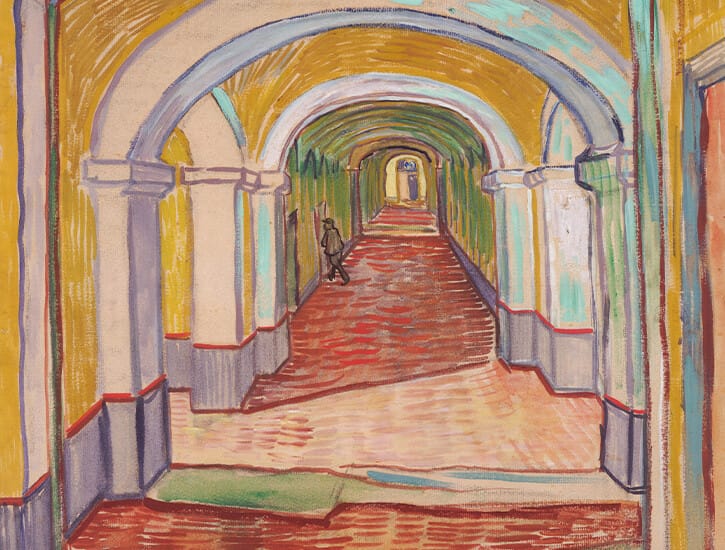
Corridor in the Asylum by Vincent Van Gogh (1889). | Metropolitan Museum
Beckomberga by Sara Stridsberg. FSG Originals, 288 pages. 2026.
Where does the mind retreat when it frays, stretches, snaps? What sort of physical space can best contain a mind turned anxious, come undone, a mind uncoupled from some previously recognizable iteration of itself? A quarter of the way through the Swedish writer Sara Stridsberg’s latest novel Beckomberga, translated into English by Deborah Bragan-Turner, a passage appears that offers the reader insight into an earlier era’s answer to these questions.
That answer was institutionalization. “It is easy to idealise the institution as the perfect place that will do everything we human beings cannot bring ourselves to do for another,” Stridsberg writes. “And yet it is terrifying, too, because the imperfect is in us: failure, weakness, loneliness.” What the psychiatric hospital ultimately accomplishes, this melancholy novel—fractured as its pages are between fact and fiction, history and one family’s personal story—illustrates, is to turn these very human imperfections into something physical. Something that can be externalized. Something a person can compartmentalize, and shove into a drawer. But sooner or later, the drawer springs open. A paradox—Pandora’s box? These kinds of experiences can never be fully locked away.
Beckomberga takes its title from the Swedish psychiatric hospital of the same name, one of Europe’s largest, located in the western section of Stockholm. In operation from 1932 to 1995, the hospital’s lifespan overlaps with some of the most important developments of the last century, such as the rise and fall of the Berlin Wall and the development of nuclear energy and weapons. Beckomberga, the novel, in turn becomes a kind of history in miniature of the twentieth century, with all its attendant hopes, weaknesses, imperfections, and optimisms, playing out both within and without Beckomberga’s walls. Following the complicated relationship between the novel’s protagonist, Jackie, and her alcoholic father, Jim, the novel traces, through intimate domestic scenes juxtaposed with essayistic passages delving into the history of the hospital, the intermingling of history with personal experience and the repercussions that mental illness and addiction have on one family’s psyche.
The result is a multifaceted novel that resists linearity, similar to the way an anxious mind navigates the twisting corridors of the past.
Conversations between Jackie and Jim during his stay at Beckomberga mix with Jackie’s interactions with the hospital’s residents, such as Sabina, a woman Jim grows close to, alongside third-person passages following the hospital’s Dr. Janowski. Passages concerning the history of the hospital pop up, seemingly from the perspective of an older Jackie, reflecting on Beckomberga years later. Occasionally, italicized paragraphs told from Jim’s perspective, as if excerpted from an interview, appear. The result is a multifaceted novel that resists linearity, similar to the way an anxious mind navigates the twisting corridors of the past.
“Sometimes it has seemed to me,” observes Jackie, “that Beckomberga’s age coincided with the age of the welfare state.” Major events of the twentieth century flow in and out of the narrative, namechecked or heavily implied by characters even when the exact dates of the narrative remain unknown. A few anchors are clear: an excerpt from a medical file near the beginning informs us that, upon being admitted to Beckomberga “following suicide attempt,” and soon after experiencing “repeated epileptic seizures as a result of long-term alcohol and prescription drug abuse,” that Jim is the father of a thirteen-year-old and was born in 1945. (The fact that his birth coincides with the end of World War II and the beginning of the postwar era feels significant.) Experiences from Jim’s time spent at Beckomberga are interwoven with Jackie’s memories and encounters with other Beckomberga patients and friends of Jim. The text frequently returns, too, to a psychiatric session held in 1995, the last year Beckomberga is open, with Olof, Beckomberga’s last patient, and his doctor, Dr. Janowski.
Time becomes a fixation, something the patients of Beckomberga both have too much of and yet that which disappears the second they cross the threshold of the hospital’s doors. “The clock’s stopped out there at half-past three,” Olof, an old man who has been a patient at Beckomberga since his teenage years, says to Dr. Janowski, referring to the outside world. The events of the outside world, too, take on a kind of fairy tale suspension of time, lending world events an uncanny effect: Jackie thinks of the Soviet cosmonaut Valentina Tereshkova’s 1963 journey in the spacecraft Vostok 6—the first time a woman was sent into space—and describes her experience as one defined by time. Tereshkova, upon her return, “appeared to have aged twenty years,” thinks Jackie; “she looked as though she had been away for decades.” “The new world is closing around us like a cage,” Jim’s doctor, Edvard Winterson, tells Jackie during one of her frequent visits. “And the illness absorbs even the most outrageous, monstrous events. Hiroshima. The great wars.” It is as though calendar time itself, with its linear and forward-moving sense of direction, cannot withstand the breakdown in narrative that mental illness introduces.
At the hospital, Jim attends group therapy and individual therapy sessions with his doctor. There is a certain interchangeability to the long-term patients: “The old men are standing in the sun, their cigarettes lit, waiting for nothing,” observes Jackie during an early visit to Jim, shortly after his admittance. “They rarely complain, they never oppose hospital rules, they are unprotesting. . . . Alcohol is the reason why many of them are here, sometimes amphetamines or morphine.” Eventually, Jim is discharged from Beckomberga, but what has been contained by treatment—whatever nihilistic streak drives him toward self-destruction—never fully disappears. “Life is a work of grief,” he tells Jackie soon after leaving. When she confesses that she once dreamt he stopped drinking, he tells her, “I’ll never be able to give you that. It’s the one thing I’ll never be able to give you.” The same could be said of the darkness and irrationality that the structures of the postwar era worked to contain—like the cyclical nature of addiction, the end of the twentieth century did not bring about the end of history, only further repetition.
One historical event in particular stands out: the Chernobyl nuclear disaster, which Jackie, as an adolescent, returns to frequently as a subject to discuss with her mother, Lone. Chernobyl both fixes certain sections of the book into a firm temporality—the late eighties or early nineties, recent enough that the disaster isn’t a distant memory but rather something a teenage girl might think about—and also becomes an odd, symbolic photo negative of Beckomberga and the idea of the psychiatric hospital and institution. Both the nuclear power plant and the psychiatric hospital contain something that the public finds dangerous and frightening; both are products of their age, born out of a kind of optimism concerning how what dwells inside of them can be harnessed and turned neutral. But both threaten to, and ultimately do, breach containment and spill over into the world: in 1986, a reactor at the Chernobyl power plant ruptured, destroying the reactor’s building and leading to the dangerous spread of radiation.
Also beginning in the eighties, as Jackie notes later in the book, patients were “removed from mental hospitals as a consequence of the criticism of the care provided in them, and as part of the wave of deinstitutionalisations sweeping across the western world. . . . Psychiatric care now happens within large general hospitals. Only about ten percent of the former beds still remain.” Today, mental illness and its attendant experiences, such as self-medicating with addictive substances, is no longer seen as something to be hidden away. But Beckomberga is not always clear as to if this is good for the patient or the patient’s family—Jim, upon his release, continues to drink.
Is it strange for me to compare these two events? The book itself does not do so explicitly, but its approach to Beckomberga is ambiguous; it is a place that became important to Jackie’s life during a certain period of it, and that importance is due to a terrible and sad thing—the absence of a parent. A subsequent struggle with depression and anxiety will follow Jackie throughout her life, a fear she characterizes as “my fear of the night, my fear of being confined, of being loved, of losing” her child. By portraying how institutionalization impacts those who are closest to the patient, Beckomberga takes a different approach from many literary depictions of psychiatric hospitals, which often focus on the mindset of the patient.
In the English-speaking literary world, the psychiatric hospital was a fixation for many writers working throughout the twentieth century. Think, for instance, of the mid-century Boston poets who shunted in and out of McLean—Sylvia Plath, Robert Lowell, Anne Sexton—who all wrote about their experiences in various forms. There is a flinty kind of glamour to the way they depict the institution, a romance in its flowered grounds and the acts that which force a person inside. “Often, an entire family is crazy, but since an entire family can’t go into the hospital, one person is dedicated crazy and goes inside,” claims Susannah Kaysen in her 1993 memoir of her own time spent in McLean, Girl, Interrupted, a book that utterly seduced me when I read it covertly as a middle schooler in the early 2000s. Bellevue in New York City, too, has been namechecked by many writers, such as Allen Ginsberg in Howl— “who talked continuously seventy hours from park to pad to bar to Bellevue / to museum to the Brooklyn Bridge”—and hosts a well-regarded literary journal, The Bellevue Review.
The New York poet James Schuyler, in his 1978 poem “Trip,” captures, wearily and succinctly, the mental whiplash that institutionalization evokes in those who experience it. “How / many trips,” he writes,
by ambulance (two,
count them two),
claustrated, pill addiction,
in and out of mental
hospitals,
the suicidalness (once
I almost made it)
but—I go on?
Tell you all of it?
I can’t.
Exhaustion seeps out of these short, tense lines, even the language sagging under the weight of all this experience—suicidalness, an awkward word, captures bone-tired discomfort of deciding whether or not one should take one’s life (“You might as well live,” as Dorothy Parker darkly joked in her own poem about the subject). In Beckomberga, Jim describes this twilight zone of indecision, characterizing his drinking as “a case of ensuring at all times that you were at exactly the right distance between life and death, so far from life that you began to resemble a dead person . . . Everything I did related to death, but I made sure that I was still at just the right distance from it.” Here, too, time is suspended: Jim is alive, but it’s a life that is lived as though he were not conscious, as though he had no future.
Mental illness and addiction are issues that cannot be swept tidily away, but instead will bleed out into family life and public life.
What the above works have in common is that they are about the experiences of writers inside of mental institutions, and the writer will, sooner or later, aestheticize the experience and their surroundings. Beckomberga sidesteps this both by refusing to assign a primary narrator—even the pages that are directly told from the perspective of Jackie are not the dominant narrative; there are too many strands, too many perspectives, and the story is too fragmented, to claim any one voice—and by refusing Jim’s perspective at length beyond occasional paragraphs told as though culled from an interview with his doctor. He is viewed, instead, mostly in the third person, from a distance—through police reports, Jackie’s memories, and conversations—rather than speaking directly to us, his audience.
We sympathize with him, we might even pity him, but we are not fully granted access to his point of view. We instead see exactly just how complicated the question of institutionalization really is, the positives and the negatives that it might have for a patient and their family: though the patient’s behavior might be too much for his or her loved ones, the absence hurts too. Mental illness and addiction are issues that cannot be swept tidily away, but instead will bleed out into family life and public life. “Some argue that the increase in mental illness [since the turn of the century] is simply evidence of the state’s control over citizens,” writes Stridsberg in an early section concerning the history of Beckomberga and its founding, “and that its diagnosis is no more than a hypothesis to explain undesirable behaviour.” The story that follows is one that will, for the most part, complicate that idea.
“Now and then in the bathroom mirror,” Stridsberg writes of Jim, “he glimpses a black sun,” the medieval symbol of melancholia and depression. The image is poetic, again an example of the mind returning to the past, the past folding in on itself. But the meaning it conveys is also something worth considering: that the experiences of Beckomberga’s patients are at once tied to their century’s solution to their problems and yet also rooted in something older, something harder to express. The depressed mind becomes its own kind of institution—more a prison—one that is not kind to itself. The last ward at Beckomberga closed in 1995. The black sun keeps looking.