, January 9, 2026
Antisocial Studies
The fight over history curricula
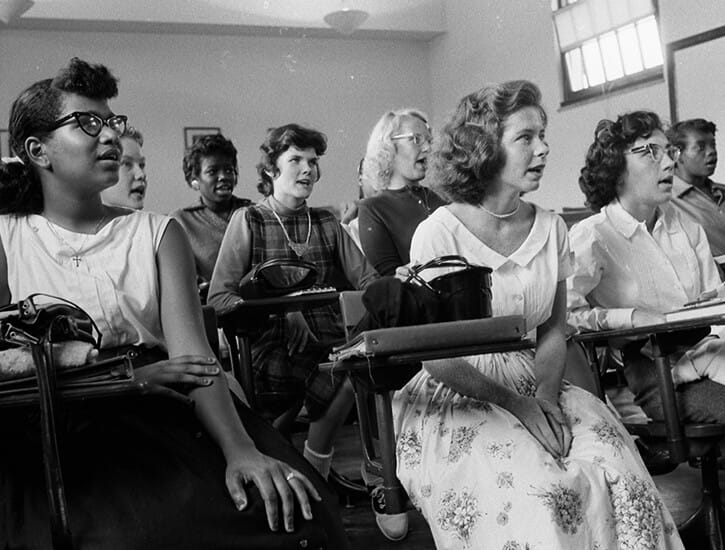
A classroom at Anacostia High School, Washington, D.C., in 1957. | Library of Congress
As any good authoritarian knows, the march to fascism requires capturing the courts, the media, and the schools. History and social studies classrooms are of particular consequence because that’s where the nation’s past is taught.
The playbook is well-established. Under autocratic Prime Minister Viktor Orbán, Hungary’s national curriculum was revised in 2020 to exclude the contributions of Jewish Hungarians and prioritize right-wing nationalist views. Meanwhile, Russia’s Vladimir Putin has been hard at work erasing Ukraine’s heritage from children’s schoolbooks. He understands that rewriting the past is vital to waging his war of aggression: last year, he declared, “Wars are won not by commanders but by schoolteachers.”
Now, it’s Trump’s turn. Since his return to office, he has slashed billions in public school funding and signed a slew of executive orders aimed at remaking social studies education and historical programming at public institutions, including schools, national parks, and museums. Barely a week after Trump’s second inauguration, the White House issued an executive order demanding an end to “radical indoctrination in K-12 schooling” and a focus on “patriotic education.” The order directs law enforcement to investigate schools and educator training programs that teach so-called “gender ideology or discriminatory equity ideology.” Then, in March, Trump issued an order on “restoring truth and sanity to American history,” characterizing programming at the Smithsonian’s National Museum of African American History and Culture as “divisive” and “anti-American.”
The administration’s actions follow similar ones made during Trump’s first term, as well as state-level efforts in recent years. Nationwide, even before Trump returned to the White House, more than twenty states moved to restrict the teaching of African American history in their classrooms. According to Edweek, at least forty-four states have begun debating legislation that would limit how schools can teach about race, histories of racialized groups, or gender identity or sexual orientation. Last November, the Texas A&M University System barred instructors from “advocat[ing] race or gender ideology, or topics related to sexual orientation or gender identity” in their classrooms without the school president’s approval. And just this week, news broke that a Texas A&M philosophy professor had been barred from teaching sections of Plato’s “Symposium” under the new rule.
The America we’ll live in a generation from now rests with our teachers, and they are being forced to square up with one hand tied behind their backs.
While Republican-led states have been at the forefront of this regressive movement, many Democratic lawmakers have backed similar legislation. The recent groundswell of support for Palestinian liberation, for instance, has spurred a new wave of Democrat-led or supported legislation censoring content in public education, including bills introduced in at least eight states this year that would adopt the International Holocaust Remembrance Alliance (IHRA) definition of antisemitism in public schools. That definition equates criticism of Israel with antisemitism and has been the subject of critique from dozens of civil society groups and rights advocates, including the UN’s Special Rapporteur on contemporary forms of racism, who argued its instrumentalization results in “harm done to human rights.”
But this legislation does not stop at erasing Palestinians. Over in deep blue California, a series of bills introduced under the guise of curbing antisemitism in schools would effectively gut the state’s implementation of earlier legislation mandating ethnic studies courses in public schools, meaning students would be denied education on the communities of color that comprise almost three-quarters of its student population. Governor Gavin Newsom signed the latest bill in that effort into law in October. When Arizona lawmakers passed a similar bill adopting the IHRA definition of antisemitism in schools back in May, Governor Katie Hobbs vetoed it, recognizing rightly that it “would undermine public education at all levels.”
While lawmakers squabble over what should be taught in schools, those responsible for teaching it are navigating increasingly hostile and precarious working environments with dwindling support and resources. The curriculum has become a central part of the fight over America’s social studies classrooms, and already, materials that reflect the nation’s checkered past and its diverse communities are being pulled back. At least one progressive curriculum provider has shuttered altogether.
The America we’ll live in a generation from now rests with our teachers, and they are being forced to square up with one hand tied behind their backs. Support for educators from the leadership of some of the nation’s largest teachers’ unions has grown more tenuous since October 2023, when Israel launched its full-scale assault on Gaza. The American Federation of Teachers quashed in committee resolutions brought to the union’s convention last year that called on it to divest from Israel bonds and “companies that facilitate and enable human rights violations, military occupations, apartheid or genocide.” Last year, when members of the National Education Association voted at their Representative Assembly to call on their union to cut ties with the Anti-Defamation League, rather than backing the rank-and-file, the union’s board overturned that democratic decision.
The field of training opportunities and resources available to teachers is also shrinking—and being policed with greater fervor. A significant loss came last summer, when the Brown University-affiliated history curriculum provider, the Choices Program, was shuttered after more than three decades as a standard-bearer in the field. Choices offered over forty units on topics ranging from racial slavery in the Americas and the Haitian Revolution to the Syrian Civil War. In 2022, when the American Historical Association published its American Lesson Plan report, a comprehensive study of the national U.S. history teaching landscape, as many as 34 percent of surveyed teachers in some states reported using the Choices Program’s curricula. According to its own data, the materials were used by over a million students in more than eight thousand high schools nationwide.
Educators I interviewed who are feeling the loss of resources in their classrooms described the Choices curricula as rich in primary sources, representative of diverse perspectives, and sensitive to both the local and transnational forces that shaped the historical events or eras they teach. “It had such a serious, rigorous, but also sensitive-to-multiple-perspectives sort of touch,” said one former Rhode Island high school instructor. Nicholas Kryczka, an AHA research coordinator who led the American Lesson Plan report, said the resources were unique in their ambition to “connect K-12 style activities with the latest in historiographic debate and inquiry at the academic level.”
The war on America’s past and those tasked with teaching it did not begin with Trump.
Brown is not offering back copies of the Choices Program’s print materials and has removed access to all its digital materials, including for those who held active licenses that should have extended beyond June 30, 2025, when Choices closed. Former staff, who spoke anonymously for fear of reprisals, told me they organized and fought to keep the program running or at least ensure their materials would remain available to educators. They said Brown refused to allow the group to continue operating as an independent organization. It also refused to allow the material to remain available in some form, even after offers from other curriculum providers to license and host it.
Spokespeople for Brown University said that cancelling Choices was part of belt-tightening on campus. But sources I interviewed who worked with Choices before it was shuttered have a different perspective: “To put it lightly, there’s a strong disagreement between the staff and the university about how the university has characterized the financial situation,” Rebecca Nedostup, a professor of history at Brown and former Choices faculty director, told me.
While Choices was affiliated with Brown University, staff said the organization was self-sustaining. The proceeds from the sale of its curriculum materials funded staff and curriculum development costs. Daniel Rodriguez, a Brown University professor who sat on the Choices advisory board, went so far as to tell the Brown Daily Herald that the program had “never once taken a penny” from the school.
Former staff told me the shock announcement of Choices’ impending closure in mid-April came a full three months after Brown’s dean of faculty, Leah VanWey, had reviewed and approved the program’s budget for the coming fiscal year, which would have kept it running until June 2026. The announcement came only eleven days after the Trump administration said it planned to freeze more than half a billion dollars in federal contracts and grants to Brown University while it reviewed its diversity, equity, and inclusion initiatives. Pro-Israel groups had also targeted the Choices Program over some of its Middle East curriculum materials beginning in December 2023.
Whatever the whole truth of the Choices Program affair, the disappearance of its resources represents a larger trend that any high school student who has paid attention in lessons on the Holocaust would recognize as concerning. “It’s remarkable the parallels that I see, the echoes I see, between the things that I read about while working on my curriculum on Weimar and what is currently happening in the United States,” mused Sarah Kreckel, a former Choices Program curriculum developer who contributed to its “Weimar Germany and the Rise of Hitler” unit.
Already, some organizations are refusing to provide resources about Gaza or other topics that could bring unwanted scrutiny from the federal government. Facing History & Ourselves, a once-respected genocide education curriculum materials provider, has remained committed to leaving Palestine out of its materials even after more than eighty of its employees, making up about half of its US-based staff, demanded it change course in December 2023. In a letter to leadership, employees criticized what they called a pro-Israel bias in the organization’s materials and an abdication of its responsibility to “address the risk of genocide against Palestinians.”
The war on America’s past and those tasked with teaching it did not begin with Trump. Some might credit Christopher Rufo, the man who led a right-wing billionaire-backed crusade against efforts to introduce more diverse curricula in schools starting in 2020. But that was just a renewal of the assault. The real fight started much earlier.
One of the greatest threats facing our schools now is the chilling effect that the Trump administration’s orders are having on unions.
For decades, public education in America has been underfunded, and starting salaries for teachers have fallen below the livable wage line in many states. Social studies education, in particular, has long been deprioritized. Federal funding for curricular experimentation in the field ended in the 1970s, when religious conservatives succeeded in slandering a cross-cultural anthropology course for fifth graders as un-American. According to familiar-sounding reporting from about fifty years ago, the groups feared that introducing young people to international cultural practices could contribute to “the breakdown of our traditional values.”
With the move toward standardization in education in the 1990s, states began developing social studies standards, but many did not implement standardized testing in the subject. According to the latest data from the National Center for Education Statistics, only about half of states nationwide administer social studies or civics assessments at some point before a student graduates from high school. With little funding or support for curriculum development and a stronger focus on English language arts and math, which are tested regularly across all fifty states and Washington, D.C., Kryczka said social studies has been “put on a back burner.” When asked to comment on the social studies standards in their states, teachers interviewed for the American Lesson Plan report offered responses ranging from lukewarm to outright negative, calling the materials “garbage,” “stupid,” and “impossible to use.”
When Kryczka and his colleagues sat down to draw up their conclusions for that report in 2022, at the height of Rufo-mania, they argued that the whole culture war schtick was a bit overblown. Instead, they wrote, “A lack of resources, instructional time, and professional respect represent far clearer threats to the integrity of history education across the United States.” If our schools succumb to the erasure of the American past in all its diversity and come to resemble, instead, babysitting programs where students in uniforms imbibe “patriotic education,” we won’t have just MAGA to blame.
The good news is that we are not yet living in a future where America’s children are taught that Barron Trump invented space travel. Today’s students remain hungry for the truth. One high school history teacher in Louisianna told me the most challenging part of her job these days is fielding student questions about why President Trump’s actions seem to violate the limits of executive power they just learned about in class. “We’ll be talking about how the president should not be a king, and then someone raises their hand and they’re like ‘What about this meme I saw from the president?’”
There is also a kernel of hope to be found in the same circumstances that made social studies and history education vulnerable to underfunding in the first place. Because social studies is not usually a subject of standardized testing, social studies teachers tend to have significant autonomy in their classrooms. That’s part of the reason they turn to resource providers like Brown University’s former Choices Program to build a curriculum for their students and supplement what are often the barest of standards. It will take time, interventions across thousands of school districts, and the involvement of tens of thousands of teachers to align the nation’s social studies and history curricula with the MAGA agenda. “As long as there’s this kind of day-to-day decision-making to be made by teachers, a lot of them are still going to go out there and look for materials on their own and find resources that they trust,” said Kryczka.
One of the greatest threats facing our schools now is the chilling effect that the Trump administration’s orders are having on unions, professional societies, administrators, and educators. It isn’t easy to resist that fear. But those brave few among us who have gone into underpaid and underappreciated teaching careers, committed to instilling within America’s children a sense of civic responsibility and an appreciation for the past, might just be up to the task. At least, I wouldn’t count them out.