, February 6, 2026
A Place to Call Home
The photography of Barbara P. Norfleet and Susan Meiselas
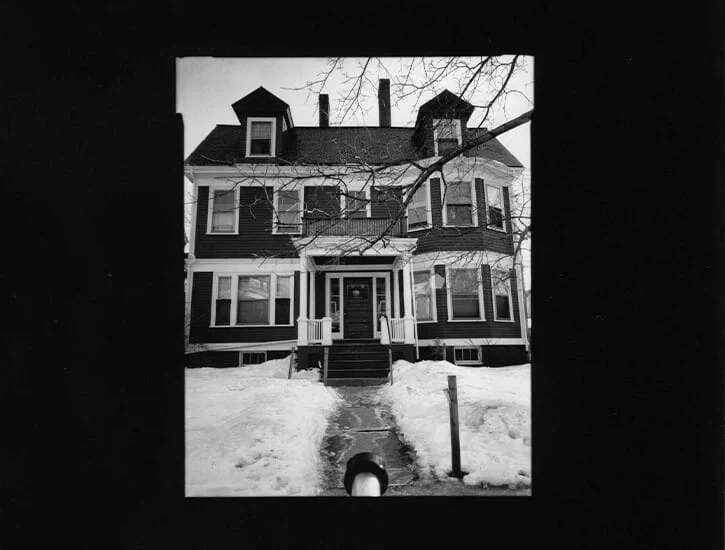
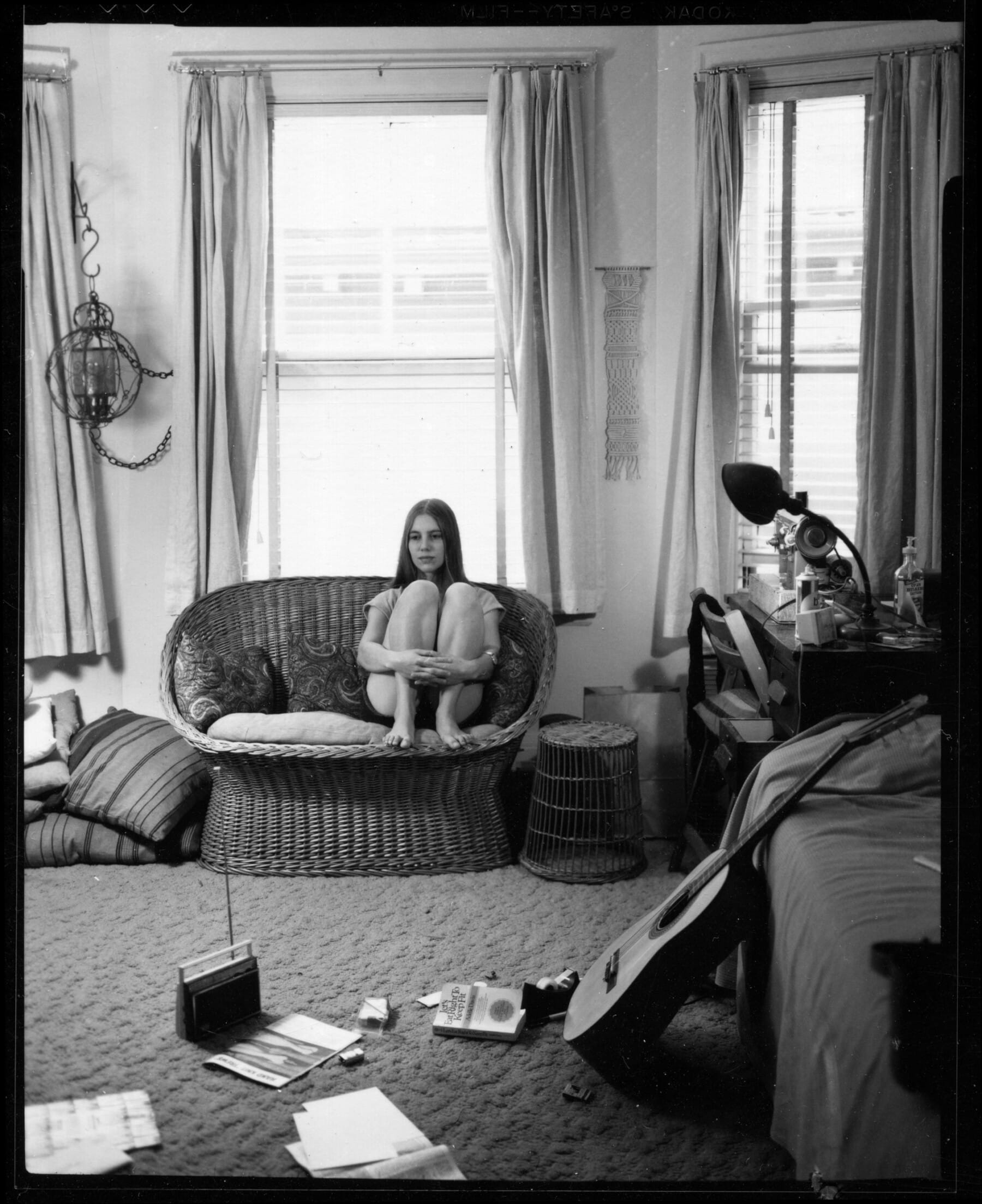
44 Irving Street, Cambridge, Massachusetts, 1970–71. | © Susan Meiselas / Magnum Photos
Cambridge is a city, not a highway. In the mid-1960s, this slogan—sung out at demonstrations and emblazoned on buttons, placards, and banners—referred to the Inner Belt, an eight-lane expressway that the Massachusetts Department of Public Works had been trying to build for almost two decades. Envisioning a modern regional highway network that would reorganize inner-city traffic and expedite travel for suburban commuters, the state’s planners had been putting forward proposals for an Inner Belt, one of which would plow a three-hundred-foot-wide freeway through Cambridge, including Central Square—then a densely populated, racially diverse working-class neighborhood—displacing an estimated 1,300 families.
As local opposition to the Belt grew into a social movement of national import, the Cambridge Civic Association asked Barbara P. Norfleet—an activist and Harvard academic—to create a publication about the cruelty of eradicating this beloved neighborhood. It would become Six Speak (1966), a booklet of interviews and photographs foregrounding the personal and community impacts.
Some years before, during Norfleet’s tenure as head of city affairs for the League of Women Voters, she had questioned the then-overwhelming public support for the Belt, including that from her very own organization. Having, as a graduate student, once resided in a cold water flat in Boston’s West End, a vibrant neighborhood across the river that had been razed during an “urban renewal” boom in the late 1950s, she was attuned to the tragedy of losing one’s home and community and decided to investigate the roadbuilding project herself. Conversations with those whose homes stood along the projected Brookline Street-Elm Street route in Central Square confirmed her suspicions and drew her into the grassroots organizing, including the commissioned booklet, even though she lived across town.
Norfleet knew how to talk to people. For the project, she interviewed six households at risk of being ravaged by the expressway and featured the extended transcriptions in Six Speak, which she published under the name Barbara N. Cohn. “I’ve dreamed of getting old in this house—of sitting there and looking out the window,” said Maria Soeiro of 2 Hastings Square. “When you’ve lived in a house for thirty years how can anyone compensate you for the feeling you have for the house?” Other individuals such as Henrietta Jackson of 121 Hamilton Street emphasized the community’s irreplaceable charm. “The whole air of the neighborhood is friendliness and interest,” she remarked. “They have a wholesome curiosity. The man across the street brings my little nephew back when he crosses the street. A little thing, but it’s what counts. Another man plants that empty lot down the street with flowers. He doesn’t even own it.” Many people described the emotional toil of the looming project combined with the governmental apathy; Peter Manetas even claimed that his wife, nearing a nervous breakdown, was compelled to visit family in Greece to escape the highway-related stress. Because of her limited time and budget, Norfleet chose to only interview individuals who owned their houses—and were likely to lose them—rather than local tenants who tended to be less well off.
Central Square, Norfleet noted, constituted an area of mixed land use whereby individuals could walk to school, go to church, catch a flick, buy groceries, and visit friends and relatives. The residents didn’t depend on cars, like those suburban commuters for whom the Belt was being built. The neighborhood thus had much in common with Boston’s North End, which, despite its public perception as a slum, Jane Jacobs had deemed “the healthiest place in the city” in The Death and Life of Great American Cities (1961), her influential attack on the previous decade’s urban renewal efforts. Norfleet likewise concluded that mixed land use “[led] to a kind of localism, to a sense of belonging and familiarity, to an affection and emotional attachment to an area and to a home.”
But regardless of the collective strength of the interviews, it was clear that pictures were needed to capture what verbal accounts couldn’t. Norfleet hired two of her sociology students, Glen J. Pearcy and Richard P. Rogers, to take the photographs—but they misunderstood the assignment. “They came back with gorgeous pictures of peeling paint and rusty nails,” she recalled in a 1991 interview with William Johnson. “I said, ‘No, I want you to take pictures of the way people see their homes.’” Due to the uncertainty of the highway, Central Square might have been decaying, its public school languishing, but Norfleet wanted to emphasize the qualities that made it special. Pearcy and Rogers indeed returned to the area to take some additional shots depicting the levity of an outdoor summer meal, the mirth of two girls doing each other’s hair on the porch, the stubborn ubiquity of “Stop the Belt” and “Save Our Cities” signs.
Meanwhile, Norfleet borrowed a Leica from a friend and made her own attempt at photographing the households, and though most of the pictures were lousy, she ended up publishing her sidewalk view of Jackson’s sun-filled porch, its railing planters spilling over with flowers. “I just thought,” Norfleet recounted in 1991, “Why am I walking the streets doing the interviews, doing all the set-up work for someone else to walk in and take the pictures? This is where the fun is.’” It was no small revelation. “I realized my whole career was wrong,” Norfleet, who turns one hundred this year, said at a symposium in 2012. “And I became a photographer.”
In Six Speak, working-class camaraderie and residential pride are verbalized and visualized to great effect; the dynamic interplay of interviews and photographs achieved an urgent emotional appeal. There’s a distinct sense that words in dialogue with pictures have the power to situate a community on local ground, to elucidate the ways people find beauty and belonging in their domestic and neighborly lives. The project’s bedrock was the irresistible, oh-so-sixties notion that conversation was the stuff of social transformation.
But Six Speak was more than a sociological analysis or a cri de coeur; it offered a record of a neighborhood whose days could be numbered. In certain ways, the booklet had formal and thematic affinities with An American Exodus: A Record of Human Erosion (1939), the classic documentary study that brought together Dorothea Lange’s stirring photographs of migrant families amid the Dust Bowl, direct quotations from her subjects, and text from her husband, economist Paul Schuster Taylor. But Lange and Taylor’s book was about what had happened, not what might happen.
Thankfully, in the end, there was no exodus from Central Square, no decimation of those streets teeming with three-deckers. In 1970, because of the citizen-led opposition, Governor Francis Sargent called a moratorium on highway building before shutting down the entire Belt proposal a year later. The success of Boston’s anti-highway movement made it something of a textbook example of democracy in action, though the heroic story is a largely forgotten one, like Bernard LaCasse’s 1980 cartoonish commemorative mural of a gang of adults and children as they fend off a bulldozer symbolizing the advance of urban renewal. Today, the artwork awkwardly finds itself in a Trader Joe’s parking lot.
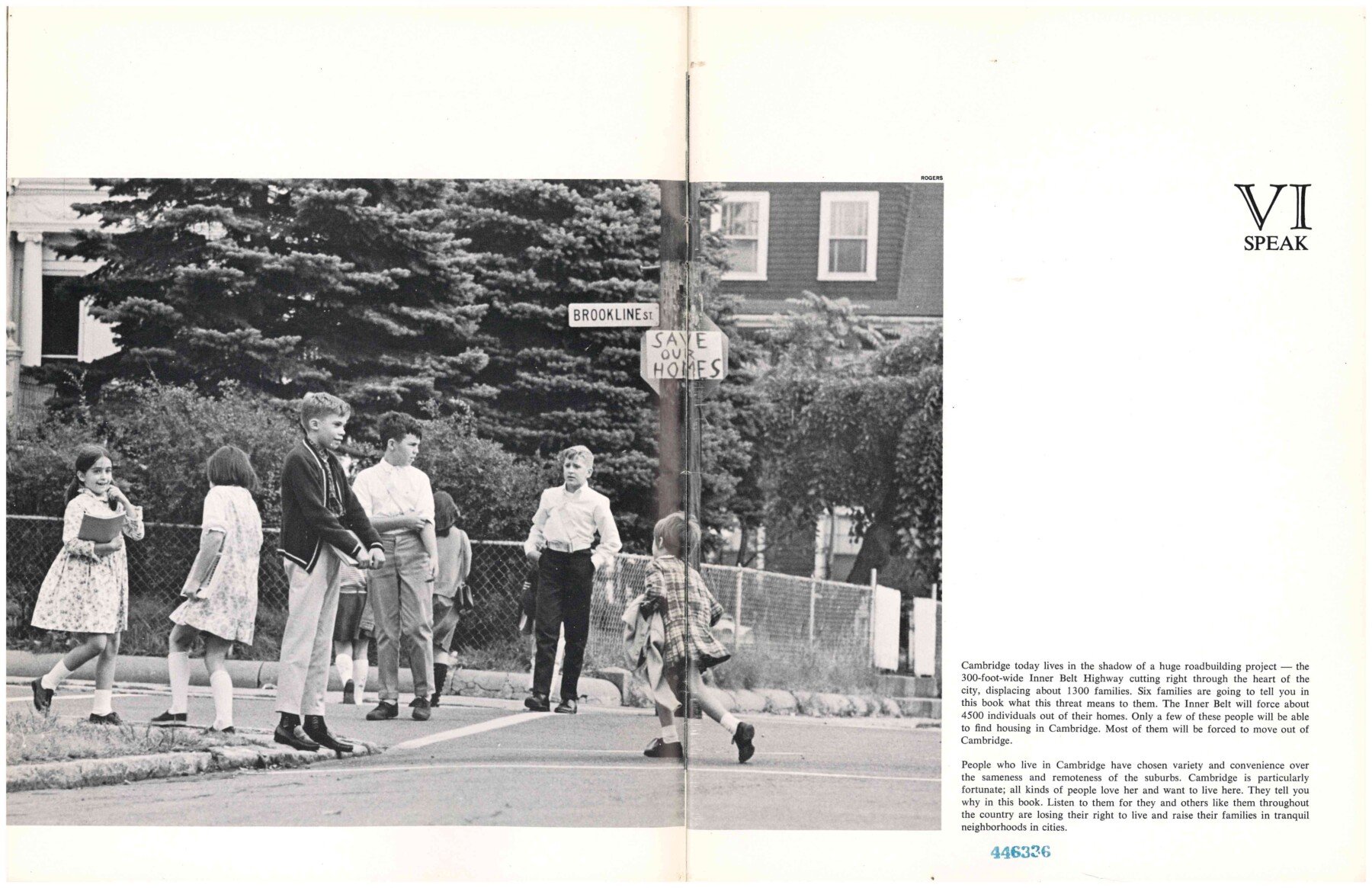
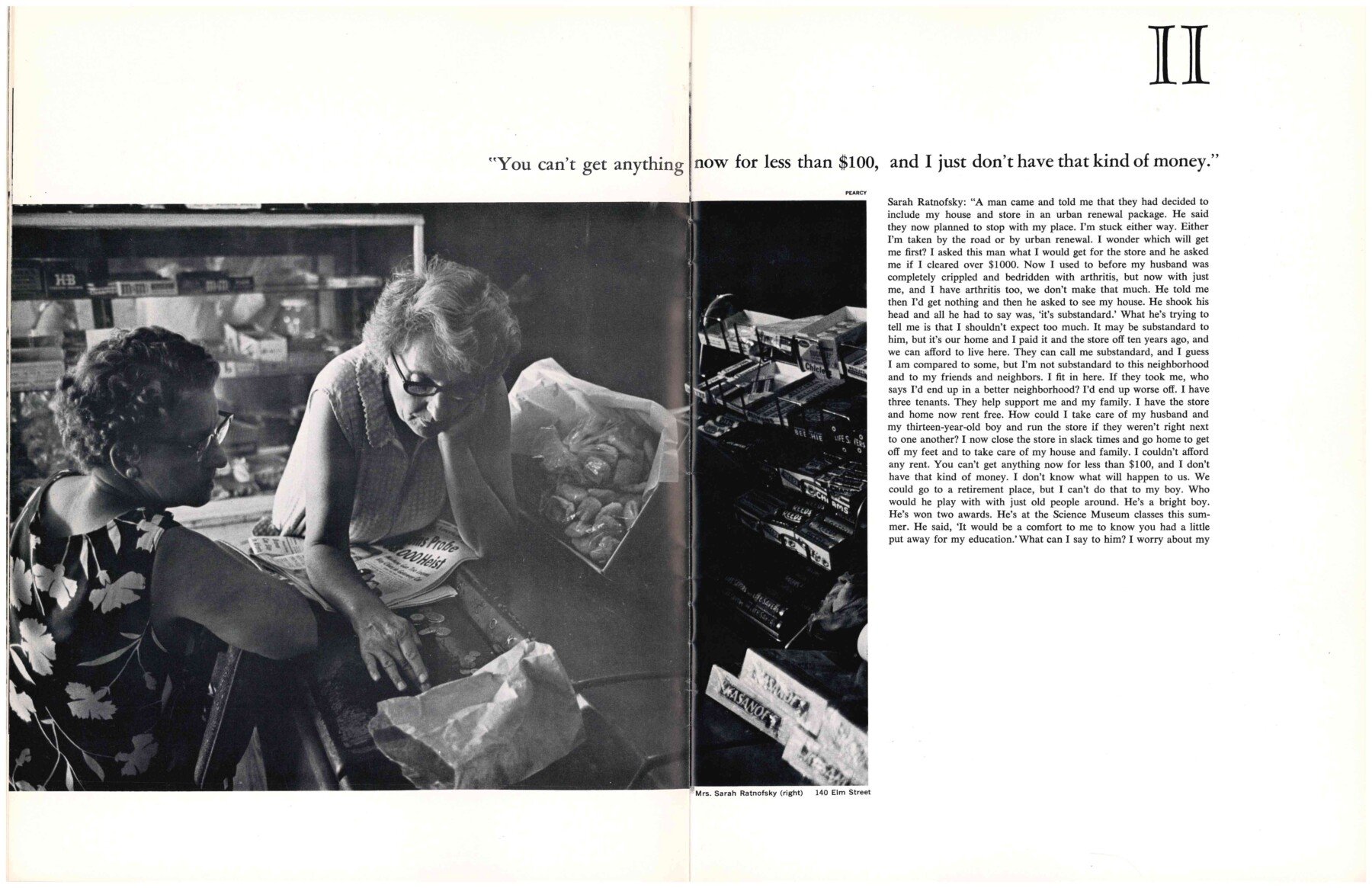
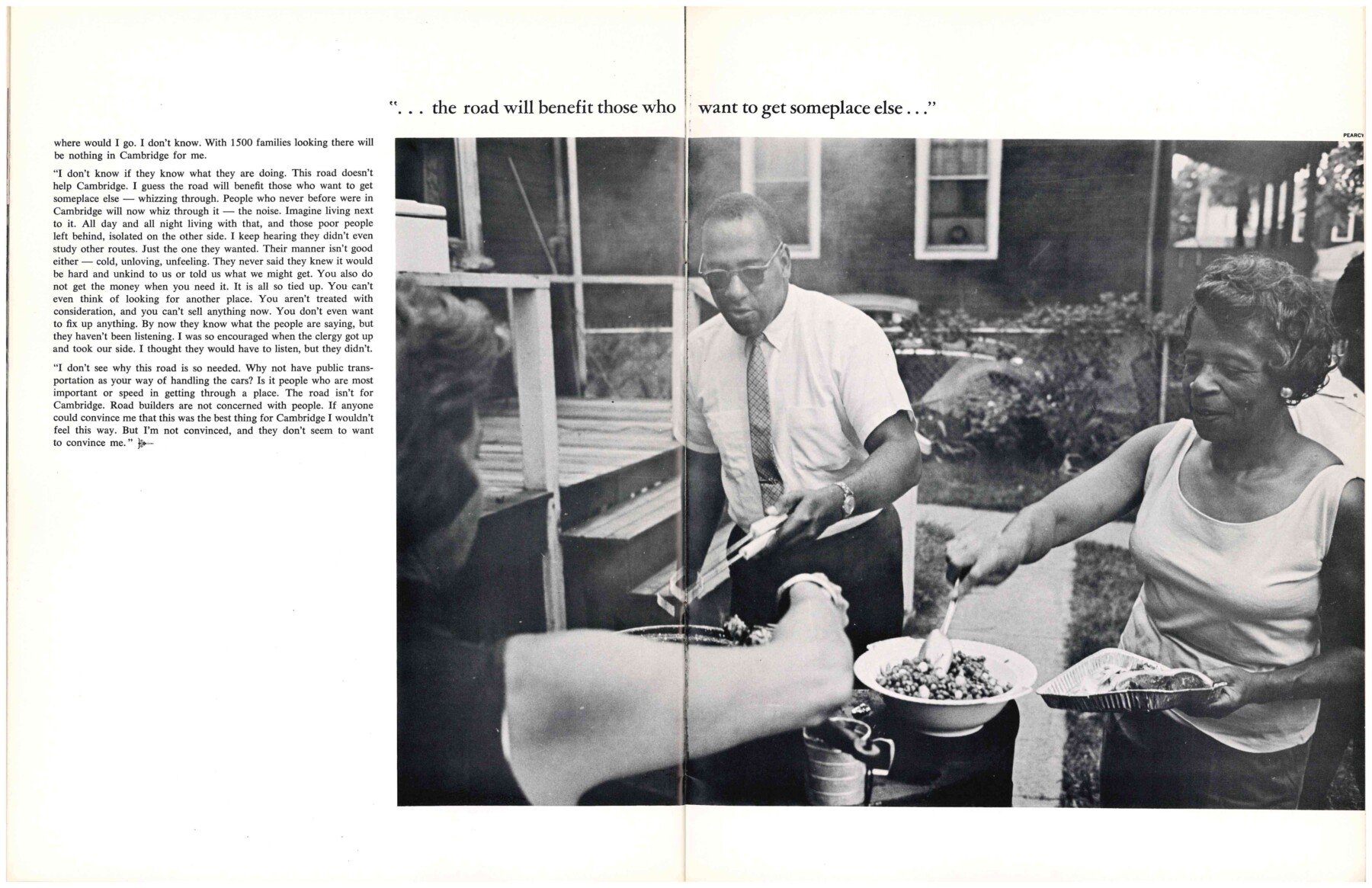
Six Speak kindled Norfleet’s interest in the history, theory, curation, and practice of photography. By 1970, Norfleet, who had a PhD in social relations yet had been lecturing in sociology for several years, was co-teaching an interdisciplinary course at Harvard’s Carpenter Center for the Visual Arts called “Photography as Sociological Description,” in which Susan Meiselas fortuitously enrolled. For the semester-long project, Meiselas photographed the tenants of her boarding house in their rooms by developing a more collaborative approach that incorporated her subjects’ written testimony. Whereas Norfleet’s Six Speak buttressed an activist campaign and Meiselas’s 44 Irving Street was an experiment in participation, their documentary projects are linked—and not just through the shared cultural context, student-teacher relationship, or combination of images and texts. In both, photography functions as a vehicle for deepening connection with one’s home and community and countering Cambridge’s creep toward homogenization.
Forty-four Irving Street was a short walk from Harvard Square—and not far from Central Square, either. Though the boarding house’s twenty inhabitants, who were mostly white, single, childless, and on the younger side, shared the kitchen and bathrooms, they scarcely interacted with each other. Why did these individuals, Meiselas wondered, choose this living situation—a non-communal commune—just as she did? “I wanted to begin to understand the texture of their lives, through their environments,” she wrote in an artist statement in 1971. She knocked on each door, uneasily introduced her envisioned project, and asked if she could take their portrait in a place of their choosing in the cramped unit. As she set up her equipment over the better part of an hour, some subjects took an interest in their portrait, commenting on which items in the room had special meaning. For example, Joan—who holds her knees to her chest upon a wicker settee, with a radio, tape dispenser, and copy of Adelle Davis’s Let’s Eat Right to Keep Fit strewn across the floor—insisted that her guitar be in the frame.
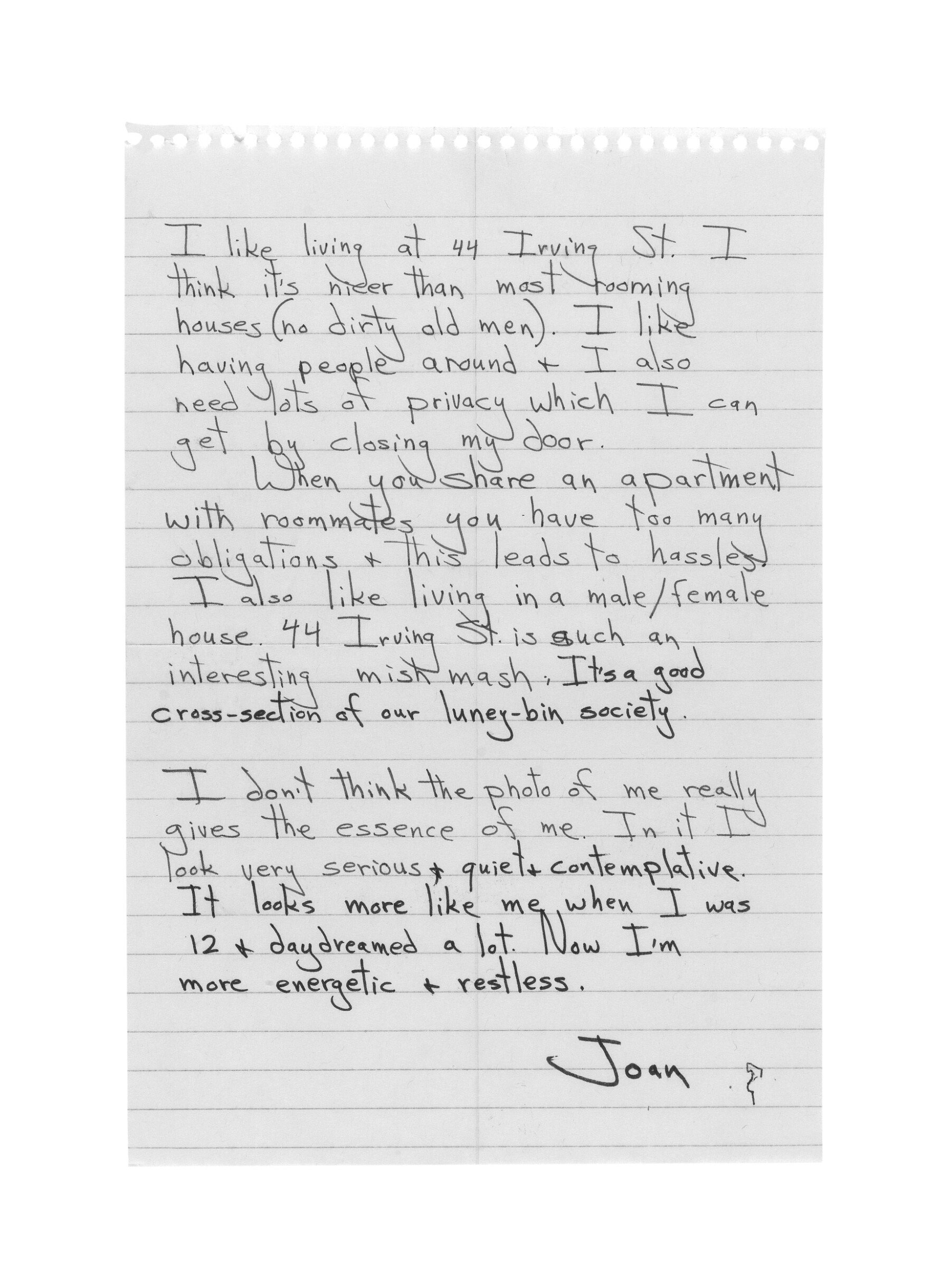
Meiselas subsequently used the pictures to begin more of a conversation with her housemates. Her approach was thus not strictly sociological like Norfleet’s; she did not pose direct questions about their ages, occupations, reasons for residing at 44 Irving, or impressions of Cambridge. As she noted, the “question was not ‘how do I observe another objectively’ but more ‘can one be a participant observor [sic]’, ‘how close can I come.’” Living in abutting rooms allowed for a closeness that wouldn’t have been possible otherwise. When Meiselas returned the day after the portrait session to give each housemate a contact print, she became fascinated by the different reactions. Then, in a curious gesture of both collaboration and critical engagement, she asked each to jot down reflections about their picture. “As I’ve lived my life since then,” Meiselas told me in 2023, “I realized that the discomfort was part of what led to what was at that time pretty innovative, which [was] to say: So, how do you see yourself in this photograph? How is the photograph portraying you differently than you might feel yourself to be?”
The residents rose to the occasion. For example, Joan expressed in angular penmanship, “I think [44 Irving Street] is nicer than most rooming houses (no dirty old men). I like having people around + I also need lots of privacy which I can get by closing my door.” And regarding Meiselas’s portrait: “I don’t think the photo of me really gives the essence of me. In it I look very serious + quiet + contemplative. It looks more like me when I was 12 + daydreamed a lot. Now I’m more energetic and restless.” Some tenants wrote about the reasonable rent, like Gil, who saw himself as “overrelaxed” in his picture and pointed out that the boarding house was “cheaper than living in an apartment in Cambridge”—and mercifully lacking in roaches. Others such as Don, a disenchanted college graduate stuck in a job he loathed, used his portrait as well as the others’ to theorize the appeal of this kind of living arrangement. In his picture, Don looks out from a doorway with an unassuming smile, though he characterized the portrait as “rather stark and bleak in appearance”; he liked it because it was at odds with his perceptions of how some saw him in the professional world. Meiselas’s series, he wrote, presented
pictures of people who are showing their true selves and their chosen surroundings to strangers, with very little concern for what these strangers may think. All that really matters is how they perceive themselves. I think this can be seen in the faces of the subjects in the pictures, and this “naturalness” is what I like about living here.
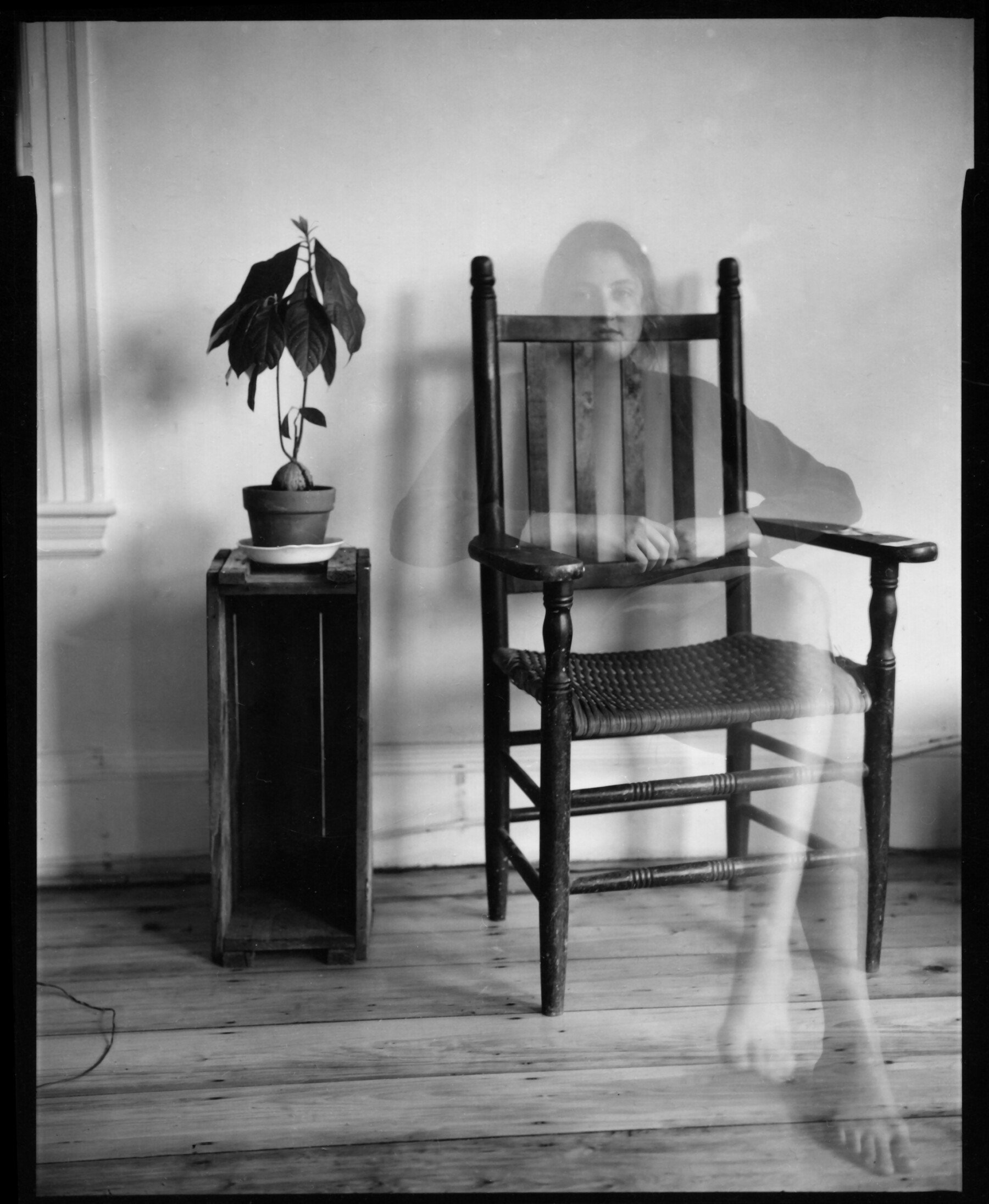
In addition to these room photos, Meiselas took a couple of self-portraits, including a long exposure of herself sitting with crossed legs and a knowing expression next to an avocado plant. Her spectral appearance suggested uncertainty as to how to contextualize her own presence. She also photographed the house’s common spaces. The pictures as well as the subjects’ notes were first presented together in a student show at the Carpenter Center in 1971. “It was like a new way of seeing,” recalled fellow photographer Jack Lueders-Booth about the series in an interview in 2024. In the early 1970s, he ran the photography facilities and helped Meiselas with some technical aspects of the project such as developing the film. “She was able to achieve a kind of penetration of portraiture where the surfaces seem like coats of the interior: you look at the person, you could see into them.”
Yet the strength of the project owed itself not so much as from her technical prowess—these pictures were, after all, among her first—but from her social intelligence. “The subject has to want me to be there for me to feel that I can be there,” Meiselas wrote of her first series in 2017. “This was the central space of collaboration, along with an act of reciprocation, that I was trying to discover right from the beginning.” On view last summer at Higher Pictures in Brooklyn and recently published as a photo book by TBW, 44 Irving Street marked a collaborative approach to documentary work that Meiselas would continue to develop in projects such as Carnival Strippers (1972–75), which examined performers in traveling “girl shows” through pictures and interviews. This series originated on a summer road trip with her partner and collaborator, filmmaker Richard P. Rogers, who had been one of the photographers for Norfleet’s Six Speak a few years earlier. In a sense, Meiselas’s participatory gesture in 44 Irving Street had something in common with Norfleet’s insistence that Rogers and Pearcy photograph the unimpressive houses in Central Square with all the affection that their owners conveyed. As the sixties spilled into the seventies, fresh approaches to documentary photography, whether arising from political need or relational scrutiny, brought people into new community formations.
Today Cambridge is still a city, not a highway—but decades of aggressive gentrification and housing market violence have made it one of the most expensive cities to live in the United States. Last year, the median monthly rent for a one-bedroom apartment was over $2,900. With its impossible affordable housing waitlist and longtime residents regularly being forced out, Cambridge—and Central Square in particular—has been rocked for years by rezoning debates and public-private partnerships promising that more tall luxury condo buildings will lead to greater housing affordability.
But to look back at Norfleet’s and Meiselas’s first photo projects encourages us to reject both the inevitability of homogenization—urban, artistic, and otherwise—and the idea that Cambridge is but a carcass of its former self, its soul sucked dry by the powers of tech, biotech, and academia. More than documents of neighborly attachment and empowerment from a much-romanticized era, these photographs now serve as agents of historical possibility that underscore housing’s relational imperatives while complicating standard notions of progress in a development-obsessed culture.