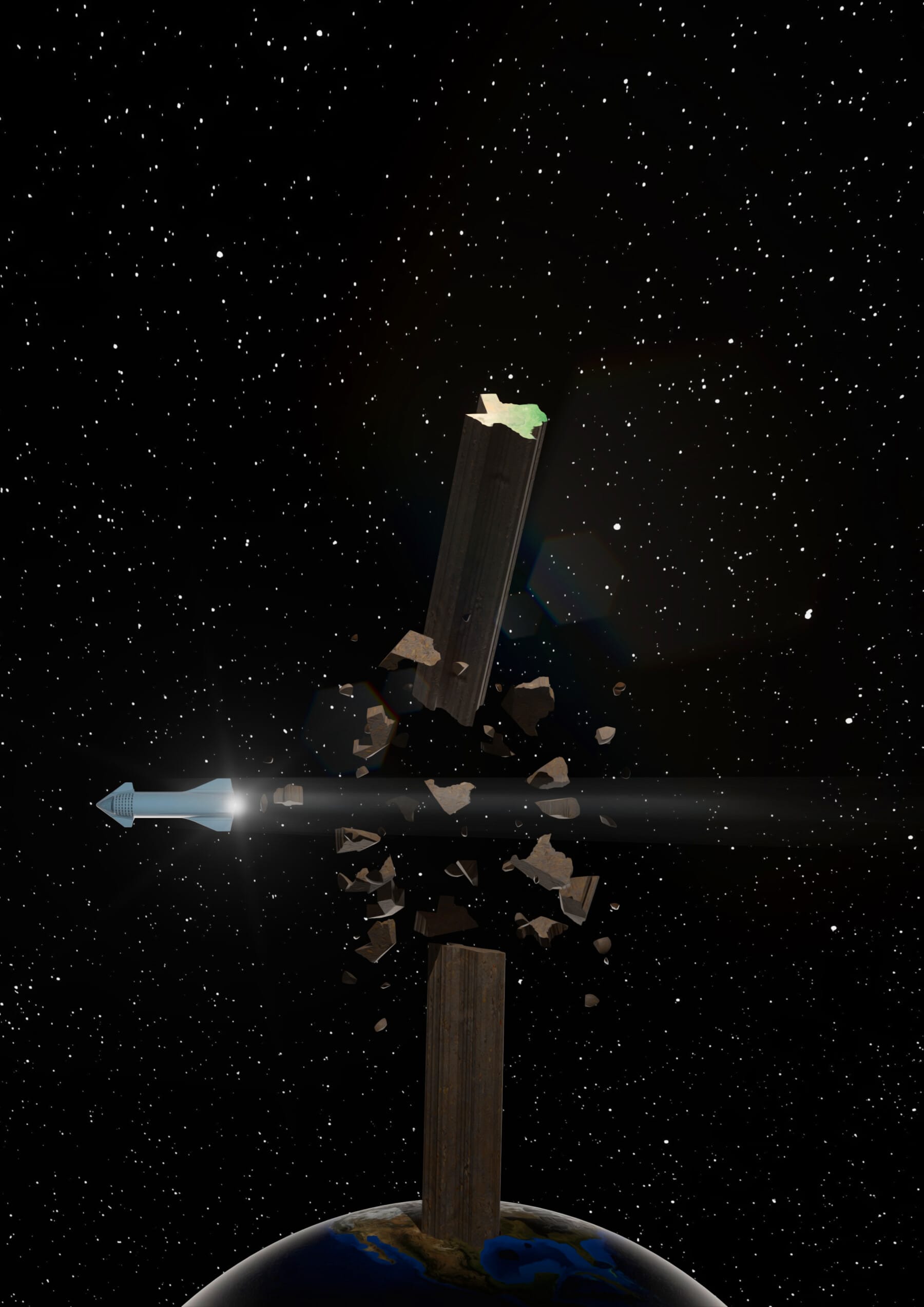
Doth the Lone Star State protest too much? There might not be much daylight between the Texan ideal of self-sufficiency and the cliché held by outsiders that the once independent republic is provincial and inward-looking. As is often the case, however, such stereotypes are negative images of a repressed truth. Violence against migrants, cattle fetishism, extractivism of both the hydrocarbon and digital varieties—everything that happens in Texas is a reflection of the whole world, which of course means that everything happening across the globe is reflected by something within state lines.
Hence “Global Texas”: an issue with concerns ranging from beef to oil to bigness domestic and abroad. A state given to superlatives has welcomed the world’s richest man, Elon Musk, alongside other Silicon Valley exiles seeking refuge from perceived persecution in Commiefornia for their heterodoxies—and, as Fred Turner points out, cheap land and electricity for the data centers required for the world economy’s turn to artificial intelligence. Joseph Bullington reports from the Gulf Coast, where Musk’s SpaceX company is transforming the wildlife refuges of the Lower Rio Grande Valley into testing sites for the rockets it promises will one day terraform Mars. Indeed, the region has become a hub for tech endeavors, among them the Taiwanese firms with long histories of labor arbitrage, as Gabriel Antonio Solis writes, now hoping to take advantage of the maquiladoras, those Mexican factories just over the border. As electronics are shipped north, natural gas is sent south; Natalia Mendoza traces the pipelines running fossil fuels from the Permian Basin in Texas to Mexican ports on the Gulf of California.
Its waters disrupted by growing tanker traffic, a tragic victim of the natural gas boom is the endangered blue whale, the largest mammal that has ever existed. Its cetaceous cousins across the Pacific may prove the future of red meat consumption in Japan, where Dylan Levi King takes a stand for the American steak and against the oleaginous Wagyu favored by tourists and the elderly. Elsewhere in ungulates, Patrick Cottrell gives us a tale of, among other things, the Sichuan takin. Sam Cowie considers Brazil’s beef magnates and cowboy Bolsonaristas stanning the American South—an affection shared by the unionists of Northern Ireland, as Oliver Eagleton shows, where some of the largest numbers of gun owners, evangelicals, and (religious) segregationists in Europe reside.
Erika Kirk, the peroxide widow of American conservatism, is reportedly keen on bringing Turning Point to Ulster. Par for the course, perhaps, in terms of cultural exports for the American imperium. Maybe we’ll franchise our legal designation of an actually nonexistent “Antifa” as terrorists next, per the recent Texas court decision chronicled by Lauren Fadiman; our growing proclivity for exorcisms observed by Joseph P. Laycock; or the beaver-themed, jumbo-sized gas station chain Buc-ee’s, detested in detail by Forrest Wilder. For those looking for something slightly more dignified, if equally mammoth, consider David Adickes’s two-story-tall busts of the U.S. presidents, the series ending with Barack Obama. With Adickes having passed recently, the Houston-based estate is seeking to place the sculptures, featured here in an exhibit by Andrew Norman Wilson. A regional park would be nice, Wilson writes, but how many of those will we have once all is a launchpad for Musk’s extraterrestrial aspirations?