, March 27, 2026
Dan and Daisy
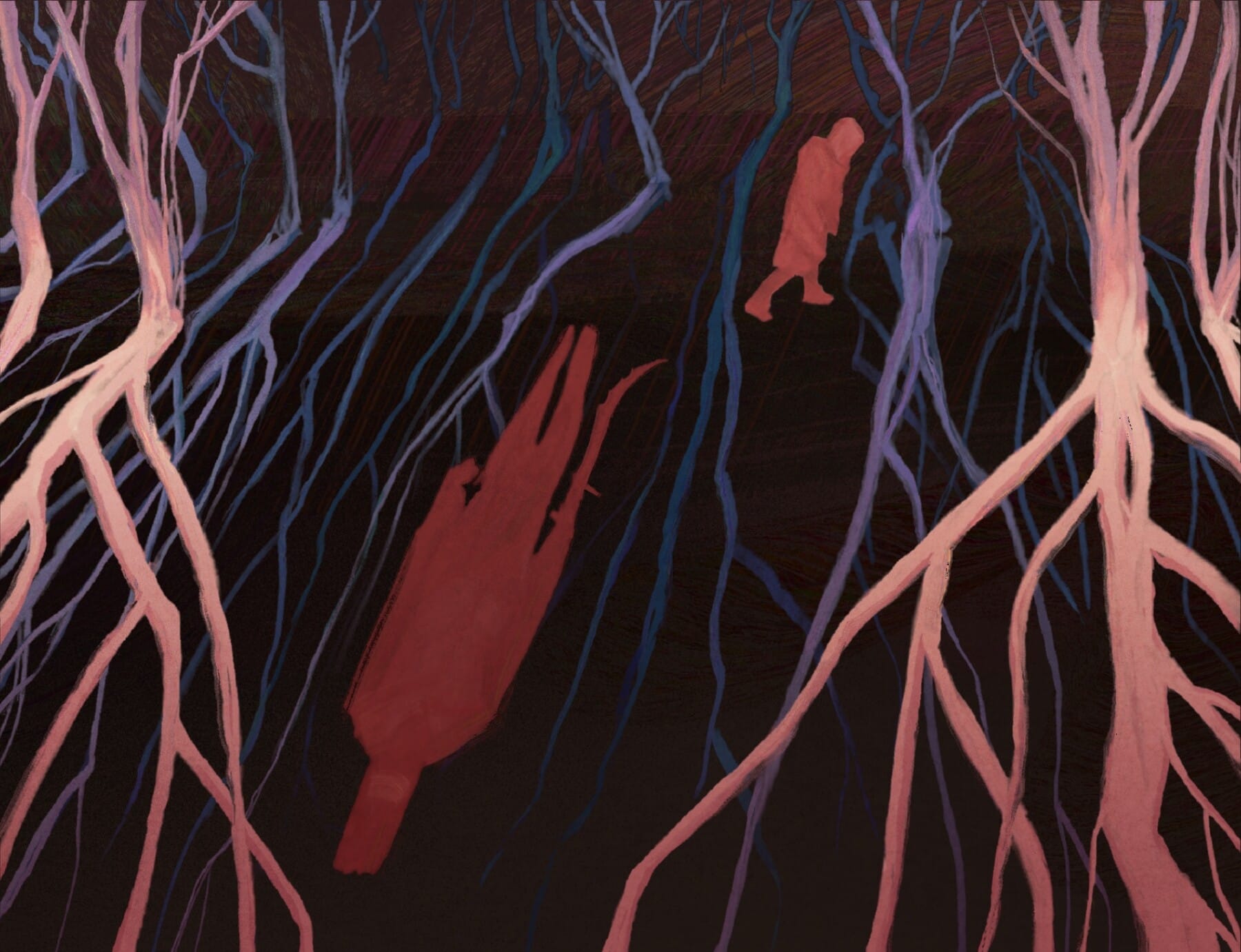
Dan Redhoke kills a bunch of people with a hay knife, eludes the police in the woods, and is finally cornered at an electrical plant where he attempts to escape by shimmying across the power lines. Unfortunately for him, neither he nor his pursuers are aware that the flowered glade next to the plant is a popular play site for the town’s children or that eleven-year-old Daisy Little, the daughter of the county sheriff, has been hiding there since Redhoke inaugurated his spree by pincushioning her father in their front yard. While he shimmies, she climbs to the metal landing he is struggling toward and stops next to a red-painted lever. She lifts her fingers to the handle, and Redhoke just has time to smile before she flips the switch. For a brief moment, his body conducts a quarter-million volts, and then he is falling, and then he is nothing.
And then he is something again. Falling still, but in absolute darkness and total silence aside from the sound of rushing wind. Free falling for hours, no ground visible at any distance below, nothing above, no planes or stars or bioluminescent fish streaming by. He falls for days, for what must be a week, for so long that the concept of time loses its meaning. He never gets tired or hungry or thirsty, his circumstances never change, and his already dubious sanity flickers like a marine light in a hurricane. Eventually he comes to understand the ultimate rule of the abyss: When you’re here, you’re here.
And when it comes to seem that he will always be here, that anything else he can remember was just a setup for this eternal joke—that’s when the vortex opens and sucks him in. A metaphorical vortex, but also a fiery pink dahlia in the space that draws him into a swirling torrent of energy. Because the abyss is just a waiting room, and the other side of his curse involves sudden trips to the world.
He wakes lying on his back in the forest, gazing up at pine tops with the acrid scent of sap in his nostrils and the soft tickle of moss under his neck. A light fog hangs in the boughs, softening the sun’s rays, and a grey shrike whistles from its perch on a low branch near a cordial orchid. It’s a lot to take in after his stretch in the mind-destroying void, and for a while he just lies there, overwhelmed by corporeal existence. Good thing he seems to be wearing some kind of heavy mask, and the tinted glass in front of his eyes keeps out the full vibrancy.
Dan doesn’t get hungry and he doesn’t get tired, he doesn’t feel the urge to do anything besides stroll and murder.
Nearby movement jostles him out of his reverie, and when he stands and turns around, his body feels fine—better than fine—despite its recent pointlessness. He sees that he is joined in the forest clearing by three young white men, kneeling in a row twenty feet away. Two wear brown robes, the third wears black jeans and a black T-shirt with unreadable script above a drawing of the Pope as an angry skeleton holding a battle-axe. All of them have long hair and acne, and the one in the middle is holding some kind of long object out in front of him. It looks familiar, but Dan can’t place it. Dude, one of them says. Shhh, another one says.
Dan tries to call out to them, but nothing happens. Somewhere between brainwave and speech the signal dies, and his mouth doesn’t even move. The boys don’t seem too plussed. Dan notices, on the ground to the side, a flat white stone with three black candles melted to nubs. The kid holding the object stands and walks toward him, tentative steps and a bowed head. He stops just out of reach and fully extends his arms, and Dan’s own hand is drawn toward the offering, as if by a miniature gravity. As soon as he touches it, he recognizes it.
A hay knife, of course. Three feet long, wooden handles on the top grip and mid grip, dark steel with sawtooth serrations. Light grooves in the wood exactly where his fingers fall. He takes the weight and it feels right, as comforting as the steering wheel of a car you grew up with, as reassuring as the toilet seat at your parents’ house. The kid lifts his head and looks at Dan with grave esteem, plus a glimmer of yearning. His mustache is a year away from legitimacy, but he’s trying. Dan feels a kind of affection for him, a mixture of gratitude and pity that develops in concert with a prickliness growing in his hand.
He tightens his grip on the hay knife. He rams it through the kid’s stomach and uses both handles to lift him off the ground, producing a fantastic bloody geyser and an elongated gurgle. Satisfaction in the physical act spreads through Dan’s body, like a pure hitter connecting on a hanging curveball. The grey shrike chirps and flies away into the fog. The other boys scream— actually, one screams and one says mother of shit—and they both start sprinting. Dan slings the dead one off of his knife and squares up, cracks his neck. The kids are twenty yards away. He picks the one on the right and slings the hay knife like a tomahawk. It nails him in the numbers and pins him to a nearby tree. The last kid runs like his life depends on it, and Dan watches him careen through the far brush. He feels better than better than fine. He feels marvelous.
And he feels something else too: a twitch, a mild compulsion to move in one direction and not the other, as if his feet know something that his mind does not. He spends the whole morning hiking. These are the old woods, all right. The town would be to the west, the highway further south. Power station to the north. When the fog clears in the afternoon, sunlight blasts through the canopy and lights the colors on fire, violet asters and scarlet lilies and dew as shiny as beads of mercury clinging to the tips of ivy leaves. Later, as dusk gathers, the forest dims but the colors glow like afterimages, bright lights in a closed eye. He considers taking off his headgear, but decides against it. He’s more comfortable with the mask on.
Over the next few days and nights, he makes a leisurely trek, stopping occasionally to interact with other wilderness enthusiasts. He finds a hiking duo and snaps their necks, he dices up a survivalist-type in his tree stand. He doesn’t get hungry and he doesn’t get tired, he doesn’t feel the urge to do anything besides stroll and murder. One evening, while drowning a couple of skinny dippers in a reservoir, he sees his reflection on the ripples, and learns that his mask is a welding helmet, a big metal shield with a thin rectangular window. His clothes are some kind of canvas jumpsuit, as dirty as if he’d spent a decade in the woods. In the few places where it’s visible—neck, wrists above the thick leather gloves—his skin is mottled and scarified. The suit and helmet and hay knife don’t really make sense together, but overall it’s a strong look. He traipses on, humming a nonsense tune in his head, although of course no sound comes out.
On the third night, his internal compass brings him to a dilapidated cabin with a wraparound porch on which four teens sit in wicker chairs, playing cards and drinking by candlelight. By this point he’s pretty confident in his strategies, and he resolves to lurk for a while. It isn’t half an hour before a longhaired guy in a letter jacket stands and stretches.
Think I’m going to take a walk, he says.
Be careful, another one says, a girl with brown hair. She asks, You heard about those people that got killed, right? And Johnny and Allison still haven’t come back from their trip. I hope they’re okay.
Nobody’s gotten killed, he says. That’s just bullshit somebody made up to scare kids at camp.
They say it’s the ghost of Dan Redhoke, the other guy says. You know he died around here, whenever that was.
One of the girls flinches.
I say it’s the ghost of Johnny’s virginity, the first guy says. If I was off in the woods with Allison, I wouldn’t bring her back so soon either.
Har har, they all say.
A few moments later letter jacket is stumbling through bushes in the dark, and Dan falls in behind him, away from the light of the cabin, both of them pulled toward the sacrificial altar to fulfill their respective duties. After he finishes the jacket guy, Dan dismembers the girl who comes looking. The two people left on the porch, a boy and a girl, are kissing when he returns, but as he crouches low to slink along the bushes under the railing, he hears a pop of suction when the girl breaks away.
I don’t know, she says. Shouldn’t they be back by now?
Come on, baby, he says. Jack’s a stud. I bet Sally is just fine with how long it’s taking.
I guess so, she says. I guess you’re right, Randy. I shouldn’t worry.
It’s okay, he says. I’ll keep you safe.
Which doesn’t seem to flow with his initial argument, but she doesn’t remark. There’s more lip smacking, then a bottle hits the floor and breaks. She speaks up.
Whew, I think I’ve had too much.
Hey, Randy says, that’s no problem. Why don’t you go inside and lie down? I’ll clean up out here and be right in.
Okay, she says.
Her footsteps track into the house, and the door closes behind them. The crickets chirp, and the stars twinkle, and the wicker chair groans as its occupant rises.
Well, Randy, the guy says to himself. I believe it’s time to get L-A-D-E.
Dan pops up and Randy makes the appropriate face while Dan disembowels him, the face of someone going from certainty of intercourse to certainty of death in one second flat. Half terror, half outrage. Then he sits back down in his chair and stares sleepily at his guts, and Dan slips into the cabin.
It’s dark inside, but there’s light from a cracked door at the end of the hall. He creeps up to it, weighs his options, and settles on the direct route. He flings the door aside, takes one big step through the threshold, raises the hay knife above his head in a power stance, and is hit with the weirdest sense of déjà vu. At least a dozen candles light the interior. The girl is sitting on the bed under the window, in her underwear and a T-shirt, a silver comb in her hand. She screams and scrambles against the wall. He doesn’t know what it is about her. The hay knife floats down, hangs at his side.
Entranced, he steps close to the bed. She’s screaming and crying and kicking, but he’s just curious now, fascinated by whatever it is that’s happening. The destructive impulse is gone, replaced by simple, elemental wonder. His empty hand reaches forward, and with one of her kicks, a bare toe grazes the side of his wrist. With contact he knows: it’s been an eternity, but they’ve met. Lifetimes ago, a butterfly flapped its wings, and an eleven-year-old girl flipped a switch. Daisy. She senses it too or maybe recognizes him. The screaming stops, and they behold each other in a moment of stillness. Even the candle flames are calm. And what Dan feels inside is not anger, or fear, but awe.
Then Randy, still alive somehow, crashes through the window beside the bed and plows into him. He loses the hay knife, and they fall on the floor. Randy is covered in so much blood that it’s hard to get a grip on him. But get a grip Dan does, a good one, around his neck. He stands, lifts Randy bodily into the air, and prepares for a squeeze that ought to send the kid’s eyeballs bulging out of his head like a squished dog toy. But Daisy has seized the hay knife, and she drives it right through Dan’s heart.
And then he is letting go of Randy, and then he is sinking to his knees, and then he is nothing.
It’s always the same.
He tumbles through a dead cosmos, a nothingness so extensive that he concludes his memories are hallucinations. Then a portal opens up, and in he goes. Next thing, he’s bursting through the lid of a coffin or kicking his way out of a morgue locker, and there’s almost always someone with very poor hearing standing nearby with their back turned.
So he rampages for a while. Not with any goals per se, not to any exact end, but because it feels like the right thing to do. Instinctive and satisfying, at least to a point. He’s a record needle dropped in a groove. He chops up loads of people. Few are memorable, and in fact they sort of blend together. Young attractive people mostly, lots of them undressed, most of them dumber than he can believe. And they drive the most unreliable cars.
And then, sooner or later, Daisy appears. It’s hard to say who wanders into whose life, but since he generally sticks to the rough area of his resurrection, Dan is inclined to think that the burden of relocation is on her. Still, it would be delusional to feign ignorance about the gravity that continues to pull him down certain streets, into certain hospital basements, onto certain yachts hosting private parties just offshore. Maybe the first few times he followed the urge out of curiosity, but by now he knows where it leads. To Daisy, always to Daisy.
And to his death, because she always kills him. Once by firing a harpoon gun through his eye slot, once by dropping a load of I-beams on him at a construction site, once by jamming a stick of dynamite under his mask and pushing him off a trestle bridge. Actually, it was someone else who pushed him off the bridge after she stuck the dynamite up there, another one of these guys he thought he had killed ten minutes before. He tries to be thorough, but there’s no counter for sheer mad luck.
In the collection of moments that come before the ones in which Daisy reboots his cycle, he watches her grow up. She’s not a teenager anymore. On the yacht she was a college grad, intelligent and intense though not without warmth. Before his vision was obstructed by the harpoon, he saw a woman with a sharp jaw, pitch black eyebrows, pale lips pressed in a determined line. Someone under no illusions about the sympathy of the universe but unwilling to give into cynicism. Maybe a bit of a stick-in-the-mud among her airhead friends, but did they know her history? Every smile of hers is a miracle. He should know. Over the years it becomes impossible to deny his apparent role as tormentor in her personal cosmology. And she is the only constant in his.
He chops up loads of people. Few are memorable, and in fact they sort of blend together. Young attractive people mostly, lots of them undressed, most of them dumber than he can believe.
On the trestle bridge she was in her mid-thirties, more beautiful than ever in scrubs and a stethoscope. She had been working at a hospital nearby, and in his down time between choking patients in their beds and performing creative surgery on security guards, Dan had the chance to peruse some files bearing her name. He found a discursive tendency in her patient notes, personal interjections in lists of symptoms. Chest pain, tender submandibular lymph nodes, loves college football. Mid-thoracic pain, art museums!, hysterectomy at forty.
And when he followed her down the tracks and onto the bridge, past the “scheduled for demolition” sign and into the high winds above the river, it was not with murderous intent. Yes, he still had the hay knife, but only because it makes him anxious to leave it behind. He wanted to talk or, since he can’t talk, maybe just look at her and try to understand the connection that binds them. No screaming or crying from her that time, not even the bewildered look from the previous few encounters. Just pure venomous hatred, even when he made his body language as nonthreatening as possible, approached so slowly a tree stump could have escaped. He reached out his hand, the one without the weapon, not an inch away from feeling her breath through the holes in his gloves—and then the cancer patient with the suspiciously great hair, the one he could have sworn he had competently strangled with IV tubing, came out of nowhere to knock him off balance. And then the dynamite up the mask and another big shove, and he wasn’t even angry, just sad. Plummeting toward the river, fully expecting to explode in midair before reaching the water, Dan allowed himself to wonder about the point of all this. The answer—a monolithic silence thinly disguised by the air rushing up around him, soon to be replaced by a more elaborate version of the same thing—made him despondent.
Dan wakes lying on his back in the forest. Hermit thrush, tassel fern, pukey yellow fog.
Nearby, a grizzled old man with a knobby staff chants under his breath. When Dan rises and approaches, the old man steps aside to reveal old faithful, lying on a stone altar, looking as sharp as ever. Electricity fills Dan’s fingers but he resists it, pressing his palms to his thighs, gritting his teeth. The old man looks perplexed. Dan lunges at him, but at the last second simply shoves him backward instead of yanking out his trachea. The man whimpers, and Dan tunes out the part of his brain saying stomp, stomp, stomp. He turns and marches away from the hay knife. It’s agonizing, an instant headache nearly as bad as a harpoon through the skull. But he keeps going, and eventually it seems like he might be able to stand the pain.
At the edge of the woods, he finds a field with an old farmhouse. He hides at the tree line until it gets dark, and on cue a gaggle of teens come out to build a bonfire. He counts eight of them. Once the fire is roaring, they get to drinking, and two sneak off into the shrubbery to Dan’s right.
Hey baby, one says. You think this is a hardwood forest?
It’s very difficult not to rush over and fold them up, but his will is sturdy. He circles around and takes the long way to the farmhouse, sneaks inside, and finds a typical array of beer and more beer and swimsuit tops. But maybe there will be—yes, one backpack in the corner. With a group this size, he can usually count on one nerdy girl being brought along as an object to taunt. He dumps out the backpack’s contents: books, notebooks, contact solution, extra batteries. He takes one of the notebooks and a handful of pens and proceeds to the back of the house where the bedrooms are. One door is closed, and through it he can hear mattress springs creaking.
Oh baby, someone says. Give it to me.
Which is usually his signal to skewer them both with a piece of rebar or a broken broomstick, but his ability to resist is growing stronger. He goes into one of the empty bedrooms and inspects the wardrobe. It’s stocked with clothes for women in strict religions, which actually works fine. He selects a sea foam muumuu and pulls it over his head. It tears a bit as he forces his welding helmet through the neck hole, but he gets everything situated. The vanity mirror shows him, however, that keeping the mask on isn’t an option. Not if he wants to revise his typical first impression, in which people run screaming from him on sight.
It makes his knees weak, but he reaches for the tightening knob behind the plate. It makes him dizzy, but he loosens the headband, grips it in his fist. Like a bandage—he rips the whole thing off, lets it fall on the floor. It takes a full minute for him to calm his breathing, and another to acclimate to the idea of looking at the mirror again.
When he does, he sees what he thought he would. Twisted, blasted, like driftwood used in a campfire. Maybe human, but not a person. And not a surprise, but it still hollows him out, in the way that getting what you expect sometimes does. The shock itself isn’t the thing, it’s the discovery that without realizing it, he had become stricken with hope.
He strips a pillowcase and pulls it over his head, tears a small hole that he can look out of with one eye. The mattress is still squeaking when he passes back down the hallway, the fire is still roaring when he trudges away from the house. For the first time he can remember, he doesn’t completely begrudge these people their coital tendencies. Pleasure is fleeting.
After walking dirt roads through the night, he comes to a highway in a peach dawn. He stands in the middle of the road, feet perpendicular to the dotted yellow line, and tries to listen. There’s a lot of noise in his head, pain and fuzziness from quitting hay knife and welding mask cold turkey, but underneath it all he can just perceive the lure, the subtle inclination that he has to move one foot instead of the other. He turns left and starts walking again.
He walks day and night, stopping at intersections to listen to gravity. Dozens of miles, a hundred. Three times that, alternating feet. A few times a day, in the more populated areas, a car will slow down next to him, some Samaritan wanting to help, or maybe just inspect, the pile of laundry trekking down the road. If they’re persistent, or if they’re a cop, which happens twice, he sidesteps just close enough for them to read one of the signs he’s made, heavy print on a sheet of notebook paper.
Speech impaired, but I’m fine.
Allergic to sun, on short walk.
Don’t need help, thank you.
He walks for a week straight, along the undulating ribbons of transcontinental asphalt, following them through limestone canyons created by demolition, rolling hills sprinkled with sagebrush, twisting back roads attended by lines of spruce and juniper and silver guardrails that sprout plastic crosses hung with wreaths and school photos. He continues to pause at intersections, to wait for a lull in the sandstorm behind his eyes, for the compass needle to settle enough to follow.
Finally, he comes to the outskirts of a city, a suburb strewn with gas lamps and potholes, brown brick buildings with tin awnings and a dishwater haze suspended above the rooftops. The clock in the square is missing its hour hand. A busy Mexican restaurant sits between a long-closed shoe store and the post office. The handful of residents on the sidewalk either completely ignore him or smile and nod. No reactions in between.
Gravity pulls him down a wide, cracked street with modest but trimmed lawns and wet leaves piling in the gutters. When he arrives at a Dutch colonial with blue walls and white shutters, boxleaf nestled under the railing of a small porch, he knows exactly who is inside. So he retrieves his notebook and tears out the sheets he’s been working on, folds them in half and slips them into the iron mailbox on the wall by her door.
Daisy,
You know who this is. Sorry to disappoint, still not dead. Writing because I hope to change how we interact. Not working for me. Doubt it is for you.
You probably noticed I don’t speak. It’s because I can’t. Otherwise would have told you on railway bridge: don’t be afraid. Not going to hurt you.
Probably hard to believe. I understand. Don’t know what I am. Not a good record, I know, but people can change. Want to get out of this. Want to be done.
What do you think? Give me a signal. Won’t approach without permission. You set terms. Tell me what to do.
With hope, D. R.
There aren’t as many places to hide in the civilized sector, but one house a little way down the block has a big elm in the side yard, with thick leafy branches about thirty feet up. He brute strengths his way up the trunk, swings a leg over a branch and keeps going until he finds a shaded perch that gives him a view of her house. The tremors in his head wax and wane. The sun goes to bed like a single parent and the night gets up to do whatever it wants. He picks pieces of bark off the tree, breaks them into smaller pieces, stacks them in neat little towers and makes a tiny city. When it’s done, his natural impulse is to sweep everything away with the tsunami of his hand, but even this can be an exercise, so he just watches the little bark town sleep, and thinks about all the bark people in their beds, not getting slashed and slaughtered by a little bark boogeyman.
In the morning, the dawn is still cold when Daisy’s door opens, and she steps outside wearing basketball shorts and a sweatshirt, a mug held with both hands. Dan shivers. He would recognize her shadow in the dark. She must be forty now, or closer to fifty. Her hair is graying, her features remain sharp, but the skin is looser. She blows on her cup, and he marvels that she can look so normal, so much like so many other people. It makes him glad. But when she walks the few steps to the mailbox, the illusion is compromised. Her gait is halting, she limps, she wobbles. She grimaces when she reaches up for the lid, maybe a shoulder injury. This is what it looks like, he thinks, when survival hurts. Where being mortal gets you.
She finds the pages, opens them. He waits for the mug to fall from her hand, to hit the porch in a burst of ceramic and coffee. But it remains in her grip. She looks up, and her head turns left and right, with an expression that is north of anxiety but south of outright terror. He feels ashamed. She turns back to the pages, reads them, flips them over, reads through them again. Then she raises her head and looks toward his tree. He jerks backward, accidentally crushing the bark city. She holds her gaze. She looks right at him.
And she steps deliberately down the stairs to the sidewalk. Her feet are bare, but she crosses onto the asphalt and approaches in a straight line. Her shorts are baggy, the legs below them are blue veined and thin. Her sweatshirt has faded to navy gray from a thousand washes. She walks directly but without hurry to the base of his tree, and stands in the grass looking up at him, squinting slightly, mug in one hand and his letter in the other.
Hi, Dan, she says.
Although this is the moment he has been hoping for, he had assumed it would take much longer to bring about, and that he would have more time to prepare. He feels woefully unready. If he could speak, he knows he would stammer. Instead, he raises his hand like someone on a parade float.
Do you want to come down? she asks.
When he reaches the earth, he stays planted to make sure she knows he won’t attack, but it seems like she already knows. Like she’s two steps, or light-years, ahead.
What’s with the muumuu? she asks. Never mind, tell me inside.
She tilts her head toward her house and, without waiting for a reply, starts walking. He is unaccustomed to people knowingly turning their backs to him or moving away at such a slow pace. He follows her across the street to her yard and up the porch steps. At the doorway, he hesitates. He has a queasy feeling of resistance that is illogical and unfamiliar. He feels vulnerable. Daisy notices, and almost smiles. She points her mug at him, gently so that it doesn’t spill.
Don’t worry, she says. We can just talk, at first.
Inside the front room, she gestures to a beige sofa. He raises the filthy fabric of his dress to protest, but she nods for him to go ahead. The cushions are soft, and he sinks in heavily. She sits in a white armchair on the other side of a glass coffee table, in the center of which stands a porcelain vase holding fire lilies. The room isn’t huge but it’s clean. Golden hour light drifts through the windows behind him. Daisy scoots back in her chair and pulls her legs underneath her. Her hands are pale and dry to the point of cracking. He has the pad of paper in his grip and she looks at it. He writes, Not sure what to say, and shows it to her.
Well, she says. I’ll go first, then.
She looks above his head, through the windows at the world they both inhabit.
I thought you’d come, she says. I mean, you always do eventually, but I knew it would be different this time. Call it a hunch I guess, but my hunches are pretty good. I have no idea how to work a harpoon gun, for example. But when it comes to you, I always know.
He is astonished by how completely he has failed to predict this moment.
He looks at his gloved hands and wonders, for the first time in several lifetimes, what it would be like to feel the flowers on the table with his bare fingertips. But this is a tactic to distract himself, because he’s nervous. Nervous to be in this place, with this woman, though he also understands now that there is nowhere else to go.
I don’t know what this thing is, she says. To get that out of the way. I figured that you would want answers. That you would want to ask if I understood this any better than you. I don’t. I don’t think it’s forever—you’ve probably wondered that, right? I don’t think it is, but I don’t think we can do anything about it. Who pulls the strings, who’s asleep at the controls, what the point is, I don’t know.
The lines on her face deepen. Her eyes are as dark and deep as empty space.
Anyway, she says, I want to tell you, I’m sorry you’re in it. Whatever this is. I’m sorry you’re in it, and that you have the side you have. I wouldn’t want it.
He feels as though her breath could crush him.
In trembling script he writes, I’m sorry too. But when she reads it her brow crinkles and her lips compress in a rueful grin. She lifts her head and stares at him.
Oh, don’t get me wrong, she says. I also want to kill you. Again.
She watches him. He hopes that his face, frightful and mostly covered by pillowcase though it is, can communicate to her that he understands what she is saying. That he wants to understand.
Because that’s my thing, she says. You probably noticed. You won’t stay down but I don’t have a problem planting you. And I don’t want to have to do it but, when the moment comes, I’m usually glad. It feels good. Blasting you back to hell or wherever it is you go.
She seems to be waiting for him to respond, but he’s at a loss. He holds the pen in his powerful, ruined hand, and the blank paper below is like a taunt, as empty as the abyss he has spent eons in, just as willing to hear his confession and just as likely to care. He nods his head in abashed understanding, draws a tiny circle with the feeble ink.
She sighs. She watches him and says, But it doesn’t help, does it?
He shakes his head at what he hopes is a respectful speed. Her gaze scours him. Daisy Little and these decades of violence. He is astonished by how completely he has failed to predict this moment. His heart, or whatever dark organ keeps him animate, shudders in the deep. He doesn’t want to go back to the void. He doesn’t want either of them to suffer anymore.
So although I kind of want to kill you, she says, I’m not going to.
He writes, I don’t want to kill you at all.
She reads it. Considers and rolls her eyes. After a moment she speaks with an affect he cannot decipher, like a bored TV sheriff. She says, Then I guess we’re at an impasse, partner.
He sees that she’s right. But something about it is funny to him. The banality of the circumstance and the acuity of his grief. The silence of Daisy’s sitting room and the light slicing the lilies on the table. The depressed wryness at the corner of her mouth and the sparks racing down his nerves like a fuse. His throat tickles. He tries to clear it. The effort makes a sound.