, December 3, 2025
Masks Off
A suite of new films evoke Cold War genres—and psychologies
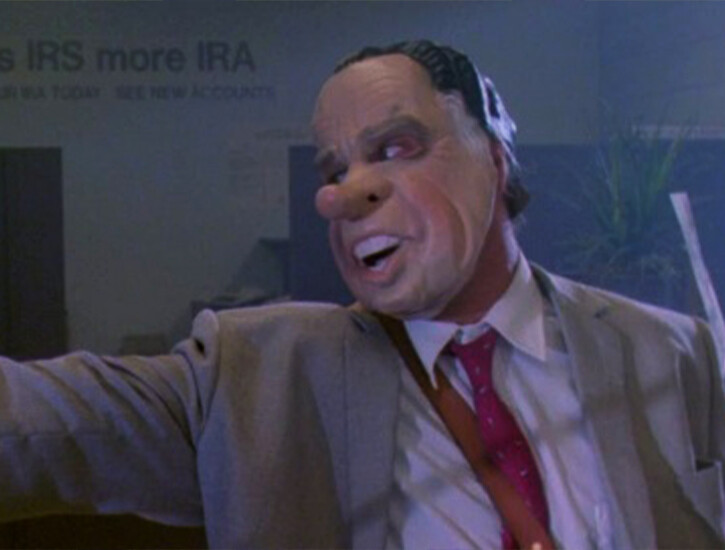
Still from Point Break (1991). | Warner Bros.
The 1969 inauguration of President Richard M. Nixon was among the first to be met with large-scale demonstrations of public fulmination. In Washington, D.C., and across the country, these protests, chiefly planned by the National Mobilization Committee to End the War in Vietnam, saw protesters chanting, marching, and flashing peace signs. A Yippie pig got loose on the National Mall, where it was chased around by hapless cops on horseback. Members of a left-wing women’s liberation group called the Women’s International Terrorist Conspiracy From Hell (WITCH), who had previous cast a hex on the Pat Nixon, regaled the crowd with “You’re A Grand Old Flag,” praising the scampering hog as the true “emblem of the land we love.” But even more curious among such “counter-inaugurations” was a another common emblem: crude papier-mâché masks made up to resemble Nixon himself, complete with blobby jowels and pointy, phallic schnoz.
It’s an iconic piece of protest memorabilia. After all, it suggests that even the mere appearance of Nixon’s grim visage was an insult. By 1969, a great many Americans were wearing the Nixon mask—even, as the president’s shrewdest biographer Garry Wills has noted, Richard Nixon. Addressing a man, and an America, so obsessively inauthentic, these crude, crappy masks were a mirror, reflecting nothing.
The glowering image of Nixon looms over a series of new American films, which differently evoke the history, imagery, and film grammar of the Nixon era, drawing comparisons to the present-day predicament in the process. They are films that tap into the governing paranoia of 1970s cinema, alternately aping and subverting the feelings of widespread American unease that blanketed the era during the Cold War.
That pock-marked Nixon mask hangs heaviest upon the head of J.B. Mooney (Josh O’Connor), in writer-director Kelly Reichardt’s recent, jazzy, anti-heist non-thriller The Mastermind. A bored, suburban Massachusetts carpenter, husband, and father to dopey twin sons, O’Connor’s J. B. is craven, ambitious, and absolutely convinced of his own cleverness—the model of the Nixonian Man. He marshals these qualities to modest use when J. B., who, some kind of spurned art school dropout, hatches a quarter-baked scheme to rip off a local art museum in broad daylight. Conceived with a team of luckless and quite obviously incompetent conspiracies, his scheme to steal four paintings by the early American modernist Arthur Dove is at least a way for J. B. to contribute to the history of the American arts, if only by subtraction.
The glowering image of Nixon looms over a series of new American films, which differently evoke the history, imagery, and film grammar of the Nixon era, drawing comparisons to the present-day predicament in the process.
The character’s actual motivations are deliberately vague. Or, in the terms applied to Dove’s own daubs, abstract. It’s all part of Reichardt’s (hyper-)self-consciously subversive approach to the genre. The film’s tensest sequence is an extended, and blithely amusing, scene of J. B. attempting to hide the stolen paintings in the loft of a barn, which sees him clumsily running up and down a rickety ladder in pitch blackness. Unshackled by the heist genre’s usual entertainments—the methodical plotting and its execution, some sustained cat-and-mouse between cop and criminal—Reichardt commits to something differently unsatisfying. The Mastermind is not just an anti-heist movie but a kind of anti-character study, in which our ostensible protagonist remains deliberately unknowable.
Indeed, the only thing we can say for sure about J. B. is that he is product of his age. Set sometime in the early 1970s, when the sixties counterculture was cooling but the anti-Vietnam movement still extremely active, The Mastermind is a pre-Watergate period piece. It unfolds in an America where the U.S. president was loathed but not-yet-humiliated. Like Nixon, J. B. seems assured of his own faculty. When he surreptitiously squirrels an antique chess piece away in his pocket during a family trip to the fictional Framingham Museum of Art, he becomes instantly convinced of his capacity to propagate grander larceny. He is also a creature of great indignation, grumbling over a family dinner when his father (Bill Camp) surfaces the name of some more successful colleague. Protests on the TV and mentions of Nixon’s name in the background draw the comparison tighter, marking J. B. as a victim of what Wills called Nixon’s “politics of resentment.”
That J. B. is instantly graspable as a character type only adds to his Nixonian bona fides. The period’s rejection depth and sophistication spoke to an era where appearances were critical and facades were themselves sufficiently revealing. (Reichardt’s obsession with textures—of the gallery’s canvasses, of the brisk New England foliage, of her characters’ corduroys—illustrate her concern with surfaces.) Both the real-life Nixon and O’Connor’s J. B. recall that Seinfeld line about the sitcom’s scheming postman, Newman. Asked if there may be more to him that meets the eye, Jerry replies, curtly: “No. There’s less.”
Such a character is completely contemporary in our own era of anti-sophistication, which makes virtues of crudity and hilarity. The modern-day right-wing majority is no longer silent. They are loud and brimming with their own resentments. Trump and Nixon are both, in the words of Watergate-era White House counsel John Dean to Politico, “two authoritarian personalities who would have a natural affinity for each other.” (Indeed, the two men kept up a semi-regular correspondence in the 1980s.) Fittingly, O’Connor’s Nixonian man cannot be saved by his affinities with old Iron Butt. After catching the eye of the cops, bailing on his family, and bussing out to the Midwest with no plan and no money, Reichardt’s “mastermind” is busted when he tries to seek refuge in an anti-Nixon protest and summarily swept into a paddy wagon. It’s an ignominious end to his Raskolnikovian capering.
If Reichardt seems mainly preoccupied with the visual textures and psychologies of the period, Kathryn Bigelow is more interested in its movies. Her Netflix potboiler, A House of Dynamite, is another throwback, this time to tense, men-in-a-room Cold War-era nuclear thrillers like Fail Safe (1964), Seven Days in May (1964), and Colossus: The Forbin Project (1970). When an Alaskan military base clocks an unidentified ICBM over the Pacific, U.S. bureaucratic brass of the military-industrial complex, scattered across all levels of government, scramble to intercept the threat. When that fails, the nation goes “cocked pistol” mode: hitting DEFCON 1 and preparing for an imminent nuclear strike on Chicago.
House of Dynamite feels like an exercise in nostalgia not for those nuclear potboilers of the early Cold War but for a competence in the face of disaster that—again, judged against present conditions—seems basically unfathomable. In light of purges, loyalty tests, and fealty pledges to Dear Leader, watching House of Dynamite, one cannot help but wonder if there would be a single authority in the present administration with the requisite coolheaded dispassion to manage such a calamity. (It also obviates the notion that Trump’s proposed “Golden Dome” system for America would be anything but foolproof, a problem presumably compounded by the administration’s stockpile of fools.)
Structured as a triptych, the film’s ticking-clock plot—which repeat the same events from other character’s perspectives—disappointingly defuses the tension itself. The film has exactly one good scene: the president of the United States (Idris Elba) being rushed out of a photo op at a girls’ basketball camp (cameo by WNBA star Angel Reese) and into his motorcade, where he weighs the fate of the world while reviewing a laminated menu of counterstrike options. It captures the exact dynamic between smiling P.R. stunts and world-changing (or -ending) decisions and the inanity of placing a civilian (however well-meaning) in charge of such monstrously consequential decisions. The very real vestige of the Cold War, the film makes clear, is not the dramatics of military decision-making or the bunkered-down aesthetics of lockdown but the threat of nuclear arsenal itself.
It wasn’t so long ago that Bigelow had been fingered as a cryptofascist owing to her Oscar-winning Osama-hunting thriller Zero Dark Thirty (2012), which seemed to justify the American use of so-called “enhanced interrogation techniques” at the height of the post-9/11 war on terror. In the Guardian, a pre-crackpot Naomi Wolf went so far as to call Bigelow a torture apologist and propagandist, a “profoundly compromised film-maker” and American Leni Riefenstahl. (For whatever it’s worth, I’ve always thought Zero Dark Thirty‘s key moment was a CIA interrogator muttering, “This is what defeat looks like, bro,” at a cowering captive, which reads not as American triumphalism but critical self-reproach.) In any event, Bigelow seems keen to loose herself from damning associations. House of Dynamite evokes the 1970s nail-biter as much as it does the soapy days of High Sorkinism, when men—and women!—of high moral character, pressed in times of extreme crisis, made all the difficult decisions that, dammit, just need to be made.
House of Dynamite plays less like some heirloom of Cold War cinema and more like the inheritor to turn-of-the-century network television for grown-ups. It’s a Netflix movie loaded with a bunch of TV actors (Elba, Jared Harris, Gabriel Basso). Perhaps the shifting of the Overton window itself has nudged Bigelow’s politics back to center. But squint and House of Dynamite looks not like the usual fascist war cry, but like a piece of soppy libsploitation. Perhaps even more so than Zero Dark Thirty, Bigelow comes across as an ideological shill. Her film valorizes the political and military exceptionalism of leaders administering to an apocalyptic dead-end scenario they created. Praise Frankenstein, but curse his monster. In the face of its basic predicament—i.e. that our entire planet teeters a top of irradiated powder keg that, if sparked, leaves world leaders and their citizenry with no workable option for survival that doesn’t include mass death—even the well-oiled gears of political proceduralism breakdown. Call it the “Zero-Sum of All Fears.”
Cover-Up, a biographical documentary about the life of journalist Seymour Hersh by Laura Poitras and Mark Obenhaus, offers a different kind of procedural. The film was over twenty years in the making, not because of the scope of its production but because it took that long for the filmmakers to earn the trust of Hersh, the fiercely dogged reporter who won a Pulitzer in 1970 exposing the American military’s role in the My Lai massacre. This is despite Poitras’s established track record working with persnickety whistleblowers through films like 2014’s Edward Snowden documentary Citizenfour and 2016’s Risk, a portrait of WikiLeaks founder Julian Assange.
Like any great work of investigative journalism, Cover-Up is as much a biography of Hersh as it is a kind of “how to.” It retraces Hersh’s steps as he befriends Pentagon higher-ups, chases rumors and dropped names, gaining the confidence of cagey subjects, and dropping a bombshell exposé detailing the merciless March 1968 slaughter of hundreds of Vietnamese men, women, and children by U.S. Army soldiers. The story, along with equally high-profile follow-ups, elevated Hersh to national prominence and fermented antiwar sentiment in America; it also positioned him as a formidable thorn in the side of the administration. President Nixon appears in Cover-Up, in one of those classic White House archival phone recordings, begrudgingly telling Kissinger that Hersh is a “son of a bitch”—a badge of honor for any politico.
The modern American political subject is deeply resentful, pitiably suburban, and completely convinced of their superiority despite cascading evidence to the contrary.
As a character study, Cover-Up foregrounds both Hersh’s dogged, hard-nosed journalistic instincts and his own recalcitrance. The filmmakers include numerous scenes of Hersh, now eighty-eight, in his home office, at risk of being swallowed in an avalanche of books, file folders, and scraps of paper scribbled over with his sloppy script. There is a sense that Hersh has been reduced to a marginal figure, banging out posts for his own Substack, each of which arrives in subscribers’ inboxes with alarming, all-caps subject lines like: “ONE HUNDRED DAYS OF CHAOS,” “A CABINET OF SYCOPHANTS,” and “THE DISMANTLING WE SHOULD HAVE SEEN COMING.” Hersh is also made to defend his use of anonymous sources. It’s a practice that has earned him countless scoops while putting him at odds with the broader journalistic establishment (who have cast doubt on some of Hersh’s more recent sources, and scoops, especially regarding his allegations of U.S. involvement in the destruction of underwater Russian pipelines in the Baltic Sea). Another thread follows Hersh’s work critiquing the modern American empire’s marauding in the Middle East and its complicity in the ongoing liquidation of Palestinians. In one scene, one anonymous source, speaking from occupied Gaza, makes a direct appeal to Hersh—and the audience—claiming that “Gaza has collapsed the past into the future.”
It’s a key line for understanding Cover-Up, as well as Bigelow and Reichardt’s films. More than mere reminiscence—for vintage fabrics, modes of filmmaking, or the dirty work of journalistic sleuthing—these films do collapse past and present. Through Hersh, Laura Poitras, and Mark Obenhaus foreground Gaza as this generation’s Vietnam, imploring the viewer to regard it with the same moral outrage. (Repeated claims of CBS News as the bastion of anti-institutional journalistic integrity also hit different in the wake of Bari Weiss being installed as the network’s editor in chief at the behest of the son of Republican mega-donor Larry Ellison.) In Josh O’Conner’s J. B., Kelly Reichardt develops a prototype of the modern American political subject: deeply resentful, pitiably suburban, and completely convinced of their superiority, despite cascading evidence to the contrary. And General Bigelow, in her own way, offers a chilly reminder that, when the dynamite goes boom—an increasingly plausible scenario, given the preponderance of leaders across national and ideological lines playing with matches—and the nuclear nightmares of the Cold War explode into the present, you had better hope you’ve been handpicked as a designated evacuator. Or at least that you don’t live in Chicago.
These movies also can’t help but kindle a certain nostalgia. The Nixonian Man seems downright literary by today’s standards. A Situation Room shored with semi-competent generals feels like a far-off fantasy in the era of ham-fisted Hegsethian gauche. Even Cover-Up’s portrait of Seymour Hersh as more-or-less epitome of reporterly integrity seems desolate in an age with little use for subtlety, competency, and integrity. A new era of American exceptionalism has been counter-inaugurated, where disgruntlement and corruption reign nakedly and where, as they say, the mask is off.